Investors Pull $414M From Crypto Funds As Inflation, MidEast War Jitters Mount

bitcoinistPublicado em 2026-03-31Última atualização em 2026-03-31

Resumo

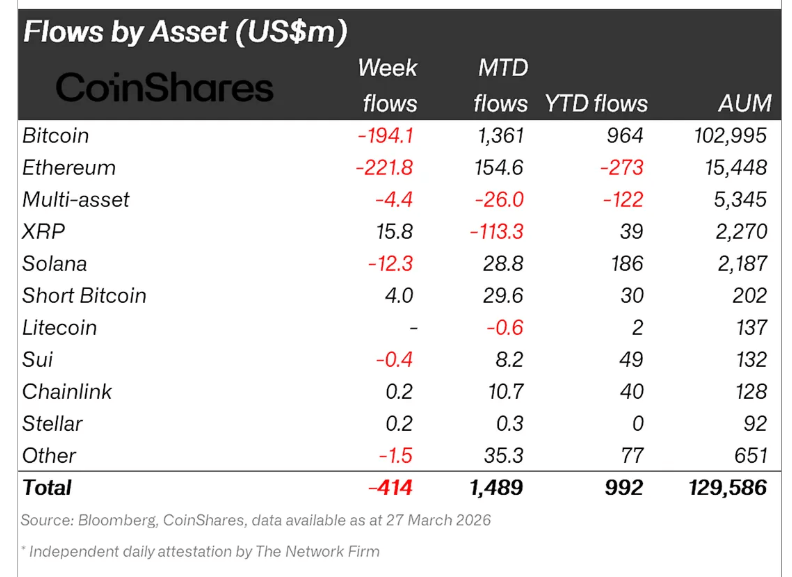
Investors withdrew $414 million from crypto funds last week, ending a five-week inflow streak. Spot Bitcoin ETFs saw $296 million in outflows, reversing earlier gains. Ether suffered the largest outflows at $222 million, pushing its year-to-date performance negative. Bitcoin remained positive for the year despite $194 million in outflows. XRP was an exception, attracting $16 million. The sell-off was driven by inflation concerns, shifting expectations for U.S. interest rate hikes, and rising Middle East tensions, causing a broad shift away from riskier assets. Total assets under management fell to near $130 billion, levels last seen in early February.

Spot Bitcoin ETFs snapped a four-week run of gains last week, posting $296 million in net outflows after pulling in more than $2.2 billion earlier in the month. The crypto reversal was swift — and it wasn’t limited to Bitcoin.

Ether Takes The Hardest Hit

Ether led all assets in outflows, shedding $222 million in a single week. That brought its year-to-date total into the red, with a net loss of $273 million — the worst performance among tracked assets.

Spot Ether ETFs also recorded $206 million in outflows for a second straight week, a sign that institutional demand for the second-largest cryptocurrency has been cooling steadily.

Bitcoin fared better in the long run. Despite $194 million leaving Bitcoin funds last week, the asset remains up $964 million in net inflows for the year.

A small group of investors even moved in the opposite direction — short-Bitcoin products drew $4 million in fresh capital, suggesting some are betting on more losses ahead.

Across the board, total assets under management in digital asset products dropped to close to $130 billion.
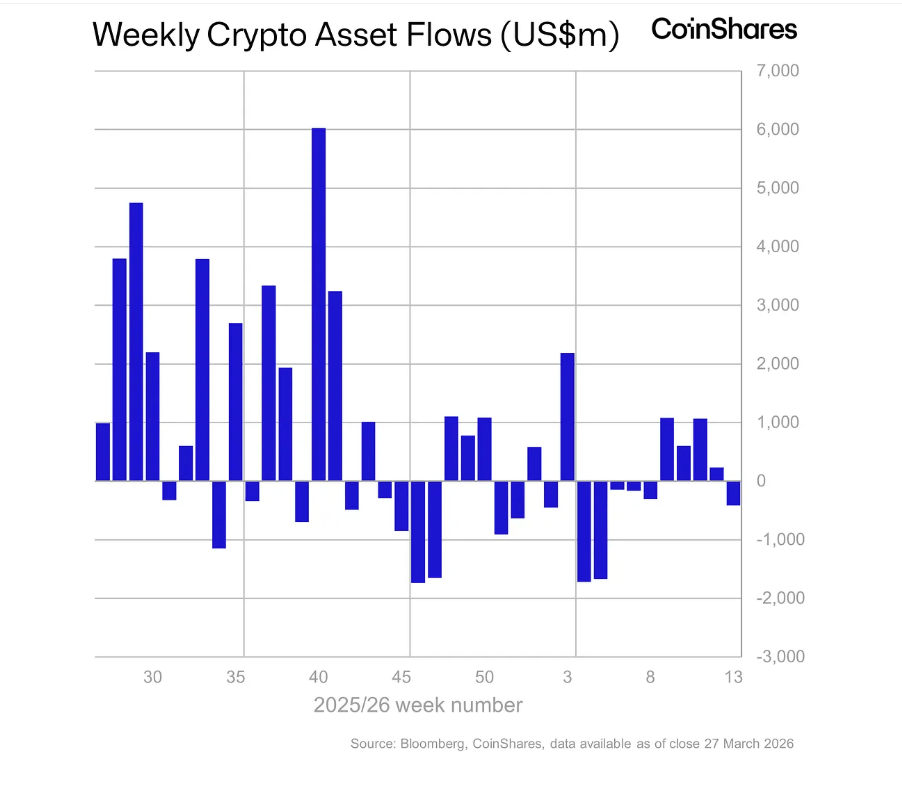
According to CoinShares head of research James Butterfill, that figure puts the market back at levels not seen since early February — broadly in line with where things stood in April 2025 during the first wave of US President Donald Trump’s tariffs.

Solana lost a little over $12 million over the same period. XRP was the exception. Reports from CoinShares show the token attracted close to $16 million in new capital, standing apart from the widespread exodus hitting nearly every other major asset.
What Spooked Investors

Three things rattled markets last week: inflation fears, shifting expectations around US interest rates, and rising tensions in the Middle East.

The most consequential of the three may be the rate outlook. Expectations heading into the June Federal Open Market Committee meeting moved away from potential cuts and toward possible hikes — a major shift that historically pushes investors away from riskier assets.

BTCUSD now trading at $67,744. Chart: TradingView

Digital assets tend to feel that pressure quickly. When borrowing costs look like they’re going up, money moves toward safer ground.

A Five-Week Streak Comes To An End

The $414 million in total outflows snapped what had been five consecutive weeks of inflows. Data from CoinShares shows the pullback reflected a broader shift toward risk-off behavior among investors, driven more by macroeconomic forces than anything specific to crypto markets.

Whether last week marks a turning point or a brief pause will likely depend on what signals come out of the Fed in the weeks ahead. For now, the money has moved — at least temporarily — to the sidelines.

Featured image from Getty Images, chart from TradingView

Perguntas relacionadas

QWhat was the total amount of net outflows from crypto funds last week, ending a five-week streak?

AThe total net outflows from crypto funds last week were $414 million, which ended a five-week streak of inflows.

QWhich cryptocurrency asset suffered the largest outflows and what was the amount?

AEther (ETH) suffered the largest outflows, shedding $222 million in a single week.

QAccording to the article, what were the three main factors that spooked investors and rattled the markets?

AThe three main factors were inflation fears, shifting expectations around US interest rates, and rising tensions in the Middle East.

QWhat was the notable exception to the widespread outflows, and how much capital did it attract?

AXRP was the notable exception; it attracted close to $16 million in new capital.

QWhat does the shift in expectations for the June Federal Open Market Committee meeting indicate, and how does it typically affect investor behavior?

AExpectations shifted away from potential interest rate cuts and toward possible hikes. This shift historically pushes investors away from riskier assets, as higher borrowing costs make safer investments more attractive.

Leituras Relacionadas

a16z: AI's 'Amnesia', Can Continuous Learning Cure It?

The article "a16z: AI's 'Amnesia' – Can Continual Learning Cure It?" explores the limitations of current large language models (LLMs), which, like the protagonist in the film *Memento*, are trapped in a perpetual present—unable to form new memories after training. While methods like in-context learning (ICL), retrieval-augmented generation (RAG), and external scaffolding (e.g., chat history, prompts) provide temporary solutions, they fail to enable true internalization of new knowledge. The authors argue that compression—the core of learning during training—is halted at deployment, preventing models from generalizing, discovering novel solutions (e.g., mathematical proofs), or handling adversarial scenarios. The piece introduces *continual learning* as a critical research direction to address this, categorizing approaches into three paths: 1. **Context**: Scaling external memory via longer context windows, multi-agent systems, and smarter retrieval. 2. **Modules**: Using pluggable adapters or external memory layers for specialization without full retraining. 3. **Weights**: Enabling parameter updates through sparse training, test-time training, meta-learning, distillation, and reinforcement learning from feedback. Challenges include catastrophic forgetting, safety risks, and auditability, but overcoming these could unlock models that learn iteratively from experience. The conclusion emphasizes that while context-based methods are effective, true breakthroughs require models to compress new information into weights post-deployment, moving from mere retrieval to genuine learning.

marsbitHá 1h

a16z: AI's 'Amnesia', Can Continuous Learning Cure It?

marsbitHá 1h

Can a Hair Dryer Earn $34,000? Deciphering the Reflexivity Paradox in Prediction Markets

An individual manipulated a weather sensor at Paris Charles de Gaulle Airport with a portable heat source, causing a Polymarket weather market to settle at 22°C and earning $34,000. This incident highlights a fundamental issue in prediction markets: when a market aims to reflect reality, it also incentivizes participants to influence that reality. Prediction markets operate on two layers: platform rules (what outcome counts as a win) and data sources (what actually happened). While most focus on rules, the real vulnerability lies in the data source. If reality is recorded through a specific source, influencing that source directly affects market settlement. The article categorizes markets by their vulnerability: 1. **Single-point physical data sources** (e.g., weather stations): Easily manipulated through physical interference. 2. **Insider information markets** (e.g., MrBeast video details): Insiders like team members use non-public information to trade. Kalshi fined a剪辑师 $20,000 for insider trading. 3. **Actor-manipulated markets** (e.g., Andrew Tate’s tweet counts): The subject of the market can control the outcome. Evidence suggests Tate’sociated accounts coordinated to profit. 4. **Individual-action markets** (e.g., WNBA disruptions): A single person can execute an event to profit from their pre-placed bets. Kalshi and Polymarket handle these issues differently. Kalshi enforces strict KYC, publicly penalizes insider trading, and reports to regulators. Polymarket, with its anonymous wallet-based system, has historically been more permissive, arguing that insider information improves market accuracy. However, it cooperated with authorities in the "Van Dyke case," where a user traded on classified government information. The core paradox is reflexivity: prediction markets are designed to discover truth, but their financial incentives can distort reality. The more valuable a prediction becomes, the more likely participants are to influence the event itself. The market ceases to be a mirror of reality and instead shapes it.

marsbitHá 2h

Can a Hair Dryer Earn $34,000? Deciphering the Reflexivity Paradox in Prediction Markets

marsbitHá 2h

Trading

Spot
Futuros

Artigos em Destaque

Como comprar WAR

Bem-vindo à HTX.com!Tornámos a compra de WAR (WAR) simples e conveniente.Segue o nosso guia passo a passo para iniciar a tua jornada no mundo das criptos.Passo 1: cria a tua conta HTXUtiliza o teu e-mail ou número de telefone para te inscreveres numa conta gratuita na HTX.Desfruta de um processo de inscrição sem complicações e desbloqueia todas as funcionalidades.Obter a minha contaPasso 2: vai para Comprar Cripto e escolhe o teu método de pagamentoCartão de crédito/débito: usa o teu visa ou mastercard para comprar WAR (WAR) instantaneamente.Saldo: usa os fundos da tua conta HTX para transacionar sem problemas.Terceiros: adicionamos métodos de pagamento populares, como Google Pay e Apple Pay, para aumentar a conveniência.P2P: transaciona diretamente com outros utilizadores na HTX.Mercado de balcão (OTC): oferecemos serviços personalizados e taxas de câmbio competitivas para os traders.Passo 3: armazena teu WAR (WAR)Depois de comprar o teu WAR (WAR), armazena-o na tua conta HTX.Alternativamente, podes enviá-lo para outro lugar através de transferência blockchain ou usá-lo para transacionar outras criptomoedas.Passo 4: transaciona WAR (WAR)Transaciona facilmente WAR (WAR) no mercado à vista da HTX.Acede simplesmente à tua conta, seleciona o teu par de trading, executa as tuas transações e monitoriza em tempo real.Oferecemos uma experiência de fácil utilização tanto para principiantes como para traders experientes.

119 Visualizações TotaisPublicado em {updateTime}Atualizado em 2026.04.23

Como comprar WAR

Discussões

Bem-vindo à Comunidade HTX. Aqui, pode manter-se informado sobre os mais recentes desenvolvimentos da plataforma e obter acesso a análises profissionais de mercado. As opiniões dos utilizadores sobre o preço de WAR (WAR) são apresentadas abaixo.

活动图片













