Interpretation of Hong Kong's New Virtual Asset Licensing Regulations: Joint Announcement by Financial Services and the Treasury Bureau and SFC Declares Entry into the 'Full Licensing' Era

marsbitPublicado em 2026-01-30Última atualização em 2026-01-30

Resumo

Hong Kong's Financial Services and Treasury Bureau (FSTB) and the Securities and Futures Commission (SFC) have jointly issued a consultation conclusion and launched a new public consultation, marking a significant step towards a comprehensive licensing regime for virtual asset (VA) activities. The new framework expands beyond the existing Anti-Money Laundering Ordinance (AMLO) requirements for Virtual Asset Trading Platforms (VATPs) to establish mandatory licensing for VA trading, custody, advisory, and asset management services. Key measures include: - **VA Trading Services**: Defined similarly to "Type 1 regulated activity (dealing in securities)" under the SFO. Licensees must meet capital requirements (HK$5 million paid-up capital, HK$3 million liquid capital) and must use SFC-regulated custodians, separating trading and custody. - **VA Custody Services**: Standalone custodians require higher capital (HK$10 million paid-up capital) and must adhere to strict operational standards for cold/hot wallet storage, private key management, and independent audits. - **New Proposed Licenses**: A one-month consultation introduces licensing for "VA advisory services" (providing investment advice on VAs) and "VA asset management" (managing VA portfolios), with no minimum threshold exemptions, closing regulatory gaps. This shift to a "fully licensed" era aims to build institutional trust by imposing traditional financial standards, enhancing investor protection, and creating a regulate...

Author: FinTax

1 Introduction

On December 24, 2025, the Hong Kong Financial Services and the Treasury Bureau (FSTB) and the Securities and Futures Commission (SFC) jointly issued a consultation conclusion on legislative proposals for regulating virtual asset trading and custody services. Simultaneously, they launched a further one-month public consultation on establishing a separate licensing regime for providers of virtual asset advisory services and virtual asset management services.
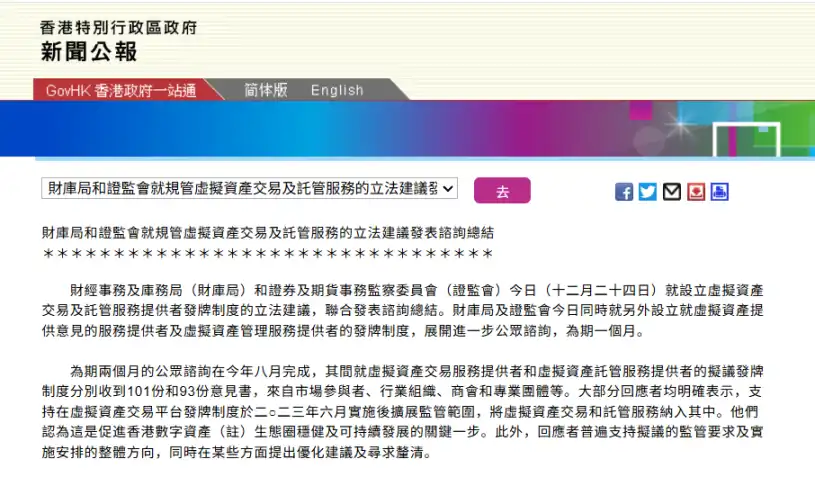
In 2023, Hong Kong amended the Anti-Money Laundering and Counter-Terrorist Financing Ordinance (AMLO), establishing a statutory licensing regime for virtual asset trading platforms. To address regulatory gaps, under the AMLO framework, the FSTB, in conjunction with the SFC, initiated a consultation on legislative proposals for regulating virtual asset trading and custody services in June 2025. The two policy documents released this time serve as a summary and response to the legislative consultation from June of last year. They clearly bring virtual asset trading and custody services under the scope of the licensing regime, propose preliminary regulatory approaches, and innovatively extend the new licensing regime to include 'services providing advice on virtual assets' and 'virtual asset management services'. This signifies that Hong Kong's virtual asset market will achieve a complete regulatory closed loop covering trading, custody, advisory, and asset management.

This article will interpret the new regulatory requirements and analyze their core impact on the market based on the two documents: the 'Consultation Conclusion on Legislative Proposals for Regulating Virtual Asset Trading and Further Public Consultation' and the 'Consultation Conclusion on Legislative Proposals for Regulating Virtual Asset Custody Services', and provide corresponding recommendations.

2 Interpretation of Policy Content

The two policy documents not only systematically summarize the feedback from the June consultation last year on the regulation of virtual asset trading and custody services but also propose to expand the scope of licensing regulation to include investment advisory and asset management activities. The involved regulatory regime is still in the legislative process and will only take effect formally after the passage of the legal amendments.

2.1 Consultation Conclusion on Legislative Proposals for Regulating Virtual Asset Trading and Further Public Consultation

This document summarizes the consultation on virtual asset trading services and simultaneously puts forward two new regulatory proposals. Firstly, it finalizes the details of regulating virtual asset trading services, clarifying the scope, financial requirements, transitional arrangements, etc., for virtual asset trading services in the document.

  • Definition Scope: Clarifies that the definition of virtual asset trading services aligns with the scope of 'Type 1 regulated activity (dealing in securities)' under the Securities and Futures Ordinance. Any business conducting buying and selling of virtual assets for clients, or inducing such activities, requires a license. This includes operating virtual asset trading matching platforms, providing over-the-counter (OTC) intermediary services, acting as a virtual asset broker to execute client trades, and providing virtual asset market-making services.
  • Capital Requirements: Specifies that the financial resource requirements for licensed virtual asset dealers are consistent with those for Type 1 licensed corporations, with a minimum paid-up share capital of HKD 5 million and minimum liquid capital of HKD 3 million. This, to some extent, filters out small service platforms with insufficient strength, enhancing the overall safety and soundness of the industry.
  • Mandatory Custody: Licensed traders must appoint an SFC-regulated virtual asset custodian to safeguard client virtual assets, ensuring the separation of trading and custody, and are prohibited from self-custody of client assets. This initially excludes the option of using overseas custodians, aiming to establish a closed-loop, controllable local custody ecosystem.

Secondly, it proposes to further expand the scope of regulation under the AMLO framework by adding licensing requirements for 'providing advice on virtual assets' and 'virtual asset management services'.

Providing advice on virtual assets refers to offering investment advice on whether to acquire or dispose of virtual assets, which virtual assets to acquire or dispose of, or how to acquire or dispose of virtual assets, or publishing decisive analysis reports, similar to investment advisors. Specific scenarios include recommending specific timing for virtual asset trades or providing virtual asset portfolio allocation plans. For such entities, the regulatory authorities intend to formulate specific regulatory requirements from dimensions such as financial resources, professional personnel, compliance obligations, and business restrictions. Exemptions will be set up for activities like in-house services, incidental acts of trading or professional services, referencing the traditional finance model.

Virtual asset management refers to providing services for managing investment portfolios of virtual assets, requiring core characteristics such as having client-authorized investment decision-making power and providing portfolio management services in a professional capacity. The regulators indicated that no minimum investment proportion exemption will be set for asset management services. Any entity providing asset management services for investment portfolios investing in virtual assets, regardless of the amount of virtual assets, must apply for a license or register. This regulation aims to prevent related risks from being transmitted to the market through unregulated advisory or asset management channels and to reduce arbitrage opportunities that use traditional financial product forms to evade specialized virtual asset regulation.

2.2 Consultation Conclusion on Legislative Proposals for Regulating Virtual Asset Custody Services

The 'Consultation Conclusion on Legislative Proposals for Regulating Virtual Asset Custody Services' constructs a regulatory system specifically for virtual asset custody, treating custody as the last line of defense for client asset safety and setting higher capital requirements.

  • Coverage Scope: The regulatory targets are business entities that custody private keys or similar tools capable of transferring client virtual assets. Among them, independent third-party custodians must apply for a specific license, while custody businesses affiliated with trading platforms may receive exemption arrangements to avoid duplicate licensing. Furthermore, responsibilities across the custody chain are clarified. For example, if an associated entity of a licensed trading platform engages in custody, it needs to separately apply for a custody license; existing financial institutions like banks providing virtual asset custody services also need to be included in this framework.
  • Capital Requirements: Sets higher capital requirements for licensed custodians than for traders. The minimum paid-up share capital is HKD 10 million, and the minimum liquid capital is HKD 3 million. This requirement aims to ensure licensed custodians have operational sustainability and risk response capabilities matching their business, reflecting the special nature of the custody business.
  • Other Stipulations: The operational standards for licensed custodians will be formulated with reference to traditional financial regulatory rules or existing custody guidelines for licensed trading platforms, covering aspects such as online/offline asset storage ratios, private key management, insurance coverage, and independent audits. For instance, requiring a high proportion of cold wallet storage while allowing flexible adjustment based on business needs to balance quick withdrawal demands and security; requiring strict multi-signature and hierarchical permission controls, regular penetration tests, and stress tests, etc.

3 Impact on Hong Kong's Crypto Industry

3.1 Comprehensive Upgrade of the Licensing System

Hong Kong's virtual asset licensing regime has undergone a fundamental transformation. It has upgraded from issuing a single license solely for centralized trading platforms (VATPs) to a comprehensive, full-industry-chain licensing system covering four core businesses: trading, custody, advisory, and asset management. The VATP licensing system targeted the specific institutional form of 'centralized exchanges', imposing comprehensive requirements including capital, custody, and anti-money laundering measures. However, the regulatory focus was primarily on the 'trading venue' itself. Business activities widely existing outside trading venues, such as over-the-counter (OTC) trading, independent asset custody, investment advisory, and specialized asset management, were either ambiguously regulated or in an unlicensed regulatory vacuum, creating potential risks and regulatory arbitrage opportunities. The independent trading license, custody license, and the proposed new advisory and asset management license systems are a systematic response to these limitations, conducive to fostering a professional and stable virtual asset service market ecosystem.

3.2 Building Institutional Trust in the Crypto Market

The new regulations build institutional trust in the crypto market through a series of quantifiable, auditable hard constraints. Firstly, establishing capital and operational thresholds benchmarked against traditional financial institutions (e.g., HKD 5 million for dealers, HKD 10 million for custodians) filters out institutions with weak risk resistance to some extent, constructing institutional credit based on capital. Secondly, forming a complete regulatory closed loop for virtual asset trading, custody, advisory, and asset management shifts asset safety from single-license, self-regulation to comprehensive regulation. For individual and institutional investors, this framework provides them with legal and regulatory safeguards similar to traditional financial services, which are easy to understand and trustworthy.

3.3 Challenges and Uncertainties After Regulatory Implementation

The update of the regulatory system inevitably comes with challenges. At the market level, some small and medium-sized service providers may face relatively severe compliance transformation challenges. Meanwhile, global crypto hot money with higher risk appetite might flow to regions with more flexible regulations due to the strict regulatory framework. At the regulatory level, this regulatory model places high demands on its professionalism. Regulatory authorities need to process a massive volume of license applications in the short term. If the approval speed lags, it could lead to a compliance vacuum in market services, inhibiting the development of legitimate businesses. Simultaneously, regulatory agencies also need sufficient technical capabilities to identify and assess risks in custody solutions, blockchain analysis tools, and new trading models.

4. Responses for Crypto Market Practitioners

In the short term, 'active compliance for survival, strategic repositioning for development' is the primary strategy for practitioners in Hong Kong's crypto market. As Hong Kong's virtual asset regulation is about to enter an era of fully licensed operation, market participants need to immediately legally categorize their businesses as trading, custody, advisory, or asset management and initiate preparations for the corresponding license application procedures. Notably, some licenses do not have a transition period; any delay may result in the risk of illegal operation after the regulations take effect.

In the medium to long term, market practitioners can gradually shift from responding to regulatory upgrades to building their core competitiveness based on compliance advantages. This requires internalizing requirements such as anti-money laundering monitoring, asset custody security, and transparent financial auditing into operational norms that exceed regulatory thresholds, providing credible, robust, and auditable financial-grade services.

The institutionalization driven by the new regulations may bring accompanying tax implications, requiring market practitioners to make forward-looking plans for potential tax burden changes. For example, it is necessary to clarify the characterization of business income based on the regulatory framework to determine the type of taxable income. Newly added compliance operating costs (such as license fees, audit fees) may also bring tax deduction opportunities, necessitating policy tracking and accounting voucher management. More importantly, as institutional clients enter the market, providing transaction records and tax reports that meet audit requirements will become a basic service capability. Market practitioners can improve their financial and tax systems in advance to meet growing business demands.

Against the backdrop of the licensing system upgrade, the market may form a competitive landscape coexisting with a few full-license comprehensive service groups and numerous specialized service providers in niche areas. Beyond obtaining licenses, practitioners who提前布局 (layout in advance) compliance technology capabilities or seek specific ecological niches for deep cooperation may find good opportunities to establish their advantages in the next phase.


Criptomoedas em alta

Perguntas relacionadas

QWhat are the key changes introduced by Hong Kong's new virtual asset licensing regulations?

AThe new regulations expand the licensing system to cover four core areas: virtual asset trading, custody, investment advice, and asset management services. This creates a comprehensive licensing framework for the entire virtual asset industry chain, moving beyond the previous focus solely on virtual asset trading platforms (VATPs).

QWhat are the minimum capital requirements for virtual asset trading and custody service providers under the new rules?

ALicensed virtual asset trading dealers must have a minimum paid-up share capital of HKD 5 million and minimum liquid capital of HKD 3 million. Licensed custodians face higher requirements, with a minimum paid-up share capital of HKD 10 million and minimum liquid capital of HKD 3 million.

QHow do the new regulations address the custody of client virtual assets for trading platforms?

ALicensed trading platforms are mandated to use a virtual asset custodian regulated by the SFC to hold client assets. This enforces a separation of trading and custody functions, prohibiting self-custody of client assets and initially excluding the use of overseas custodians to build a closed-loop, controllable local custody ecosystem.

QWhat two new types of services are proposed to be brought under the licensing regime in the further consultation?

AThe further public consultation proposes to bring 'providing advice on virtual assets' (similar to investment advisory services) and 'providing virtual asset management services' (portfolio management) under a new licensing framework to prevent risks from unregulated activities.

QWhat is a potential challenge for the market following the implementation of these comprehensive regulations?

AA key challenge is the compliance burden, particularly for smaller service providers who may struggle to meet the new capital and operational requirements. This could lead to market consolidation and potentially drive some risk-tolerant global crypto capital to jurisdictions with more flexible regulatory frameworks.

Leituras Relacionadas

GPT-5.6 Countdown: Abandon the Illusion of a Single API, Computational Iteration Can't Outpace a Single Page of Compliance

In mid-June, three seemingly independent industry events—the compliance-driven throttling of Fable 5, the open-sourcing of GLM-5.2, and the leaked release timeline for GPT-5.6—are pushing the global AI industry toward a watershed moment. These shifts signal a fundamental restructuring of the industry's underlying logic. First, **"usability" has substantially overtaken "advanced capabilities"** as the primary weight, pushing the global large language model (LLM) supply chain into a "dual-track" phase of controlled closed-source and local open-source coexistence. Second, **the competitive moats of closed-source giants are shifting**. Their technical focus is moving from "language intelligence" toward "spatial intelligence (world models)"—a domain heavily reliant on computing power. Third, faced with常态化 transnational compliance risks, **a "model-agnostic" decoupled design has become a survival necessity for application-layer developers to maintain business continuity.** The article details how Anthropic's Fable 5, despite its advanced engineering feats, was restricted for non-U.S. citizens within 72 hours of launch, highlighting how geopolitical compliance can instantly limit even the most advanced models. In response, the open-source camp, exemplified by Zhipu AI's MIT-licensed GLM-5.2, is gaining market share by offering stable performance improvements and significant cost advantages (up to 70% savings for enterprises), while achieving full adaptation with domestic semiconductor platforms. Meanwhile, closed-source leaders like OpenAI are pivoting. The anticipated GPT-5.6 reportedly shifts focus from language to spatial intelligence and world models, aiming to rebuild a generational gap in areas like 3D understanding, simulation, and industrial design that demand immense compute. The core conclusion is that the LLM supply chain's logic has changed. Enterprises must now evaluate infrastructure based on a composite of technical performance and policy compliance. For developers, complete reliance on a single closed-source API poses unacceptable risk. Implementing a truly model-agnostic architecture—enabling swift switches to compliant, locally deployable open-source alternatives—is no longer just good practice but a fundamental baseline for business continuity.

marsbitHá 1h

GPT-5.6 Countdown: Abandon the Illusion of a Single API, Computational Iteration Can't Outpace a Single Page of Compliance

marsbitHá 1h

Is the 'Token Subsidy War' Among AI Giants Almost Over?

The article discusses the ongoing "token subsidy war" among AI giants like OpenAI and Anthropic, questioning whether it's nearing its end. It reveals that current AI subscription prices are heavily subsidized, with some plans offering tokens at up to 70 times the actual cost to attract and retain heavy users, especially developers and enterprises. This strategy mirrors past internet-era subsidy battles, but with a key difference: AI tokens lack "lock-in" effects. Unlike ride-hailing or food delivery apps, users can easily switch between AI providers as APIs become standardized, making it difficult for companies to raise prices post-subsidy. The piece highlights a structural asymmetry in the competition. Giants like Google, with massive advertising revenue, can afford to subsidize tokens indefinitely, akin to using "tokens as a weapon." In contrast, venture-backed companies like OpenAI and Anthropic face pressure to become profitable, especially as they approach IPO. The article cites Google Ventures founder Bill Maris, who suggests Google could slash token prices by 80%, putting immense pressure on competitors. Two potential endgames are presented: the "internet service" model (subsidize, monopolize, then raise prices) and the "utility" model (tokens become a standardized, low-margin commodity like electricity). Given the low switching costs, the latter seems more likely. The competition may not have a single winner but could instead accelerate AI's evolution into a foundational, infrastructure-level technology, akin to a public utility. For now, users continue to benefit from heavily subsidized token costs.

marsbitHá 1h

Is the 'Token Subsidy War' Among AI Giants Almost Over?

marsbitHá 1h

Beyond the Stadium: The Profitable Games Surrounding the World Cup

"Beyond the Pitch: The Profit Game Around the World Cup" The FIFA World Cup transcends being a sporting spectacle, evolving into a massive global arena for speculation and profit-seeking. The 2026 tournament has amplified this dynamic, creating a multi-layered ecosystem of financial opportunism alongside the football. **Prediction markets** have surged into the mainstream. Platforms like Polymarket and Kalshi saw trading volumes for World Cup contracts soar, attracting new users with their financial trading model and high-profile, chain-based wealth stories that overshadow traditional sports betting in terms of growth and narrative. However, **traditional sportsbooks** remain the dominant force, leveraging established user habits, legal markets, and comprehensive product offerings to handle the vast majority of speculative wagers, with projections suggesting record-breaking betting volumes. Capital markets also react. **"Concept stocks"** in countries like South Korea and Japan experience volatile price swings based on team performance and anticipated fan spending on items like chicken, beer, and viewing parties, effectively becoming a stock market reflecting fan sentiment. The **ticket resale market** has become a sophisticated arena for arbitrage. Prices fluctuate wildly based on team draws and star power, with sellers sometimes listing tickets they don't yet own in a practice akin to short-selling, while FIFA's own "Right to Buy" tokens add another layer of speculative trading. **Collectibles and merchandise** offer another avenue. Panini sticker albums, with their inherent scarcity and nostalgic value, can become high-value collectibles. Limited-edition or locally themed jerseys command significant premiums on secondary markets, and even counterfeit vendors profit from fans' desire for affordable match-day identity. The **cryptocurrency** space has seen a frenzy of speculative, unauthorized World Cup-themed meme coins on chains like Solana. These tokens, often exploiting team names and player imagery, experience extreme pump-and-dump cycles, creating stories of massive gains for a few early entrants and steep losses for many others. Finally, an entire industry thrives on **providing information and tools** to other speculators. Developers create platforms like SeatSidekick to track ticket inventory and prices, while paid Telegram groups and subscriptions sell betting tips and predictions, monetizing the widespread desire for an informational edge. In essence, the World Cup has become a compressed, global laboratory for speculation. While the games determine champions on the field, a parallel, complex network of financial transactions—spanning prediction contracts, bets, stocks, tickets, collectibles, crypto, and information services—settles its own scores in the global market.

marsbitHá 2h

Beyond the Stadium: The Profitable Games Surrounding the World Cup

marsbitHá 2h

How Does Codex Use a Computer? Three Entry Points and Permission Boundaries

This article explains the three primary methods for Codex to interact with a computer, each with distinct use cases, permission boundaries, and trust levels. **1. Computer Use:** This offers the broadest access, allowing Codex to visually control and interact with the graphical user interface of authorized macOS/Windows apps, system settings, and even iOS simulators. It's ideal for tasks lacking APIs or structured tools, such as operating legacy software or multi-app workflows. However, it's the slowest method and has the widest permission scope, requiring careful supervision for sensitive actions. **2. Chrome Extension:** This grants Codex access to the user's logged-in Chrome browser state, including cookies, profiles, and open tabs. It's best for tasks requiring user identity across websites like Gmail, LinkedIn, Salesforce, or internal dashboards. Its key advantage is multi-tab control for complex workflows. While more powerful for browser-based tasks than Computer Use, it carries higher sensitivity as actions are performed under the user's identity. **3. In-App Browser:** This is a browser isolated within the Codex thread, separate from the user's personal browsing data. It excels in web development and debugging scenarios—previewing local servers, testing responsive layouts, or annotating designs directly on the page. Its isolation is a strength for development but a limitation for tasks requiring login sessions. The core principle is to choose the narrowest, safest, and most structured interface for the task. Use plugins or MCPs first, resort to visual control (Computer Use) only for GUI-dependent tasks, employ the Chrome extension for identity-reliant browser work, and prefer the In-App Browser for isolated development. **Appshots** are clarified as a fourth, complementary tool for *inputting* context—capturing a screenshot of a window to point Codex to something—rather than a method for Codex to *act*. Together, this layered approach highlights a key to AI agent productization: not granting unlimited permissions, but constraining them within clear boundaries for specific tasks while preserving user oversight.

marsbitHá 3h

How Does Codex Use a Computer? Three Entry Points and Permission Boundaries

marsbitHá 3h

Trading

Spot
Futuros

Artigos em Destaque

Como comprar ERA

Bem-vindo à HTX.com!Tornámos a compra de Caldera (ERA) simples e conveniente.Segue o nosso guia passo a passo para iniciar a tua jornada no mundo das criptos.Passo 1: cria a tua conta HTXUtiliza o teu e-mail ou número de telefone para te inscreveres numa conta gratuita na HTX.Desfruta de um processo de inscrição sem complicações e desbloqueia todas as funcionalidades.Obter a minha contaPasso 2: vai para Comprar Cripto e escolhe o teu método de pagamentoCartão de crédito/débito: usa o teu visa ou mastercard para comprar Caldera (ERA) instantaneamente.Saldo: usa os fundos da tua conta HTX para transacionar sem problemas.Terceiros: adicionamos métodos de pagamento populares, como Google Pay e Apple Pay, para aumentar a conveniência.P2P: transaciona diretamente com outros utilizadores na HTX.Mercado de balcão (OTC): oferecemos serviços personalizados e taxas de câmbio competitivas para os traders.Passo 3: armazena teu Caldera (ERA)Depois de comprar o teu Caldera (ERA), armazena-o na tua conta HTX.Alternativamente, podes enviá-lo para outro lugar através de transferência blockchain ou usá-lo para transacionar outras criptomoedas.Passo 4: transaciona Caldera (ERA)Transaciona facilmente Caldera (ERA) no mercado à vista da HTX.Acede simplesmente à tua conta, seleciona o teu par de trading, executa as tuas transações e monitoriza em tempo real.Oferecemos uma experiência de fácil utilização tanto para principiantes como para traders experientes.

489 Visualizações TotaisPublicado em {updateTime}Atualizado em 2026.06.02

Como comprar ERA

Discussões

Bem-vindo à Comunidade HTX. Aqui, pode manter-se informado sobre os mais recentes desenvolvimentos da plataforma e obter acesso a análises profissionais de mercado. As opiniões dos utilizadores sobre o preço de ERA (ERA) são apresentadas abaixo.

活动图片