International Crypto Crime Ring Exposed: South Korea Uncovers $100 Million Laundering Scheme

bitcoinistPublicado em 2026-01-20Última atualização em 2026-01-20

Resumo

South Korean authorities have uncovered a major international crypto crime ring, involving three Chinese nationals, that laundered approximately $101.7 million (150 billion won) through an illegal foreign exchange scheme. The suspects used domestic and international cryptocurrency accounts linked to Korean bank accounts, disguising the funds as payments for cosmetic surgery and overseas education. This case emerges as South Korea strengthens its crypto oversight, planning to expand anti-money laundering rules, implement the Travel Rule for crypto transfers, and introduce Bitcoin ETFs. Additionally, the Financial Services Commission is fast-tracking stablecoin legislation and preparing to lift the ban on institutional crypto trading, albeit with potential investment caps.

South Korean officials have unveiled a major international cryptocurrency crime ring involved in laundering approximately 150 billion won, equivalent to around $101.7 million, through an unauthorized foreign exchange scheme.

The Korea Customs Service (KCS) announced on Monday that three Chinese nationals have been referred to prosecution for purported violations of the Foreign Exchange Transactions Act.

Large-Scale Cryptocurrency Laundering Scheme

Local media reports have pointed out that between September 2021 and June of last year, the suspects allegedly laundered their funds by allegedly manipulating both domestic and international cryptocurrency accounts in conjunction with Korean bank accounts.

According to the KCS, the criminal activities were disguised as legitimate expenses, including cosmetic surgery fees for foreigners and educational costs for students studying abroad.

The accused ring utilized a complex operation to evade scrutiny from financial authorities. They reportedly bought crypto in multiple countries, transferred the assets to digital wallets in South Korea, converted them into Korean won, and funneled the money through various local bank accounts to further conceal their operations.

This action comes as South Korea is actively debating a new regulatory framework for its crypto market. Despite the growing popularity of digital assets as a common investment among local households, authorities have recently intensified their oversight on cryptocurrency transactions.

South Korea Takes New Regulatory Steps

In a move towards greater regulation, the government revealed plans to broaden its anti-money laundering (AML) framework and emphasized the implementation of the Travel Rule—a compliance measure that requires sharing information on crypto transfers, effective even for transactions below 1 million won (approximately $680).

In addition to addressing money laundering concerns, the South Korean government outlined its 2026 Economic Growth Strategy, which includes plans to introduce Bitcoin (BTC) Exchange-Traded Funds (ETFs) this year.

This announcement marks a significant policy shift, as cryptocurrency-based exchange-traded funds (ETFs) have been banned in South Korea since 2017.

Despite reaffirming its position in 2024, post the US Securities and Exchange Commission’s (SEC) approval of similar products, the South Korean government has now pointed to the success of crypto funds in the US and Hong Kong as influencing factors for this change.

FSC Fast-Tracks Stablecoin Legislation

The country’s Financial Services Commission (FSC) is also set to expedite the next phase of its digital asset legislation this quarter, aiming to establish a clear regulatory framework for stablecoins.

While the Second Phase of the Virtual Asset User Protection Act has faced delays until early 2026 due to disagreements between the FSC and the Bank of Korea (BOK), major policy decisions have been made.

As reported by Bitcoinist, these will include investor protection measures like no-fault liability for cryptocurrency operators and safeguards that separate bankruptcy risks for stablecoin issuers.

South Korea is also ready to lift its longstanding ban on institutional cryptocurrency trading, with anticipations of this initiative commencing later this year. Reports suggest that the FSC may impose limitations on corporate cryptocurrency investments, restricting them to 5% of a company’s equity capital.

The daily chart shows the total crypto market cap’s drop to $3.12 trillion. Source: TOTAL on TradingView.com

Featured image from DALL-E, chart from TradingView.com

Perguntas relacionadas

QWhat was the total amount of money laundered by the international cryptocurrency crime ring exposed in South Korea?

AThe crime ring laundered approximately 150 billion won, which is equivalent to around $101.7 million.

QHow did the suspects disguise their criminal activities to avoid detection by financial authorities?

AThey disguised the activities as legitimate expenses, such as cosmetic surgery fees for foreigners and educational costs for students studying abroad.

QWhat significant regulatory step is South Korea planning to take regarding Bitcoin this year?

AThe South Korean government plans to introduce Bitcoin (BTC) Exchange-Traded Funds (ETFs) this year.

QWhat is the Travel Rule, and how is South Korea applying it to cryptocurrency transactions?

AThe Travel Rule is a compliance measure that requires sharing information on crypto transfers. South Korea is applying it to all transactions, even those below 1 million won (approximately $680).

QWhat major policy change is the Financial Services Commission (FSC) expediting for stablecoins?

AThe FSC is expediting legislation to establish a clear regulatory framework for stablecoins, which includes investor protection measures like no-fault liability for operators and safeguards separating bankruptcy risks for issuers.

Leituras Relacionadas

Casper Network Publishes the Casper Manifest, a Multi-Year Roadmap to Power Regulated Real-World Assets and the Machine Economy

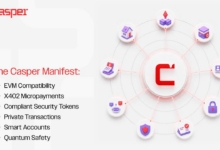
The Casper Association has published "The Casper Manifest," a multi-year technical roadmap for Casper Network. Introduced at the Digital Finance Forum in Bermuda, the roadmap outlines nine coordinated initiatives designed to position the layer-1 blockchain as the infrastructure for regulated real-world asset (RWA) tokenization and the machine-to-machine economy. Key initiatives focus on: 1. **Developer Access:** Adding full Ethereum Virtual Machine (EVM) compatibility alongside its existing WebAssembly (Wasm) execution layer. 2. **User Experience:** Implementing gasless transactions, batch operations, and smart accounts with biometric authentication. 3. **Institutional Compliance & Privacy:** Building compliant security tokens aligned with the ERC-3643 standard and a multi-phase roadmap for confidential transactions with built-in audit tools. 4. **Machine Economy:** Implementing the X402 open payment standard to enable AI agents and machines to make autonomous, programmatic micropayments. 5. **Token Infrastructure:** Creating a Native Token Registry to give all tokens protocol-level status with fixed, predictable costs. 6. **Quantum Safety:** Developing hybrid accounts with both classical and quantum-resistant keys. The first initiative, X402 micropayments, is expected within weeks. Subsequent releases through 2026 and 2027 will include EVM compatibility, compliant security tokens, the Native Token Registry, gasless transactions, and quantum-safe features. The goal is to create a blockchain that is frictionless for users, trusted by institutions, and native for machines.

TheNewsCryptoHá 1h

Casper Network Publishes the Casper Manifest, a Multi-Year Roadmap to Power Regulated Real-World Assets and the Machine Economy

TheNewsCryptoHá 1h

TechFlow Intelligence: Trump-Linked Companies Transfer $12 Million in Assets Before China Visit, 'The Big Short' Protagonist Warns of Stock Market Bubble Again

The article reports multiple developments across tech, crypto, and finance. In AI, Mozilla used AI for large-scale code review, Google confirmed hackers used AI to find zero-day exploits, and OpenAI deployed GPT-5.5 to find errors in math benchmarks. A court ruled Anthropic's scanning and destroying books for AI training as fair use, while its Claude platform launched on AWS. Google's new video model 'Omni' was leaked. In crypto/Web3, Trump-linked companies transferred $12M in crypto assets before a China visit. BlackRock chose Ethereum for tokenized funds, and a hacker stole $174k via a malicious NFT that tricked an AI. Jack Dorsey's first tweet NFT plummeted from $2.9M to under $5. In chips/hardware, TSMC approved an additional $20B for its Arizona plant. Apple's Tim Cook and Elon Musk will accompany Trump to China, while Nvidia's Jensen Huang is notably absent. For markets, Michael Burry warned of parabolic stock rises and suggested near-total sell-offs, with online discussions comparing current sentiment to the 1999 bubble. Other notes include WTI oil surpassing $100, a 20% price hike for Beijing-Shanghai high-speed rail, and new products like Unitree's $26.9k humanoid robot. The underlying theme suggests AI is becoming infrastructure, creating pressure on old systems while a new order is not yet ready, leaving investors anxious.

marsbitHá 1h

TechFlow Intelligence: Trump-Linked Companies Transfer $12 Million in Assets Before China Visit, 'The Big Short' Protagonist Warns of Stock Market Bubble Again

marsbitHá 1h

Trading

Spot
Futuros
活动图片