Insider Trading in War: 5 People Involved, the Highest Earner Was Arrested

marsbitPublicado em 2026-04-24Última atualização em 2026-04-24

Resumo

On April 24, the U.S. Department of Justice arrested U.S. Army Special Forces Staff Sergeant Gannon Ken Van Dyke for insider trading related to the capture of Venezuelan President Nicolás Maduro on January 3. Van Dyke allegedly profited over $400,000 by placing bets on a prediction market, Polymarket, using insider knowledge of the covert operation. According to the indictment, Van Dyke registered an account (0x31a5) on December 26 and made a series of bets predicting Maduro’s capture and U.S. military involvement in Venezuela. He withdrew most of his funds on the day of the operation and attempted to obscure his tracks by transferring assets through crypto and brokerage accounts. This case marks the first time the DOJ has prosecuted insider trading on Polymarket. PolyBeats had previously identified five suspicious accounts, including Van Dyke’s—the highest earner—in January. The other accounts, with profits ranging from $34,000 to $145,000, remain under unofficial scrutiny but have not been charged. Their lower profits, indirect access to information, and unclear legal boundaries may complicate prosecution. Polymarket has since strengthened its market integrity rules, explicitly prohibiting trading based on confidential or insider information. Van Dyke’s arrest, nearly four months after his trades, signals increased regulatory attention and the persistent traceability of blockchain-based transactions.

On April 24, Eastern Time, the U.S. Department of Justice announced the arrest of active-duty Army Special Forces Staff Sergeant Gannon Ken Van Dyke.

The indictment released by the Department of Justice on the same day revealed that Van Dyke participated in the operation to capture Venezuelan President Nicolás Maduro from the Presidential Palace in Caracas on January 3 of this year.

According to reports, Van Dyke bet on Maduro's capture through a prediction market on the eve of the operation, earning over $400,000. Although the report did not disclose specific account information, by comparing the betting direction and profit amount mentioned, we identified account 0x31a5.
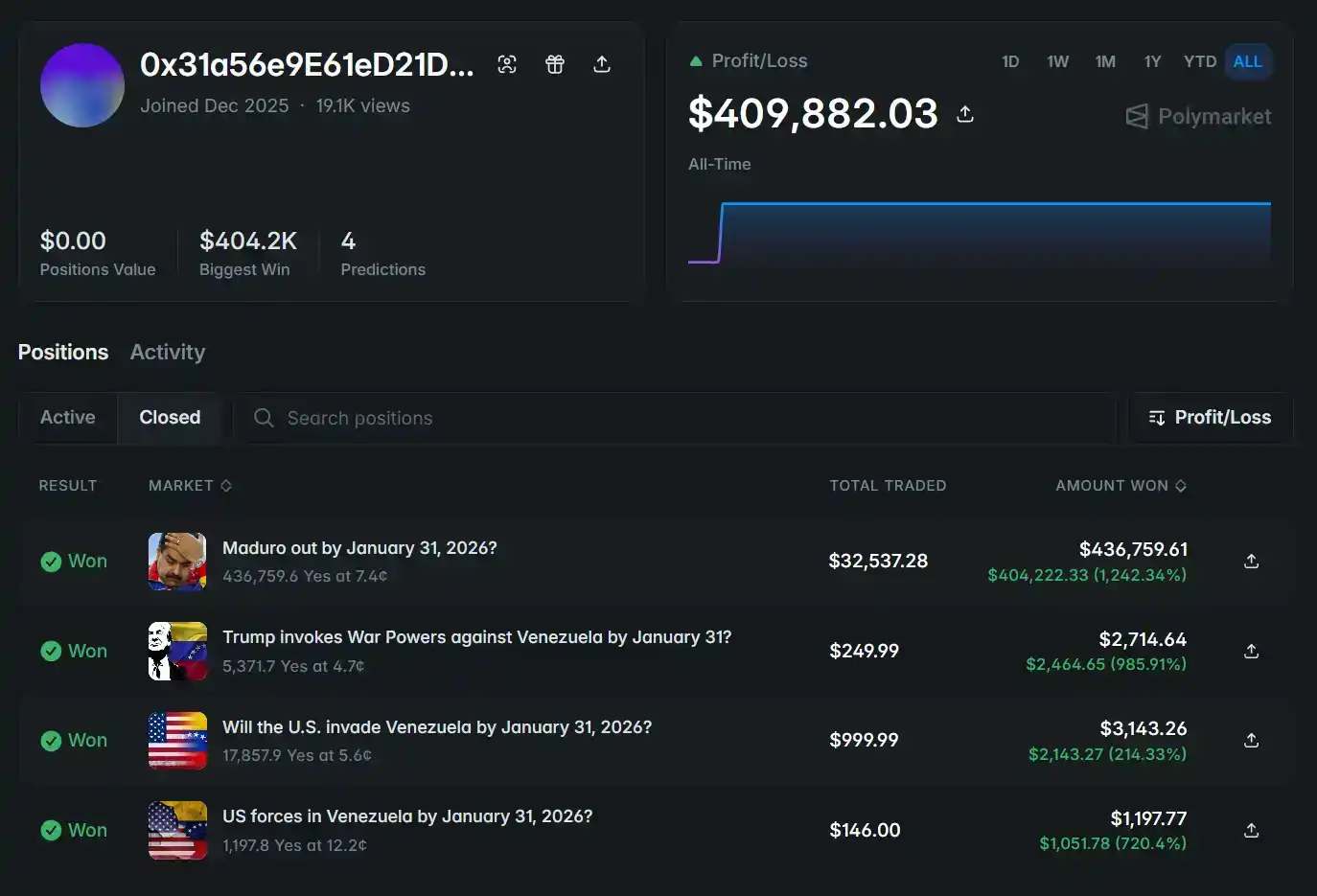
This is one of the five insider accounts点名ed by PolyBeats in two consecutive reports on January 4 and January 7.

Van Dyke Account Review

Let's rewind to January 4 of this year.

After the Maduro capture incident, PolyBeats immediately analyzed on-chain data,锁定ed five accounts, and completed public reporting within 24 hours after the operation ended. For details, see 《They Missed $2 Million Because Maduro Wasn't Supposed to Spend New Year at Home》
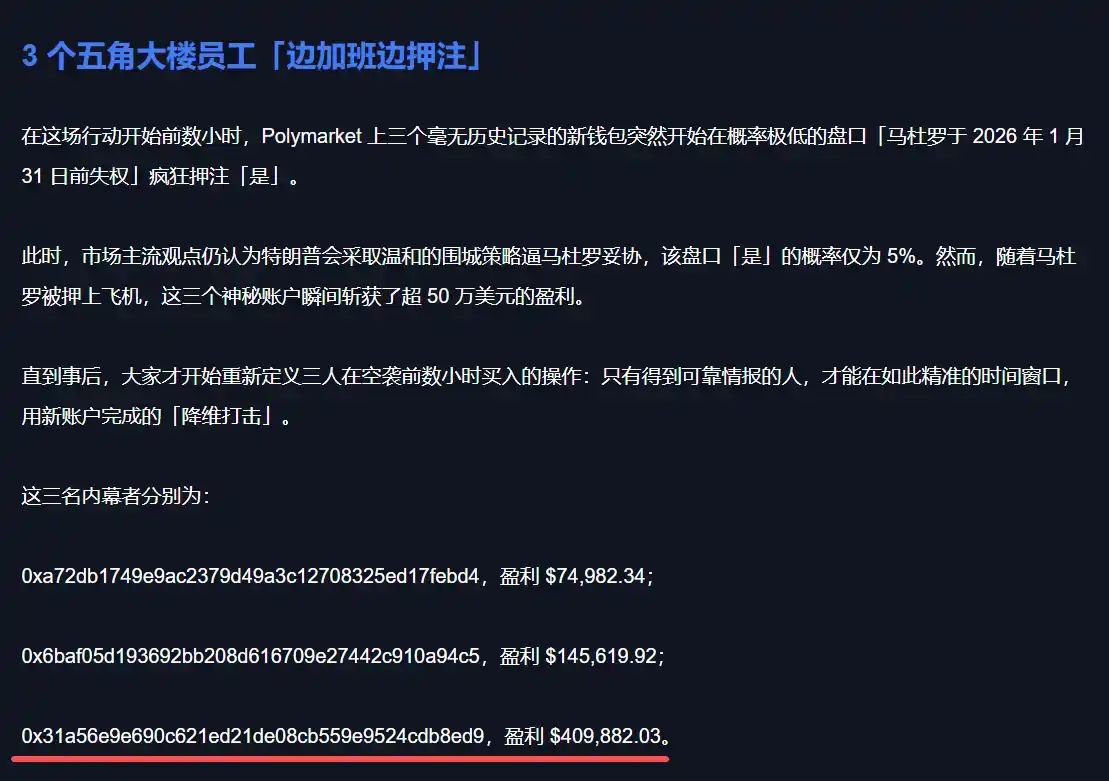
Among them, Van Dyke's account was the highest earner of the five. The account was registered on December 26, 2025, and subsequently placed a series of bets highly related to the capture operation, such as "Maduro's ouster" and "U.S. troops entering Venezuela," The total principal was approximately $30,000, with total profits exceeding $400,000.

On the day of the operation, the account withdrew most of its funds, transferred them to an overseas cryptocurrency account, and then deposited them into a newly opened brokerage account.

On January 6, three days after the operation ended, media began reporting abnormal trades related to this operation on Polymarket. On the same day, the account requested deletion from Polymarket, citing "inability to access the registered email." Simultaneously, he changed the registered email of the cryptocurrency exchange to an anonymous email secretly created as early as December 14.
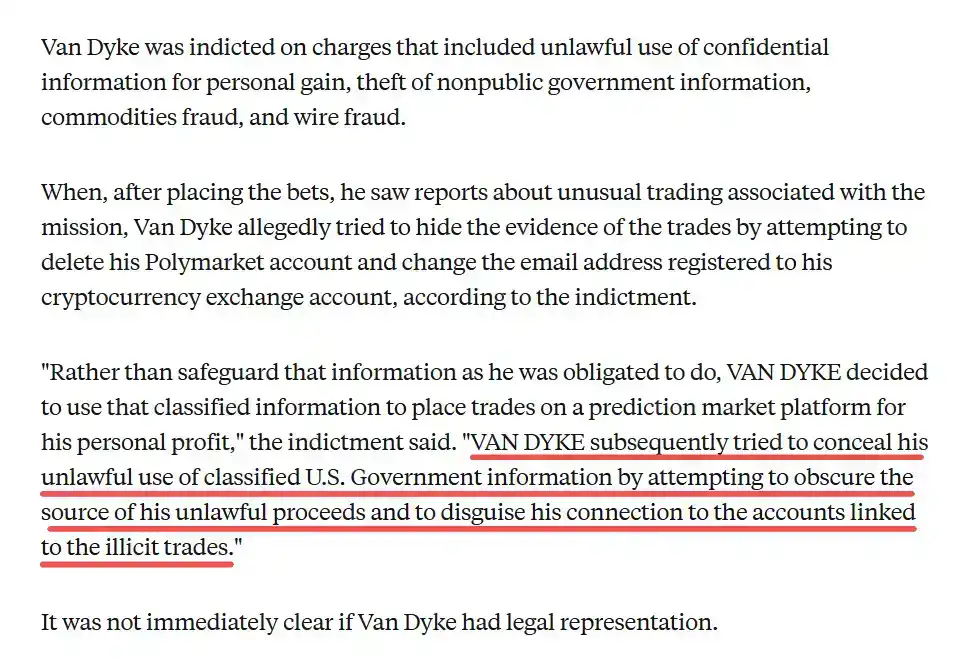
New account, precise positioning, withdrawal on the day of the incident, post-event痕迹 destruction—this set of operational procedures was the异常特征 we重点标记ed in the January review.

Today, the Department of Justice gave this address a name: Gannon Ken Van Dyke.

More Than One Person in the Story

Van Dyke's arrest is the first case of insider trading on Polymarket formally prosecuted by the DOJ. But this story never involved just him.

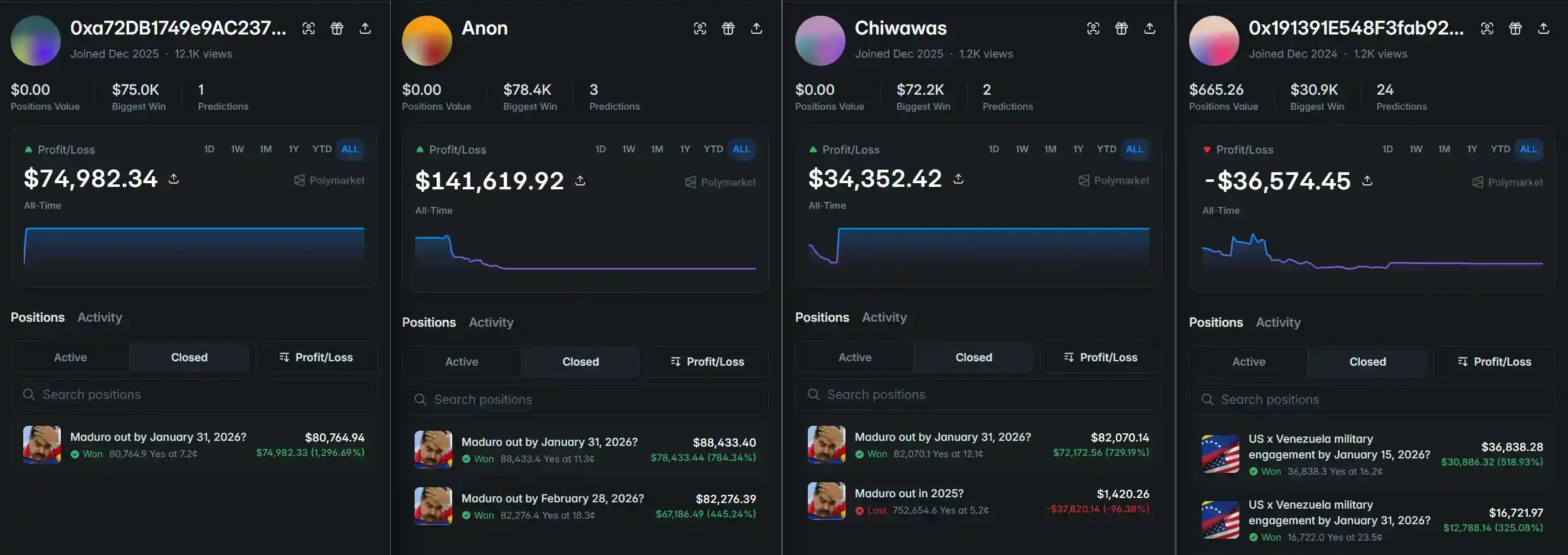
In the two January reports, PolyBeats标注ed a total of five accounts. Apart from Van Dyke, there has been no official investigation information regarding the other four:

0xa72db1749e9ac2379d49a3c12708325ed17febd4, profit $74,982;

0x6baf05d193692bb208d616709e27442c910a94c5, profit $145,619;

0x168b100d7a6620a2f49a455344c2c006eaf1714b, profit approx. $34,000;

0x168b100d7a6620a2f49a455344c2c006eaf1714b, profit approx. $54,000.
Why haven't these four accounts been arrested yet?

The most direct reason is the amount. Van Dyke's profit was nearly $410,000, the highest among the four accounts, making his执法优先级 most clear.

A more critical reason is identity. Van Dyke is an active-duty soldier, signed a confidentiality agreement, and was directly involved in action planning, making the identity verification path extremely short. The true identities and information sources of the other four accounts are still unclear. If they obtained second-hand information, the legal boundaries would be much模糊er, significantly increasing the difficulty of prosecution.

Another layer is Polymarket's own reporting boundaries. The platform claims they proactively discovered and reported Van Dyke to law enforcement, but the other four同样存在异常的 accounts were显然 not reported together. The platform has no explanation for this.

However, one thing is changing this situation.

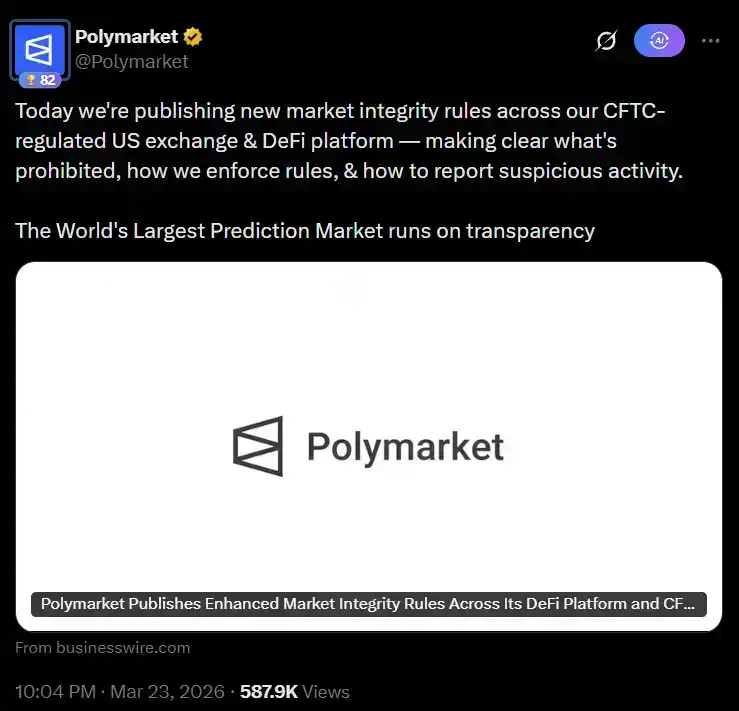
In March of this year, Polymarket released an enhanced market integrity rule, explicitly prohibiting three types of behavior: trading based on legally required confidential information, trading based on others' insider information, and participation in related markets by individuals with the power to influence event outcomes. As the rule was implemented, this indictment from the DOJ also sends the same signal to everyone: the platform is willing to cooperate with investigations, records on the blockchain will not disappear, and investigations themselves can last for months.
There was nearly a four-month gap between Van Dyke's positioning and his arrest. For the other four accounts, and for all those with information asymmetry attempting insider trading in prediction markets, this arrest may be just the beginning.


Perguntas relacionadas

QWho was arrested by the U.S. Department of Justice on April 24th in connection with the Venezuelan presidential capture operation?

AGannon Ken Van Dyke, an active-duty U.S. Army Special Forces staff sergeant.

QHow much profit did Van Dyke allegedly make by betting on the capture of Venezuelan President Nicolás Maduro on the prediction market?

AOver $400,000.

QWhich platform was used for the insider trading bets related to the military operation, as identified by PolyBeats?

APolymarket.

QHow many insider trading accounts did PolyBeats originally identify in their January investigation?

AFive accounts.

QWhat was one of the key reasons Van Dyke was prioritized for arrest compared to the other four accounts?

AHe was an active-duty soldier who signed confidentiality agreements and was directly involved in the operation, making his identity and information trail easier to verify.

Leituras Relacionadas

Seeking Alpha's Hot Article: Why Might the U.S. Stock Market Crash in June?

In a recent Seeking Alpha article, financial professor and analyst Damir Tokic argues that the US stock market may be poised for a significant crash in June 2026. The core thesis centers on a "mega-bubble" in equities, particularly within the technology sector, which has driven the S&P 500 to near-record valuations, with a Shiller P/E ratio exceeding 40—a level comparable to the 2000 dot-com bubble. Tokic identifies two primary catalysts for a potential collapse. First, he points to unsustainable market exuberance fueled by what he terms the "Trump Stimulus"—massive AI capital expenditure by tech giants, which he believes is politically driven and cannot last. Second, and more urgently, he highlights the escalating Iran war as a critical threat. The ongoing closure of the Strait of Hormuz has created a severe global energy supply crunch. Strategic petroleum reserves are projected to hit critically low operational levels by June, potentially causing oil prices to spike above $200 per barrel and triggering a severe, supply-driven inflationary shock. This scenario, Tokic warns, would force the Federal Reserve's hand. Despite currently maintaining a dovish bias, the Fed would likely be compelled to officially pivot to a hawkish stance at its June FOMC meeting to combat soaring inflation and bond yields. He contends that such a shift—or even a failure to act, which would destroy Fed credibility—could be the trigger that punctures the market bubble. The resulting downturn, he concludes, could rival the bear markets of 2000 and 2008, advising investors to prepare for a major correction.

marsbitHá 15m

Seeking Alpha's Hot Article: Why Might the U.S. Stock Market Crash in June?

marsbitHá 15m

AI PC Battle: Bet on the Toll Booth, Not the Camp

**Title:** The AI PC Battle: Don't Bet on Sides, Bet on the Tollbooth **Summary:** The AI PC competition is moving beyond simple "x86 vs. Arm" narratives. The core investment thesis should focus on identifying which players can sustain margins, cash flow, and pricing power throughout the upgrade cycle, rather than backing a particular architecture. The opportunity is analyzed in three layers: 1. **The Advanced Foundry Tollbooth:** TSMC is positioned to collect "tolls" regardless of which chip designer wins, due to its dominant ~70% share in advanced semiconductor manufacturing, which is essential for high-end AI PC chips. 2. **Compute & Platform Spillover:** AMD represents an offensive in the x86 CPU+GPU space, while NVIDIA leverages its GPU and CUDA software stack dominance. Both benefit from the demand for increased local AI compute. 3. **Architecture Diffusion & Turnaround Plays:** ARM and Intel offer potential for significant upside (elasticity), but investments here require stricter discipline due to higher execution risks and competitive challenges. The industry is transitioning from concept to shipment validation. While short-term forecasts for AI PC adoption have been revised down slightly due to tariffs and procurement delays, the long-term trend towards AI becoming a standard PC feature remains intact. The key driver for upgrade cycles will be whether compelling enterprise applications (e.g., privacy-sensitive computing, low-latency inference) emerge beyond consumer-focused features like meeting summarization. Investment strategy should prioritize companies with platform-level advantages and recurring revenue streams. TSMC offers high certainty as the foundational tollbooth. AMD presents a strong offensive play within the established ecosystem. ARM and Intel are higher-risk, higher-potential-reward turnaround bets. The report cautions against chasing short-term hype and emphasizes a disciplined, long-term approach focused on buying ecosystem strength and cash-flow certainty after market enthusiasm subsides. **Key Risks:** Underwhelming AI PC applications slowing upgrade cycles; slow improvement in Windows on Arm compatibility; macro/tariff impacts on PC demand; potential advanced node supply-demand mismatches affecting TSMC; high overall AI sector valuations making stocks vulnerable to a risk-off shift in markets.

marsbitHá 29m

AI PC Battle: Bet on the Toll Booth, Not the Camp

marsbitHá 29m

Ten-Thousand-Word Analysis: From $10 to $290, MRVL Wins the Entire AI Era by 'Not Making GPUs'

Marvell Technology's stock price surged from under $10 in 2016 to a record $290 in June 2026, fueled not by making GPUs, but by dominating AI infrastructure connectivity. This analysis argues the market misvalues MRVL as merely a smaller Broadcom in custom AI chips, overlooking its true, unique position. Marvell's core strength lies in enabling high-speed data flow for AI clusters through three interconnected businesses. First, it holds a commanding ~70% market share in high-speed optical DSPs (essential for data center light modules), a deep-moat business with accelerating growth. Second, its custom AI chip design business serves hyperscalers like AWS, Microsoft, and Google, with a significant revenue pipeline despite lower margins. Third, stable cash flows come from Ethernet switch chips and enterprise storage controllers. Together, they form a full-stack "AI data movement" platform. CEO Matt Murphy's transformative leadership since 2016, involving strategic divestments, key acquisitions (like Inphi for optical DSPs), and securing long-term agreements with major cloud providers, repositioned the company. A pivotal $2 billion strategic investment from NVIDIA in 2026 underscored Marvell's critical role in the AI ecosystem, particularly through collaborations like NVLink Fusion. While Marvell faces risks—including client concentration (losing the Amazon Trainium3 design), lower-margin business mix, competitive threats, insider selling, and complex supply chains—its fundamentals remain strong. The optical interconnect moat is widening with the acquisition of Celestial AI (photonics fabric), and financial metrics show accelerating revenue growth and operating leverage. With a PEG ratio suggesting undervaluation relative to its growth, the thesis is that the market undervalues Marvell's monopolistic position in AI "plumbing" while overemphasizing its competitive custom chip segment. The story transcends investing, symbolizing how in any complex system—from the internet to AI—the value of "connection" ultimately surpasses that of individual "nodes."

marsbitHá 59m

Ten-Thousand-Word Analysis: From $10 to $290, MRVL Wins the Entire AI Era by 'Not Making GPUs'

marsbitHá 59m

AI Relay Stations Spark Heated Debate on Zhihu: Behind Cheap Tokens, What Are Users Really Worried About?

A discussion on Zhihu about "AI relay stations" shifted the niche developer topic of "cheap tokens" into broader user awareness. Users moved beyond simply questioning the legitimacy of these services to focus on practical concerns: Where do cheap tokens truly come from? Is the model being accessed the real one? Can relay stations see prompts, code, and API keys? For occasional users, are the risks worth it? The core debate centered less on price and more on trust. A primary worry is model authenticity—the risk of "model swapping," where users paying for a premium model might be routed to a cheaper one, creating an information asymmetry. Others argued that cost comparisons matter; while cheaper than official pay-as-you-go APIs, relay stations may not be the lowest-cost option versus subscriptions, domestic models, or free tiers, making user needs assessment crucial. Speculation about token sources ranged from legitimate bulk discounts to gray-area methods like account sharing or exploiting regional pricing. This opacity makes risk assessment difficult for users. Data security emerged as a critical concern, especially for enterprise use. When processing sensitive information like code, contracts, or client data, the inability to verify a relay station's data handling, retention, or access policies poses significant compliance and confidentiality risks. The evolving consensus suggests relay stations can be used cautiously for low-sensitivity, disposable tasks (e.g., summarizing public info, simple translation). However, they should not be the default for sensitive, professional, or production workflows involving proprietary data, Agents, or automated systems. Recommendations include avoiding large prepayments, not relying on a single service, using test prompts to monitor quality, anonymizing data where possible, and keeping official channels as backups. Ultimately, the discussion framed tokens not just as a billing unit but as a measure of real cost encompassing price, model integrity, data security, and service stability. The popularity of relay stations highlights user demand for affordable access, but the debate underscores a key trade-off: the savings from cheap tokens may come at the price of trust, transparency, and control over one's data and AI experience.

marsbitHá 1h

AI Relay Stations Spark Heated Debate on Zhihu: Behind Cheap Tokens, What Are Users Really Worried About?

marsbitHá 1h

Trading

Spot
Futuros

Artigos em Destaque

Como comprar PEOPLE

Bem-vindo à HTX.com!Tornámos a compra de ConstitutionDAO (PEOPLE) simples e conveniente.Segue o nosso guia passo a passo para iniciar a tua jornada no mundo das criptos.Passo 1: cria a tua conta HTXUtiliza o teu e-mail ou número de telefone para te inscreveres numa conta gratuita na HTX.Desfruta de um processo de inscrição sem complicações e desbloqueia todas as funcionalidades.Obter a minha contaPasso 2: vai para Comprar Cripto e escolhe o teu método de pagamentoCartão de crédito/débito: usa o teu visa ou mastercard para comprar ConstitutionDAO (PEOPLE) instantaneamente.Saldo: usa os fundos da tua conta HTX para transacionar sem problemas.Terceiros: adicionamos métodos de pagamento populares, como Google Pay e Apple Pay, para aumentar a conveniência.P2P: transaciona diretamente com outros utilizadores na HTX.Mercado de balcão (OTC): oferecemos serviços personalizados e taxas de câmbio competitivas para os traders.Passo 3: armazena teu ConstitutionDAO (PEOPLE)Depois de comprar o teu ConstitutionDAO (PEOPLE), armazena-o na tua conta HTX.Alternativamente, podes enviá-lo para outro lugar através de transferência blockchain ou usá-lo para transacionar outras criptomoedas.Passo 4: transaciona ConstitutionDAO (PEOPLE)Transaciona facilmente ConstitutionDAO (PEOPLE) no mercado à vista da HTX.Acede simplesmente à tua conta, seleciona o teu par de trading, executa as tuas transações e monitoriza em tempo real.Oferecemos uma experiência de fácil utilização tanto para principiantes como para traders experientes.

488 Visualizações TotaisPublicado em {updateTime}Atualizado em 2026.06.02

Como comprar PEOPLE

Discussões

Bem-vindo à Comunidade HTX. Aqui, pode manter-se informado sobre os mais recentes desenvolvimentos da plataforma e obter acesso a análises profissionais de mercado. As opiniões dos utilizadores sobre o preço de PEOPLE (PEOPLE) são apresentadas abaixo.

活动图片












