ING Now Allows Crypto Investments as SUBBD Token Soars

bitcoinistPublicado em 2026-02-03Última atualização em 2026-02-03

Resumo

The cryptocurrency market is experiencing a divergence, with institutional players like ING adopting crypto services—adding legitimacy—while retail traders pursue high-risk assets. Tokens like SUBBD are surging, reflecting a strong risk-on appetite. SUBBD Token targets the $85 billion creator economy by offering a decentralized platform with AI tools, aiming to solve Web2 issues like high fees and limited control. It has raised $1.4M and offers a 20% APY staking reward to incentivize holding. This represents a shift toward utility-driven crypto projects.

The cryptocurrency market is showing a fascinating divergence: institutional giants are building the floor while retail traders are aggressively testing the ceiling.

Reports that major banking institutions like ING are warming up to direct crypto services signal a critical shift in market structure.

That’s not just about accessibility, it’s about the legitimization of digital assets as a standard portfolio component for conservative European wealth. (Frankly, when a legacy bank moves, it validates the asset class for risk-averse capital that has remained on the sidelines for a decade).

Meanwhile, the retail sector is operating with a totally different risk profile. Just look at the parabolic moves in assets like $SUBBD. The surge in these niche, community-driven tokens suggests that despite macroeconomic headwinds, risk-on appetite remains voracious.

The dichotomy is stark: while bankers analyze Bitcoin ETFs, the ‘degen’ economy is hunting for 100x multipliers in the AI infrastructure sector. This barbell structure, stability on one end, high volatility on the other, implies liquidity is returning to the system, but it’s bifurcated.

But the most astute capital is looking beyond the safety of banks or the casino-like nature of memes. Smart money is positioning itself in the middle ground: utility-driven protocols that solve tangible Web2 problems using Web3 infrastructure.

Specifically, the intersection of Artificial Intelligence and the creator economy is emerging as the next major growth narrative. Investors are increasingly rotating profits from high-volatility plays into infrastructure projects like SUBBD Token that offer sustainable revenue models.

Visit SUBBD Token’s official page.

SUBBD Token Targets the $85 Billion Creator Economy

While the broader market debates regulatory frameworks, SUBBD Token is executing a targeted strike on the $85 billion content creation industry. The current Web2 model? It’s fundamentally broken for creators. Platforms often extract up to 70% of earnings in fees, impose arbitrary bans, and enforce strict geographical payment restrictions.

SUBBD uses Ethereum-based EVM-compatible smart contracts to dismantle these barriers, offering a decentralized alternative where creators actually retain control over their content and revenue.

The project differentiates itself by integrating proprietary AI models directly into its ecosystem. This isn’t merely about payment processing, it’s about workflow automation. The platform features an AI Personal Assistant for automated interactions and advanced AI Voice Cloning technology, allowing influencers to scale their presence without scaling their workload.
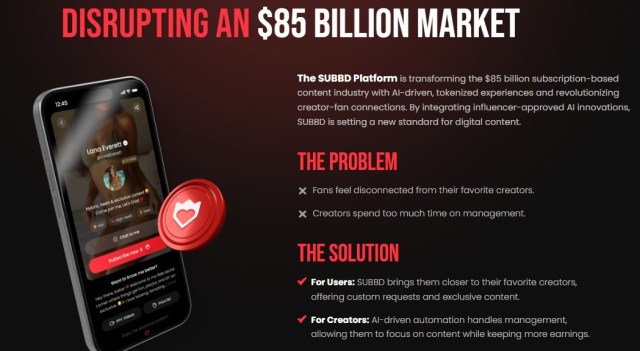
For fans, the utility is equally tangible: token-gated access creates an exclusive layer of interaction that fiat subscriptions can’t replicate.

From a portfolio standpoint, this represents a shift from speculative assets to productive ones. By merging Web3 transparency with AI-driven influencer tools, the project addresses the fragmentation of current software. Instead of subscribing to five different services for chatbots, voice generation, and payments, creators access a unified ecosystem. That consolidation of utility is precisely what transforms a token from a trading vehicle into a fundamental infrastructure play.

Explore the SUBBD ecosystem.

Early Capital Flows and Staking Metrics

The market’s appetite for this AI-Web3 hybrid model is reflected in the early capital inflows. According to official data, the project has already raised $1.4M, a figure that suggests significant conviction from early entrants despite the broader market’s volatility.
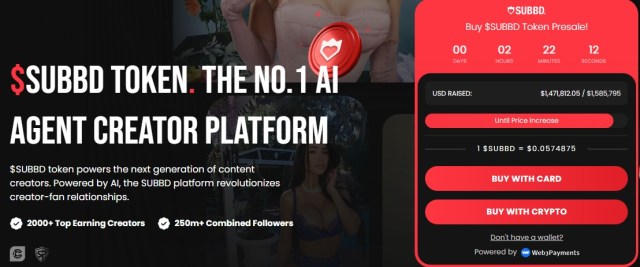
With tokens currently priced at $0.0574875, the entry point allows for position sizing that’s difficult to achieve in established large-cap assets.

Beyond the capital raise, the protocol’s retention mechanics are designed to mitigate the sell pressure often seen in new launches. The staking structure offers a fixed 20% APY for the first year, creating a compelling incentive for holders to lock supply. This isn’t just an inflationary reward; it’s a mechanism to align user behavior with long-term platform growth.

Stakers also gain access to XP multipliers and exclusive ‘behind the scenes’ content drops, gamifying the holding process.
This approach, combining high-yield staking with functional platform benefits, creates a liquidity sink that stabilizes the token economy.

While ING clients are limited to market-beta returns, SUBBD offers a third path: early-stage exposure to a utility protocol with built-in yield generation.

As the presale advances, the window to acquire tokens at the $0.0002802 valuation tightens, placing a premium on early decision-making.

View the official SUBBD presale site.

The information provided in this article does not constitute investment advice, financial advice, trading advice, or any other sort of advice and you should not treat any of the article’s content as such. Cryptocurrency markets are highly volatile and carry significant risk. Always conduct your own due diligence before making any investment decisions.


Perguntas relacionadas

QWhat major shift in the cryptocurrency market does the article highlight regarding traditional banking institutions like ING?

AThe article highlights that major banking institutions like ING are warming up to direct crypto services, signaling a critical shift in market structure. This move legitimizes digital assets as a standard portfolio component for conservative European wealth and validates the asset class for risk-averse capital.

QHow does SUBBD Token differentiate itself in the cryptocurrency market according to the article?

ASUBBD Token differentiates itself by targeting the $85 billion creator economy with a decentralized alternative that allows creators to retain control over their content and revenue. It integrates proprietary AI models for workflow automation, including an AI Personal Assistant and AI Voice Cloning technology, and provides token-gated access for fans.

QWhat is the current price of SUBBD Token and what incentive does the staking structure offer?

AThe current price of SUBBD Token is $0.0574875. The staking structure offers a fixed 20% APY for the first year, which incentivizes holders to lock supply and aligns user behavior with long-term platform growth. Stakers also gain access to XP multipliers and exclusive content.

QWhat problem in the current Web2 model for creators does SUBBD Token aim to solve?

ASUBBD Token aims to solve the problems in the current Web2 model where platforms often extract up to 70% of earnings in fees, impose arbitrary bans, and enforce strict geographical payment restrictions. It offers a decentralized alternative that allows creators to retain control and revenue.

QHow much capital has SUBBD Token raised according to the official data mentioned in the article?

AAccording to official data, SUBBD Token has raised $1.4M, indicating significant conviction from early entrants despite the broader market's volatility.

Leituras Relacionadas

Global Stock Market's Storm Center: South Korea's Stock Market De-leveraging Is Largely Complete

Storm's Eye: South Korean Market De-leveraging Nears Completion The recent sharp correction in South Korean equities, with the KOSPI index dropping 32% from its June high, has been a key trigger for global tech stock volatility. The core driver was not a fundamental shift but a forced de-leveraging process within the market's unique structure, which is now largely complete. Two main leverage channels amplified the sell-off: 1. **Leveraged ETFs:** Their size, proportionally four times larger than in the U.S., peaked near $50 billion. Their mandatory daily rebalancing mechanism created a vicious cycle of "price drop → forced selling → further drop." Approximately 75% of this excess has been unwound, shrinking to $26 billion, with regulatory curbs now blocking new inflows. 2. **Hedge Fund Leverage:** Using swaps to magnify exposure, hedge funds saw their net long positioning fall by over 50% from peak levels. The most intense phase of this institutional de-leveraging is over. In contrast, **retail margin debt** poses minimal systemic risk. At 0.5% of market cap, it is far lower than in the U.S. or China, lacks automatic triggers, and is concentrated in smaller stocks. The conclusion: the high-leverage structures most prone to "chain-reaction selling" have been substantially cleared. The market is transitioning from a liquidity-driven crash to one priced more on fundamentals. The article argues that the AI trend—centered on Korean memory chips—remains intact. This episode represents a painful but necessary clearing of crowded trades, not the end of the AI revolution. For investors, the key question is conviction in the long-term AI direction; if the trend is real, current volatility is a cost of entry, not a terminal risk.

链捕手Há 51m

Global Stock Market's Storm Center: South Korea's Stock Market De-leveraging Is Largely Complete

链捕手Há 51m

The Eternal Fragments of Money: Third-Party Payment Has No First Principle

"The Enduring Fragments of Money: Third-Party Payments Lack a First Principle" Stripe is reportedly attempting to acquire PayPal, marking a significant shift reminiscent of PayPal's merger with the original X.com 30 years ago. The article analyzes Stripe's strategic challenges and the broader payments industry landscape. Despite its initial success with a developer-friendly API model, Stripe missed its optimal IPO window during the pandemic and has since seen its valuation decline. Its attempts to expand through acquisitions and new ventures, particularly in stablecoins (like its OUSD project) and Agent-focused payments (ACP/MPP protocols), have faced headwinds. The author argues that the payment industry remains highly fragmented and is ultimately an adjunct to the traditional banking system. This structure limits the potential for any single player, including Stripe, to achieve complete dominance. While stablecoins and the future rise of autonomous Agent economies present potential growth avenues, they are not yet mainstream and still require integration with the existing financial system. For now, Agent-based transactions are largely used for speculative "volume boosting" rather than substantive business applications. Stripe's current move to acquire PayPal is seen as an attempt to bolster its weak consumer-facing (C-side) business after its stablecoin-focused strategies faltered. Meanwhile, PayPal is described as structurally outdated, unable to revive itself through new products like Venmo or PYUSD. The future of payments may lie not in payments themselves but in value-added services like more efficient settlement networks. The author suggests that companies like Stripe and Circle, which are building their own blockchains (Tempo, Arc) and stablecoins, are positioning themselves to eventually profit from high-efficiency settlement systems. These new networks could potentially bypass some traditional banking layers. In conclusion, the article posits that third-party payment is a perpetually fragmented battlefield where scale alone cannot ensure victory. Players must find new models, focusing on efficiency to compete with the entrenched banking system. Stripe's acquisition of PayPal represents a bet on this uncertain future.

链捕手Há 1h

The Eternal Fragments of Money: Third-Party Payment Has No First Principle

链捕手Há 1h

Trading

Spot
活动图片




