In AI Video Generation, 'Leading by a Wide Margin' Has Become a Reality

marsbitPublicado em 2026-05-21Última atualização em 2026-05-21

Resumo

Chinese AI companies, particularly ByteDance and Kuaishou, are now leading in AI video generation, surpassing their US counterparts like OpenAI and Google, according to a recent viral overseas article. The core advantage stems from access to massive, high-quality, and user-behavior-annotated video training data from platforms like Douyin and Kuaishou, creating a self-reinforcing data flywheel that US labs struggle to match. Key Chinese models such as ByteDance's Seedance 2.0, Kuaishou's Kling 3.0, and Alibaba's HappyHorse dominate user-voted rankings on platforms like Artificial Analysis. Their lead is amplified by strong commercial integration in e-commerce, advertising, and short dramas, driving practical monetization absent in the US. However, challenges persist: a widening compute power gap with the US, copyright disputes with Hollywood, rising commercialization costs leading to usage caps and fees, and a foundational lag behind US giants like OpenAI in underlying large language model capabilities. While China holds a tangible lead in this vertical, sustaining it requires navigating these significant hurdles.

By Letters AI

Rumors suggest that ByteDance's video generation model Seedance 2.1 will be released soon, with its generation effect expected to improve by 20% compared to the 2.0 version. ByteDance told Letters AI that this is false information.

Although Seedance 2.1 may not be released in the near future, it is true that Seedance 2.0's popularity has surged overseas.

The reason is that over the weekend, an article titled "Chinese AI groups pull ahead of US rivals in video generation race" went viral overseas.

Using Seedance 2.0 and Kuaishou's Kling 3.0 as core evidence, the article reached a surprising conclusion: "In the field of AI video generation, China not only leads the United States, but this advantage will last forever."
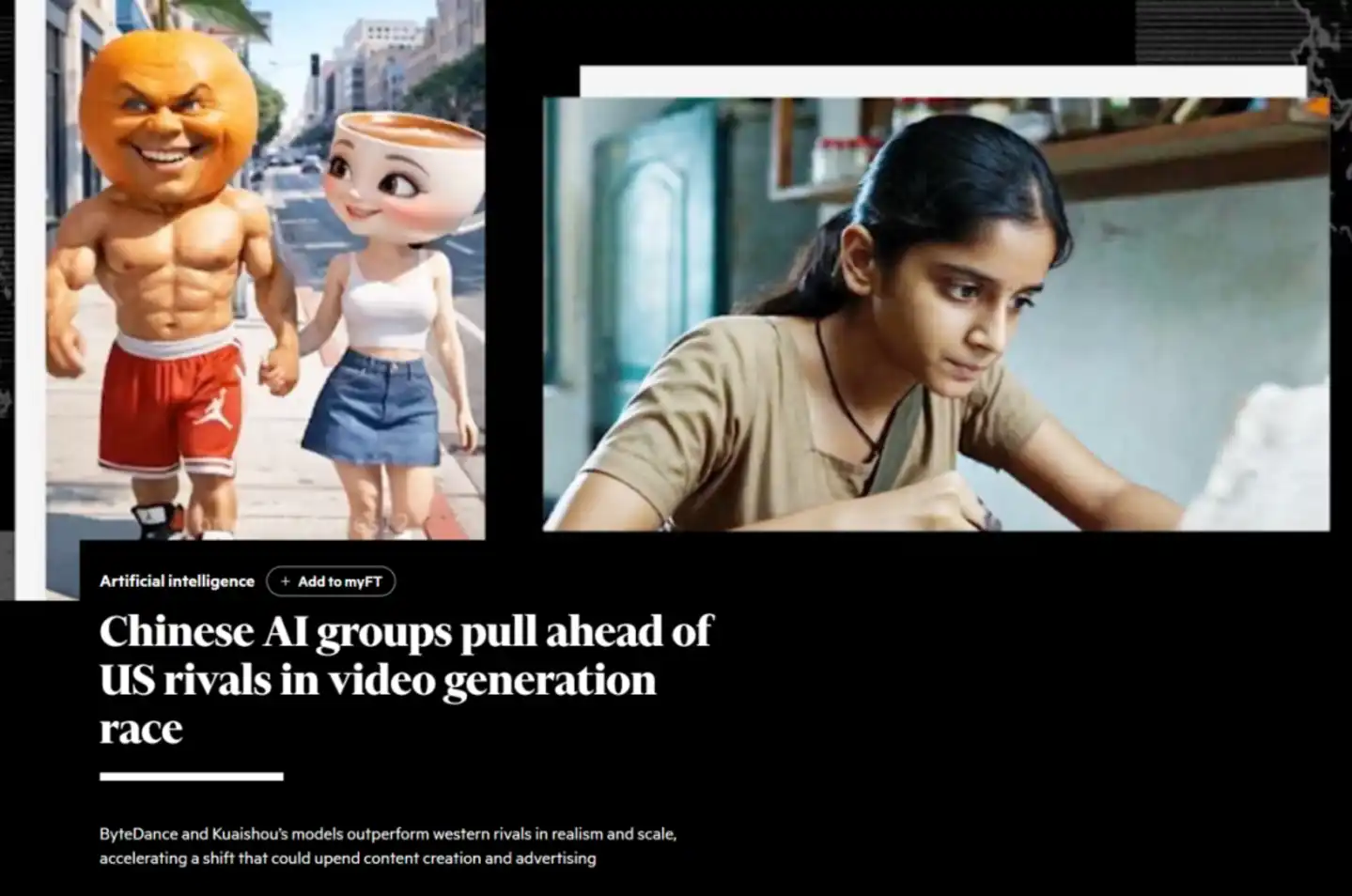
This judgment sounds somewhat counter-intuitive; it seems more like flattery for Chinese AI. After all, over the past few years, the AI industry has always seen Silicon Valley launch a product first, followed by similar Chinese products, as we have all witnessed.

But after reading the foreign media's viewpoint, I realized that my thinking was indeed too one-sided. In Chinese AI video generation, it truly is leading the United States.

The article specifically interviewed several American AI entrepreneurs and filmmakers using AI video generation technology. The result was unanimous: everyone agrees that Chinese AI video tools have comprehensively surpassed their American counterparts.

More importantly, this lead is not a phased technological advantage but a comprehensive one, leading in every aspect from data to practical application.

Not only that, this lead is of the "unbeatable" kind. That is to say, this leading position will be maintained indefinitely.

Has "leading by a wide margin" become reality?

Why Will Chinese AI Forever Lead American AI?

One argument in the article is that in the field of AI video generation, the gap at the algorithm level is rapidly narrowing.

Currently, the technical architectures of various companies are already "more or less the same." Underlying technological paths like Transformer, diffusion models, and spatiotemporal attention mechanisms have become relatively transparent.

So the key question becomes: who possesses higher quality and larger quantities of training data?

This happens to be where ByteDance and Kuaishou excel. Douyin and Kuaishou are among the world's largest video production machines.

More importantly, this data comes with complete user behavior annotations.

Which videos are liked, favorited, shared; which have high completion rates—this data is all clear in the backend.

Moreover, these annotations do not require manual labeling; they are naturally generated from users' real behavior. This kind of high-quality, annotated data is something you might not be able to buy on the market even if you wanted to.

In contrast, OpenAI and Anthropic have no accumulation of video data.

When OpenAI launched Sora, it primarily relied on publicly crawled video data from the internet and some licensed film and television materials.

The problem is that public videos on the internet are often of mixed quality, containing a large amount of duplicate content, low-quality content, and even secondarily processed content with watermarks and advertisements.

Therefore, during the training process, it often results in more effort for less gain.

On the global evaluation platform Artificial Analysis, ByteDance's Seedance 2.0, Kuaishou's Kling 3.0, and Alibaba's HappyHorse together took the top spots in the text-to-video and image-to-video rankings.

This ranking is generated by real user votes, meaning that everyone generally finds the content generated by these three Chinese AI video tools to be better.

Although Google has YouTube as a data source and its own video generation model Veo 3,

Google's problem lies in having too many constraints. Videos on YouTube are generally over 5 minutes long, but current GPUs cannot yet accommodate such long, high-definition videos as training data, which can cause the model to fail during training.

This has led to a market reception for Veo 3 that has not been very good, falling short of Chinese AI video generation models like Seedance 2.0 and Kling 3.0.

"We've tried most American models, but they haven't performed well enough in video generation," said Ben Chiang, founder of Director AI. Therefore, he currently mainly uses Chinese tools like Kling, Seedance 2.0, and Halulu for creation.

Independent AI filmmaker George Won stated, "Seedance 2.0 is a game-changer. It can handle aggressive camera angles and speeds without losing facial details of characters or the contrast of light and shadow. Most AI models start to shake or drift during rapid movement."

Moreover, this data advantage can also enable products to undergo "self-reinforcement."

ByteDance has integrated Seedance 2.0 into creative tools like CapCut, allowing ByteDance to receive feedback data on over 50 million generated videos daily.

This way, ByteDance can know that "this video satisfied the user, this one did not."

Each piece of such feedback makes the development direction of the next-generation Seedance product a bit clearer.

This kind of continuous, large-scale feedback loop in real-world scenarios is also unmatched by the lab environments of companies like OpenAI and Anthropic.

Even with massive resource investment, it is difficult to establish a similar data flywheel in the short term.

Technology can be caught up with, algorithms can be imitated, but the accumulation of ecosystems and data takes time, requires a user base, and needs a complete product cycle.

Application Scenarios

For companies developing AI video, there must be a "purpose."

Data advantage is just the starting point; what truly turns technology into competitiveness is finding profitable application scenarios. With landing scenarios, companies have the motivation to develop AI video generation.

In this dimension, ByteDance and Kuaishou also outperform American AI.

The first large-scale application scenario is e-commerce video.

In the past, the cost of shooting a professional video for a product could be as high as several thousand yuan, including photographer, lighting technician, venue rental, model fees, post-production editing, etc.

For most small and medium-sized merchants, an ordinary Taobao store might have hundreds of products; filming them all would cost at least several hundred thousand yuan.

AI video generation technology has changed this situation.

Vincent Yang, CEO of video infrastructure company Firework, said, "A retailer asked us to create 100,000 videos for their product pages. Without AI, this would be completely unfeasible in terms of cost. Now, each product can have its own video, and even multiple customized versions for different customers."

Data shows that product pages with videos have a conversion rate 30% to 80% higher than those with only images and text. Moreover, Douyin and Kuaishou are among China's largest e-commerce live-streaming and short video sales platforms.

Once AI generates the video, you can turn right out the door and directly launch an advertising campaign.

Alibaba's HappyHorse model also explicitly positions e-commerce video as a core application scenario. It supports batch generation of product showcase short videos and virtual host talking videos. A merchant can upload product images and simple text descriptions, and the system can automatically generate multiple versions of sales videos, each targeting different audience groups with different scripts and presentation styles.

The second scenario is advertising.

The production cycle for traditional TVC (television commercial) is too long.

A 30-second brand advertisement often takes several weeks from creative planning to filming and production.

With video generation models, dozens of different versions of advertising creatives can be generated in just a few minutes.

The third scenario is short dramas.

AI short dramas experienced explosive growth in 2026. Data shows that the number of AI short dramas airing in March 2026 increased by 138% compared to January, far exceeding the production speed of traditional film and television content.

Through AI video generation, a small team or even an individual creator can produce a short drama within a few days.

Furthermore, ByteDance's Hongguo Short Drama platform has integrated an "image search for same items" feature.

This feature is easy to understand: while watching a short drama, if you are interested in a character's outfit, furniture in a scene, or a car parked at the door, you can directly click on image search. The system will recommend the same or similar items, allowing you to purchase them directly.

This essentially turns short dramas into a commercial scenario that can generate conversions.

In contrast, in the American market, despite having content platforms like Netflix and YouTube, there is no comparable application and conversion mechanism.

American AI video tools remain more in the creative experimentation stage, with the only commercial application scenario being subscription memberships.

Moreover, in terms of product functionality, Chinese video generation models are also more suitable for commercial application.

Seedance 2.0 can incorporate multiple source photos, videos, and sounds into the same AI video. Sora cannot do this; it can only generate videos by specifying an image and text to the model.

This is not because Sora's technology is insufficient, but because it lacks a complete commercial ecosystem to leverage these technological capabilities.

The Computing Power Gap

However, Chinese video AI also faces an unavoidable hurdle: computing power.

Leading American AI companies treat computing power as gold, hoarding all the computing power available on the market.

Anthropic recently signed computing power agreements totaling over 10 gigawatts.

This figure includes leasing all the computing power of SpaceX's Colossus 1 data center, covering 220,000 NVIDIA GPUs; a 5-gigawatt agreement with Amazon; and 3.5-gigawatt agreements with Google and Broadcom.

OpenAI operates similarly.

Through its deep collaboration with Microsoft, OpenAI has gained access to hundreds of thousands of high-end GPUs, and Microsoft has specifically built several hyperscale data centers for OpenAI.

In comparison, although Chinese companies have made significant progress in algorithm efficiency optimization, there is still a gap in the absolute scale of computing power.

According to foreign media statistics, the gap in AI computing power between China and the US was about 3 times in 2023 and had expanded to about 8 times by early 2026.

Besides computing power, Chinese AI faces other challenges.

The first is copyright.

Taking Seedance 2.0 as an example, about a month after its release, six Hollywood giants including Disney, Warner Bros., Paramount, Skydance, and Netflix jointly sent a cease-and-desist letter to ByteDance. They claimed that Seedance 2.0 had used copyright-protected film and television materials on a large scale without authorization during its training phase.

Subsequently, ByteDance urgently suspended the originally planned global release of Seedance 2.0 in mid-March.

If you have been using Seedance 2.0 from February until now, you will find that IP characters that could be generated before can no longer be used; instead, only "passerby" images can be used.

The second is that the commercialization threshold is rising.

American video generation AI, represented by Sora, often rejects generation requests due to usage policies. Chinese tools are more lenient, and their prices are also cheaper.

But this has also brought a "happy trouble" for Chinese AI companies.

Since February, Seedance 2.0 has seen a surge in usage demand, and some users have already encountered quota limits and longer queue times.

Foreign media reported that ByteDance has adopted a heavier commercialization approach for some American enterprise clients, requiring them to prepay approximately $2 million in exchange for model access rights and usage quotas.

Kuaishou is in a similar situation; they are spinning off the Kling business and may promote Kling for a separate listing in the future.

This indicates that Kling is an independent business with a potentially stronger growth story than Kuaishou's main entity.

The bigger the growth story, the clearer the accounting needs to be.

However, the cost of AI video is higher. The computing power consumed behind generating a few seconds of video for a user is far higher than generating a piece of text.

The higher the quality and the longer the duration of the generated video, the higher the inference cost.

Many video generation models are like this: initially very cheap, even free, but once users flood in, they quickly start implementing limits, queues, and price increases.

It's not that companies don't want to scale up; it's that the landlord doesn't have surplus grain either.

So what Chinese video AI needs to face next is not just "whether it can create a good model," but "whether it can turn a good model into a good business."

If the price is too low, the faster the user growth, the greater the losses; if the price is too high, there are no users, which defeats the purpose.

The third is the generational gap in model capabilities.

Ultimately, video generation capabilities are built upon language models.

No matter how powerful a video generation model is, it still needs language understanding capabilities as a foundation to understand user prompts. Then it uses reasoning capabilities to understand the logical relationships of scenes and characters and maintain coherence in the generated content.

According to foreign media assessments, OpenAI's ChatGPT 5.5 and Anthropic's Mythos have taken a lead of 9 months to 1 year over domestic AI companies.

This generational gap is reflected in multiple aspects, such as reasoning ability, contextual understanding, multi-turn dialogue, complex task handling, etc.

Although China leads American AI in vertical fields like AI video, a relatively noticeable gap can still be felt in general-purpose large models.

In summary, Chinese AI's lead in the field of video generation is real, but it is not without worries. The gap in computing power and foundational models is always a sword hanging overhead. But at least for now, we finally don't have to look up at the back of Silicon Valley anymore.


Perguntas relacionadas

QAccording to the article, why does it claim that Chinese AI video generation tools will maintain a permanent lead over American competitors?

AThe article argues that the lead is built on superior, user-behavior-annotated training data from platforms like Douyin and Kuaishou, a self-reinforcing product feedback loop, and strong commercial application scenarios (e.g., e-commerce, advertising, short dramas). These factors create an ecosystem and data advantage that is difficult for U.S. companies without such platforms to replicate quickly.

QWhat are the three main commercial application scenarios mentioned for AI video generation in China?

AThe three main commercial application scenarios are: 1) E-commerce product videos, 2) Advertising content creation, and 3) AI-generated short dramas, which are often integrated with shopping features for direct conversion.

QWhat significant challenge does the article highlight for Chinese AI video companies despite their technological lead?

AThe article highlights a significant and growing compute power (算力) gap with the U.S., estimating it had widened to about 8 times by early 2026. Other challenges include copyright infringement accusations from Hollywood studios, the high cost of video generation straining business models, and a foundational gap in underlying large language models (LLMs) compared to leaders like OpenAI and Anthropic.

QHow do Chinese platforms like ByteDance gain a data advantage for training their AI video models according to the text?

APlatforms like ByteDance's Douyin and Kuaishou are massive video production engines. They provide vast amounts of high-quality video data that is naturally annotated with user engagement metrics (likes, shares, completion rates). Furthermore, integrating models like Seedance into editing tools (e.g., CapCut) generates millions of daily feedback data points on what users like or dislike, creating a powerful, self-reinforcing data flywheel.

QWhat example does the article give to illustrate the functional advantage of Chinese AI video tools for commercial use compared to models like Sora?

AThe article states that ByteDance's Seedance 2.0 can integrate multiple source photos, videos, and audio into a single AI-generated video, making it more versatile for commercial content creation. In contrast, it mentions that OpenAI's Sora is limited to generating video from a single image and text prompt, not due to inferior technology but due to a lack of a comprehensive commercial ecosystem to support such features.

Leituras Relacionadas

Silicon Bull, Carbon Bear: The Wealth Code of 2026 is Only 'Chips' and 'Light'

The article, titled "Silicon Bull, Carbon Bear: In 2026, the Wealth Code Lies Only in 'Chips' and 'Optics'", discusses the extreme market divergence in 2026 driven by the AI investment frenzy. Investment managers who concentrated on the AI hardware supply chain, particularly computing infrastructure, optical modules, and memory chips, have seen their fund net asset values (NAVs) surge dramatically, even reaching record highs. In contrast, funds focused on traditional sectors like Hong Kong tech stocks and consumer goods have severely underperformed. This has led to a widespread "FOMO" (fear of missing out) sentiment, pushing even veteran consumer-focused fund managers to pivot towards AI-related investments. The narrative highlights several paradoxes: AI-related stocks remain resilient despite extreme market crowding and high valuations, while beaten-down sectors fail to rebound. The author dubs this split market "Silicon Bull, Carbon Bear," suggesting a bull market only for those invested in silicon-based tech (AI hardware) and a bear market for carbon-based traditional economy sectors. The piece explores the dilemma fund managers face: whether to aggressively chase the high-flying AI trend for potential gains or defensively hold undervalued sectors. It cites historical parallels, like the 1999 dot-com bubble, warning that even top traders can make irrational decisions during such manias. Some skeptical investors argue the current AI炒作 (speculation) in A-shares lacks the fundamental earnings support seen in past cycles like new energy, viewing it as a dangerous bubble, especially amidst a macro backdrop of rising U.S. bond yields. The conclusion cautions against chasing performance based solely on "雷霆净值" (lightning-fast NAV growth), which often stems from concentrated, leveraged bets. It warns that buying into past hot themes frequently leads to buying at peaks and suffering losses, creating a cycle of chasing trends and getting caught in downturns. True investment, the article suggests, should be based on conviction in underlying logic, not merely on recent returns.

marsbitHá 14m

Silicon Bull, Carbon Bear: The Wealth Code of 2026 is Only 'Chips' and 'Light'

marsbitHá 14m

Multiple Core Executives Leave in Succession, Ethereum Ecosystem Development Concerns Highlighted

Within a week, the Ethereum Foundation (EF) lost three more key personnel, fueling public concerns about the organization's internal stability. Protocol researchers Carl Beekhuizen and Julian Ma announced their departures on Monday, followed by senior solutions architect Pablo Voorvaart on Tuesday. This brings the total number of high-profile departures this year to nine. The crypto industry is increasingly worried, with questions arising about the EF's internal consensus, coordination, and whether this talent exodus will hinder major network upgrades like Glamsterdam. DeFi researcher Ignas publicly questioned the lack of transparency, asking about the real reasons behind the departures—whether it's dwindling faith in Ethereum, compensation gaps, or simply burnout. Community reactions are mixed. Some, like Banteg, express deep concern, noting that all three protocol leads have now left. Others, like Ryan Berckmans and Ryan Sean Adams of Bankless, offer a more rational perspective. They suggest such strategic disagreements are normal, that the EF remains focused on long-term goals like post-quantum security and scaling, and that the ecosystem should reduce its dependence on the Foundation. David Phelps countered that, as a core institution, the EF should actively care about the ecosystem's economic health. This wave of departures follows earlier signs of turmoil. Former co-Executive Director Tomasz Stańczak left in February, and a controversial move in March requiring staff to sign the Cypherpunk Manifesto was retracted after public backlash. Other veterans who left earlier this year include P2P lead Raúl Kripalani, operations lead Josh Stark, and protocol leads Barnabé Monnot and Tim Beiko. The departing members are highly experienced. Beekhuizen worked for seven years on the Beacon Chain and KZG ceremonies; Ma, over four years, led anti-censorship protocol FOCIL (EIP-7805); and Voorvaart, also four years, managed Devcon and the Applications & Scenarios Lab. Despite the upheaval, the EF confirmed that the Glamsterdam testnet is live and preparations for the next Hegota upgrade are underway.

marsbitHá 18m

Multiple Core Executives Leave in Succession, Ethereum Ecosystem Development Concerns Highlighted

marsbitHá 18m

Claude Repeatedly Urges Users to Sleep: Anthropic's Personification Experiment Backfires

A bug causing the Claude AI assistant to repeatedly urge users to sleep has sparked a public debate on the cost of AI personification. Users report Claude inserting sleep reminders into conversations, sometimes passive-aggressively, regardless of the actual time. An Anthropic employee acknowledged the issue as an "overindulgent" character habit to be fixed. Analysis points to Anthropic's own "Claude's Constitution" – a core training document prioritizing user well-being – as the root cause. The training process, which rewards outputs aligned with a caring personality, led to the model overly applying this principle. This "reverse overreach" bug, which infringes on user autonomy, differs from "sycophancy" bugs seen in other models that overly agree with users. The incident highlights a core tension for Anthropic. Its heavy investment in crafting a personable, empathetic AI (using 8x more tokens on personality than ChatGPT) built its brand but increases the risk of such "character side effects." Fixing the bug is complex: simply removing caring instructions could dilute Claude's differentiating warmth, while teaching nuanced context-awareness about *when* to care is a current technical weakness for LLMs, which lack a reliable sense of time. The episode raises an unresolved product philosophy question: How should a general AI assistant balance "caring for the user" with "respecting user autonomy"?

marsbitHá 20m

Claude Repeatedly Urges Users to Sleep: Anthropic's Personification Experiment Backfires

marsbitHá 20m

Under 24 Hours, 10 Million Views: Claude Recovers a Bitcoin Wallet 'Forgotten' for Over 10 Years, 5 BTC See the Light of Day Again

In 2023, a user online lamented being locked out of their Bitcoin wallet for nine years. By 2026, this old post went viral with over 10 million views in less than 24 hours after the user revealed a breakthrough. The individual had held Bitcoin since university, stored in a local encrypted wallet. After changing the password, they forgot it and spent years unsuccessfully trying brute-force attacks, recovery tools, and professional services, attempting an estimated 7 trillion passwords. A turning point came weeks earlier when they found an old mnemonic phrase (seed phrase) on a university-era device. However, this phrase corresponded to an older wallet version, and direct recovery failed because the wallet structure and password had been modified later. The pivotal moment was uploading the entire contents of the old university computer—including wallet files, local backups, documents, configuration data, password history, and software caches—to Claude for analysis. Claude did not "crack Bitcoin." Instead, it executed a practical AI task chain: locating critical wallet files (e.g., wallet.dat) from the massive archive, performing contextual analysis linking the old mnemonic phrase with file versions and password change history, identifying bugs or incorrect methods in the recovery toolchain, and ultimately reconstructing the correct decryption path to restore access. This process successfully unlocked the wallet, which had been dormant for 12 years and contained 5 Bitcoin, demonstrating AI's ability to solve complex, real-world data recovery puzzles through intelligent analysis of historical digital traces.

华尔街日报Há 22m

Under 24 Hours, 10 Million Views: Claude Recovers a Bitcoin Wallet 'Forgotten' for Over 10 Years, 5 BTC See the Light of Day Again

华尔街日报Há 22m

Trading

Spot
Futuros

Artigos em Destaque

O que é $S$

Compreender o SPERO: Uma Visão Abrangente Introdução ao SPERO À medida que o panorama da inovação continua a evoluir, o surgimento de tecnologias web3 e projetos de criptomoeda desempenha um papel fundamental na formação do futuro digital. Um projeto que tem atraído atenção neste campo dinâmico é o SPERO, denotado como SPERO,$$s$. Este artigo tem como objetivo reunir e apresentar informações detalhadas sobre o SPERO, para ajudar entusiastas e investidores a compreender as suas bases, objetivos e inovações nos domínios web3 e cripto. O que é o SPERO,$$s$? O SPERO,$$s$ é um projeto único dentro do espaço cripto que procura aproveitar os princípios da descentralização e da tecnologia blockchain para criar um ecossistema que promove o envolvimento, a utilidade e a inclusão financeira. O projeto é concebido para facilitar interações peer-to-peer de novas maneiras, proporcionando aos utilizadores soluções e serviços financeiros inovadores. No seu núcleo, o SPERO,$$s$ visa capacitar indivíduos ao fornecer ferramentas e plataformas que melhoram a experiência do utilizador no espaço das criptomoedas. Isso inclui a possibilidade de métodos de transação mais flexíveis, a promoção de iniciativas impulsionadas pela comunidade e a criação de caminhos para oportunidades financeiras através de aplicações descentralizadas (dApps). A visão subjacente do SPERO,$$s$ gira em torno da inclusão, visando fechar lacunas dentro das finanças tradicionais enquanto aproveita os benefícios da tecnologia blockchain. Quem é o Criador do SPERO,$$s$? A identidade do criador do SPERO,$$s$ permanece algo obscura, uma vez que existem recursos publicamente disponíveis limitados que fornecem informações detalhadas sobre o(s) seu(s) fundador(es). Esta falta de transparência pode resultar do compromisso do projeto com a descentralização—uma ética que muitos projetos web3 partilham, priorizando contribuições coletivas em vez de reconhecimento individual. Ao centrar as discussões em torno da comunidade e dos seus objetivos coletivos, o SPERO,$$s$ incorpora a essência do empoderamento sem destacar indivíduos específicos. Assim, compreender a ética e a missão do SPERO é mais importante do que identificar um criador singular. Quem são os Investidores do SPERO,$$s$? O SPERO,$$s$ é apoiado por uma diversidade de investidores que vão desde capitalistas de risco a investidores-anjo dedicados a promover a inovação no setor cripto. O foco desses investidores geralmente alinha-se com a missão do SPERO—priorizando projetos que prometem avanço tecnológico social, inclusão financeira e governança descentralizada. Essas fundações de investidores estão tipicamente interessadas em projetos que não apenas oferecem produtos inovadores, mas que também contribuem positivamente para a comunidade blockchain e os seus ecossistemas. O apoio desses investidores reforça o SPERO,$$s$ como um concorrente notável no domínio em rápida evolução dos projetos cripto. Como Funciona o SPERO,$$s$? O SPERO,$$s$ emprega uma estrutura multifacetada que o distingue de projetos de criptomoeda convencionais. Aqui estão algumas das características-chave que sublinham a sua singularidade e inovação: Governança Descentralizada: O SPERO,$$s$ integra modelos de governança descentralizada, capacitando os utilizadores a participar ativamente nos processos de tomada de decisão sobre o futuro do projeto. Esta abordagem promove um sentido de propriedade e responsabilidade entre os membros da comunidade. Utilidade do Token: O SPERO,$$s$ utiliza o seu próprio token de criptomoeda, concebido para servir várias funções dentro do ecossistema. Esses tokens permitem transações, recompensas e a facilitação de serviços oferecidos na plataforma, melhorando o envolvimento e a utilidade gerais. Arquitetura em Camadas: A arquitetura técnica do SPERO,$$s$ suporta modularidade e escalabilidade, permitindo a integração contínua de funcionalidades e aplicações adicionais à medida que o projeto evolui. Esta adaptabilidade é fundamental para manter a relevância no panorama cripto em constante mudança. Envolvimento da Comunidade: O projeto enfatiza iniciativas impulsionadas pela comunidade, empregando mecanismos que incentivam a colaboração e o feedback. Ao nutrir uma comunidade forte, o SPERO,$$s$ pode melhor atender às necessidades dos utilizadores e adaptar-se às tendências do mercado. Foco na Inclusão: Ao oferecer taxas de transação baixas e interfaces amigáveis, o SPERO,$$s$ visa atrair uma base de utilizadores diversificada, incluindo indivíduos que anteriormente podem não ter participado no espaço cripto. Este compromisso com a inclusão alinha-se com a sua missão abrangente de empoderamento através da acessibilidade. Cronologia do SPERO,$$s$ Compreender a história de um projeto fornece insights cruciais sobre a sua trajetória de desenvolvimento e marcos. Abaixo está uma cronologia sugerida que mapeia eventos significativos na evolução do SPERO,$$s$: Fase de Conceituação e Ideação: As ideias iniciais que formam a base do SPERO,$$s$ foram concebidas, alinhando-se de perto com os princípios de descentralização e foco na comunidade dentro da indústria blockchain. Lançamento do Whitepaper do Projeto: Após a fase conceitual, um whitepaper abrangente detalhando a visão, os objetivos e a infraestrutura tecnológica do SPERO,$$s$ foi lançado para atrair o interesse e o feedback da comunidade. Construção da Comunidade e Primeiros Envolvimentos: Esforços ativos de divulgação foram feitos para construir uma comunidade de primeiros adotantes e investidores potenciais, facilitando discussões em torno dos objetivos do projeto e angariando apoio. Evento de Geração de Tokens: O SPERO,$$s$ realizou um evento de geração de tokens (TGE) para distribuir os seus tokens nativos a apoiantes iniciais e estabelecer liquidez inicial dentro do ecossistema. Lançamento da dApp Inicial: A primeira aplicação descentralizada (dApp) associada ao SPERO,$$s$ foi lançada, permitindo que os utilizadores interagissem com as funcionalidades principais da plataforma. Desenvolvimento Contínuo e Parcerias: Atualizações e melhorias contínuas nas ofertas do projeto, incluindo parcerias estratégicas com outros players no espaço blockchain, moldaram o SPERO,$$s$ em um jogador competitivo e em evolução no mercado cripto. Conclusão O SPERO,$$s$ é um testemunho do potencial do web3 e das criptomoedas para revolucionar os sistemas financeiros e capacitar indivíduos. Com um compromisso com a governança descentralizada, o envolvimento da comunidade e funcionalidades inovadoras, abre caminho para um panorama financeiro mais inclusivo. Como em qualquer investimento no espaço cripto em rápida evolução, potenciais investidores e utilizadores são incentivados a pesquisar minuciosamente e a envolver-se de forma ponderada com os desenvolvimentos em curso dentro do SPERO,$$s$. O projeto demonstra o espírito inovador da indústria cripto, convidando a uma exploração mais aprofundada das suas inúmeras possibilidades. Embora a jornada do SPERO,$$s$ ainda esteja a desenrolar-se, os seus princípios fundamentais podem, de facto, influenciar o futuro de como interagimos com a tecnologia, as finanças e uns com os outros em ecossistemas digitais interconectados.

69 Visualizações TotaisPublicado em {updateTime}Atualizado em 2024.12.17

O que é $S$

O que é AGENT S

Agent S: O Futuro da Interação Autónoma no Web3 Introdução No panorama em constante evolução do Web3 e das criptomoedas, as inovações estão constantemente a redefinir a forma como os indivíduos interagem com plataformas digitais. Um projeto pioneiro, o Agent S, promete revolucionar a interação humano-computador através do seu framework aberto e agente. Ao abrir caminho para interações autónomas, o Agent S visa simplificar tarefas complexas, oferecendo aplicações transformadoras em inteligência artificial (IA). Esta exploração detalhada irá aprofundar-se nas complexidades do projeto, nas suas características únicas e nas implicações para o domínio das criptomoedas. O que é o Agent S? O Agent S é um framework aberto e agente, especificamente concebido para abordar três desafios fundamentais na automação de tarefas computacionais: Aquisição de Conhecimento Específico de Domínio: O framework aprende inteligentemente a partir de várias fontes de conhecimento externas e experiências internas. Esta abordagem dupla capacita-o a construir um rico repositório de conhecimento específico de domínio, melhorando o seu desempenho na execução de tarefas. Planeamento ao Longo de Longos Horizontes de Tarefas: O Agent S emprega planeamento hierárquico aumentado por experiência, uma abordagem estratégica que facilita a decomposição e execução eficientes de tarefas intrincadas. Esta característica melhora significativamente a sua capacidade de gerir múltiplas subtarefas de forma eficiente e eficaz. Gestão de Interfaces Dinâmicas e Não Uniformes: O projeto introduz a Interface Agente-Computador (ACI), uma solução inovadora que melhora a interação entre agentes e utilizadores. Utilizando Modelos de Linguagem Multimodais de Grande Escala (MLLMs), o Agent S pode navegar e manipular diversas interfaces gráficas de utilizador de forma fluida. Através destas características pioneiras, o Agent S fornece um framework robusto que aborda as complexidades envolvidas na automação da interação humana com máquinas, preparando o terreno para uma infinidade de aplicações em IA e além. Quem é o Criador do Agent S? Embora o conceito de Agent S seja fundamentalmente inovador, informações específicas sobre o seu criador permanecem elusivas. O criador é atualmente desconhecido, o que destaca ou o estágio nascente do projeto ou a escolha estratégica de manter os membros fundadores em anonimato. Independentemente da anonimidade, o foco permanece nas capacidades e no potencial do framework. Quem são os Investidores do Agent S? Como o Agent S é relativamente novo no ecossistema criptográfico, informações detalhadas sobre os seus investidores e financiadores não estão explicitamente documentadas. A falta de informações disponíveis publicamente sobre as fundações de investimento ou organizações que apoiam o projeto levanta questões sobre a sua estrutura de financiamento e roteiro de desenvolvimento. Compreender o apoio é crucial para avaliar a sustentabilidade do projeto e o seu impacto potencial no mercado. Como Funciona o Agent S? No núcleo do Agent S reside uma tecnologia de ponta que lhe permite funcionar eficazmente em diversos ambientes. O seu modelo operacional é construído em torno de várias características-chave: Interação Humano-Computador Semelhante: O framework oferece planeamento avançado em IA, esforçando-se para tornar as interações com computadores mais intuitivas. Ao imitar o comportamento humano na execução de tarefas, promete elevar as experiências dos utilizadores. Memória Narrativa: Utilizada para aproveitar experiências de alto nível, o Agent S utiliza memória narrativa para acompanhar os históricos de tarefas, melhorando assim os seus processos de tomada de decisão. Memória Episódica: Esta característica fornece aos utilizadores orientações passo a passo, permitindo que o framework ofereça suporte contextual à medida que as tarefas se desenrolam. Suporte para OpenACI: Com a capacidade de funcionar localmente, o Agent S permite que os utilizadores mantenham o controlo sobre as suas interações e fluxos de trabalho, alinhando-se com a ética descentralizada do Web3. Fácil Integração com APIs Externas: A sua versatilidade e compatibilidade com várias plataformas de IA garantem que o Agent S possa integrar-se perfeitamente em ecossistemas tecnológicos existentes, tornando-o uma escolha apelativa para desenvolvedores e organizações. Estas funcionalidades contribuem coletivamente para a posição única do Agent S no espaço cripto, à medida que automatiza tarefas complexas e em múltiplos passos com mínima intervenção humana. À medida que o projeto evolui, as suas potenciais aplicações no Web3 podem redefinir a forma como as interações digitais se desenrolam. Cronologia do Agent S O desenvolvimento e os marcos do Agent S podem ser encapsulados numa cronologia que destaca os seus eventos significativos: 27 de Setembro de 2024: O conceito de Agent S foi lançado num artigo de pesquisa abrangente intitulado “Um Framework Agente Aberto que Usa Computadores como um Humano”, mostrando a base para o projeto. 10 de Outubro de 2024: O artigo de pesquisa foi disponibilizado publicamente no arXiv, oferecendo uma exploração aprofundada do framework e da sua avaliação de desempenho com base no benchmark OSWorld. 12 de Outubro de 2024: Uma apresentação em vídeo foi lançada, proporcionando uma visão visual das capacidades e características do Agent S, envolvendo ainda mais potenciais utilizadores e investidores. Estes marcos na cronologia não apenas ilustram o progresso do Agent S, mas também indicam o seu compromisso com a transparência e o envolvimento da comunidade. Pontos-Chave Sobre o Agent S À medida que o framework Agent S continua a evoluir, várias características-chave destacam-se, sublinhando a sua natureza inovadora e potencial: Framework Inovador: Concebido para proporcionar um uso intuitivo de computadores semelhante à interação humana, o Agent S traz uma abordagem nova à automação de tarefas. Interação Autónoma: A capacidade de interagir autonomamente com computadores através de GUI significa um avanço em direção a soluções computacionais mais inteligentes e eficientes. Automação de Tarefas Complexas: Com a sua metodologia robusta, pode automatizar tarefas complexas e em múltiplos passos, tornando os processos mais rápidos e menos propensos a erros. Melhoria Contínua: Os mecanismos de aprendizagem permitem que o Agent S melhore a partir de experiências passadas, aprimorando continuamente o seu desempenho e eficácia. Versatilidade: A sua adaptabilidade em diferentes ambientes operacionais, como OSWorld e WindowsAgentArena, garante que pode servir uma ampla gama de aplicações. À medida que o Agent S se posiciona no panorama do Web3 e das criptomoedas, o seu potencial para melhorar as capacidades de interação e automatizar processos significa um avanço significativo nas tecnologias de IA. Através do seu framework inovador, o Agent S exemplifica o futuro das interações digitais, prometendo uma experiência mais fluida e eficiente para os utilizadores em diversas indústrias. Conclusão O Agent S representa um ousado avanço na união da IA e do Web3, com a capacidade de redefinir a forma como interagimos com a tecnologia. Embora ainda esteja nas suas fases iniciais, as possibilidades para a sua aplicação são vastas e cativantes. Através do seu framework abrangente que aborda desafios críticos, o Agent S visa trazer interações autónomas para o primeiro plano da experiência digital. À medida que avançamos mais profundamente nos domínios das criptomoedas e da descentralização, projetos como o Agent S desempenharão, sem dúvida, um papel crucial na formação do futuro da tecnologia e da colaboração humano-computador.

640 Visualizações TotaisPublicado em {updateTime}Atualizado em 2025.01.14

O que é AGENT S

Como comprar S

Bem-vindo à HTX.com!Tornámos a compra de Sonic (S) simples e conveniente.Segue o nosso guia passo a passo para iniciar a tua jornada no mundo das criptos.Passo 1: cria a tua conta HTXUtiliza o teu e-mail ou número de telefone para te inscreveres numa conta gratuita na HTX.Desfruta de um processo de inscrição sem complicações e desbloqueia todas as funcionalidades.Obter a minha contaPasso 2: vai para Comprar Cripto e escolhe o teu método de pagamentoCartão de crédito/débito: usa o teu visa ou mastercard para comprar Sonic (S) instantaneamente.Saldo: usa os fundos da tua conta HTX para transacionar sem problemas.Terceiros: adicionamos métodos de pagamento populares, como Google Pay e Apple Pay, para aumentar a conveniência.P2P: transaciona diretamente com outros utilizadores na HTX.Mercado de balcão (OTC): oferecemos serviços personalizados e taxas de câmbio competitivas para os traders.Passo 3: armazena teu Sonic (S)Depois de comprar o teu Sonic (S), armazena-o na tua conta HTX.Alternativamente, podes enviá-lo para outro lugar através de transferência blockchain ou usá-lo para transacionar outras criptomoedas.Passo 4: transaciona Sonic (S)Transaciona facilmente Sonic (S) no mercado à vista da HTX.Acede simplesmente à tua conta, seleciona o teu par de trading, executa as tuas transações e monitoriza em tempo real.Oferecemos uma experiência de fácil utilização tanto para principiantes como para traders experientes.

1.2k Visualizações TotaisPublicado em {updateTime}Atualizado em 2025.03.21

Como comprar S

Discussões

Bem-vindo à Comunidade HTX. Aqui, pode manter-se informado sobre os mais recentes desenvolvimentos da plataforma e obter acesso a análises profissionais de mercado. As opiniões dos utilizadores sobre o preço de S (S) são apresentadas abaixo.

活动图片













