Korean Cryptocurrency Market Platform Kimpga Integrates with Global Web3 Data Platform RootData, Providing Popularity and Growth Scores for Token Projects

marsbitPublicado em 2026-08-05Última atualização em 2026-08-05

Resumo

South Korean cryptocurrency market data platform Kimpga (kimpga.com) has announced a data partnership with the global Web3 project data platform RootData. As a result, Kimpga has integrated comprehensive token project information directly into its platform services. The integration introduces a new "RD Score" column within Kimpga's market listings. Clicking the score opens a detailed data window that displays the "RD Popularity Index," the "RD Growth Index," and key fundamental project data such as leading investors, core team members, and project category tags. For example, for Solana (SOL), users can view its indices and identify major backers like Polychain Capital, a16z, and Multicoin Capital directly from the interface, with links to full RootData project pages for deeper research. Jin Jae-yong, a representative of Kimpga, stated that the partnership allows users to quickly assess a project's fundamental strength, including its development team and investor lineup, without leaving the market data screen. This addresses a key challenge for investors who previously had to rely solely on price and premium data. RootData is a widely used global platform providing Web3 project details on funding history, team composition, and investor portfolios for due diligence and investment analysis. Kimpga, which boasts 10 million cumulative users, is a leading Korean crypto market platform providing real-time data and price premiums from over 18 domestic and international exchanges. ...

Reporter:Chae-eun Oh

The Korean domestic cryptocurrency market platform Kimpga (kimpga.com) announced a data partnership with the global Web3 project data platform RootData and has begun directly providing token project information within its platform services.

Core Features and Data Display

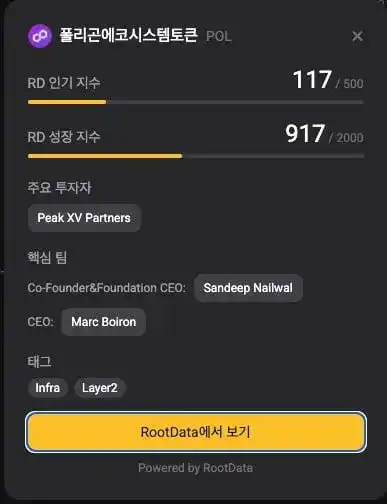
Through this data integration, Kimpga's market listing panel will add an "RD Score" for each token. Upon clicking the score, a window containing detailed project data will pop up, allowing users to intuitively view:
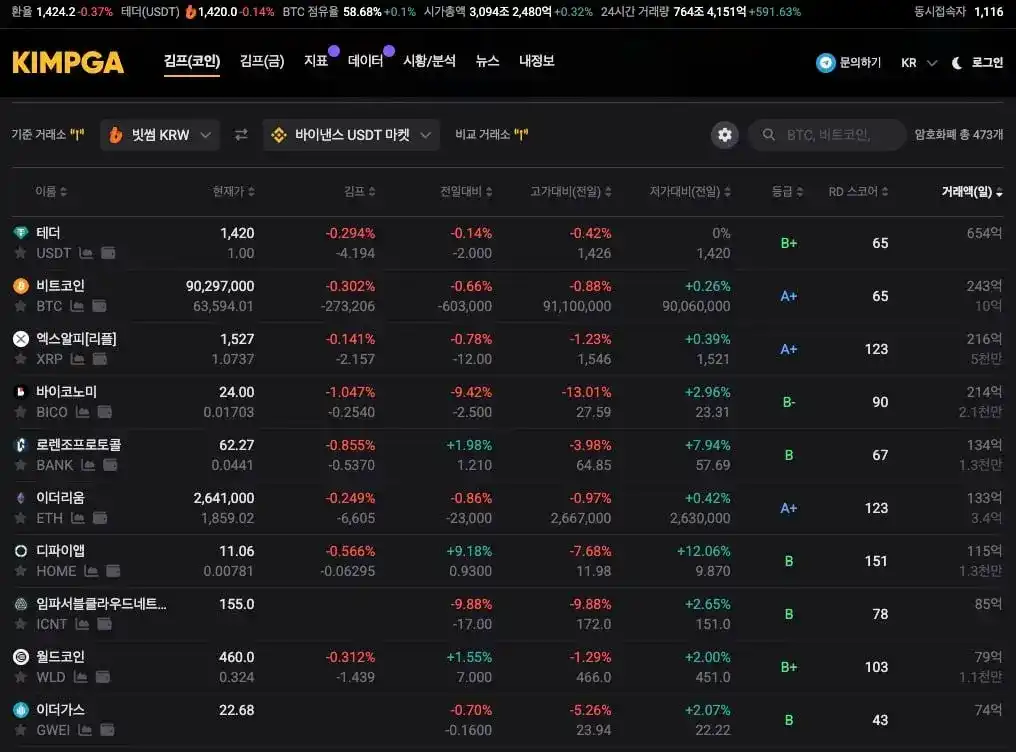
  • RD Popularity Index: An indicator quantifying market attention towards a project.

  • RD Growth Index: An indicator showcasing project development and growth trends.

  • Project Fundamental Data: Including key investment institutions, core team composition, project category tags, etc.

For example, with Solana (SOL), users can not only view its RD Popularity and Growth Indices but also directly confirm key investment institutions such as Polychain Capital, a16z (Andreessen Horowitz), Multicoin Capital, and co-founder information within the same interface. Each data item is linked to RootData's project detail page, facilitating deeper user research.
Enhancing Investment Decision Efficiency

Kimpga Representative Jin Jae-yong stated:

"With just real-time prices and premiums, it's difficult for investors to understand the development teams and investment lineup behind projects. By integrating RootData, users can quickly confirm a project's fundamental strength without switching or leaving the market interface."

RootData is a global platform providing Web3 project data such as fundraising history, team composition, and investment firm portfolios in a database format. It is widely used by global investors and researchers as a tool for project due diligence and investment analysis.

Continuously Strengthening Data Services

Previously, Kimpga had partnered with the token assessment rating platform APYWA to introduce token rating data. The official announcement states that following this integration with RootData, the platform has further complemented its existing market data and rating data layers with project fundamental information, providing stronger support for user investment decisions.

Currently, Kimpga has accumulated 10 million users and is a mainstream cryptocurrency market platform in Korea, providing real-time market data and premium data from over 18 major domestic and international exchanges.

Disclaimer: This article is based on market data and does not constitute investment advice for any specific cryptocurrency.


Criptomoedas em alta

Perguntas relacionadas

QWhat is the main collaboration announced between Kimpga and RootData?

AKimpga, a South Korean cryptocurrency market platform, has announced a data collaboration with the global Web3 project data platform RootData. This integration allows Kimpga to provide comprehensive project information and indices for various tokens directly within its platform.

QWhat are the two key RD (RootData) indices that Kimpga users can now access for each token?

AKimpga users can now access the RD Popularity Index, which quantifies market attention for a project, and the RD Growth Index, which illustrates the project's development and growth trends.

QAccording to Kimpga's representative, what problem does the integration with RootData help solve for investors?

AAccording to Kimpga representative Jin Jae-yong, relying solely on real-time prices and premiums makes it difficult for investors to understand the background of a project, such as its development team and investor lineup. The integration allows users to quickly confirm a project's fundamental strength without leaving the market interface.

QBesides RootData, which other data service has Kimpga previously partnered with to enhance its offerings?

APrior to the RootData collaboration, Kimpga had already partnered with the token assessment rating platform APYWA to introduce token rating data.

QWhat is Kimpga's current user base and its market position as described in the article?

AThe article states that Kimpga currently has a cumulative user base of 10 million people and is a mainstream cryptocurrency market platform in South Korea, providing real-time market and premium data from over 18 major domestic and international exchanges.

Leituras Relacionadas

Stunning, Musk Joins Forces with Huang Jen-hsun to Deploy the Stellar Brain! AI Computing Center Launched into Space

SpaceX, in its first public earnings report, has announced a partnership with NVIDIA to launch Starmind, an orbital AI computing network. This initiative aims to move AI's computational foundation into space to solve the critical challenges of energy consumption and heat dissipation faced by terrestrial data centers. The core concept involves deploying data centers equipped with NVIDIA's advanced GPUs (like the upcoming Rubin) into sun-synchronous orbit. Key advantages include near-continuous solar power for energy, the vacuum of space for highly efficient radiative cooling, and the absence of terrestrial constraints like land use and grid capacity. The first computational node, the Starmind AI1 satellite, is described as a massive vehicle with a 75-meter wingspan, generating 210 kW of solar power to run a 150 kW computing payload—equivalent to a full NVIDIA GB300 supercomputer rack. These "compute satellites" will connect to users via SpaceX's existing Starlink constellation using high-speed laser links, promising low-latency access from anywhere on Earth. SpaceX's ability to realize this vision is underpinned by its Starship rocket, designed for low-cost, high-frequency launches to transport thousands of satellites, and massive planned manufacturing facilities like the Gigasat factory and the Terafab chip plant. Elon Musk framed the project within the context of the Kardashev Scale, proposing Starmind as humanity's first substantive step toward becoming a Type II civilization capable of harnessing a star's energy. The ultimate goal is to deploy one terawatt of computational power in space, with even more ambitious plans involving lunar-based manufacturing and launch systems. The report positions Starmind not merely as a commercial AI service, but as a foundational infrastructure project to expand human intelligence and capability beyond Earth, leveraging SpaceX's integrated strengths in rockets, satellites, and global connectivity.

marsbitHá 53m

Stunning, Musk Joins Forces with Huang Jen-hsun to Deploy the Stellar Brain! AI Computing Center Launched into Space

marsbitHá 53m

Despite the sell-off, Goldman Sachs remains bullish on Samsung and SK Hynix. Here's why.

Goldman Sachs maintains "Buy" ratings on Samsung Electronics and SK Hynix despite recent stock declines. Its bullish view centers on three core arguments. Firstly, it expects HBM (High Bandwidth Memory) pricing to re-establish a premium over conventional DRAM by 2027, with a projected blended ASP of around $2.9/Gb. This is driven by tight supply-demand dynamics, increasing manufacturing complexity for newer HBM generations, and the need to restore its historical price premium. Secondly, the volatility of the memory cycle is expected to moderate due to widespread adoption of 3-5 year Long-Term Agreements (LTAs) with key customers. These contracts, covering a significant portion of planned capacity, feature mechanisms like price floors, prepayments, and penalties, reducing supplier risk and improving earnings visibility. Thirdly, inventory levels remain low at key suppliers and major customers, providing a buffer against a sharp downturn. Furthermore, robust demand from enterprise SSDs for AI servers is seen offsetting weakness in consumer segments like smartphones and PCs, preventing NAND markets from slipping into oversupply in the near term. While risks exist—such as potential weaker AI demand or aggressive capacity expansion—Goldman Sachs believes the combination of HBM repricing, LTAs, and low inventory underpins a more stable earnings outlook for the leading Korean memory makers.

marsbitHá 1h

Despite the sell-off, Goldman Sachs remains bullish on Samsung and SK Hynix. Here's why.

marsbitHá 1h

He Was the Hero of Shanghai's Two Major Industries, Yet Passed Away Quietly in Regret

He was a pivotal figure in the development of two major Shanghai industries—semiconductors and commercial aircraft—yet passed away in quiet regret. Jiang Shangzhou, son of a veteran revolutionary and a Swiss-educated technocrat, became Deputy Director of the Shanghai Economic Commission in 1997. Tasked with identifying strategic industries, he championed integrated circuits (ICs) despite a climate of skepticism. Countering a national plan for just two 8-inch chip production lines, he boldly declared Shanghai would build ten within five years. He masterminded the Zhangjiang microelectronics zone, personally recruited top talent like Morris Chang, and helped establish SMIC. Through innovative financing that circumvented Western embargoes, SMIC grew rapidly, with Shanghai exceeding its target by building 18 lines. Simultaneously, while battling lung cancer, Jiang led the push for China's large commercial aircraft program as head of a state major projects panel. He argued it was a strategic imperative that would drive advancements across multiple industries. His relentless advocacy culminated in the 2006 state approval that paved the way for the C919. Jiang's career was marked by foresight often deemed too超前. Earlier postings in Sanya and Yangpu saw his ideas for tourism and economic reform initially rejected, only to be validated years later. In 2009, he became Chairman of the embattled SMIC. Despite his deteriorating health, he steered the company until his death in 2011, leaving a final insight for the chip industry: China need not master every process but must lead in key areas. He did not live to see the C919 fly or SMIC's full recovery, but his foundational work made Shanghai a national leader in both semiconductors and aerospace. Colleagues remembered him as a visionary whose impact shaped the three decades that followed.

marsbitHá 1h

He Was the Hero of Shanghai's Two Major Industries, Yet Passed Away Quietly in Regret

marsbitHá 1h

Trading

Spot

Artigos em Destaque

Como comprar DATA

Bem-vindo à HTX.com!Tornámos a compra de DATA Network (DATA) simples e conveniente.Segue o nosso guia passo a passo para iniciar a tua jornada no mundo das criptos.Passo 1: cria a tua conta HTXUtiliza o teu e-mail ou número de telefone para te inscreveres numa conta gratuita na HTX.Desfruta de um processo de inscrição sem complicações e desbloqueia todas as funcionalidades.Obter a minha contaPasso 2: vai para Comprar Cripto e escolhe o teu método de pagamentoCartão de crédito/débito: usa o teu visa ou mastercard para comprar DATA Network (DATA) instantaneamente.Saldo: usa os fundos da tua conta HTX para transacionar sem problemas.Terceiros: adicionamos métodos de pagamento populares, como Google Pay e Apple Pay, para aumentar a conveniência.P2P: transaciona diretamente com outros utilizadores na HTX.Mercado de balcão (OTC): oferecemos serviços personalizados e taxas de câmbio competitivas para os traders.Passo 3: armazena teu DATA Network (DATA)Depois de comprar o teu DATA Network (DATA), armazena-o na tua conta HTX.Alternativamente, podes enviá-lo para outro lugar através de transferência blockchain ou usá-lo para transacionar outras criptomoedas.Passo 4: transaciona DATA Network (DATA)Transaciona facilmente DATA Network (DATA) no mercado à vista da HTX.Acede simplesmente à tua conta, seleciona o teu par de trading, executa as tuas transações e monitoriza em tempo real.Oferecemos uma experiência de fácil utilização tanto para principiantes como para traders experientes.

280 Visualizações TotaisPublicado em {updateTime}Atualizado em 2026.07.01

Como comprar DATA

Discussões

Bem-vindo à Comunidade HTX. Aqui, pode manter-se informado sobre os mais recentes desenvolvimentos da plataforma e obter acesso a análises profissionais de mercado. As opiniões dos utilizadores sobre o preço de DATA (DATA) são apresentadas abaixo.

活动图片