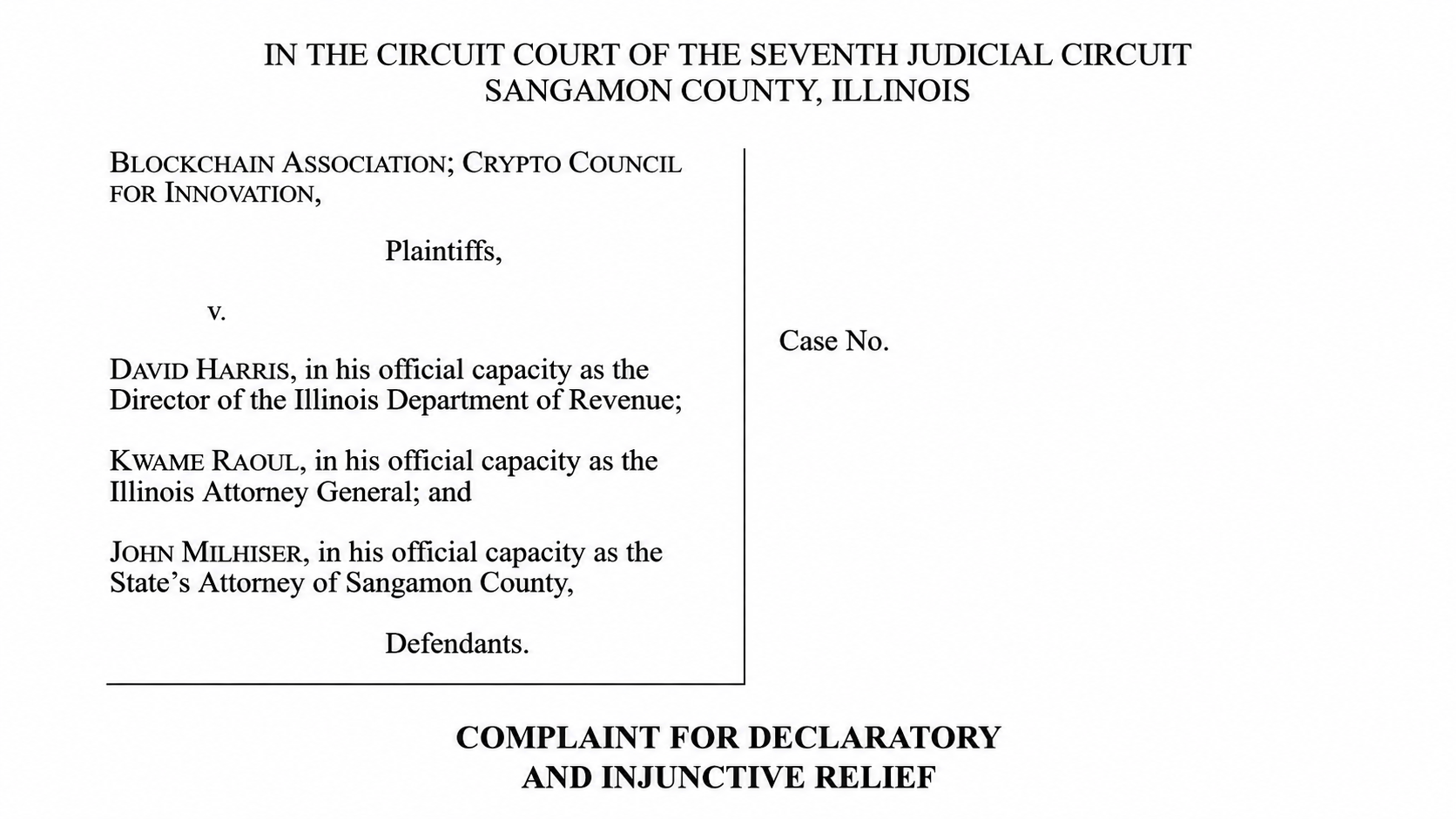
On August 21, the Blockchain Association and the Crypto Council for Innovation filed a lawsuit in the Sangamon County Circuit Court against Illinois Department of Revenue Director David Harris, Attorney General Kwame Raoul, and Sangamon County State's Attorney John Milhiser. They seek to have the Digital Asset Tax Act declared unlawful and to obtain a preliminary and permanent injunction to prevent it from taking effect.
Crypto Community Targets Unprecedented Tax
The dispute centers on how Illinois calculates the levy. Instead of taxing a customer's profit, the law imposes a 0.2% tax on the value of a digital asset when certain actions are taken through a digital asset intermediary. The lawsuit states that the tax could be triggered even when a customer "buys nothing, sells nothing, receives nothing, and transfers no ownership."
This means exchanging Bitcoin, moving it between accounts, or paying a storage service fee could incur the tax. The suit notes that Illinois previously treated digital assets much like other financial property for tax purposes: income or capital gains were potentially taxable, while the transactions or storage services themselves were generally not. That will change on January 1.
This discrepancy is at the heart of the case. Illinois does not levy a comparable transaction tax on those who buy stocks, transfer money between personal accounts, or store cash, gold, or securities at a bank or broker. The plaintiffs argue the state is effectively taxing the mechanisms used to hold or move value, not the economic transaction itself.
A Single Crypto Transaction Could Open a Taxation 'Pandora's Box'
The situation becomes more complex when a platform provides multiple services at once. Buying cryptocurrency might involve an exchange trade, crediting the customer's account, and subsequent storage on the platform. The lawsuit notes the law never clearly states whether this common sequence creates one, two, or three taxable events.
Storage presents another issue because it is continuous, not a one-time event. The suit notes Illinois never clarifies whether a year of storage is one taxable event, whether each billing period creates a new event, or whether a change in account balance triggers a new cycle. The answer could affect the size of tax bills "by orders of magnitude," according to the lawsuit.
The law also leaves the plaintiffs questioning how the taxable "value" of an asset is actually calculated. The lawsuit states the law nowhere specifies whether valuation occurs when an order is placed, when the intermediary executes it, or at the final settlement of the transaction.
Illinois Location Rules Leave Intermediaries 'Holding the Bag'
Determining whether a customer is actually located in Illinois creates another pitfall. Account data, mailing addresses, IP addresses, and other information can trigger a presumption that the customer is in the state. The intermediary must then prove otherwise, and the complaint notes conflicting data could force platforms to rely on guesswork.
This guesswork carries serious consequences. The lawsuit says intermediaries face civil and criminal penalties for non-compliance, while companies are already spending heavily on lawyers, tax consultants, and system modifications even before the law takes effect. The plaintiffs argue some firms may ultimately refuse to serve customers who might be in Illinois rather than risk criminal liability.
1,624-Page Bill Intensifies Constitutional Fight
These groups also challenge how the tax became law. Senate Bill 3019 began as a two-page document concerning agricultural funding, but amendments filed by May 31 transformed it into a sprawling 1,624-page package covering numerous topics. The Digital Asset Tax Act comprised less than 20 pages of the final bill. This latest lawsuit follows one initiated by The Digital Chamber against Illinois in July.
According to the suit, legislators notified the public of committee hearings roughly an hour before the bill was approved by both chambers within a 24-hour period. The plaintiffs argue this process violated Illinois' constitutional requirements, resulting in a law whose core obligations remain unclear despite being backed by criminal penalties.
The lawsuit also claims the tax violates the federal Internet Tax Freedom Act by discriminating against electronic commerce, contravenes the Dormant Commerce Clause, and infringes on state and federal due process guarantees. The organizations also cite provisions of Illinois' Uniformity Clause and raise claims concerning the legislative process. They argue any one of these flaws may be sufficient to overturn the law.
In the immediate term, the crucial question is whether Illinois can begin collecting the tax on January 1. The Blockchain Association and Crypto Council for Innovation want the court to block the tax before businesses are required to register and start collecting it, turning the next four months into a test of whether one state can impose a special tax on financial activity simply because it is conducted using digital assets.