Hyperliquid gains strength from 2 key areas: What this means for HYPE’s demand

ambcryptoPublicado em 2026-03-29Última atualização em 2026-03-29

Resumo

Recent on-chain activity indicates a shift in demand for Hyperliquid (HYPE), driven by significant whale accumulation and protocol buybacks. A whale deposited $4 million USDC and acquired over $2.1 million worth of HYPE, followed by a TWAP order targeting 99,000 tokens, signaling sustained buying that absorbed supply without major price disruption. This demand, coupled with ongoing token buybacks and a reduction of 37.5 million HYPE through burns, has tightened circulating supply (approx. 238.4 million of 962 million total), increasing price sensitivity to new demand. However, sustainability remains uncertain as buybacks rely on trading volume, and monthly distributions or whale selling could reintroduce supply. While deflation supports stability, lasting price strength depends on consistent demand and a shrinking float; fading activity may expose HYPE to downside pressure.

Recent on-chain activity shows a clear shift in how demand forms around Hyperliquid [HYPE]. A whale deposited $4 million USDC, then acquired about 56,208 HYPE worth roughly $2.1 million at $38.21.

As accumulation continued, a TWAP order targeted 99,000 HYPE over 10 hours, signaling sustained buying rather than a single entry. This steady execution absorbed supply while limiting price disruption.
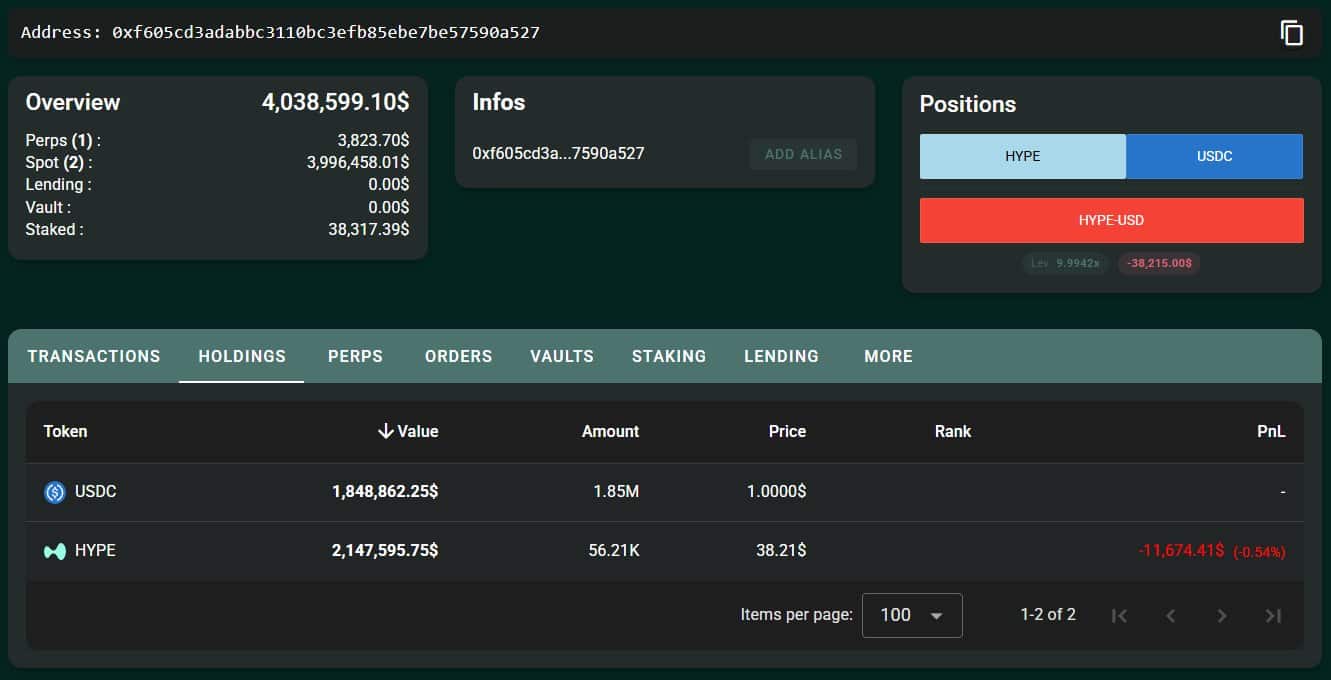
Source: X

This dual flow tightened supply while reinforcing support, especially as prices held above $40, despite prior $22 million selling pressure. As a result, HYPE increasingly behaved like a revenue-linked asset driven by usage rather than narrative momentum.

HYPE deflation grows, but float still controls price

This demand-driven setup now shifted attention toward how supply actually behaves in the market. Hyperliquid removed about 37.5 million HYPE through burns, while daily buybacks continue absorbing tokens.

As these flows persist, circulating supply was near 238.4 million out of a total of 962 million at press time, leaving a large portion locked or inactive. This matters because price responds to tradable float rather than headline reductions.

As buybacks move tokens into system addresses and long-term wallets, float tightens, increasing sensitivity to fresh demand. However, monthly distributions of about 1.2 million HYPE and whale selling during rallies reintroduce supply.

This interaction shows deflation supports price stability, yet sustained upside depends on whether float keeps shrinking while demand remains consistent.

Is HYPE demand durable or flow-driven?

Price strength now shifts attention from who is buying to whether that demand can actually hold. Recent support reflects structured inflows, yet the market now tests if this strength can persist without visible drivers.

This happens because protocol buybacks depend on trading volume, which keeps demand active only while activity remains elevated. As volumes stay strong, price holds firm; however, any slowdown quickly reduces this underlying support.

Controlled accumulation also signals intent, yet it does not confirm long-term holding, especially if buyers target short-term positioning. Markets often absorb such flows if broader demand fails to follow.

This creates a fragile balance, where sustained demand confirms strength, while fading activity exposes price to downside pressure once temporary support weakens.


Final Summary

  • Hyperliquid shows strong demand from buybacks and whale accumulation, yet sustainability depends on continued trading volume and follow-through demand.
  • HYPE’s outlook depends on shrinking float and sustained absorption, as fading activity or whale distribution could weaken support and limit upside.


Criptomoedas em alta

Perguntas relacionadas

QWhat recent whale activity indicates a shift in demand formation for Hyperliquid (HYPE)?

AA whale deposited $4 million USDC and then acquired approximately 56,208 HYPE worth about $2.1 million, followed by a TWAP order targeting 99,000 HYPE over 10 hours, signaling sustained buying rather than a single entry.

QHow has Hyperliquid's token supply been affected by its economic mechanisms?

AHyperliquid has removed about 37.5 million HYPE through token burns, and daily buybacks continue to absorb tokens. The circulating supply is approximately 238.4 million out of a total supply of 962 million, with a large portion locked or inactive.

QWhat is the relationship between HYPE's price and its tradable float?

AThe price of HYPE responds to the tradable float rather than the headline supply reduction. As buybacks move tokens into system addresses and long-term wallets, the float tightens, making the price more sensitive to new demand.

QWhat is the primary driver of the protocol's buyback mechanism, and what risk does this create?

AProtocol buybacks depend on trading volume. This creates a risk because demand remains active only while trading activity is elevated; any slowdown in volume quickly reduces this underlying buyback support.

QAccording to the article, what two factors are critical for HYPE's sustained price strength?

ASustained price strength depends on the float continuing to shrink while demand remains consistent. It is a fragile balance where fading activity or whale distribution could weaken support and limit upside.

Leituras Relacionadas

Global Stock Market's Storm Center: South Korea's Stock Market De-leveraging Is Largely Complete

Storm's Eye: South Korean Market De-leveraging Nears Completion The recent sharp correction in South Korean equities, with the KOSPI index dropping 32% from its June high, has been a key trigger for global tech stock volatility. The core driver was not a fundamental shift but a forced de-leveraging process within the market's unique structure, which is now largely complete. Two main leverage channels amplified the sell-off: 1. **Leveraged ETFs:** Their size, proportionally four times larger than in the U.S., peaked near $50 billion. Their mandatory daily rebalancing mechanism created a vicious cycle of "price drop → forced selling → further drop." Approximately 75% of this excess has been unwound, shrinking to $26 billion, with regulatory curbs now blocking new inflows. 2. **Hedge Fund Leverage:** Using swaps to magnify exposure, hedge funds saw their net long positioning fall by over 50% from peak levels. The most intense phase of this institutional de-leveraging is over. In contrast, **retail margin debt** poses minimal systemic risk. At 0.5% of market cap, it is far lower than in the U.S. or China, lacks automatic triggers, and is concentrated in smaller stocks. The conclusion: the high-leverage structures most prone to "chain-reaction selling" have been substantially cleared. The market is transitioning from a liquidity-driven crash to one priced more on fundamentals. The article argues that the AI trend—centered on Korean memory chips—remains intact. This episode represents a painful but necessary clearing of crowded trades, not the end of the AI revolution. For investors, the key question is conviction in the long-term AI direction; if the trend is real, current volatility is a cost of entry, not a terminal risk.

链捕手Há 51m

Global Stock Market's Storm Center: South Korea's Stock Market De-leveraging Is Largely Complete

链捕手Há 51m

The Eternal Fragments of Money: Third-Party Payment Has No First Principle

"The Enduring Fragments of Money: Third-Party Payments Lack a First Principle" Stripe is reportedly attempting to acquire PayPal, marking a significant shift reminiscent of PayPal's merger with the original X.com 30 years ago. The article analyzes Stripe's strategic challenges and the broader payments industry landscape. Despite its initial success with a developer-friendly API model, Stripe missed its optimal IPO window during the pandemic and has since seen its valuation decline. Its attempts to expand through acquisitions and new ventures, particularly in stablecoins (like its OUSD project) and Agent-focused payments (ACP/MPP protocols), have faced headwinds. The author argues that the payment industry remains highly fragmented and is ultimately an adjunct to the traditional banking system. This structure limits the potential for any single player, including Stripe, to achieve complete dominance. While stablecoins and the future rise of autonomous Agent economies present potential growth avenues, they are not yet mainstream and still require integration with the existing financial system. For now, Agent-based transactions are largely used for speculative "volume boosting" rather than substantive business applications. Stripe's current move to acquire PayPal is seen as an attempt to bolster its weak consumer-facing (C-side) business after its stablecoin-focused strategies faltered. Meanwhile, PayPal is described as structurally outdated, unable to revive itself through new products like Venmo or PYUSD. The future of payments may lie not in payments themselves but in value-added services like more efficient settlement networks. The author suggests that companies like Stripe and Circle, which are building their own blockchains (Tempo, Arc) and stablecoins, are positioning themselves to eventually profit from high-efficiency settlement systems. These new networks could potentially bypass some traditional banking layers. In conclusion, the article posits that third-party payment is a perpetually fragmented battlefield where scale alone cannot ensure victory. Players must find new models, focusing on efficiency to compete with the entrenched banking system. Stripe's acquisition of PayPal represents a bet on this uncertain future.

链捕手Há 1h

The Eternal Fragments of Money: Third-Party Payment Has No First Principle

链捕手Há 1h

Trading

Spot

Artigos em Destaque

Como comprar HYPE

Bem-vindo à HTX.com!Tornámos a compra de Hyperliquid (HYPE) simples e conveniente.Segue o nosso guia passo a passo para iniciar a tua jornada no mundo das criptos.Passo 1: cria a tua conta HTXUtiliza o teu e-mail ou número de telefone para te inscreveres numa conta gratuita na HTX.Desfruta de um processo de inscrição sem complicações e desbloqueia todas as funcionalidades.Obter a minha contaPasso 2: vai para Comprar Cripto e escolhe o teu método de pagamentoCartão de crédito/débito: usa o teu visa ou mastercard para comprar Hyperliquid (HYPE) instantaneamente.Saldo: usa os fundos da tua conta HTX para transacionar sem problemas.Terceiros: adicionamos métodos de pagamento populares, como Google Pay e Apple Pay, para aumentar a conveniência.P2P: transaciona diretamente com outros utilizadores na HTX.Mercado de balcão (OTC): oferecemos serviços personalizados e taxas de câmbio competitivas para os traders.Passo 3: armazena teu Hyperliquid (HYPE)Depois de comprar o teu Hyperliquid (HYPE), armazena-o na tua conta HTX.Alternativamente, podes enviá-lo para outro lugar através de transferência blockchain ou usá-lo para transacionar outras criptomoedas.Passo 4: transaciona Hyperliquid (HYPE)Transaciona facilmente Hyperliquid (HYPE) no mercado à vista da HTX.Acede simplesmente à tua conta, seleciona o teu par de trading, executa as tuas transações e monitoriza em tempo real.Oferecemos uma experiência de fácil utilização tanto para principiantes como para traders experientes.

331 Visualizações TotaisPublicado em {updateTime}Atualizado em 2026.06.02

Como comprar HYPE

Discussões

Bem-vindo à Comunidade HTX. Aqui, pode manter-se informado sobre os mais recentes desenvolvimentos da plataforma e obter acesso a análises profissionais de mercado. As opiniões dos utilizadores sobre o preço de HYPE (HYPE) são apresentadas abaixo.

活动图片











