Hyperliquid: Can a $2.3 mln whale buy drive HYPE to $50?

ambcryptoPublicado em 2026-04-10Última atualização em 2026-04-10

Resumo

Hyperliquid (HYPE) has been trading within an ascending channel, reaching a two-week high of $40.9 and currently priced at $40.4, with 4.7% daily and 14% weekly gains. A newly created whale wallet deposited $5 million into Hyperliquid and purchased 59.2k HYPE worth $2.3 million, with an additional $2.6 million in USDC likely for further purchases. This whale activity and rising long positions, reflected in a Long/Short Ratio of 1.41, indicate strong bullish sentiment. Technical indicators like the RSI at 63 and price holding above key moving averages support continued upward momentum, potentially targeting $50 if resistance at $43 is broken. However, profit-taking has been observed, with $4.9 million in positive netflow, which could trigger a pullback. Key support levels are at $37 and $35.

Hyperliquid [HYPE] has traded within an ascending channel since it held $35 a week ago, touching a two-week high of $40.9. As of this writing, HYPE traded at $40.4, up 4.7% on the daily charts, adding to its 14% weekly gains.

With market conditions turning suitable, whales have taken the opportunity to re-enter the market.

Hyperliquid whale adds $2.3 million worth of HYPE

Whales have continued to accumulate HYPE, especially as it shows strong upside momentum. According to Lookonchain, a newly created wallet deposited $5 million into HyperLiquid and began buying HYPE after it crossed the $40 mark.

So far, the whale has purchased 59.2k HYPE worth $2.3 million. Still, the account holds $2.6 million in USDC, likely to be used for more purchases. With HYPE holding above the entry price, the whale is already up $10k.

Usually, when whales enter the market during an uptrend, it signals confidence and helps defend higher levels.

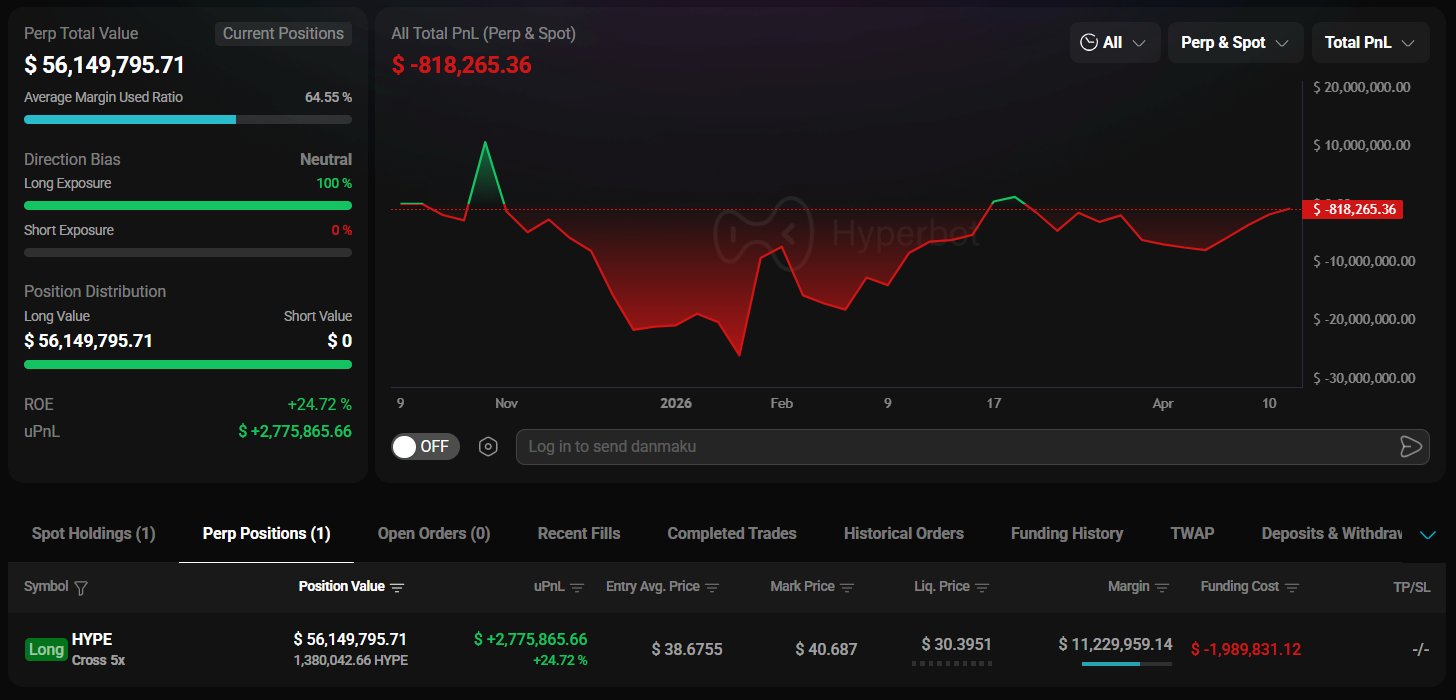
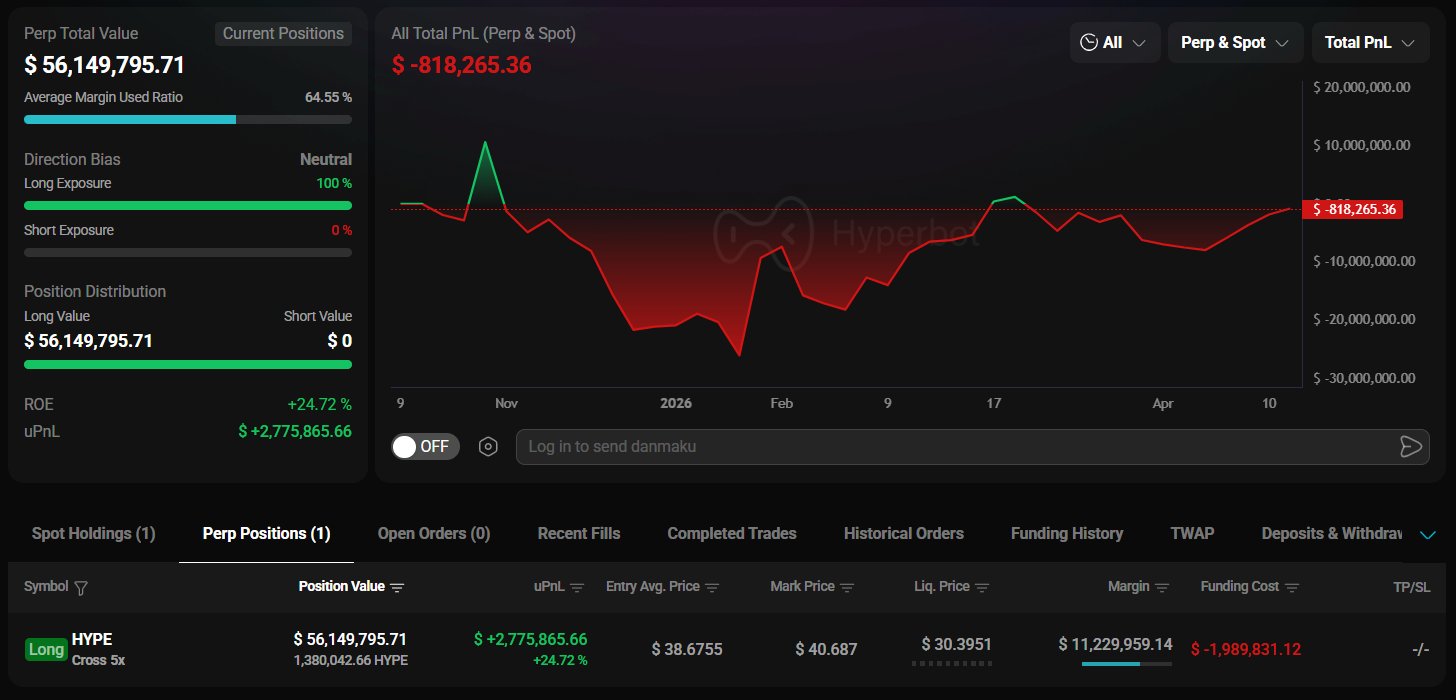
Coupled with that, whales have seen their profit margin surge amid the recent gains. Onchain Lens reported that a whale who held a 5x long position since the 6th of December 2025 is now erasing all losses.
Source: Onchain Lens

After HYPE dropped below $20, this whale saw his position go down by over $26 million. Despite the deep, the whale kept covering his position, losing $1.9 million in funding fees in the process.

However, with HYPE now trading above $40, the whale’s floating profit is over $2.77 million. Such determination to hold a losing position for five months showed confidence in the market.
Source: Coinalyze

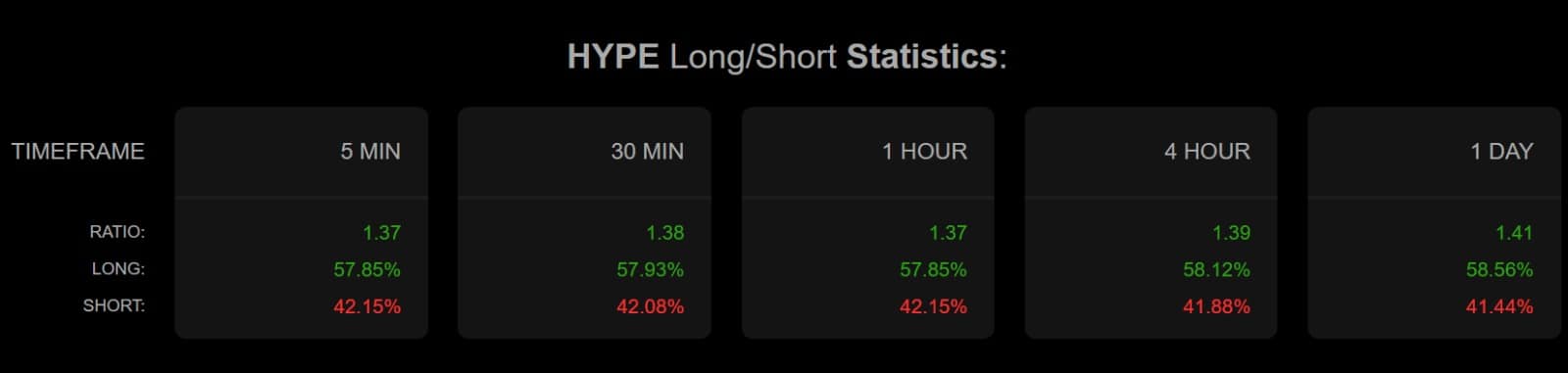
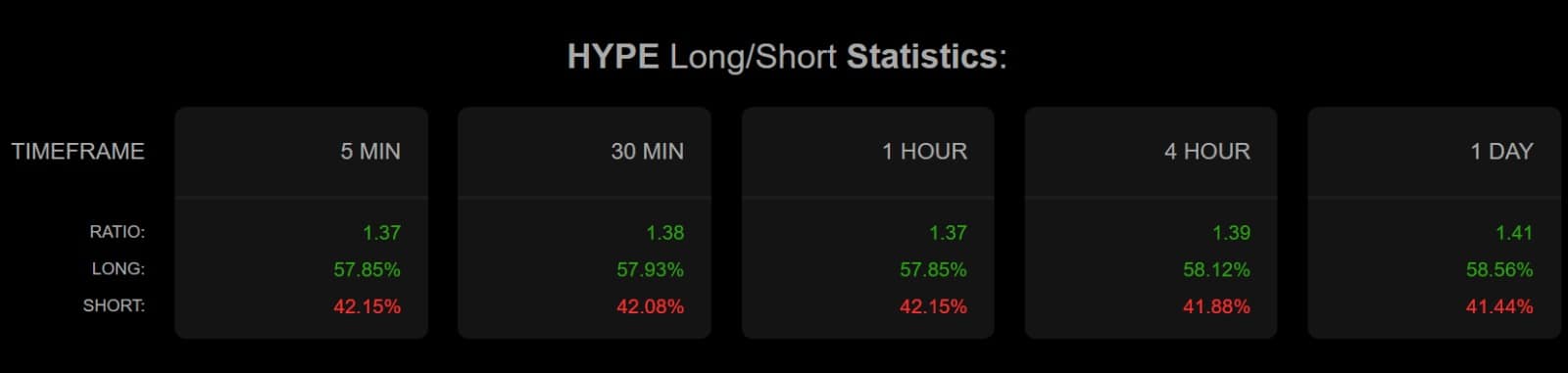
Besides this whale, the market has seen an influx in demand for long positions. Coinalyze data showed that the altcoin’s Long/Short Ratio rose to 1.41, with 58.5% of positions held by longs.

This implied that most market participants flipped bullish and deployed capital, betting on the prevailing trend’s continuation.

Historically, whale buying pressure on the spot and rising profitability in the perpetuals have boosted asset price action.

Is the demand sufficient to boost HYPE?

Hyperliquid showed bullish momentum amid rising market demand, especially driven by whales. The recent demand significantly strengthened the upside momentum.

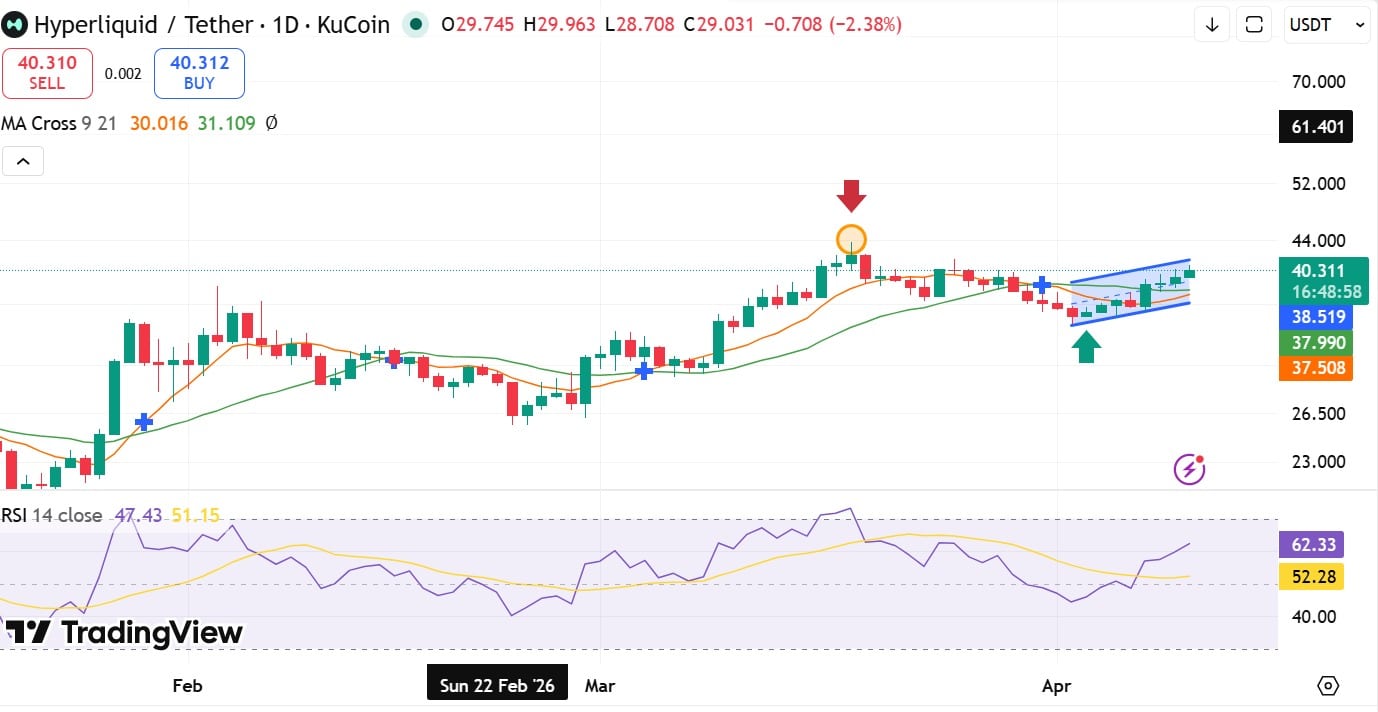
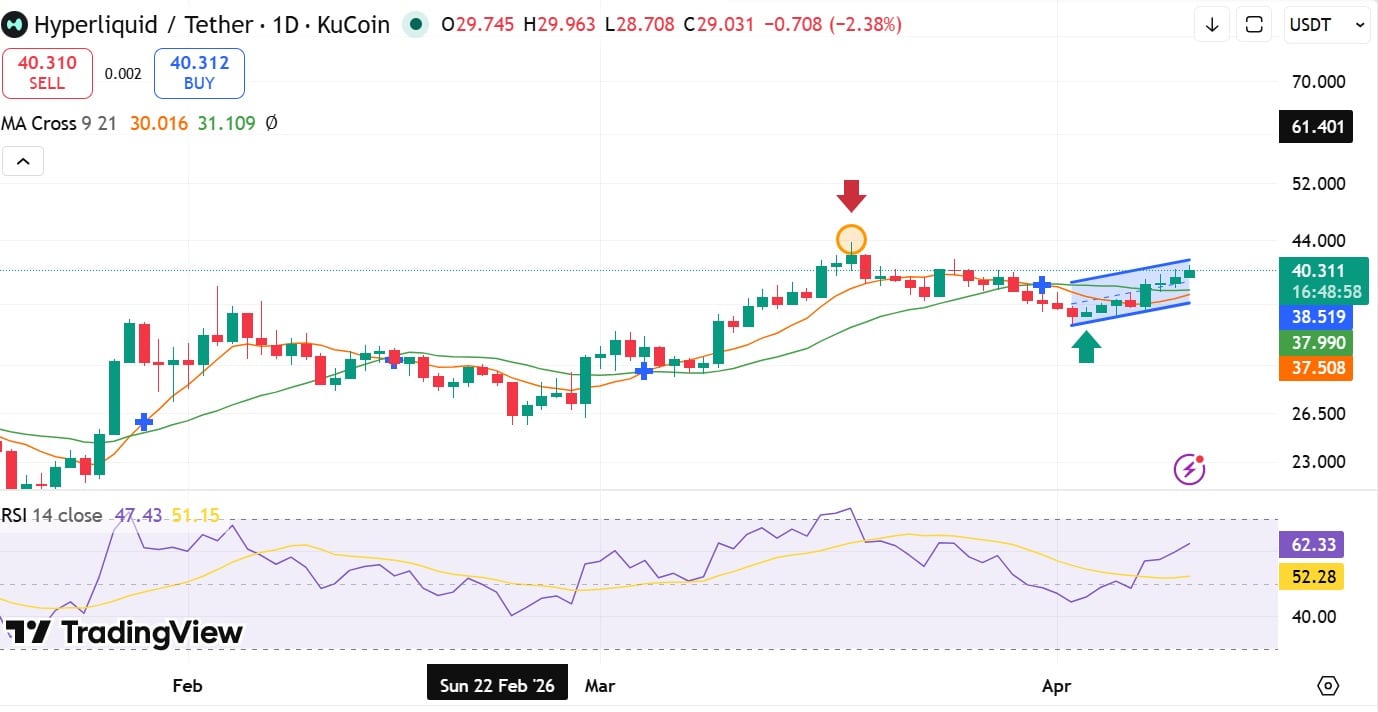
The altcoin’s Relative Strength Index (RSI) climbed to 63, remaining firmly within the bullish zone and indicating strong demand. At the same time, the altcoin held above the 9- and 21-day moving averages, reflecting a sustained upside momentum.
Source: Tradingview

Such market conditions point towards the likelihood of the trend’s continuation. If the momentum holds, HYPE will flip $43 resistance, where the uptrend previously collapsed, setting the ground for a move towards $50.

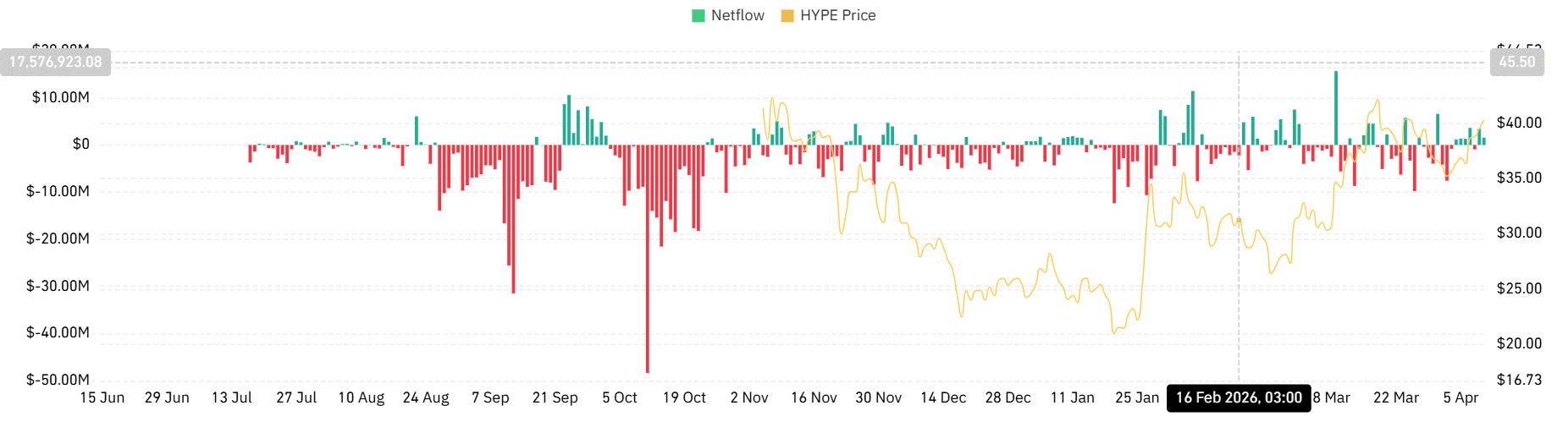
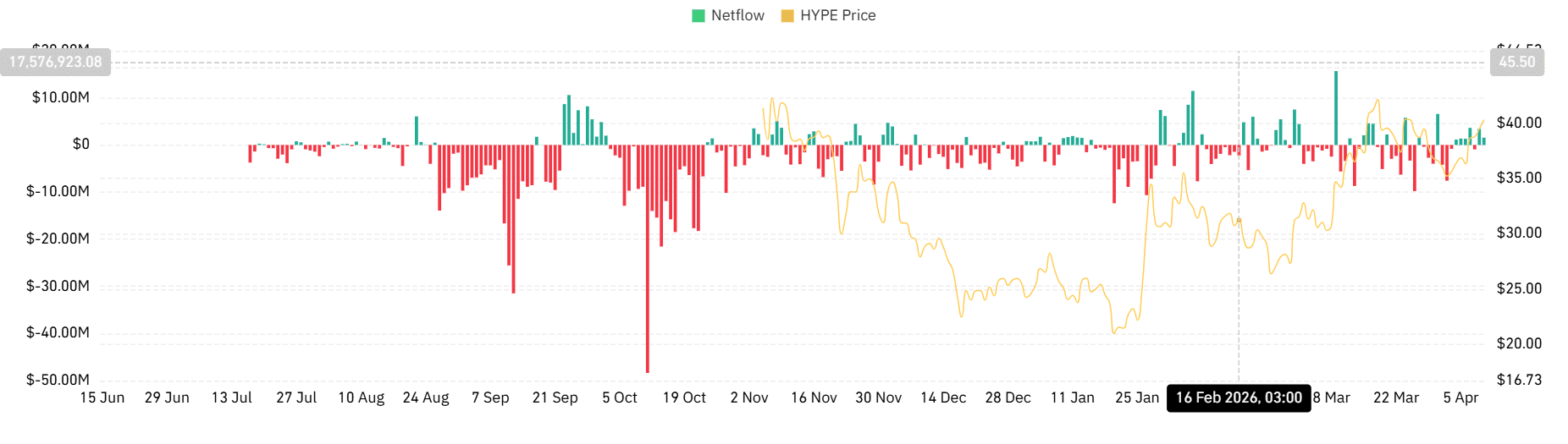
However, as HYPE crossed the $40 mark, investors who had been underwater showed greater determination to cash out at these levels. As such, the altcoin recorded positive Netflow on the 9th and 10th of April, totaling $4.9 million.
Source: CoinGlass

A positive Netflow suggested more sellers entered exchanges as prices pumped. Such profit-taking could derail the uptrend and trigger a pullback.

If profit-takers overwhelm demand, the 9- and 21-day moving averages at $37 will provide support, with $35 as a critical level.


Final Summary

  • A newly created whale wallet deposited $5 million on Hyperliquid and purchased 59.2k HYPE worth $2.3 million.
  • HYPE has traded within an ascending channel, touching a high of $40.9, but profit-taking could derail the rally.


Perguntas relacionadas

QWhat significant purchase did a whale make on Hyperliquid according to the article?

AA newly created whale wallet deposited $5 million into Hyperliquid and purchased 59.2k HYPE tokens worth $2.3 million, with an additional $2.6 million in USDC still available for potential future purchases.

QWhat is the current price and key resistance level for HYPE mentioned in the article?

AAs of the writing, HYPE was trading at $40.4. The key resistance level mentioned is $43, which is where the previous uptrend collapsed. A break above this could set the stage for a move towards $50.

QWhat on-chain metric suggests that most market participants are bullish on HYPE?

AThe Long/Short Ratio for HYPE rose to 1.41, with 58.5% of positions held by longs, indicating that a majority of traders are betting on the price increasing.

QWhat potential risk to the current uptrend does the article identify?

AThe article identifies profit-taking as a potential risk. It notes positive netflow of $4.9 million on April 9th and 10th, suggesting more sellers were moving tokens to exchanges to cash out, which could derail the uptrend and trigger a pullback.

QWhat technical indicators support the bullish momentum for HYPE?

AThe Relative Strength Index (RSI) climbed to 63, indicating strong bullish momentum. Additionally, the price was holding above the 9- and 21-day moving averages, further supporting a sustained upside trend.

Leituras Relacionadas

Is AI Creating a New Class of 'Information Poor'?

AI is generating a new kind of "information poverty." The core issue isn't that AI denies answers to the poor; it's that it provides abundant, cheap, and plausible-sounding answers to everyone. This availability shifts the true scarcity from obtaining answers to possessing the **judgment to evaluate them** and the access to turn them into real-world opportunities. New information poverty thus describes those who have AI tools and outputs, but lack the complementary skills, authorization, and contextual experience to critically assess and act on them. Research reveals a multi-layered divide: access to AI is stratified by income and platform design (e.g., premium vs. free, embedded tools). In workplaces, usage heavily favors higher-paid, more experienced, or formally trained employees, with AI often automating entry-level tasks that were traditional stepping stones. Crucially, the heaviest users are often mid-career professionals whose existing expertise allows them to effectively judge and leverage AI outputs, while novices risk over-relying on them without building judgment. While controlled experiments show AI can significantly boost low-skilled workers' performance, real-world adoption and benefit are constrained by unequal social and organizational structures. Historically, general-purpose technologies first reward those with existing complementary capital. AI, by affecting judgment-based work, may accelerate and deepen this initial inequality gap, even if it narrows over decades. The danger lies in the illusion of competence it creates, potentially stunting the very critical thinking needed in an era where judgment is paramount.

marsbitHá 5m

Is AI Creating a New Class of 'Information Poor'?

marsbitHá 5m

Jensen Huang 'Saves' South Korean Stock Market: Locks In SK Hynix Memory, Chip Shortage to Continue

On June 5th, South Korea's stock market experienced a sharp decline, with major chipmakers like Samsung and SK Hynix dropping nearly 10%. Amidst the turmoil, NVIDIA CEO Jensen Huang's visit to Seoul played a dramatic role in boosting market sentiment. Following a dinner meeting with SK Group Chairman Chey Tae-won and SK Hynix CEO Kwak Noh-Jung, Huang confirmed that NVIDIA's new Vera CPU will utilize SK Hynix DRAM. The companies announced a multi-year technical partnership to co-develop next-generation memory for NVIDIA's AI infrastructure, covering products from data centers to personal AI and robotics. This collaboration extends beyond memory supply. SK Hynix is integrating NVIDIA's AI and Omniverse platform into its own semiconductor design and manufacturing processes, including computational lithography and creating digital twins of its fabrication plants for autonomous operation. While strengthening ties with SK Hynix, NVIDIA is diversifying its supply chain for the upcoming HBM4 memory, with Samsung, SK Hynix, and Micron all certified as suppliers for its Vera Rubin platform. Despite this, Huang warned that the global chip shortage, driven by relentless demand from AI factory construction, is expected to persist for several years across the entire supply chain. His visit underscores NVIDIA's systematic effort to deepen integration with South Korea's broader tech industry.

marsbitHá 58m

Jensen Huang 'Saves' South Korean Stock Market: Locks In SK Hynix Memory, Chip Shortage to Continue

marsbitHá 58m

Nasdaq Plunges 4.2% in a Single Day: Does "Black Friday" Burst the U.S. Stock Market Bubble?

The Nasdaq plunged 4.18% on June 5, 2026, its worst single-day drop in over a year, as a much stronger-than-expected US jobs report triggered fears of economic overheating and delayed Federal Reserve interest rate cuts. The selloff, centered on high-valuation tech and AI stocks like Nvidia and Broadcom, spread across major indices. The article examines whether this signals a market top. The strong May non-farm payrolls data, nearly double expectations, pushed bond yields higher, directly hurting rate-sensitive tech stocks. This exposed vulnerabilities in the crowded AI trade, where valuations had soared on narratives of infinite growth, despite emerging signs of slowing order momentum and corporate AI monetization challenges. Prior to the drop, market indicators flashed warning signs: historically high valuations (e.g., Shiller CAPE ratio near 39.5), extreme bullish sentiment, and high levels of leverage. Technical charts showed key support levels being breached. Wall Street is divided on the outlook. Bears, citing risks of "stagflation" and AI bubble comparisons to the dot-com era, warn of a potential significant correction. Bulls view the drop as a healthy correction within a bull market, underpinned by a strong economy and expected corporate earnings growth of around 7% in 2026. The immediate future hinges on upcoming key events: the May CPI inflation data and the mid-June FOMC meeting. Their outcomes will critically shape market expectations for the Fed's rate path. The article concludes that conditions for a major market top are aligning, marking a fragile transition from narrative-driven gains to a phase demanding validation from macroeconomic data and corporate fundamentals. Caution is advised.

marsbitHá 1h

Nasdaq Plunges 4.2% in a Single Day: Does "Black Friday" Burst the U.S. Stock Market Bubble?

marsbitHá 1h

Nasdaq Plunges 4.2% in a Single Day, Did 'Black Friday' Pop the U.S. Stock Bubble?

The Nasdaq Composite plummeted 4.18% on June 5, its biggest single-day drop since April 2025, triggering widespread debate over whether the U.S. stock market has peaked. The sell-off was sparked by a stronger-than-expected U.S. non-farm payrolls report, which fueled fears of economic overheating and pushed back market expectations for Federal Reserve rate cuts, leading to a sharp rise in Treasury yields. The AI sector, the primary driver of the recent bull market, suffered severe losses, with the Philadelphia Semiconductor Index crashing over 10%. Stocks like Nvidia, Broadcom, and Micron led the decline. Concerns are mounting about the sustainability of AI capital expenditures and high valuations, with signs of order cuts for next-generation chips emerging. Analyses point to several warning signs: historically high market valuations (e.g., elevated Shiller CAPE ratio, Buffett Indicator), extreme bullish sentiment indicators, and significant insider selling. The sell-off also caused a key technical breakdown, with the S&P 500 breaking below its short-term moving average and testing its 200-day moving average. Wall Street is divided on the outlook. Bears warn this could be the start of a bubble deflation or a "stagflation" scenario, while bulls view it as a healthy, overdue correction within a bull market driven by solid corporate earnings growth. A more moderate view suggests the easy liquidity-driven rally is over, and markets are entering a phase of fundamental stock-picking with potential for consolidation. The immediate future hinges on key upcoming events: the May CPI report and the mid-June FOMC meeting. Their outcomes will be critical in determining whether this is a temporary pullback or the beginning of a more significant trend reversal. The consensus is that the era of one-directional market gains may be ending, requiring increased investor caution.

Odaily星球日报Há 1h

Nasdaq Plunges 4.2% in a Single Day, Did 'Black Friday' Pop the U.S. Stock Bubble?

Odaily星球日报Há 1h

The First Case on AI Agents: What Was Adjudicated?

"The First 'Agent' Ruling: What Was Decided?" On April 30, the Guangzhou Internet Court issued a ruling—China's first behavior preservation order in the intelligent agent (AI agent) field. The defendant, an open-source AI agent software, was ordered to stop downloads, cease actions that bypassed a platform's technical protection measures, and delete related tutorials and data. The core issue: the software used the operating system's "accessibility service" permissions to automate user interactions within other apps without those platforms' authorization. This mirrors a recent US case where Amazon sued Perplexity for similar reasons—bypassing Amazon's API to directly scrape and interact with its pages—and won a preliminary injunction. Both rulings establish a crucial legal boundary for the AI agent era: agents cannot operate unchecked. The article argues the fundamental legal principle emerging is one of **dual authorization**. An AI agent requires both **user consent** AND **platform consent** to operate legitimately within that platform's ecosystem. Bypassing platform rules through system-level permissions, even with user permission, undermines platform responsibilities for content moderation, data security, and user privacy, creating liability issues. The piece uses the evolution of "Doubao Phone" (an AI-integrated smartphone) as a case study. Its initial, aggressive version that bypassed platform controls faced roadblocks. Its upcoming 2.0 version is reportedly pivoting to negotiate API access and authorization deals with major platforms (like Alibaba's ecosystem), seen as a strategic adaptation to the new regulatory reality. A global trend is identified: the era of unregulated, "wild west" growth for AI agents is ending, replaced by a **compliance race**. This raises barriers to entry, as securing platform authorizations becomes a new cost. Open-source status is also not a legal shield if the code facilitates bypassing technical protections. In conclusion, these first rulings target not the largest, but the most **aggressive and representative** cases. By setting precedent with them, regulators are efficiently steering the entire industry towards a new, more regulated operating paradigm defined by dual authorization and platform cooperation.

marsbitHá 1h

The First Case on AI Agents: What Was Adjudicated?

marsbitHá 1h

Trading

Spot
Futuros

Artigos em Destaque

Como comprar HYPE

Bem-vindo à HTX.com!Tornámos a compra de Hyperliquid (HYPE) simples e conveniente.Segue o nosso guia passo a passo para iniciar a tua jornada no mundo das criptos.Passo 1: cria a tua conta HTXUtiliza o teu e-mail ou número de telefone para te inscreveres numa conta gratuita na HTX.Desfruta de um processo de inscrição sem complicações e desbloqueia todas as funcionalidades.Obter a minha contaPasso 2: vai para Comprar Cripto e escolhe o teu método de pagamentoCartão de crédito/débito: usa o teu visa ou mastercard para comprar Hyperliquid (HYPE) instantaneamente.Saldo: usa os fundos da tua conta HTX para transacionar sem problemas.Terceiros: adicionamos métodos de pagamento populares, como Google Pay e Apple Pay, para aumentar a conveniência.P2P: transaciona diretamente com outros utilizadores na HTX.Mercado de balcão (OTC): oferecemos serviços personalizados e taxas de câmbio competitivas para os traders.Passo 3: armazena teu Hyperliquid (HYPE)Depois de comprar o teu Hyperliquid (HYPE), armazena-o na tua conta HTX.Alternativamente, podes enviá-lo para outro lugar através de transferência blockchain ou usá-lo para transacionar outras criptomoedas.Passo 4: transaciona Hyperliquid (HYPE)Transaciona facilmente Hyperliquid (HYPE) no mercado à vista da HTX.Acede simplesmente à tua conta, seleciona o teu par de trading, executa as tuas transações e monitoriza em tempo real.Oferecemos uma experiência de fácil utilização tanto para principiantes como para traders experientes.

296 Visualizações TotaisPublicado em {updateTime}Atualizado em 2026.06.02

Como comprar HYPE

Discussões

Bem-vindo à Comunidade HTX. Aqui, pode manter-se informado sobre os mais recentes desenvolvimentos da plataforma e obter acesso a análises profissionais de mercado. As opiniões dos utilizadores sobre o preço de HYPE (HYPE) são apresentadas abaixo.

活动图片












