Huawei Cloud Rejects Token Price War, Zhou Yuefeng Seeks a New Winning Formula for AI Cloud

marsbitPublicado em 2026-06-06Última atualização em 2026-06-06

Resumo

At the 2026 Huawei Cloud INSPIRE Creator Conference, CEO Zhou Yuefeng outlined Huawei Cloud's distinct strategy in the competitive AI cloud market. Instead of engaging in price wars based on token volume or Maas revenue—a common focus for rivals like Alibaba Cloud and ByteDance's Volcano Engine—Huawei Cloud is shifting the competition towards real-world productivity gains. Zhou highlighted three core differentiators: a fully domestic computing stack (Ascend, Kunpeng), a focus on government and enterprise clients rather than consumer internet, and a deep commitment to open-source ecosystems. To this end, Huawei Cloud launched a suite of new products under the "Agentic Infra" paradigm, including the AICS Lingqu computing cluster, AMS memory storage, and the ModelArts Next platform. These aim to solve enterprise challenges in deploying AI agents, such as latency, memory, scheduling, and security. The strategy further involves creating specialized industry zones ("AI Dream Factories") for sectors like healthcare and embodied intelligence. For example, a smart medical zone developed with Shanghai Ruijin Hospital aims to democratize expert-level diagnostic capabilities. In essence, Huawei Cloud is positioning itself not as a commodity token provider, but as the foundational infrastructure for industrial AI, leveraging its domestic supply chain and hybrid cloud solutions to serve sectors where productivity, not just scale, is the ultimate measure of value.

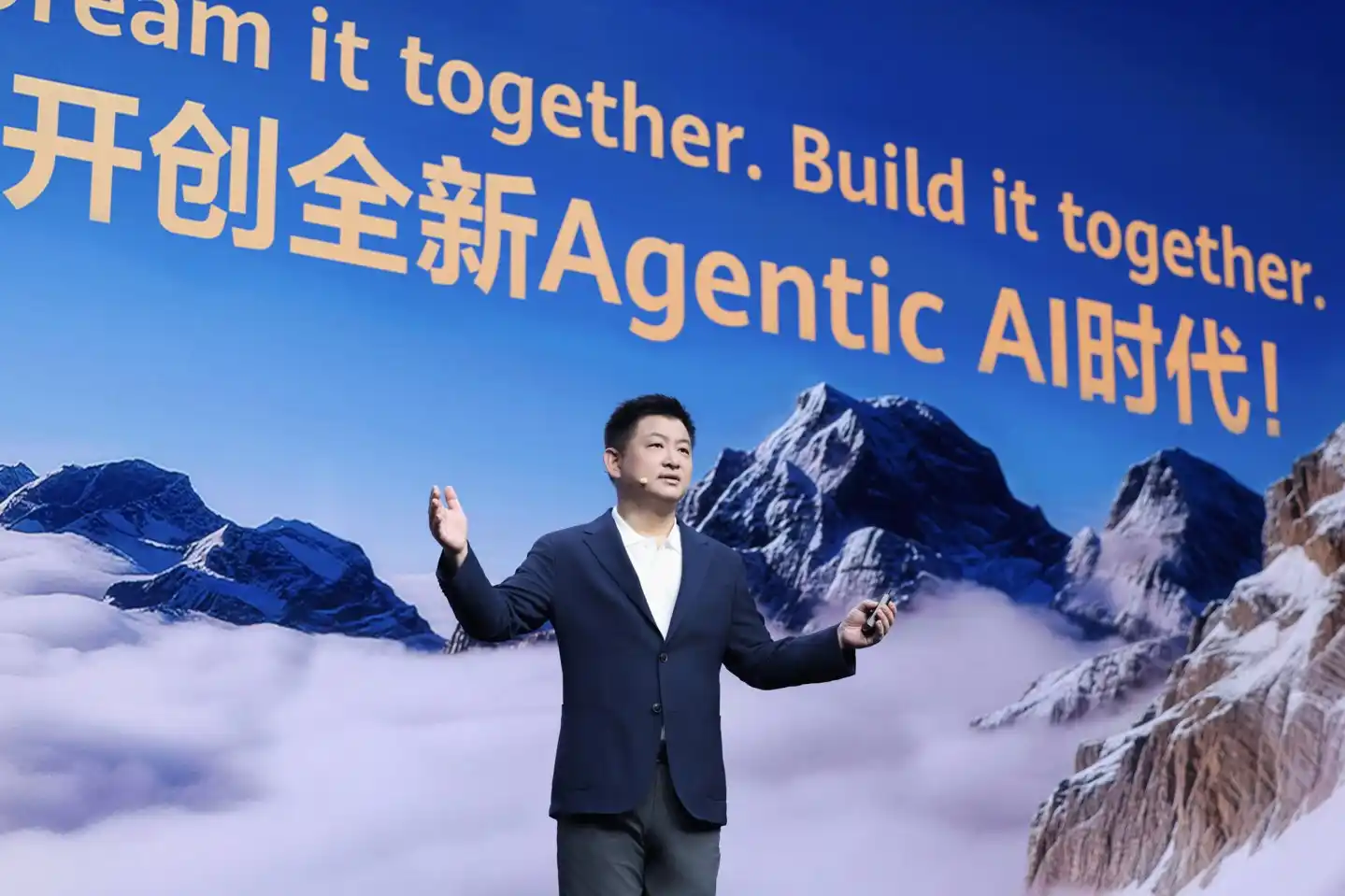
"I don't care much about the total amount of Tokens, nor do I care much about the total revenue." At the Huawei Cloud INSPIRE Creator Conference held on June 5, 2026, Zhou Yuefeng, Director of Huawei and CEO of Huawei Cloud, gave his first media interview since taking office, clearly and unequivocally conveying the current strategic focus of Huawei Cloud.

This is a rare statement in the current Chinese AI cloud market.

Over the past six months, cloud vendors represented by Alibaba Cloud and Volcano Engine have continuously emphasized the narrative of AI cloud, using daily Token call volume and MaaS revenue scale as new growth anchors. Even large model vendors like MoonShot AI, DeepSeek, and Zhipu have repeatedly lowered inference prices. The industry's key focus has been model call volume and scale.

Huawei Cloud is choosing a different way to enter this crowded battlefield. Huawei Cloud released its most intensive batch of new products oriented towards AI since last year in one go: AICS Lingqu Intelligent Computing Cluster, AMS Agentic Memory Storage, CCE Volcano Next - Integrated General-Purpose & AI Scheduling Engine, AgentSphere Secure Autonomous Operation Foundation, as well as ModelArts Next, the enterprise-grade intelligent agent platform AgentArts (open-source version openJiuwen), and collectively proposed a new "Agentic Infra" paradigm.

The KPI Zhou Yuefeng defined for Huawei Cloud is not Token count, but "whether each Token truly enhances productivity." During the window period of limited domestic computing power supply and a reshaping business model, Huawei Cloud has extracted itself from the "competition for second place in the AI cloud" race.
Not Competing on Token Scale

Zhou Yuefeng, at the press meeting, made a rare direct response regarding the differences with Alibaba Cloud and Volcano Engine. He said Huawei Cloud differs from other cloud vendors for three reasons.

First, the computing power route is different. Huawei Cloud uses an entirely domestically developed computing power hardware and software system, including Ascend, Kunpeng, CANN, Euler, etc. This path is more challenging because Huawei cannot use others' computing power; it can only turn domestic solutions into an industry-grade answer.

Consequently, Huawei Cloud must build a second computing plane, offering another ecological choice alongside the globally dominant path formed by NVIDIA + mainstream public clouds. Huawei Cloud cannot and does not intend to use hardware from "all nations" to compete with peers on computing power scale. Zhou Yuefeng said, "I am not willing to compare revenue or scale rankings with other cloud companies, it's meaningless."

Second, the commercial focus is different. Internet-based cloud vendors naturally rely on C-end traffic and developer ecosystems, whereas Huawei Cloud places its main focus on government & enterprise sectors and industries vital to the national economy and people's livelihood. For example, Huawei Hybrid Cloud has held the top market share in government, finance, and central & state-owned enterprises for multiple consecutive years, serving over 5,500 customers globally.

Zhou Yuefeng stated that the iteration speed of models and computing power is too fast; models could become outdated soon after deployment. Therefore, he advises that government and enterprise clients should not build their own 10,000-card clusters. Instead, they should combine local data with remote public cloud AI computing power/model services, leveraging technologies like confidential inference, confidential training, and confidential computing to balance data sovereignty and computing power sharing. Essentially, this delivers the iteration benefits of the public cloud to clients who cannot fully migrate to the public cloud.

Third, the ecosystem approach is different. Huawei Cloud has embraced open-source quite thoroughly: Ascend CANN, Euler operating system, CCE Volcano scheduling, and the ModelArts toolchain are all open-source. The open-source version of the intelligent agent platform AgentArts, openJiuwen, shares over 90% codebase commonality with its commercial version.

The conference also jointly launched the "Hundred Models, Thousand Forms, Gather on Cloud for Win-Win" plan with over 20 leading model vendors including Zhipu, DeepSeek, MiniMax, Kimi, StepFun, Baidu, Meituan LongCat, iFLYTEK Spark, etc.

When domestic computing power is still limited in capability and supply, expanding the ecosystem and increasing model choices is the way to solidify the second computing plane.

Agentic Infra: Shifting the Battlefield from Selling Tokens to Selling Productivity

If the computing power route determines what Huawei Cloud "does not fight," then Agentic Infra determines what it "wants to fight."

Zhou Yuefeng presented a judgment on the evolution of the AI industry: four years ago, doing AI meant buying computing power cards; three years ago, it was training large models; this year, it is using intelligent agents. Computing power and models are receding to the background, while intelligent agents are stepping to the forefront.

The competitive focus of AI cloud is shifting from Token throughput to whether intelligent agents can truly run effectively within enterprises.

Huawei Cloud's product matrix is also realigned according to this judgment. The "four components" of Agentic Infra — efficient Token factory, continuous learning, integrated general-purpose & AI scheduling, and secure autonomy — each address critical engineering challenges enterprises face when deploying intelligent agents.

AICS Lingqu reduces the Token latency for a 100,000-card cluster to under 10 milliseconds; AMS provides petabyte-level memory space via NPU-direct CMS, solving the Agent's long-term task memory bottleneck; CCE Volcano Next improves resource utilization by over 30% through shared training and inference pools; AgentSphere achieves 100-millisecond-level startup and hundreds of thousands of batch creations per minute with its lightweight sandbox.

ModelArts Next restructures the MaaS playbook. Its model routing supports cost-priority, effect-priority, and balanced strategies, already integrated with over 15 SOTA models, achieving scheduling accuracy over 95%, and reducing average calling costs by 20%.

But Huawei Cloud's truly differentiated bet lies in the industry zones. At this conference, Huawei Cloud launched four "Industry AI Dream Factory" zones at once: Smart Healthcare, Embodied AI, Smart Manufacturing, and Scientific Computing.

The Smart Healthcare zone, co-developed with Shanghai Ruijin Hospital, features the RuiPath large model. Over 20 hospitals including Handan, Rui'an, Qianxinan, and Wu'an, ranging from top-tier to municipal and county-level, have collectively joined. This marks the first time that capabilities like pathological diagnosis, highly dependent on expert experience, are being delivered as a "cloud service" to county-level hospitals at scale.

The Embodied AI zone launched the world's first full-process embodied AI development platform, CloudRobo, aiming to meet the full-link toolchain demands of over 300 embodied AI startups in China.

Zhou Yuefeng stated that healthcare and finance are the most mature and data-rich industries in China's digitalization, "If AI cannot succeed in these industries, it will be even harder in others." In these fields, the yardstick for measuring AI value should not be daily active users or Token counts, but rather the proportion of financial risk prevention, the improvement in credit efficiency, the probability of accurate diagnoses for remote patients.

Connecting these threads, the strategic outline of Huawei Cloud becomes clear: using a domestically developed computing power + open-source ecosystem as the foundation; covering government and enterprise sectors with hybrid cloud + confidential computing; and shifting the competition from "selling Tokens" to "selling productivity" through Agentic Infra + industry zones.

This path is much slower than chasing MaaS revenue and harder to present attractive year-on-year data, but it circumvents the current intense price war in the AI cloud. It bets on a market not yet priced: who can secure the underlying infrastructure position when intelligent agents truly enter the industry.

On the AI cloud track, Huawei Cloud can only adopt a different solution. Zhou Yuefeng concluded, "I cannot build a silicon-based 'black land' made of hardware from all nations." While other cloud vendors compare whose Tokens offer higher cost-performance, Huawei Cloud is striving to see if this domestic computing power system can meet the real future needs of China's industrial AI.(Author | Zhang Shuai, Editor | Yang Lin)


Criptomoedas em alta

Perguntas relacionadas

QAccording to the article, what is Huawei Cloud's strategic focus, and how does it differ from other major AI cloud providers in China?

AHuawei Cloud's strategic focus is not on maximizing token volume or revenue, but on ensuring that 'every token truly enhances productivity.' This contrasts with other major Chinese AI cloud providers like Alibaba Cloud and Volcano Engine, who emphasize daily token calls and MaaS revenue scale as key growth metrics and engage in intense price competition on inference costs.

QWhat are the three key reasons CEO Zhou Yuefeng gives for Huawei Cloud's different approach compared to other cloud companies?

AZhou Yuefeng cites three reasons: 1. Different compute path: Huawei Cloud relies entirely on a domestic R&D system (Ascend, Kunpeng, CANN, Euler), creating a 'second compute plane' distinct from the dominant NVIDIA path. 2. Different commercial focus: Huawei Cloud heavily targets government and enterprise (G/ICT) and key national industries, rather than relying on consumer internet traffic. 3. Different ecosystem strategy: Huawei Cloud employs a thorough open-source approach for its core technologies and collaborates broadly with model vendors through initiatives like the 'Hundred Models, Thousand Forms' plan.

QWhat is 'Agentic Infra,' and what role does it play in Huawei Cloud's strategy for the AI cloud market?

A'Agentic Infra' (Agentic Infrastructure) is a new paradigm introduced by Huawei Cloud. It represents a shift in the AI cloud competition focus from token throughput to enabling agents to operate effectively within enterprises. It consists of a 'four-piece suite' addressing key engineering challenges: efficient token factories (AICS), continuous learning/memory (AMS), integrated scheduling for training and inference (CCE Volcano Next), and secure autonomous operation (AgentSphere). This moves the battlefield from 'selling tokens' to 'selling productivity.'

QWhat are 'Industry AI Dream Factory' zones, and can you name two specific examples mentioned in the article?

A'Industry AI Dream Factory' zones are specialized platforms launched by Huawei Cloud to provide AI solutions and tools tailored to specific vertical industries. Two examples mentioned are: 1. The Smart Healthcare Zone, which features the RuiPath large model co-developed with Shanghai Ruijin Hospital and serves over 20 hospitals. 2. The Embodied Intelligence Zone, which introduced CloudRobo, a full-process development platform aimed at serving over 300 embodied AI startups in China.

QHow does Huawei Cloud propose to serve government and enterprise clients who cannot fully migrate to the public cloud, according to Zhou Yuefeng?

AZhou Yuefeng suggests a hybrid approach for such clients. He advises against them building large-scale AI clusters themselves due to the rapid iteration of models and compute. Instead, he recommends keeping data locally while leveraging remote public cloud AI compute/model services. This is combined with technologies like confidential inference, training, and computing to balance data sovereignty with access to shared compute power. This model essentially delivers the iteration benefits of the public cloud to clients with stricter data requirements.

Leituras Relacionadas

Just now, DeepSeek V4 updates with DSpark, improving inference speed by 80%

DeepSeek has updated its DeepSeek V4 model with the DSpark speculative decoding framework, achieving a significant 60-85% speedup in generation for Flash models and 57-78% for Pro models while maintaining the same overall throughput. This engineering-focused update, rather than a core architectural change, introduces DSpark to address latency and throughput bottlenecks in high-concurrency production environments. DSpark combines high-throughput parallel generation with adaptive load-aware verification. Its key innovations include a semi-autoregressive generation architecture to model dependencies within token blocks and a hardware-aware confidence-scheduled verification system. This system uses a confidence head to predict token acceptance probabilities, allowing it to dynamically optimize verification length per request and allocate compute only to tokens with the highest expected payoff. The asynchronous scheduler is designed for real-world deployment, ensuring zero-overhead scheduling and continuous CUDA graph replay while preserving the target model's output distribution. In tests across mathematical reasoning, code generation, and daily dialogue, DSpark outperformed state-of-the-art models like Eagle3 and DFlash, increasing average acceptance length by 26.7%-30.9% and 16.3%-18.4% respectively on Qwen3 target models. DeepSeek also open-sourced DeepSpec, a full-stack codebase for training and evaluating speculative decoding draft models, providing a standardized toolkit that includes data preparation tools, model implementations, training code, and evaluation scripts.

marsbitHá 3h

Just now, DeepSeek V4 updates with DSpark, improving inference speed by 80%

marsbitHá 3h

BIT Research: The 2028 Halving Is Not the End, the Real Shake-Up of the Bitcoin Mining Industry Is Just Beginning

The Bitcoin mining industry is undergoing its most complex structural adjustment since inception. Despite Bitcoin's price holding near $61,000 and the network hash rate approaching a record 1 ZH/s, miner profitability is deteriorating. The industry is operating close to its breakeven point, with the 2028 halving expected to accelerate consolidation. The challenges extend beyond the halving's subsidy reduction; the industry's revenue model has yet to successfully transition towards a fee-driven structure. Increasingly, mining companies are evolving from simple Bitcoin producers into infrastructure and energy operators, including providers of AI/HPC computing power. Competition is shifting from pure hash rate expansion to business model upgrades. Economic pressure is evident. The theoretical daily mining revenue at current prices is around $78 million, yet the actual figure is only about $33 million—a 136% gap. Transaction fees remain low at roughly $220k daily, far below historical implied levels. With a current estimated industry-wide breakeven price near $65,000, mining alone is struggling to generate ideal profits. The 2028 halving is projected to push the fundamental production cost floor to approximately $93,289. This will likely accelerate a shift towards consolidation among larger, well-capitalized miners with diversified revenue streams. Competitive advantage will belong to institutionalized players with access to low-cost energy, AI/HPC hosting operations, and stronger balance sheets. In essence, Bitcoin mining is transitioning from a "mining business" to an "infrastructure business." Future profitability and resilience will depend less on block rewards and more on diversified income sources like energy management and computational infrastructure services. For investors, the key question is not the halving itself, but which miners can successfully navigate this business model transformation.

marsbitHá 4h

BIT Research: The 2028 Halving Is Not the End, the Real Shake-Up of the Bitcoin Mining Industry Is Just Beginning

marsbitHá 4h

This is How God Karpathy Uses Claude?

Andrej Karpathy, a prominent figure in AI, has reportedly joined Anthropic, leading to a noticeable decrease in his open-source contributions and social media activity. A document claiming to be his personal "CLAUDE.md" file—a set of instructions for the Claude AI to follow within a specific codebase—has been circulating online. While its authenticity is unverified, the content aligns closely with Karpathy's publicly shared principles on effective AI-assisted programming. The document outlines key rules for AI coding assistants, emphasizing the importance of reading existing code thoroughly before writing new code to maintain consistency. It advises against over-engineering, advocating for simple, surgical modifications that match the project's existing style. Other guidelines include clarifying assumptions upfront, writing meaningful tests, thoughtful debugging, and carefully considering dependencies. The core message is that these principles help prevent common AI coding failures, such as introducing unnecessary abstractions, style drift, or making invisible architectural decisions. The community has noted that even experts like Karpathy require detailed instructions to guide AI effectively, akin to managing a junior developer. A related GitHub repository, "andrej-karpathy-skills," which encapsulates these ideas, is reported to significantly reduce Claude's code error rate. Ultimately, the advice stresses that the best CLAUDE.md is tailored to one's own tech stack and coding practices.

marsbitHá 4h

This is How God Karpathy Uses Claude?

marsbitHá 4h

Trading

Spot

Artigos em Destaque

Como comprar WAR

Bem-vindo à HTX.com!Tornámos a compra de WAR (WAR) simples e conveniente.Segue o nosso guia passo a passo para iniciar a tua jornada no mundo das criptos.Passo 1: cria a tua conta HTXUtiliza o teu e-mail ou número de telefone para te inscreveres numa conta gratuita na HTX.Desfruta de um processo de inscrição sem complicações e desbloqueia todas as funcionalidades.Obter a minha contaPasso 2: vai para Comprar Cripto e escolhe o teu método de pagamentoCartão de crédito/débito: usa o teu visa ou mastercard para comprar WAR (WAR) instantaneamente.Saldo: usa os fundos da tua conta HTX para transacionar sem problemas.Terceiros: adicionamos métodos de pagamento populares, como Google Pay e Apple Pay, para aumentar a conveniência.P2P: transaciona diretamente com outros utilizadores na HTX.Mercado de balcão (OTC): oferecemos serviços personalizados e taxas de câmbio competitivas para os traders.Passo 3: armazena teu WAR (WAR)Depois de comprar o teu WAR (WAR), armazena-o na tua conta HTX.Alternativamente, podes enviá-lo para outro lugar através de transferência blockchain ou usá-lo para transacionar outras criptomoedas.Passo 4: transaciona WAR (WAR)Transaciona facilmente WAR (WAR) no mercado à vista da HTX.Acede simplesmente à tua conta, seleciona o teu par de trading, executa as tuas transações e monitoriza em tempo real.Oferecemos uma experiência de fácil utilização tanto para principiantes como para traders experientes.

147 Visualizações TotaisPublicado em {updateTime}Atualizado em 2026.06.02

Como comprar WAR

Discussões

Bem-vindo à Comunidade HTX. Aqui, pode manter-se informado sobre os mais recentes desenvolvimentos da plataforma e obter acesso a análises profissionais de mercado. As opiniões dos utilizadores sobre o preço de WAR (WAR) são apresentadas abaixo.

活动图片