How to View the Divergence Between Gold and Oil Prices?

marsbitPublicado em 2026-03-23Última atualização em 2026-03-23

Resumo

The article analyzes the divergence between gold and oil prices following the outbreak of the U.S.-Iran war. While oil prices surged significantly, gold experienced a decline, contrary to expectations given its traditional role as a safe-haven asset during geopolitical crises. Gold serves three primary hedging functions: against geopolitical risk, inflation risk, and U.S. dollar risk. Since late 2023, gold had been in a strong bull market, rising from $1,800 to over $5,000, driven by simultaneous geopolitical tensions (e.g., Russia-Ukraine war, Middle East conflicts), inflationary pressures, and a weakening dollar due to the Fed's premature rate cuts. However, after the U.S. "decapitation" strike on Iran, gold prices fell sharply. This was attributed to two main factors: a shift of capital from gold to oil, as investors repositioned portfolios to capitalize on rising oil prices, and a liquidity crisis in U.S. financial markets that forced large-scale sell-offs of gold—a highly liquid asset—to meet redemption demands. More critically, growing pessimism about a prolonged U.S.-Iran conflict raised fears of sustained high oil prices, potential global economic disruption, and a possible reversal of Fed monetary policy (delayed cuts or even renewed hikes). This expectation of tighter policy caused gold’s dollar-related hedging function to reverse, overwhelming its geopolitical and inflation hedging roles and leading to a severe correction. Oil prices also experienced volatility...

Since the outbreak of the US-Iran war, as two commodities highly correlated with geopolitics, crude oil and gold have shown completely different trends: the former has risen sharply, while the latter has fallen slightly. Why is this?

As a natural currency, gold has three major hedging functions: hedging against geopolitical risks, inflation risks, and US dollar risks. The price of gold is simultaneously influenced by these three forces, thus playing varying degrees of hedging roles at different stages.
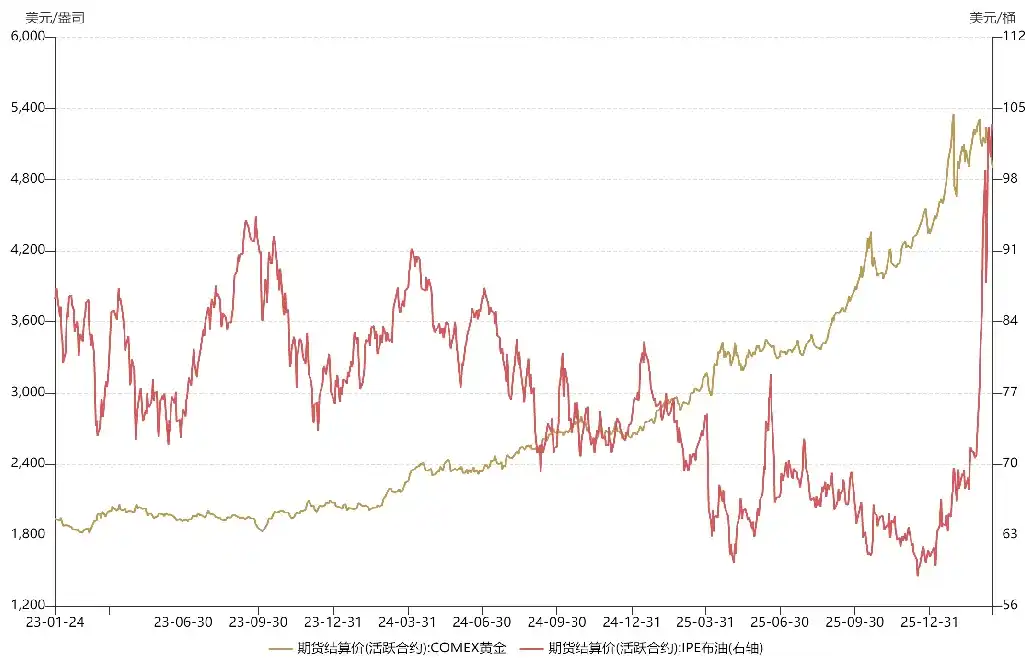
Since the end of 2023, precious metals have experienced a super bull market, with the price of gold soaring from $1,800 to over $5,000. The reason for such strong upward momentum is that gold simultaneously served as a hedge against geopolitical risks, inflation risks, and US dollar risks.

In October 2023, on top of the Russia-Ukraine war, large-scale conflicts broke out between Israel and Palestine, plunging the Middle East into turmoil. In 2024, the Red Sea crisis erupted, and the Bab el-Mandeb Strait was blockaded. In 2025, Trump took office, and the international order became precarious. These are all manifestations of chaotic geopolitical situations, providing strong support for the price of gold.

On the other hand, in 2023, the US economy shifted from overheating to stagflation. By 2024, influenced by political factors, the Federal Reserve boldly initiated an interest rate-cutting cycle before inflation issue was fully resolved, leading to a resurgence of US dollar liquidity. On one hand, there was mid-cycle easing, and on the other, the risk of secondary inflation. Gold simultaneously served as a hedge against US dollar risks and inflation risks, fueling the takeoff of gold prices.

With all three hedging functions in place, how could the price of gold not rise? In addition, benefiting from the Federal Reserve's easing cycle, both emerging and developed markets, whether in A-shares or US stocks, experienced a bull market.

Now, regarding oil prices, last year's average oil price was significantly lower than the previous year. This was because after Trump took office, he persuaded OPEC to significantly increase crude oil production in an attempt to force Russia to make concessions at the negotiating table. This strategy initially worked, with Putin repeatedly softening his stance on peace talks. If not for the US-Iran war, it was expected that Russia and Ukraine would sign a ceasefire agreement in the first half of this year.

Since the outbreak of the Middle East war, the prices of gold and oil have experienced multiple fluctuations, with their trends diverging due to different causes.

For gold, in mid-to-late January (half a month before the war), as the probability of a US-Iran conflict continued to rise, the price of gold increased, reflecting its geopolitical hedging attribute. According to the market's mainstream expectations at the time, this conflict might be similar to last year's "Midnight Hammer" operation, with a short duration, making it more of a temporary trend.

After the US carried out a "decapitation" strike on Iran, the price of gold rebounded briefly but soon plummeted. This was because the main force shifted from gold to crude oil. Due to the excessive concentration of gold holdings earlier, the main funds chose to sell gold to obtain liquidity for going long on crude oil. In other words, the "position switching" from gold to crude oil led to a fall in gold and a rise in oil.

On the other hand, as overseas markets began to price in a prolonged US-Iran war, risk assets such as US stocks came under pressure, triggering a wave of redemptions. The US financial market faced a liquidity crisis, and as an asset with liquidity second only to cash, gold was heavily sold. In other words, the selling pressure on gold in early March was not because international investors were bearish on gold but rather a self-preservation strategy amid the liquidity crisis.

If it were just a liquidity crisis, the price of gold would often form a "deep V" trend, providing buying opportunities. However, the more troublesome part came later. Since mid-March, overseas expectations for the US-Iran conflict have become more pessimistic, with concerns not only about the potential long-term blockade of the strait but also about the possibility of warring parties launching large-scale attacks on each other's energy facilities. This would keep oil prices at relatively high levels for an extended period, dealing a devastating blow to the global economy and even causing the collapse of the international order. In such a scenario, the Federal Reserve might delay its interest rate-cutting pace or even restart a rate-hiking cycle as it did in 2022. Based on this expectation, the price of gold plummeted, with the extent of the correction breaking the highest record in recent years.

In other words, gold's geopolitical hedging function is still at play, but the current sharp decline in gold prices is driven by expectations of a reversal in the Federal Reserve's monetary policy. The US dollar anti-hedging attribute of gold has overshadowed its geopolitical and inflation hedging attributes, becoming its main driver. Compared to previous declines, the fundamentals of gold have changed. It is no longer a liquidity crisis or profit-taking but rather overseas concerns about the tightening of the Federal Reserve's monetary policy. These concerns are also reflected in risk assets such as A-shares and US stocks, as no one is spared when disaster strikes.

Since the outbreak of the US-Iran war, oil prices have also experienced twists and turns. The reason for this volatility is that overseas investors' perception of geopolitics has deviated. After the "decapitation" strike, oil prices continued to rise, reaching nearly $120 per barrel. However, in early March, as Trump hinted that "the war will end soon," the market began executing "TACO" trades, believing that the Iran situation might ease, and oil prices once plummeted by 30%. However, unlike tariff issues, the initiative in a geopolitical crisis does not lie with Trump. He cannot extricate himself easily while the strait is blockaded. Eventually, the market corrected its expectations for oil, and prices returned to an upward trend.

On geopolitical issues, the market sometimes makes misjudgments, but such pricing deviations are not necessarily bad. A drop in oil prices can反而 provide opportunities to add positions, making it easier for latecomers to enter the market.

Looking ahead, the trends of gold and oil prices will depend on the pace of the US-Iran conflict. If it evolves into a prolonged war like the Russia-Ukraine conflict, gold may lack配置 value in the first half of the year, and in the short term, one might focus on the energy chain. However, the situation could still reverse. The US-Iran war may reach a critical turning point, which will determine whether the Strait of Hormuz can be unblocked in the short term. It all depends on Trump's choice.


Criptomoedas em alta

Perguntas relacionadas

QAccording to the article, what are the three main safe-haven functions of gold?

AThe three main safe-haven functions of gold are: hedging against geopolitical risks, hedging against inflation risks, and hedging against U.S. dollar risks.

QWhat event in 2025 is mentioned as a factor contributing to the chaotic geopolitical situation that supported gold prices?

ADonald Trump taking office in 2025 is mentioned as a factor that made the international order precarious, contributing to the chaotic geopolitical situation.

QWhy did the price of gold fall sharply after the U.S. 'decapitation' strike on Iran, as explained in the article?

AThe price fell because major funds switched from gold to crude oil, selling gold to obtain liquidity for oil positions. Additionally, a liquidity crisis in U.S. financial markets led to large-scale selling as gold is a highly liquid asset.

QWhat was the main reason for the significant drop in gold prices from mid-March onwards, according to the analysis?

AThe main reason was the market's expectation that the Federal Reserve might delay interest rate cuts or even restart a rate hike cycle due to concerns that the U.S.-Iran conflict could keep oil prices high and severely impact the global economy.

QWhat does the article suggest is the key factor that will determine the future trends of gold and oil prices?

AThe future trends of gold and oil prices will depend on the pace and development of the U.S.-Iran conflict, specifically whether it becomes a protracted war like in Ukraine and the critical issue of whether the Strait of Hormuz can be unblocked in the short term.

Leituras Relacionadas

Must-Watch Events Next Week|CLARITY Act Could Face Senate Vote; SpaceX, Circle to Report Earnings (8.3-8.9)

**Summary: Key Events and Developments to Watch (August 3-9)** The upcoming week is marked by significant financial disclosures, key legislative deadlines, and notable product updates. **Major Financial Events:** Several companies are scheduled to release their Q2 2026 earnings. American Bitcoin (ABTC) will report on August 3, followed by SpaceX and Hut 8 Mining Corp. on August 4, and Circle on August 5. Notably, a significant portion of SpaceX shares (up to 12% of total shares) will be unlocked on August 6 following their earnings release. **Key Legislative Deadline:** The U.S. Senate faces an August 7 deadline to secure 60 votes for the CLARITY Act, a bipartisan bill aiming to establish a federal regulatory framework for cryptocurrencies. The Senate may hold a full vote on the bill during the week. **Economic Data:** The U.S. July Non-Farm Payrolls report will be released on August 7, providing crucial labor market data. **Technology & Product Updates:** * **Shutdowns:** DeFi portfolio tracker Zapper and wallet app Ctrl Wallet will cease operations on August 3. * **Upgrades:** LayerZero will deprecate its v1 relayers on August 3. XRP Ledger's new version 3.3.0, featuring five new functions, is expected next week. * **AI:** Elon Musk announced that the advanced Grok 4.6 AI model is set for release around August 7. * **Bitcoin:** The BIP-110 forced signaling for a potential Bitcoin network change is scheduled to begin around August 8. **Other Notable Events:** Chinese robotics firm Unitree Tech has set its preliminary price inquiry for its IPO for August 5. South Korean exchange Upbit will delist AQT and AERGO tokens on August 3.

marsbitHá 1h

Must-Watch Events Next Week|CLARITY Act Could Face Senate Vote; SpaceX, Circle to Report Earnings (8.3-8.9)

marsbitHá 1h

Stocks Are Plummeting More Sharply Than Cryptocurrencies. Where Has the Money Gone?

Stock Markets Plunge Deeper Than Cryptocurrencies: Where Did the Money Go? In late July, Seoul's Kospi index triggered circuit breakers for two consecutive days, plummeting over 40% from its June high. The collapse was led by heavyweight stocks like SK Hynix, whose record profits still disappointed investors, and devastating leveraged ETFs, with one major product losing over 83% of its value. This signaled a global, forced deleveraging targeting the most crowded trades. Interestingly, while stocks exhibited extreme volatility akin to crypto markets, Bitcoin rose nearly 15% in July after a prior steep drop. Analysis shows the money fleeing equities did not flow into Bitcoin. Instead, Bitcoin had already absorbed its sell-off in May-June, when U.S. spot Bitcoin ETFs saw historic outflows. The true safe-haven beneficiary was gold, whose price rose over 20% year-on-year, highlighting a decoupling between Bitcoin and gold as "digital gold." The sell-off was a targeted unwinding of leveraged positions in tech and semiconductors, accelerated by broker-dealer risk management and shifts in the AI narrative, including new competition from Chinese memory chipmakers. The retreat path was clear: from high-valuation tech stocks to cash and U.S. Treasuries, then to gold. For Bitcoin to attract sustained institutional inflows, conditions like eased global liquidity pressure, a "soft-landing" Fed rate cut, and U.S. regulatory clarity via legislation like the stalled CLARITY Act are needed. Currently, Bitcoin is not a safe haven but an already-cleared asset. Its low correlation with tech stocks, however, makes it a potential diversification play for institutional portfolios once the storm passes. The money isn't here yet, but the positioning is underway.

marsbitHá 1h

Stocks Are Plummeting More Sharply Than Cryptocurrencies. Where Has the Money Gone?

marsbitHá 1h

In Conversation with Ray Dalio: We Are Currently in an AI Bubble, with 1% of My Portfolio in Bitcoin

Ray Dalio, founder of Bridgewater Associates, warns in an interview that the current AI boom shows classic bubble characteristics, which could lead to significant economic downturns as seen in past cycles like 1929 or 2000. He explains that speculative enthusiasm, fueled by debt and overvaluation, often precedes a crash when rising rates or taxation force asset sales, causing widespread losses and recession. Dalio also outlines his "Big Cycle" theory, describing an approximate 80-year pattern where widening wealth gaps, massive government deficits, and shifting geopolitical power (like China's rise) create internal conflict and global instability. He emphasizes that we are in a late-cycle, transitional phase where traditional powers like the US and UK face decline. For personal wealth protection, Dalio advises diversification beyond cash into assets like stocks, bonds, real estate, and particularly gold, which he prefers over Bitcoin. While he holds about 1% of his portfolio in Bitcoin as a non-printable hard asset, he views gold as more secure from technological or governmental threats. Regarding AI's impact, Dalio believes it will disproportionately benefit capital owners, worsening inequality by replacing both physical and cognitive labor. He suggests that human intuition and emotional intelligence, combined with AI, will be key for future workers. On taxation, Dalio argues that wealth taxes are impractical and risk triggering asset sell-offs, reducing productive investment. He points to the UK as a cautionary example of debt, low productivity, and political strife. Geopolitically, Dalio foresees a more regionalized world, with the US showing weakness in prolonged conflicts like with Iran, akin to past imperial declines. The ideal outcome, he suggests, is coexisting powerful blocs (e.g., Americas, China-Asia Pacific) without major war.

marsbitHá 5h

In Conversation with Ray Dalio: We Are Currently in an AI Bubble, with 1% of My Portfolio in Bitcoin

marsbitHá 5h

Trading

Spot

Artigos em Destaque

Como comprar WAR

Bem-vindo à HTX.com!Tornámos a compra de WAR (WAR) simples e conveniente.Segue o nosso guia passo a passo para iniciar a tua jornada no mundo das criptos.Passo 1: cria a tua conta HTXUtiliza o teu e-mail ou número de telefone para te inscreveres numa conta gratuita na HTX.Desfruta de um processo de inscrição sem complicações e desbloqueia todas as funcionalidades.Obter a minha contaPasso 2: vai para Comprar Cripto e escolhe o teu método de pagamentoCartão de crédito/débito: usa o teu visa ou mastercard para comprar WAR (WAR) instantaneamente.Saldo: usa os fundos da tua conta HTX para transacionar sem problemas.Terceiros: adicionamos métodos de pagamento populares, como Google Pay e Apple Pay, para aumentar a conveniência.P2P: transaciona diretamente com outros utilizadores na HTX.Mercado de balcão (OTC): oferecemos serviços personalizados e taxas de câmbio competitivas para os traders.Passo 3: armazena teu WAR (WAR)Depois de comprar o teu WAR (WAR), armazena-o na tua conta HTX.Alternativamente, podes enviá-lo para outro lugar através de transferência blockchain ou usá-lo para transacionar outras criptomoedas.Passo 4: transaciona WAR (WAR)Transaciona facilmente WAR (WAR) no mercado à vista da HTX.Acede simplesmente à tua conta, seleciona o teu par de trading, executa as tuas transações e monitoriza em tempo real.Oferecemos uma experiência de fácil utilização tanto para principiantes como para traders experientes.

190 Visualizações TotaisPublicado em {updateTime}Atualizado em 2026.06.02

Como comprar WAR

Discussões

Bem-vindo à Comunidade HTX. Aqui, pode manter-se informado sobre os mais recentes desenvolvimentos da plataforma e obter acesso a análises profissionais de mercado. As opiniões dos utilizadores sobre o preço de WAR (WAR) são apresentadas abaixo.

活动图片












