Author: Rishabh Gupta
Compiled by: Jiahuan, ChainCatcher
Original title:7 Painful Lessons from 4 Years of Web3 Entrepreneurship
As a budding founder, I spent years pouring my heart into three infrastructure-layer projects that ultimately failed. In 2025, I started building a consumer product that people actually want to use. Here, I share my hard-earned insights on user acquisition and fundraising.
I've been in this industry for about 4 years.
In 2023, when "account abstraction" was the hottest topic in the circle, I started developing in the EVM ecosystem. At that time, everyone was building SDKs (Software Development Kits) for account abstract wallets. Rollup scaling solutions were also hot—Optimism, Arbitrum, and various RaaS (Rollup as a Service) dominated.
As a math enthusiast, I was deeply attracted to ZK (Zero-Knowledge proofs), believing it would change the world (I firmly believe it will, eventually).
I mistakenly believed that: Complexity == Credibility.
When VCs asked about application scenarios, I would confidently list zkML (Zero-Knowledge Machine Learning), zk identity, zk voting—but even today, no one is really using these areas. I mistook amazing technology for a useful product.
Over time, I began to believe that the more complex an idea was, the greater its chance of success.
VCs also told me that in the crypto space, building infrastructure was the only path to success.
It took me nearly 2 years and over 500 rejections to realize this wasn't for me.
Entering the Solana Ecosystem
This was a completely new ecosystem for me—here, people care about application scenarios. Even meme coins are okay, because revenue matters.
Speed matters. Distribution matters.
Having built consumer applications on Solana for 7 months, here are my insights:
1. Build for Young Users Willing to Try New Things
Try to develop for young people who are naturally receptive to new products.
In the consumer crypto space, this usually means people trading in the "trenches" or young users aged 13-21.
A 2024 study by the Consumer Technology Association showed that 86% of Gen Z (11-26 years old) consider technology core to life—a higher percentage than any older generation. They own more devices and are more willing to spend on tech products.
They are more willing to try new apps, experiment with new features, and change habits.
Users over 25 are generally less willing to adopt new workflows unless there is a very strong incentive.
(Note: If you're in the institutional business, this may not apply.)
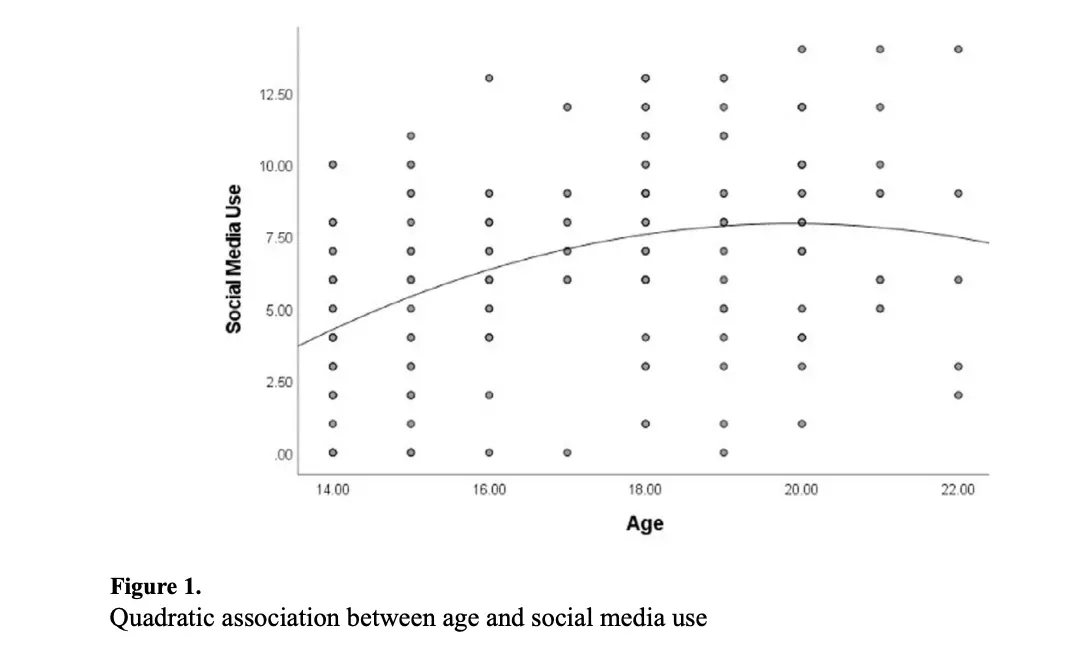
Research shows that social activity peaks around age 20-21. This means products built for young people are inherently more shareable.
2. Make the Product Inherently "Viral" to Reduce Marketing Costs
If you don't have a huge marketing or advertising budget, the product itself must be the traffic channel.
In crypto, shareability is especially important because:
-
KOL marketing is very expensive.
-
Trust is extremely low.
-
Everyone expects rewards or incentives.
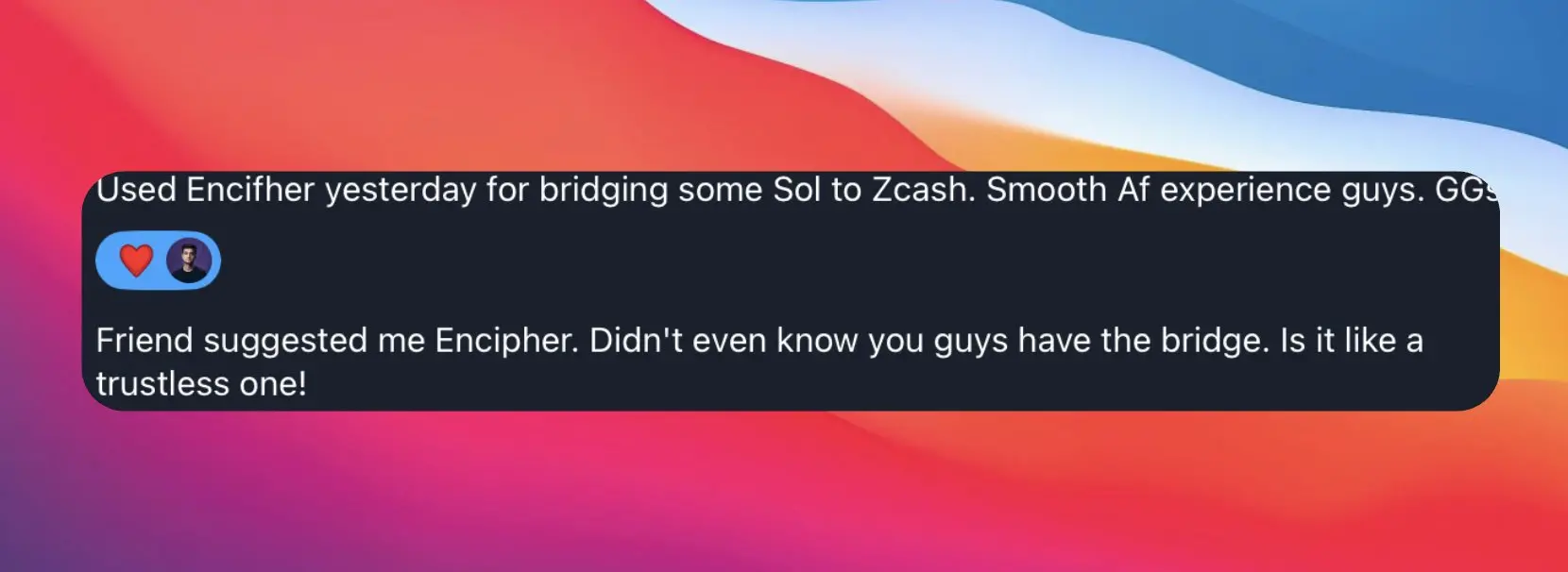
If your product gives users a reason to spontaneously share it with friends and communities, you've earned publicity without burning money. This is hard, but it's worth optimizing for from day one.
3. Launch Features Users Request as Soon as Possible
When users report a poor experience or a bug, fix it immediately, especially if it's a pain point that hinders use.
I used to wait until the end of the day to apply patches. The result was users DMing me: "Since your app doesn't have this feature, I'm going to use Product Y for now."
Once users go to a competitor and form a habit, it's hard to pull them back.
So, try to fix things immediately (ideally within 2-5 hours).
If multiple users request a feature and it's feasible:
-
Build it within 2-3 days.
-
Tell them it was launched based on their feedback.
-
Maybe even give them a reward.
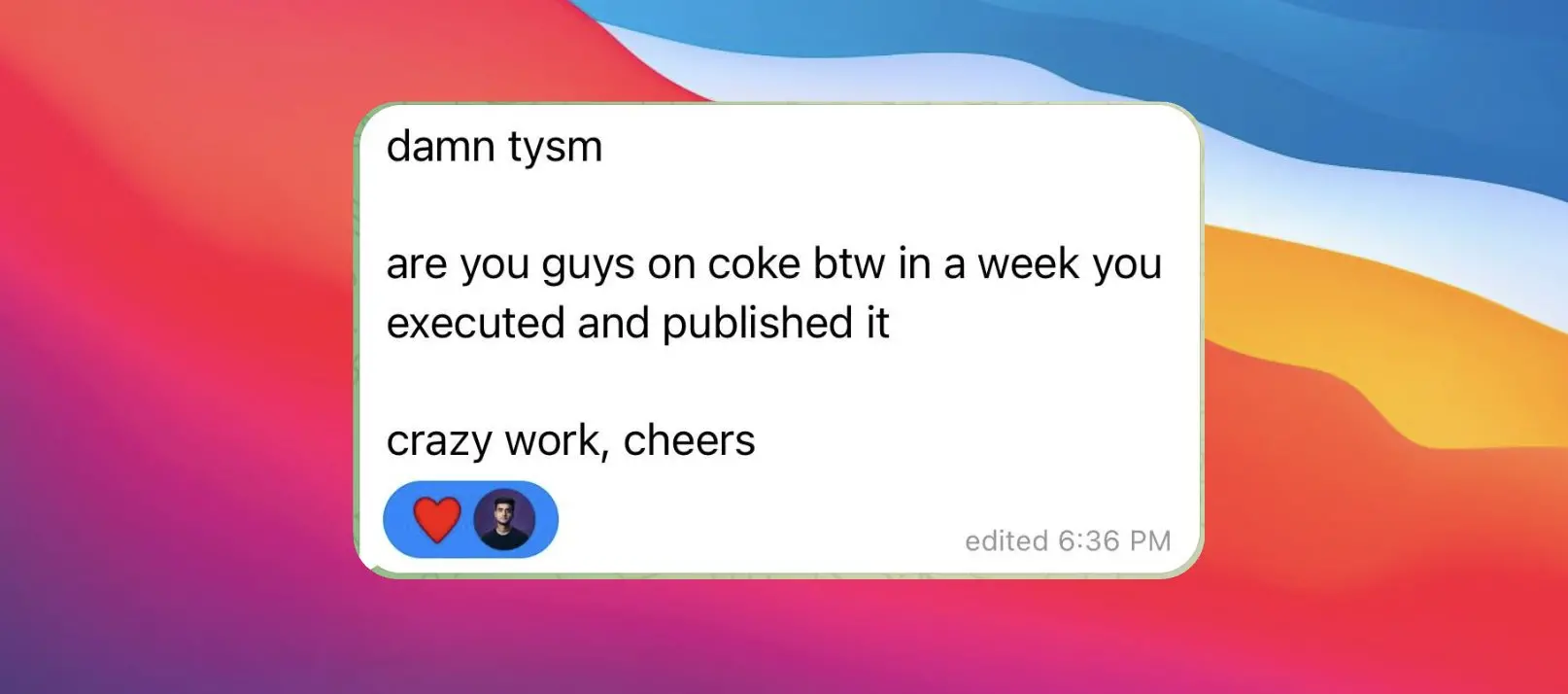
This builds deep trust. Users will start to feel the product "belongs to them," and this sense of emotional ownership is incredibly powerful in early-stage products.
4. The App Name is Very Important
This seems simple, but many people (including me) have messed it up.
The app name should be highly recognizable and easy to share verbally.
My previous product was called "Encifher," a name extremely hard to remember. Even investors and partners would misspell it when creating group chats.
So we later changed it to encrypt.trade. Simple, memorable, sexy.
5. Talking to Users is Hard, But Essential
Finding and talking to users is extremely difficult, especially when what you're building isn't part of the current "hot narrative."
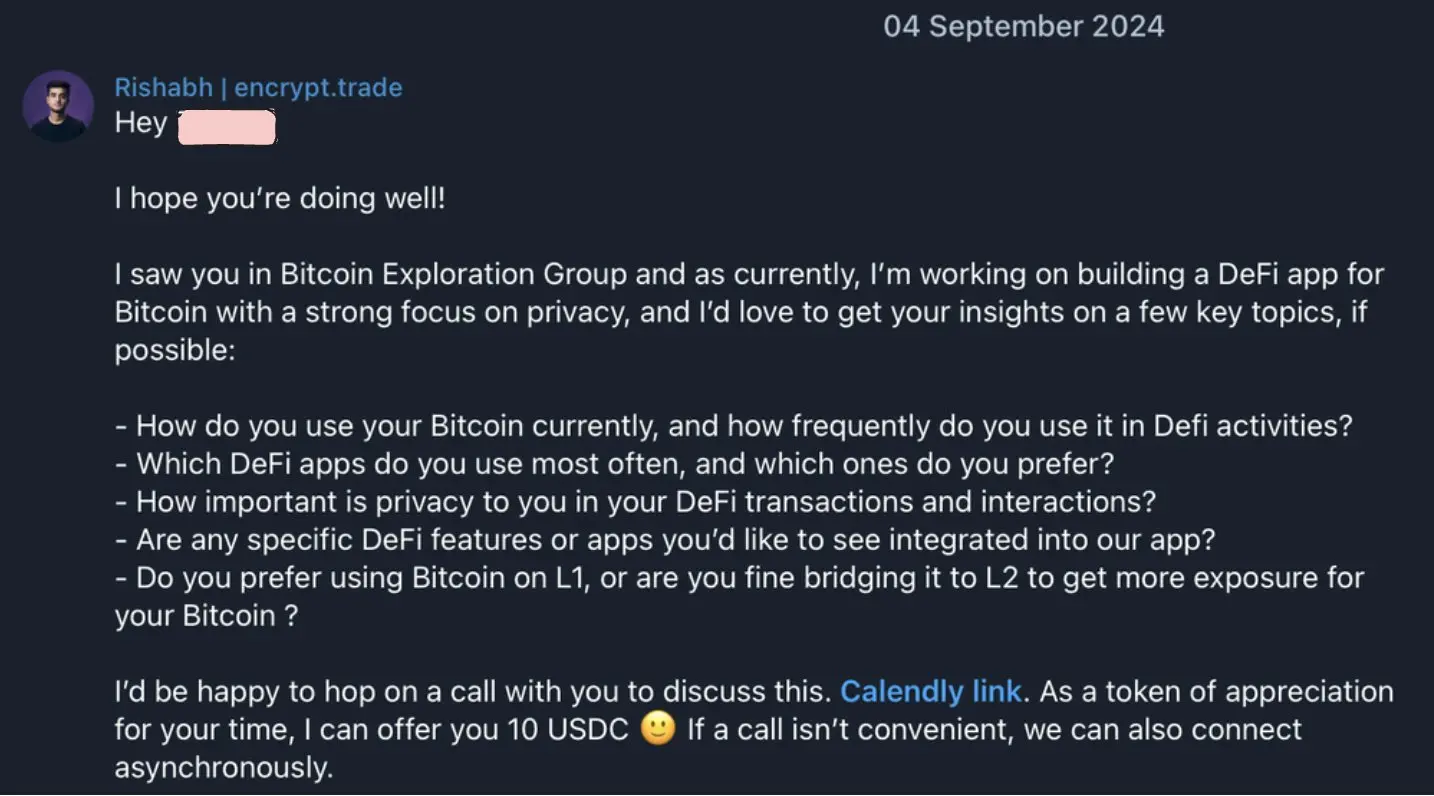
When I started working on privacy, it wasn't popular. I contacted nearly 1000 people via Cold-DM: maybe 10 out of 100 would reply. Only 3-4 of those could provide substantial help.
I talked to anyone who showed the slightest interest
I iterated on the product with them
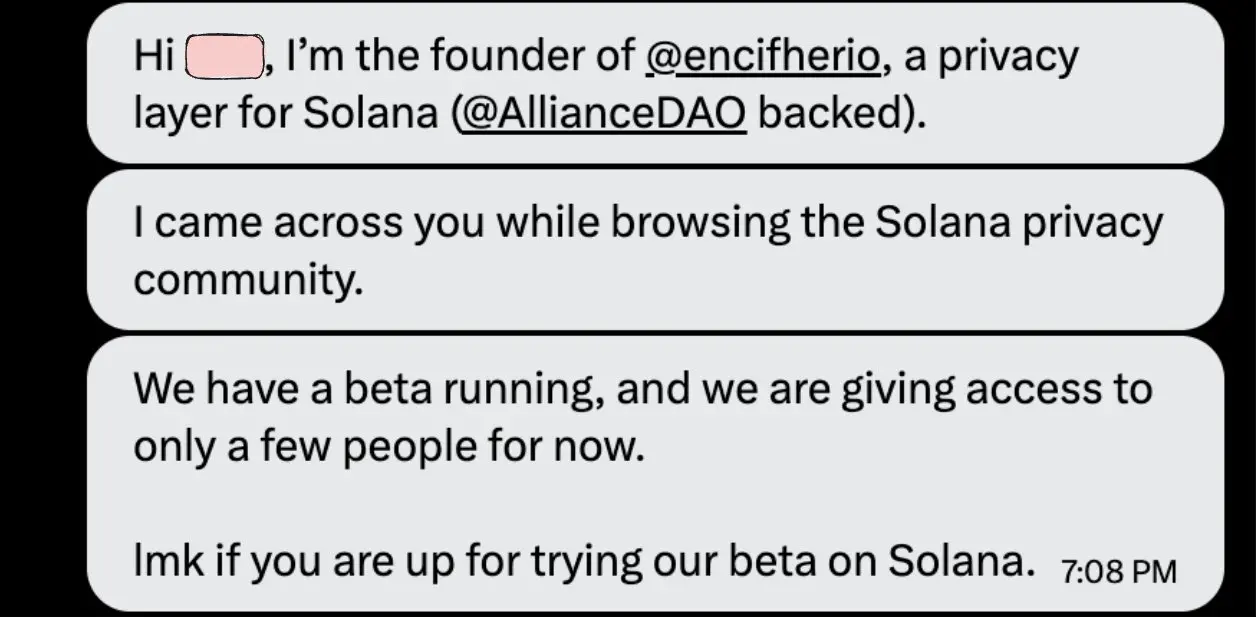
Framing a Cold-DM is also an iterative process. Here are some key points to note:
-
Start with a warm greeting.
-
Put the highlights (funding status, trading volume, etc.) at the beginning.
-
Mention where you found them.
-
Give a friendly call to action.
-
Always remember to follow up.
There's no perfect Cold-DM; you must A/B test to find what works for your target audience.
Here's a decent Cold-DM template to use: But be aware, this process is slow and exhausting.
In the crypto circle, few people reply to DMs because scams are everywhere.
Low reply rates are the norm (I know, it's a bit frustrating).
Nevertheless, you must do it.
Your goal at this stage is not to get 1000 users.
Your goal is 10-20 early users who care about the problem, are willing to try the product, and will provide honest feedback.
These early users will become your support system.
Early products often go wrong; these users will help you through that phase.
6. Iterate Quickly
The crypto industry changes rapidly, and attention spans are extremely short.
You must study user behavior, not just listen to their words:
-
What are they doing repeatedly?
-
What kind of workarounds are they using?
-
What are they already willing to pay for? (Many ideas sound good, but if users aren't willing to pay, it can't survive.)
7. Make Your Website Simple to the Point of Being "Foolproof"
Never make any assumptions about the user's knowledge.
As a developer, you've stared at the product for hundreds of hours and find it obvious, but for someone entering for the first time, it's completely foreign.
-
Don't introduce new terminology or complex processes.
-
Minimize the number of clicks.
-
The core value should be presented within 5 seconds of entering the app.
Conclusion
Building consumer crypto products is both fun and challenging. Speed of iteration, user-centric thinking, and marketing ability are more important than perfect technology. This is completely different from B2B.
Twitter:https://twitter.com/BitpushNewsCN
Bitpush TG Discussion Group:https://t.me/BitPushCommunity
Bitpush TG Subscription: https://t.me/bitpush







