Hoskinson Says Failed Wyoming Clinic Refocused Him On Cardano And Midnight

bitcoinistPublicado em 2026-05-28Última atualização em 2026-05-28

Resumo

Charles Hoskinson, founder of Cardano, announced the closure of a family-backed medical clinic in Gillette, Wyoming, citing unsustainable financial losses. The clinic, which served approximately 22,000 patients, was losing about $1.7 million per month due to structural issues in the U.S. healthcare system and insufficient local support. Hoskinson framed the shutdown as a strategic refocusing of his time and resources. He stated that his primary daily priorities are now driving adoption for Cardano's privacy-focused sidechain, Midnight, and returning Cardano to the top tier of cryptocurrencies. He emphasized that these are areas where he has direct expertise and agency, unlike the healthcare venture which he described as a costly diversion.

Charles Hoskinson said the closure of his family-backed Wyoming medical clinic has reinforced where his attention now belongs: Cardano, Midnight and the crypto ventures where he believes he has the most direct agency.

In a May 27 livestream, the Cardano founder gave an detailed account of why the Gillette, Wyoming clinic is being shut down, framing the decision as the result of structural losses, weak local support, difficult healthcare economics and a business model he said could not survive without subsidy or a private-equity-style operating approach.

Hoskinson said the project began in 2021 as a family effort involving his father and brother, both physicians, and was intended to build a “center of excellence” in an underserved rural market. The clinic eventually served about 22,000 patients, which he said amounted to roughly two-thirds of the town. But the economics moved in the wrong direction.

According to Hoskinson, the facility initially lost about $4 million per month before cost reductions brought losses down to roughly $1.7 million per month. He said even that reduced burn rate remained untenable, especially because reimbursements for primary care and mental health often failed to cover the clinic’s cost per appointment.

Related Reading: Hoskinson Reaffirms Cardano Focus After IO Treasury Proposals Pass

“The American health care system is broken,” Hoskinson said. “This was never a business. It was basically a charity.” He added that the clinic had become “an indispensable component of the public health of that county,” but said local and state stakeholders were unwilling to provide the kind of support needed to keep it operating.

Why This Matters For Cardano And Midnight

The most relevant part for crypto markets and Cardano observers came when Hoskinson connected the clinic’s failure to his own allocation of time. He said his strongest focus is no longer on running fee-for-service clinical operations, but on areas where he has expertise and influence.

“Every day I wake up, I say, ‘How do I get Midnight adopted? And how do I get Cardano back into the top 10, back into the top five?’” Hoskinson said. “These are the things that I’m primarily interested in. And these are the things that I have core expertise in and agency over changing.”

That line gives the livestream a different significance from a local business postmortem. Hoskinson has often operated across a wide portfolio of ventures, including blockchain, ranching, healthcare, regenerative medicine and policy interests. In this video, he described the clinic as a costly diversion that ultimately could not be reconciled with his main professional priorities.

He did not present the closure as a bankruptcy or liquidity problem. Hoskinson said he has “well more than enough money” to settle bills and close accounts, and that the facility will remain vacant for a time while conversations continue with other healthcare systems that may be able to use the building.

The explanation also included a broader critique of US healthcare incentives. Hoskinson argued that clinics in primary care are structurally disadvantaged by insurance reimbursements, Medicare and Medicaid rates, hospital billing advantages and a system that rewards procedures, cancer treatment and pharmaceuticals far more than routine care. He said the clinic faced a choice between dramatically increasing patient volume, relying more heavily on mid-level providers and reducing specialist capacity, or shutting down.

“We could have built it as a steel warehouse with crude fixtures. It would still lose money,” he said. “That’s just the reality of the matter. It had nothing to do with the capex. It had to do with the opex.”

For Cardano, the livestream is notable less for any specific roadmap update than for the signal it sends about Hoskinson’s bandwidth. He described Midnight adoption and Cardano’s return to the upper tier of crypto market rankings as daily priorities, while making clear that running a rural clinic is not a venture he expects to revisit soon.

At press time, ADA traded at $0.23.
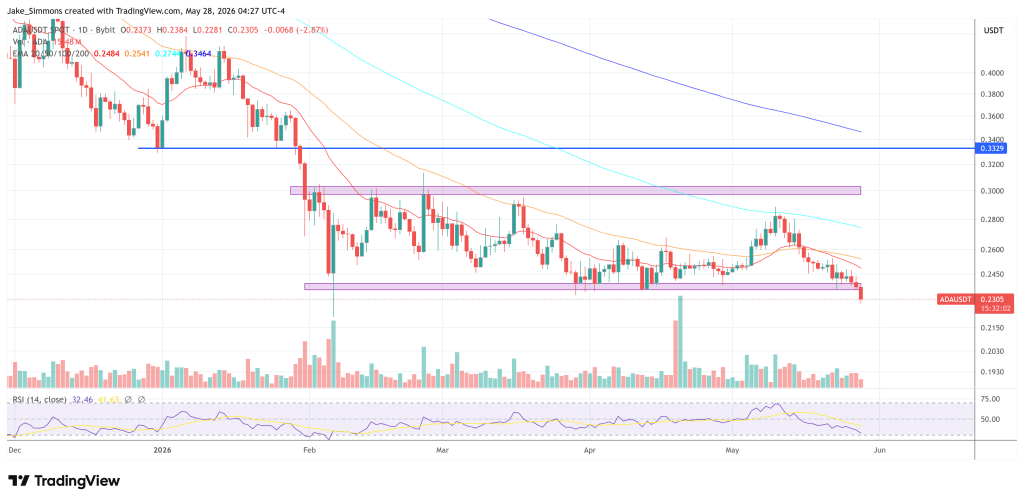
ADA drops below key support, 1-day chart | Source: ADAUSDT on TradingView.com

Perguntas relacionadas

QWhat is the primary reason Charles Hoskinson cited for closing the Wyoming medical clinic?

AHoskinson cited structural financial losses, weak local support, difficult healthcare economics, and an unsustainable business model that relied on subsidies or a private-equity-style approach.

QAccording to Hoskinson, what are his main daily professional priorities now?

AHis main daily priorities are focusing on getting Midnight adopted and getting Cardano back into the top 10, and ultimately the top 5, of the crypto market rankings.

QHow did Hoskinson characterize the clinic's role and its financial nature?

AHe characterized the clinic as an indispensable component of public health for the county, but stated it was never a true business and was essentially operating as a charity due to its financial losses.

QWhat broader issue in the US healthcare system did Hoskinson criticize in relation to the clinic's failure?

AHe criticized a system that structurally disadvantages primary care clinics through low insurance reimbursements, Medicare/Medicaid rates, and hospital billing advantages, while disproportionately rewarding procedures, cancer treatment, and pharmaceuticals over routine care.

QWhat does the clinic's closure signal for Hoskinson's involvement with Cardano?

AIt signals a refocusing of his time and bandwidth away from non-core ventures like healthcare and towards his crypto expertise, specifically on driving adoption for Midnight and improving Cardano's market position.

Leituras Relacionadas

After Marvell's 32% Surge, the Chinese Chip Family Behind It Emerges

The stock price of Marvell Technology surged 32.5% on June 2nd, driven by NVIDIA CEO Jensen Huang highlighting its custom ASICs and optical interconnects as core to AI data center architecture. This event brought attention to the Chinese semiconductor family behind Marvell: the Dai siblings. The story centers on three siblings, all UC Berkeley graduates, whose three-decade entrepreneurial journey aligns with major semiconductor industry shifts. In 1995, youngest sister Dai Wei Li co-founded Marvell with her husband Sehat Sutardja and his brother, focusing on storage controllers. Eldest brother Dai Wei Min founded EDA company Ultima, later sold to Cadence, and later founded VeriSilicon (芯原) in China, becoming a leading semiconductor IP provider. Second brother Dai Wei Jin co-founded EDA firm Silicon Perspective (sold to Cadence) and GPU IP company Vivante, later acquired by VeriSilicon. The combined "Dai-Sutardja" family network extends beyond Marvell. Their ventures and investments form a comprehensive ecosystem for the post-Moore's Law, chiplet era. Key holdings include: Dream Big Semiconductor (AI SuperNICs, acquired by Arm), Alphawave (high-speed SerDes IP, acquired by Qualcomm), and Silicon Box (a chiplet advanced packaging foundry). VeriSilicon itself thrives on the AI ASIC and IP boom in China. Collectively, the family's AI infrastructure-related portfolio is estimated at over $22 billion. Their strategy represents a distinct path: building critical components for open standards and key manufacturing capacity in the chiplet era, rather than pursuing standalone AI chip dominance. While this path may not create the next NVIDIA, it has enabled repeated successful exits and sustained influence within the global semiconductor industry.

marsbitHá 49m

After Marvell's 32% Surge, the Chinese Chip Family Behind It Emerges

marsbitHá 49m

Microsoft is Afraid of Being Marginalized by AI Giants

Microsoft, once the defining force of the PC era, now faces a familiar challenge in the AI age: the risk of being relegated to a profitable but invisible infrastructure provider. This anxiety was laid bare at Build 2026, where CEO Satya Nadella unveiled a major strategic pivot. The catalyst was a quiet April agreement that dissolved Microsoft's exclusive licensing and cloud-hosting deal with OpenAI, its once-vital partner. This erased Microsoft's key AI moat. With OpenAI and Anthropic defining AI applications and gaining enterprise traction—even within Microsoft's own ranks—Nadella had to answer: without exclusivity, what is Microsoft's role? The answer was a suite of seven in-house AI models, a developer-focused AI workstation (Surface RTX Spark Dev Box), and, most crucially, the Agent 365 platform for enterprise AI governance. The models, notably targeting Anthropic's strengths in coding and enterprise, signal a defensive move. However, the broader strategy is to make the models themselves less decisive. Financially, Microsoft's AI revenue is strong, driven largely by Azure running others' models. Yet its user-facing products like Copilot show weak penetration and engagement. Microsoft earns infrastructure money but lacks direct user mindshare. Nadella's core fear is being "hollowed out." As OpenAI and Anthropic prepare for IPOs and gain financial independence, they may build their own infrastructure, threatening Azure's lucrative AI revenue stream. Microsoft's window is to entrench itself deeper: not as the model creator, but as the indispensable platform for securely deploying, managing, and governing all AI models within the enterprise through Agent 365. Build 2026 revealed Microsoft's bet: in the AI era, the ultimate power lies not in any single model, but in the enterprise "operating system" that controls them. Nadella is determined to ensure Microsoft is the driver of this new era, not just a passenger.

marsbitHá 1h

Microsoft is Afraid of Being Marginalized by AI Giants

marsbitHá 1h

CPU, Quietly Returning to the Center of the AI Computing Power Stage

Over the past three years, AI computing power narratives have been dominated by GPUs. However, starting in 2026, this story began to shift. While training large models remains GPU-intensive, the rapid growth of inference and AI agent workloads, which require high levels of task orchestration, concurrency, and data flow management, has highlighted a renewed critical role for CPUs. These are tasks GPUs are not designed to handle. Intel's recent launch of the Xeon 6+ processor, built on its Intel 18A process and featuring up to 288 efficiency cores (E-cores), exemplifies this strategic pivot. It is positioned not as a mere companion to GPUs but as the essential "control plane" for AI infrastructure, optimized for high-density, energy-efficient, and high-throughput workloads characteristic of AI agents and inference. This "CPU resurgence" is not about CPUs outperforming GPUs in raw computation. It reflects a systemic bottleneck: as AI scales from training single models to deploying countless intelligent agents, the demand for coordination and data handling surges. Major cloud providers are also developing their own high-density ARM-based server CPUs for similar workloads. However, Intel's success with this strategy faces significant challenges. Competition includes NVIDIA's integrated CPU-GPU solutions, the expanding adoption of cloud vendors' in-house ARM CPUs, and the crucial market test of Intel's 18A manufacturing process against rivals like TSMC's N2. In conclusion, CPUs are indeed reclaiming a central, though redefined, role in AI compute—managing the complex orchestration that enables massive-scale AI deployment. While the trend is clear, which company will ultimately lead this CPU resurgence remains an open question to be decided in the data centers of 2027 and beyond.

marsbitHá 1h

CPU, Quietly Returning to the Center of the AI Computing Power Stage

marsbitHá 1h

Trading

Spot
Futuros

Artigos em Destaque

Como comprar ADA

Bem-vindo à HTX.com!Tornámos a compra de Cardano (ADA) simples e conveniente.Segue o nosso guia passo a passo para iniciar a tua jornada no mundo das criptos.Passo 1: cria a tua conta HTXUtiliza o teu e-mail ou número de telefone para te inscreveres numa conta gratuita na HTX.Desfruta de um processo de inscrição sem complicações e desbloqueia todas as funcionalidades.Obter a minha contaPasso 2: vai para Comprar Cripto e escolhe o teu método de pagamentoCartão de crédito/débito: usa o teu visa ou mastercard para comprar Cardano (ADA) instantaneamente.Saldo: usa os fundos da tua conta HTX para transacionar sem problemas.Terceiros: adicionamos métodos de pagamento populares, como Google Pay e Apple Pay, para aumentar a conveniência.P2P: transaciona diretamente com outros utilizadores na HTX.Mercado de balcão (OTC): oferecemos serviços personalizados e taxas de câmbio competitivas para os traders.Passo 3: armazena teu Cardano (ADA)Depois de comprar o teu Cardano (ADA), armazena-o na tua conta HTX.Alternativamente, podes enviá-lo para outro lugar através de transferência blockchain ou usá-lo para transacionar outras criptomoedas.Passo 4: transaciona Cardano (ADA)Transaciona facilmente Cardano (ADA) no mercado à vista da HTX.Acede simplesmente à tua conta, seleciona o teu par de trading, executa as tuas transações e monitoriza em tempo real.Oferecemos uma experiência de fácil utilização tanto para principiantes como para traders experientes.

1.2k Visualizações TotaisPublicado em {updateTime}Atualizado em 2026.06.02

Como comprar ADA

Discussões

Bem-vindo à Comunidade HTX. Aqui, pode manter-se informado sobre os mais recentes desenvolvimentos da plataforma e obter acesso a análises profissionais de mercado. As opiniões dos utilizadores sobre o preço de ADA (ADA) são apresentadas abaixo.

活动图片