Hoskinson Says Cardano Just Cleared A Major Binance Hurdle

bitcoinistPublicado em 2026-03-13Última atualização em 2026-03-13

Resumo

Charles Hoskinson, founder of Cardano, announced a major milestone for the ecosystem: the upcoming Binance spot listing of NIGHT, the native token of the privacy-focused sidechain Midnight. Hoskinson emphasized that this is the first Cardano-native asset to be listed on Binance, which he described as the world's largest altcoin exchange and the center of gravity for liquidity. He framed this development as a breakthrough that removes a significant structural barrier, opening the door for other Cardano assets to access top-tier global liquidity. Beyond market access, Hoskinson connected the listing to broader trends of chain abstraction and compliance, suggesting Midnight's technology could enable privacy-preserving tools essential for scaling tokenized real-world assets. He also presented this achievement as a direct rebuttal to critics who have questioned Cardano's ability to launch large-scale projects and remain relevant in the DeFi space.

Charles Hoskinson says the Cardano ecosystem has crossed a threshold it had struggled to reach for years: a Binance spot listing for a native asset. In a March 11 livestream, the Cardano founder described Binance’s announced support for Midnight’s token NIGHT as a milestone not just for that project, but for the broader effort to bring native assets into tier-one global liquidity.

NIGHT Gets Listed On Binance

Hoskinson framed the development around Midnight, the privacy-focused sidechain project tied to the Cardano ecosystem, whose token had already appeared on Binance Alpha. The bigger breakthrough, in his telling, is the move toward Binance spot. “Binance just tweeted today, Binance is excited to announce the Midnight Holder airdrop,” he said. “Plus, the token is going to be listed on Binance soon. So coming to Binance spot is NIGHT the first Cardano native asset to be listed on Binance. How about that?”

That distinction matters because Hoskinson cast Binance as the center of gravity for altcoin markets. He argued that getting a Cardano-native asset onto the exchange removes a structural barrier that had limited the ecosystem’s reach. “It’s a major milestone for the ecosystem. It’s opened the door for all other Cardano native assets,” he said. “This was a very high bar. It’s the largest market in the world... 80% of all altcoin trading is done here on Binance. It’s the market of markets, the granddaddy of them all.”

In Hoskinson’s telling, the significance goes beyond market access. He tied Midnight’s Binance arrival to a broader thesis around chain abstraction, account abstraction and compliance infrastructure, arguing that Midnight is meant to sit at the intersection of those trends as centralized and decentralized finance draw closer together.“

Traditional finance and DeFi are kind of coming together and Binance has always been on the forefront of that with BNB and what they’ve done with the Binance infrastructure,” he said. “When Midnight comes to this infrastructure and we can do things with this infrastructure, we can talk about reimagining the art of possible compliance and moving into the smart compliance world.”

He then pushed that argument further, saying privacy-preserving compliance tools could be essential if tokenized real-world assets are to scale. “That will open up $10 trillion of real world assets to enter the space above and beyond just making exchanges safer and more efficient,” Hoskinson said, pointing specifically to travel rule compliance and providing information “without revealing the underlying information.”

A rebuttal To Cardano Skeptics

The tone of the stream made clear that Hoskinson sees the Binance milestone as vindication after a long stretch of criticism around Cardano’s relevance in DeFi and its ability to launch large-scale products. He explicitly presented Midnight’s progress as a rebuttal to those narratives.

“There are some people who wrote off Cardano and they said, ‘Cardano can’t launch a billion-dollar project. Cardano can’t get tier one liquidity. Cardano’s days in the DeFi space are over. It’s not relevant anymore,’” he said. “And for us to be able to show them that they’re all wrong — you don’t get too many days like this.”

He compared the moment to earlier ecosystem inflection points, including Coinbase’s ADA listing in 2021 and the more recent arrival of USDCX, suggesting this latest move breaks another long-standing distribution bottleneck for Cardano-linked assets.

At press time, ADA traded at $0.2636.
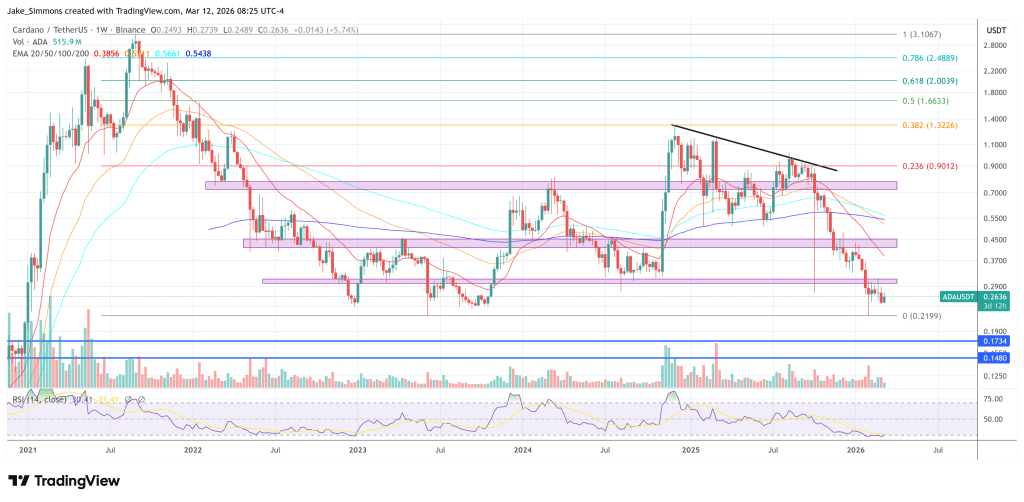
ADA hovers below key resistance, 1-week chart | Source: ADAUSDT on TradingView.com

Perguntas relacionadas

QWhat major milestone did Charles Hoskinson announce for the Cardano ecosystem regarding Binance?

ACharles Hoskinson announced that Midnight's token (NIGHT) will be listed on Binance spot, making it the first Cardano native asset to achieve a Binance spot listing.

QAccording to Hoskinson, why is Binance's role in altcoin trading significant for Cardano native assets?

AHoskinson stated that Binance is the largest market for altcoin trading, with 80% of all altcoin trading occurring there, making it a critical platform for liquidity and market access.

QHow does Hoskinson connect Midnight's Binance listing to broader trends in finance?

AHe links it to chain abstraction, account abstraction, and compliance infrastructure, suggesting Midnight sits at the intersection where traditional finance and DeFi are converging, enabling advanced privacy-preserving compliance tools.

QWhat does Hoskinson claim the Binance listing rebuts about Cardano?

AIt rebuts criticisms that Cardano cannot launch a billion-dollar project, secure tier-one liquidity, or remain relevant in the DeFi space, demonstrating the ecosystem's capability and growth.

QWhat potential does Hoskinson see for privacy-preserving compliance tools in tokenizing real-world assets?

AHe believes these tools could unlock $10 trillion in real-world assets by enabling compliance (like travel rule) without revealing underlying information, making exchanges safer and more efficient.

Leituras Relacionadas

70% of the Public Opposes AI, Americans Hope the U.S. Loses the AI War

70% of Americans believe AI development is moving too fast, with growing public resistance evolving from online criticism to real-world protests and violence. This widespread anti-AI sentiment stems from fears of job losses, rising utility costs, environmental damage, threats to democracy, and financial instability. Key incidents illustrate the backlash: Google's former CEO Eric Schmidt was loudly booed at a graduation for promoting AI; AI company ads are vandalized; protests and even violent attacks target AI firms and data centers. Polls show deep public pessimism and strong local opposition to data center construction, often surpassing resistance to nuclear power plants. The core grievances are economic and practical: AI is seen as automating jobs, concentrating wealth, and increasing household electricity and water bills due to massive data center resource demands. Environmentalists also oppose AI's high energy use and carbon emissions. This opposition has turned AI into a major political issue in the US. While the Trump administration prioritizes AI innovation for global competition, bipartisan pushback is growing. Democrats and factions within the MAGA movement are forming temporary alliances to support stricter regulations and local bans on new data centers, pressuring the administration to choose between its tech industry backers and its voter base. The situation highlights a profound national divide over AI's future.

marsbitHá 1m

70% of the Public Opposes AI, Americans Hope the U.S. Loses the AI War

marsbitHá 1m

Agents Take Over Traffic Distribution Power: What Are Tencent, ByteDance, and Alibaba Competing For?

In the race to dominate the AI era's entry point, China's tech giants—Tencent, ByteDance, and Alibaba—are aggressively deploying AI Agents to control the future of traffic distribution. Alibaba is pursuing a dual-track "closed loop + openness" strategy. Its Qianwen app is evolving into a super-Agent integrated across its ecosystem (Taobao, Alipay, etc.) to handle complex tasks like travel planning. Concurrently, it is opening its platform to external brands (Luckin Coffee, KFC) and has launched a B2B Agent platform, "Wukong," targeting enterprise automation. Its other flagship, Quark, aims to be an "AI super search box" for information and tasks. ByteDance is executing an omnipresent "sprawl strategy." Its Doubao app boasts over 300 million monthly active users and is evolving into a default AI entry point for daily life, with plans for paid versions and e-commerce integration. Its core weapon is the Kouzi platform, a visual "AI assembly factory" for developers to build custom Agents. ByteDance is also pushing hardware integration, collaborating on AI phones and developing smart glasses to embed Doubao everywhere. Tencent is playing its long-held "ultimate card" by quietly embedding an AI Agent directly into WeChat. This Agent, accessible via a swipe, can understand user commands and automatically execute tasks by calling upon WeChat's millions of mini-programs (e.g., finding and ordering coffee). This leverages WeChat's unparalleled 1.4-billion-user ecosystem to position the app as an AI-powered "service operating system," a move that could dramatically reshape the competitive landscape. The core battleground is shifting from competing for "user screen time" to competing to be the "default execution layer" for user intent. The business model is evolving from an "attention economy" to an "intent economy," where the Agent that can most efficiently fulfill a user's need gains control over service access and token flow. This represents a fundamental change in how users connect with digital services, making the fight for the Agent入口 (entry point) a pivotal moment for redefining industry leadership in the AI age.

marsbitHá 1h

Agents Take Over Traffic Distribution Power: What Are Tencent, ByteDance, and Alibaba Competing For?

marsbitHá 1h

Trading

Spot
Futuros

Artigos em Destaque

Como comprar ADA

Bem-vindo à HTX.com!Tornámos a compra de Cardano (ADA) simples e conveniente.Segue o nosso guia passo a passo para iniciar a tua jornada no mundo das criptos.Passo 1: cria a tua conta HTXUtiliza o teu e-mail ou número de telefone para te inscreveres numa conta gratuita na HTX.Desfruta de um processo de inscrição sem complicações e desbloqueia todas as funcionalidades.Obter a minha contaPasso 2: vai para Comprar Cripto e escolhe o teu método de pagamentoCartão de crédito/débito: usa o teu visa ou mastercard para comprar Cardano (ADA) instantaneamente.Saldo: usa os fundos da tua conta HTX para transacionar sem problemas.Terceiros: adicionamos métodos de pagamento populares, como Google Pay e Apple Pay, para aumentar a conveniência.P2P: transaciona diretamente com outros utilizadores na HTX.Mercado de balcão (OTC): oferecemos serviços personalizados e taxas de câmbio competitivas para os traders.Passo 3: armazena teu Cardano (ADA)Depois de comprar o teu Cardano (ADA), armazena-o na tua conta HTX.Alternativamente, podes enviá-lo para outro lugar através de transferência blockchain ou usá-lo para transacionar outras criptomoedas.Passo 4: transaciona Cardano (ADA)Transaciona facilmente Cardano (ADA) no mercado à vista da HTX.Acede simplesmente à tua conta, seleciona o teu par de trading, executa as tuas transações e monitoriza em tempo real.Oferecemos uma experiência de fácil utilização tanto para principiantes como para traders experientes.

1.3k Visualizações TotaisPublicado em {updateTime}Atualizado em 2026.06.02

Como comprar ADA

Discussões

Bem-vindo à Comunidade HTX. Aqui, pode manter-se informado sobre os mais recentes desenvolvimentos da plataforma e obter acesso a análises profissionais de mercado. As opiniões dos utilizadores sobre o preço de ADA (ADA) são apresentadas abaixo.

活动图片