Hormuz Strait Sparks Oil War, Will the Fed Cut Rates in June First?

marsbitPublicado em 2026-03-12Última atualização em 2026-03-12

Resumo

U.S. February CPI data showed inflation remained at 2.4% year-on-year, with core CPI at 2.5%, indicating persistent price pressures. The report, collected before U.S.-Israel airstrikes on Iran, did not fully reflect potential energy price impacts from recent geopolitical tensions. Morgan Stanley maintains expectations for two 25-basis-point Fed rate cuts in June and September, though rising oil prices could delay this timeline. Market probabilities currently favor a 64% chance of a June cut. Escalating military conflict between the U.S./Israel and Iran has heightened risks of a major oil supply shock. Iran's threat to close the Strait of Hormuz, a critical chokepoint for 20% of global oil shipments, has already driven Brent crude above $100 per barrel. A prolonged closure could push prices to $150 or higher, reminiscent of 1970s-style energy crises, potentially forcing the Fed to maintain higher rates for longer. Bitcoin continues to trade between $54,000 and $78,400, showing relative resilience compared to traditional assets like stocks and bonds. While short-term holders are selling at a loss—a typical bearish signal—crypto market leverage has significantly reduced, decreasing forced selling pressure. The upcoming FOMC meeting remains a key catalyst for both traditional and crypto markets.

On March 11, the U.S. Bureau of Labor Statistics released the February Consumer Price Index (CPI) report, showing a seasonally adjusted CPI increase of 0.3% month-on-month and a year-on-year rise of 2.4%, unchanged from January; core CPI rose 0.2% month-on-month and 2.5% year-on-year.

Also consistent with the previous month. The energy index rose 0.5% month-on-month, with gasoline prices up 0.8% monthly but still down 5.6% annually; the food index rose 0.4% month-on-month, with an annual increase of 3.1%; the housing component rose 3.0% year-on-year, with only a 0.2% monthly increase, indicating that rent and owner's equivalent rent pressures have eased.

This report was largely in line with market expectations, with inflation stagnating at 2.4% and core indicators showing no significant signs of accelerated decline. The February data collection ended in late February, just before the first U.S.-Israel airstrike on Iran, so it did not fully reflect the subsequent impact of energy price fluctuations. Multiple institutions pointed out that if the slight downward bias from data filling methods during the government shutdown is excluded, actual inflation may be close to 2.8%; conversely, if tariff transmission effects are excluded, it may fall to around 2.2%. However, regardless of the adjustment, inflation remains some distance from the Fed's 2% target, especially with sticky components like housing and services remaining at high levels.

Morgan Stanley noted that the Fed may still cut rates as early as June, but the oil price shock triggered by the Iran conflict could delay this process.

The bank's economists maintain their previous forecast, expecting the Fed to cut rates by 25 basis points each in June and September this year—despite rising energy prices potentially exacerbating inflationary pressures. However, they also believe that the Fed may delay the first rate cut to September or even December, both of which could push the next rate cut to 2027.
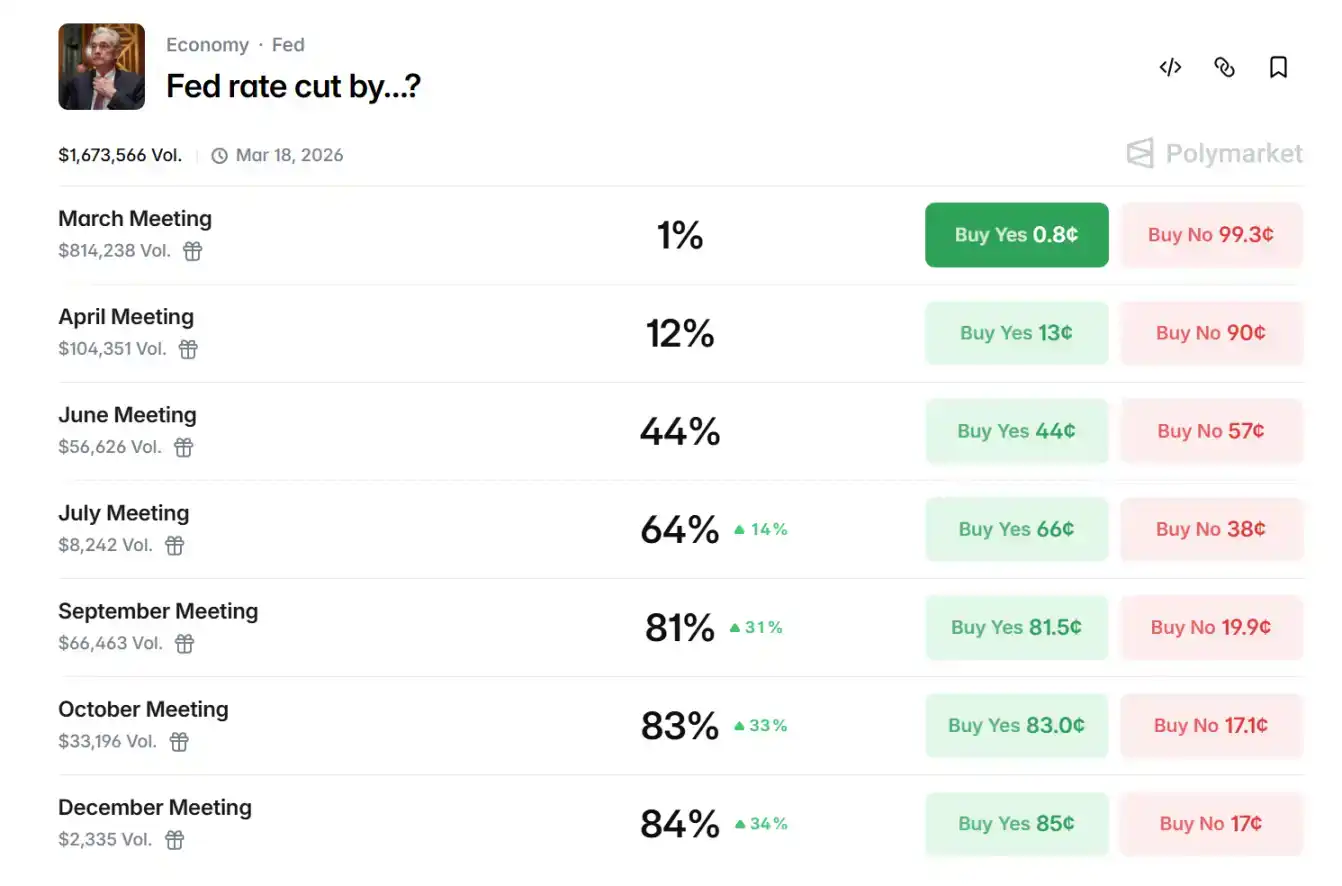
Data from Polymarket shows that the market is currently betting on an 81% probability of a rate cut in September this year, a 64% probability in June, and a 12% probability in April.

Looking ahead to the second half of the year, the Fed's rate cut path remains uncertain. The evolution of the war, inflation trajectory, and employment data will be key variables. If energy prices continue to rise, the Fed may choose to extend the high-interest-rate cycle; conversely, if geopolitical risks ease and core inflation declines, it could open the door for one or two rate cuts. For crypto assets, maintaining high interest rates will continue to suppress risk appetite and valuations, but once a clear signal of rate cuts emerges, market liquidity will recover, providing momentum for Bitcoin's price rise.

Hormuz Strait Becomes Focus, Oil Crisis Imminent

The simultaneous U.S.-Iran military conflict further complicates the policy balance.

On February 28, the U.S. and Israel launched a joint airstrike on Iran. The conflict has lasted nearly two weeks, involving multiple rounds of strikes, energy facility risks, and regional chain reactions. Iran's potential control over the Hormuz Strait has raised global energy supply concerns, with the CPI energy component's month-on-month rebound being an initial reflection.

Iran's Islamic Revolutionary Guard Corps (IRGC) explicitly warned that it would not allow "a single liter of oil" to pass through the Hormuz Strait and claimed that if the blockade continues, oil prices could soar to $200/barrel. The Strait, as a global energy chokepoint, is effectively closed. Satellite data shows most oil tankers are stranded or detouring on both sides of the Strait. Iranian broadcasts warn that any ship attempting to pass will be attacked. The U.S. Navy provides limited escort coverage, leading to a sharp decline in actual traffic.

The Hormuz Strait carries approximately 20 million barrels of crude oil and petroleum products daily, accounting for about 20% of global oil consumption and one-fifth of global seaborne liquefied natural gas (LNG), mainly from exports by Saudi Arabia, Iraq, the UAE, Kuwait, and Iran itself, with destinations primarily in Asia (led by China, India, Japan, and South Korea). Once this bottleneck is cut off, a structural gap in global supply immediately emerges.

From a macroeconomic transmission mechanism perspective, the U.S.-Iran conflict systematically constrains the Fed's rate cut path through the core channel of oil prices. First, the conflict directly impacts global oil supply security. The Hormuz Strait handles about 21% of global seaborne oil trade. Any shipping disruption risk or military threats will immediately push up risk premiums, leading to significant upward pressure on international oil prices. Iran has threatened to maintain the blockade if the conflict persists. Analysts warn that prices could test the $120-150/barrel range in the short term, or even higher; in the long term, if the Strait remains closed for weeks, it could recreate a 1970s-style energy shock,叠加 cost-push inflation.

Historical cases clearly support this logic: During the 1990 Gulf War, soaring oil prices led the Fed to pause its easing cycle; after the 2011 Middle East turmoil and the 2022 Russia-Ukraine conflict, energy price shocks forced the Fed to maintain a tightening stance or delay easing. Although the current U.S.-Iran situation has not yet evolved into a full-blown energy crisis, its persistent disturbance to oil prices is enough to make the FOMC more conservative in assessing financial conditions and inflation prospects, avoiding any easing signals that could amplify risks.

Market data shows that on March 12, Brent crude futures returned above the $100 mark, rising nearly 9% intraday. WTI crude oil is currently at $93.52, up over 8% intraday.

What’s Next for BTC

Since October 2025, Glassnode on-chain data shows that the 7-day exponential moving average for short-term holders has remained below 1, currently at 0.985, confirming that recent buyers are selling at a loss—a typical characteristic of a bear market phase.
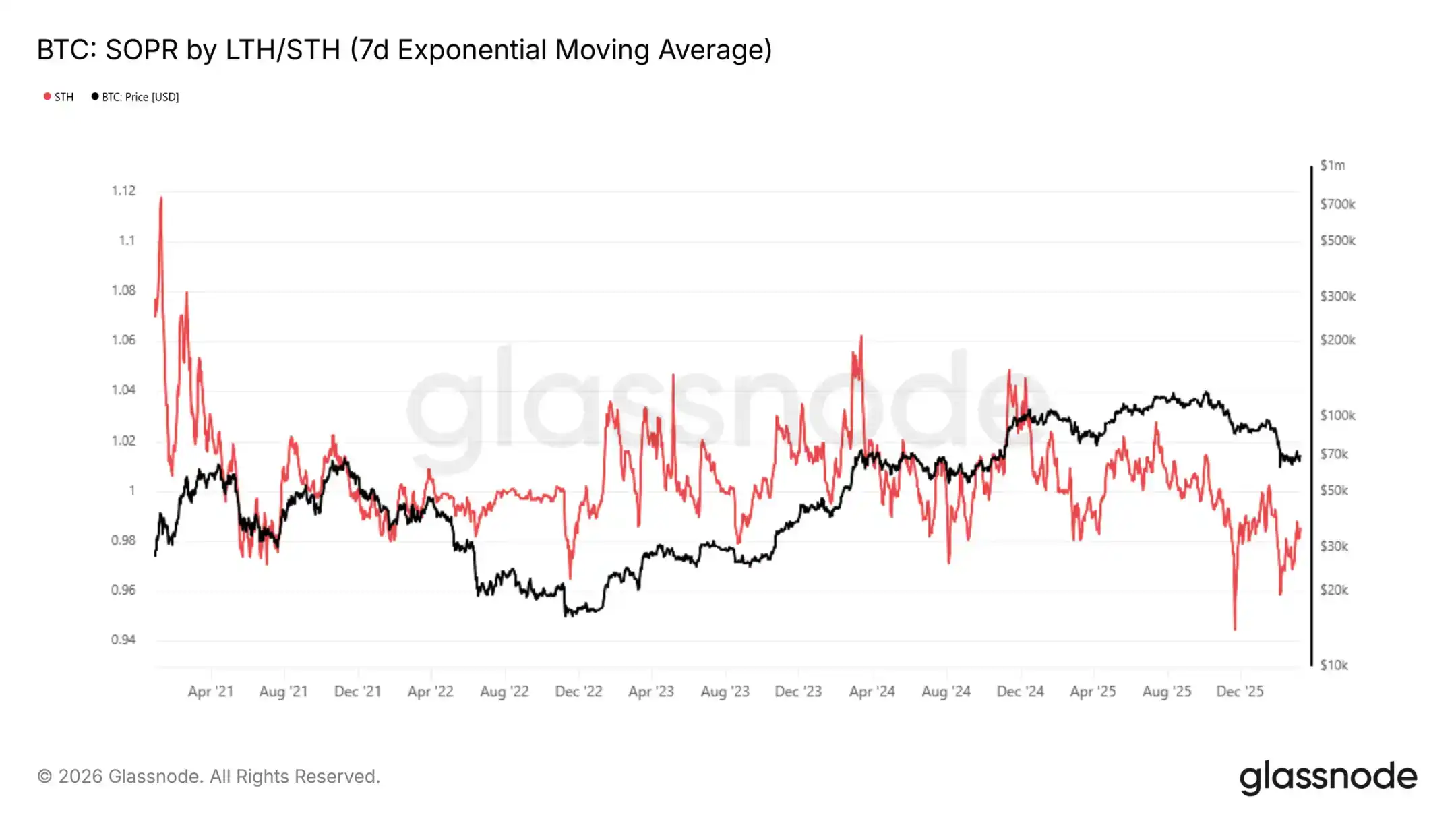
Prices continue to be constrained between the realized price of $54,400 and the true market average price of $78,400. Before decisively stabilizing above $70,000, returns show a明显的 negative skew.

Wintermute stated that macro factors are currently dominating everything, but cryptocurrencies showed resilience last week while stocks, bonds, and even gold fell. The high correlation between cryptocurrencies and stocks in recent quarters is beginning to show cracks. The most likely explanation is that marginal sellers are scarce. The leverage scale in the cryptocurrency market is about $60 billion, roughly half of the peak level. In contrast, speculative positions in gold have accumulated significantly. When all assets fall, cryptocurrencies need to absorb much less forced selling pressure.

From a 12-18 month cycle perspective, the current price level is quite attractive, although the range where BTC buyers are willing to enter extends from the current price down to the low $50,000s. The market still has room to fall further, but most of the deleveraging phase seems to be over. Currently, cryptocurrencies are holding their ground and narrowing the performance gap with other risk assets. Whether this trend can continue once trading volume recovers remains to be seen. Next week's FOMC meeting is a near-term catalyst.

For precious metals, according to Bitget market data, gold is currently oscillating around $5,153, while silver is hovering around $85. The U.S. dollar index (DXY) is currently fluctuating in the 99.35-99.48 range. For U.S. bonds, the 10-year Treasury yield is about 4.21%-4.25%, with a slight intraday increase.
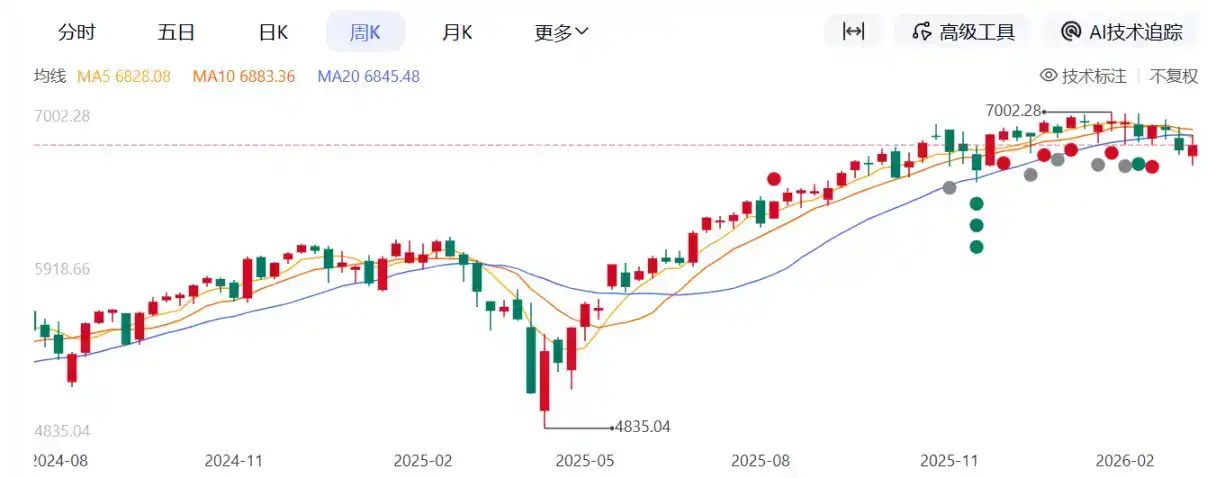
The S&P 500 index is still correcting, currently at 6,775.8. The Nasdaq index is up slightly, currently at 22,716.


Perguntas relacionadas

QWhat was the year-over-year CPI inflation rate reported for February, and how did it compare to January?

AThe year-over-year CPI inflation rate for February was 2.4%, which was unchanged from January.

QAccording to the article, what is the primary macroeconomic mechanism through which the US-Iran conflict is impacting the Federal Reserve's potential interest rate cuts?

AThe conflict is impacting the Fed's rate cut path through its effect on oil prices. A blockade or threat to the Strait of Hormuz creates a risk premium and pushes international oil prices higher, which can lead to cost-push inflation and force the Fed to maintain a more conservative, higher-for-longer interest rate stance.

QWhat specific warning did the Iranian Islamic Revolutionary Guard Corps (IRGC) issue regarding the Strait of Hormuz?

AThe IRGC warned that it would not allow "a single liter of oil" to pass through the Strait of Hormuz and declared that any ship attempting to pass would be attacked.

QBased on Polymarket data cited in the article, what was the probability the market was assigning to a Federal Reserve rate cut in June at the time of writing?

AAccording to Polymarket data, the probability of a rate cut in June was 64%.

QWhat does the article suggest is a key difference between the current state of the cryptocurrency market and traditional markets like stocks and gold?

AThe article suggests that the cryptocurrency market is showing resilience and a decoupling from traditional assets. It states that while stocks, bonds, and gold were falling, crypto held its ground, partly because its leverage has been reduced to about half its peak, meaning there is less forced selling pressure to absorb compared to gold, which has seen a large buildup of speculative positions.

Leituras Relacionadas

Annual Salary of Millions Competing for Electricians, Meta Rushes to Open Its Own Technical School

The AI boom is facing an unexpected bottleneck: a severe shortage of skilled construction workers and electricians. As tech giants like Meta, OpenAI, and Alphabet race to build massive data centers—such as OpenAI's $16 billion "Stargate" project—they are hitting a critical labor wall. The U.S. needs an estimated 130,000 more electricians, 240,000 construction workers, and 150,000 supervisors by 2030 for AI infrastructure alone, but tens of thousands of electrician jobs go unfilled each year. While AI companies offer high premiums, with electricians earning up to $280,000 annually, worker scarcity still causes massive losses—delays on a single project can cost $14.2 million per month. The complexity of building AI data centers, which require immense power (equivalent to powering hundreds of thousands of homes), sophisticated electrical systems, and advanced liquid cooling solutions, demands highly skilled technicians who are in short supply. To combat this, companies are investing heavily in training. Meta has committed $115 million to a free training school offering tuition, housing, and stipends, targeting 5,000 new workers. OpenAI is partnering with unions to secure skilled labor. These efforts are paying off, with a significant rise in Gen Z interest in trade schools over college. However, the power demands are staggering. AI data centers are driving a rapid surge in electricity consumption, projected to account for up to 12% of U.S. power use by 2028 and raising costs for consumers. Furthermore, the construction boom is project-based, leading to a potential future glut of trained workers once building peaks, which could depress wages industry-wide. The race for AI supremacy now depends as much on skilled hands as on advanced chips.

marsbitHá 56m

Annual Salary of Millions Competing for Electricians, Meta Rushes to Open Its Own Technical School

marsbitHá 56m

OpenAI No Longer Sells Its Most Expensive Model for Profit

OpenAI is shifting its business strategy away from promoting its most expensive, flagship models for every task. Recent price cuts—80% for GPT-5.6 Luna and 20% for Terra—signal a deeper change: the company now actively advises users that many tasks don't require the most powerful model. Instead, OpenAI recommends a tiered approach: use the high-end GPT-5.6 Sol for complex planning and analysis, then delegate execution to cheaper models like Luna. This mirrors moves by Anthropic, which recently launched Claude Opus 5 at half the price of its top model, Fable 5. Both companies are de-emphasizing flagship models as primary revenue drivers, using them instead for brand prestige and technological showcases. The industry is entering a "mass-market" phase, similar to automotive, where high-volume, cost-effective models handle daily operations and drive scale. OpenAI's price reductions are partly enabled by AI models themselves optimizing underlying code and infrastructure, creating a self-reinforcing cycle of efficiency gains and cost reduction. Competition is shifting from "who is smartest" to "who offers the best value." The goal is no longer selling individual models but fostering widespread API adoption and ecosystem lock-in. By making AI calls cheap and ubiquitous, companies like OpenAI aim to become the indispensable, utility-like infrastructure powering automated workflows—the "water and electricity" of software, quietly embedded everywhere.

marsbitHá 56m

OpenAI No Longer Sells Its Most Expensive Model for Profit

marsbitHá 56m

Will the Fed Definitely Raise Interest Rates in September? How Will Crypto and U.S. Stocks Withstand the Pressure?

The market's expectation for a September Fed rate hike surged dramatically in early August, jumping from under 50% to over 80% within a week. This shift followed a contentious July FOMC meeting, where a 9-3 vote to hold rates revealed growing dissent from hawkish members advocating for an immediate hike to combat persistent inflation. The primary catalyst for this repricing is rising oil prices, driven by renewed geopolitical tensions around the Strait of Hormuz, which threaten global supply. Energy costs directly influence inflation metrics, making the upcoming July CPI report (due August 12th) a critical data point. If it shows inflation reaccelerating, the probability of a September hike will solidify. For Bitcoin and crypto assets, this is typically bearish news. Bitcoin continues to behave as a high-beta, liquidity-sensitive risk asset. A rate hike raises the opportunity cost of holding non-yielding assets and could drive capital toward money markets, pressuring crypto prices in the short term. However, historical patterns suggest that if a hike is perceived as the end of a tightening cycle rather than the start, any negative price impact may be brief. U.S. stocks, particularly crypto-linked equities like Coinbase and growth-oriented tech stocks, are also vulnerable. Higher rates increase discount rates in valuation models, putting pressure on high-multiple companies. This coincides with a pivotal tech earnings season where investor focus has shifted from massive AI capital expenditure to tangible revenue and cash flow generation. Companies with negative cash flow and weak growth narratives could face heightened volatility if borrowing costs rise in September. In summary, a September Fed hike has evolved into a mainstream market scenario. Key factors to watch are oil prices, the July CPI report, and Fed communications, which will determine the final decision and its impact on volatile crypto and equity markets.

marsbitHá 1h

Will the Fed Definitely Raise Interest Rates in September? How Will Crypto and U.S. Stocks Withstand the Pressure?

marsbitHá 1h

Trading

Spot
活动图片




