HongKongDoll Reveals Conditions of Opinion's $100 Million Valuation KOL Round; Hot Project Mired in 'Rug' Controversy

marsbitPublicado em 2026-03-04Última atualização em 2026-03-04

Resumo

The prediction market project Opinion (OPN), one of the most anticipated TGEs in early 2026, faced significant backlash from the community following its token distribution announcement. Despite strong backing from top VCs including YZi Labs (formerly Binance Labs), Hack VC, and Jump Crypto, and its position as a leading platform in the prediction market niche, the airdrop allocation disappointed many users. Although 23.5% of the total 1 billion OPN supply was designated for airdrops, only 3.5% was unlocked at TGE, with the remainder vested over 7 months. In contrast, insiders—including the team, advisors, and investors—collectively held over 54% of tokens. Many users reported losses, with some estimating that their airdropped tokens were worth far less than their initial investment. High-profile KOLs like HongKongDoll publicly shared their negative returns, further fueling community anger. Additional frustration arose from last-minute Sybil account purges and the perception that Binance received disproportionately favorable treatment, with its Launchpool allocation fully unlocked at TGE. While the project's fundamentals remain strong, the incident has severely damaged community trust, with many labeling the event a "rug" or "scam." Rebuilding user confidence is now Opinion's most pressing challenge.

If we were to vote for the most anticipated TGE in the crypto space in early 2026, the prediction market Opinion (OPN) would likely be a top contender.

This project has almost all the elements to become a market sensation: top-tier VC backing, a hot sector, strong ties to the Binance ecosystem, and the prediction market narrative, which has been one of the hottest trends in recent years, attracting immense attention even before its launch.

The funding lineup is nothing short of stellar. Opinion Labs has raised a total of $25 million across three rounds: an initial angel round in August 2024, a $5 million Seed round led by YZi Labs (formerly Binance Labs) in March 2025, and a $20 million Pre-Series A round in February this year, attracting top-tier institutions like Hack VC, Jump Crypto, and Primitive Ventures.

Hack VC is a well-known fund in the crypto space focused on AI and DeFi, having early investments in Anthropic; Jump Crypto is a key pillar of the Solana ecosystem with assets under management in the tens of billions. The simultaneous backing from these two institutions is itself a strong market signal. Meanwhile, YZi Labs (formerly Binance Labs) participated in both the angel and Seed rounds without missing a beat, directly paving the way for Opinion's listing within the Binance ecosystem.

The timing of the sector choice is impeccable. Continuous funding for Polymarket and Kalshi, partnerships with mainstream media, and soaring trading volumes have made prediction markets one of the hottest crypto narratives since 2025. Opinion, deeply entrenched in the BSC ecosystem, has long ranked among the top three prediction markets by TVL, emerging as an early leader in this wave.

The market's high expectations for prediction markets are also evident in the resource allocation. Binance set up a dedicated Launchpool for OPN, allocating 2% of the supply for BNB/USDC staking mining. Pre-market trading saw prices surge over 30%, hitting a high of $0.57. Binance's endorsement solidified OPN's market position even before its official launch.

With all these positive factors combined, Opinion was listed by many as a must-farm project for Season 1 airdrops, with numerous users investing real money in hopes of a substantial return from this highly anticipated project.

However, when the airdrop query page went live, community expectations turned to disappointment, which quickly escalated into anger.
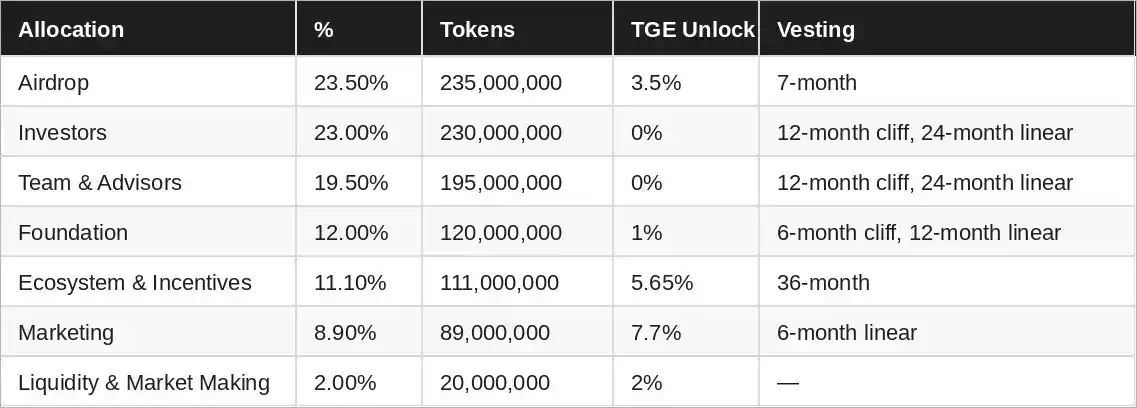
OPN has a total supply of 1 billion tokens. On the surface, the airdrop allocation of 23.5% (235 million tokens) doesn’t seem low. The problem, however, is that only 3.5% (35 million tokens) were unlocked on TGE day, with the remainder to be released over 7 months linearly. For the vast majority of farming users, the immediate rewards were far less than expected.

Meanwhile, another set of data pushed community sentiment over the edge: the team and advisors hold a combined 19.5%, investors hold 23%, and the foundation holds 12%—insiders collectively hold over 54% of the tokens, while all the hardworking community users only get 3.5% on TGE day.

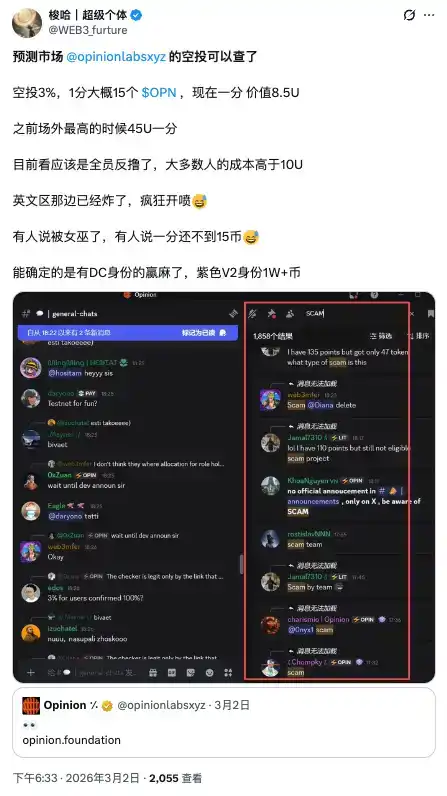
Actual user returns were dismal. Multiple participants publicly shared their scores and earnings. Influencer Suoha (@WEB3_furture) summarized: "Airdrop 3%, one point is about 15 OPN, now worth $8.5 per point. At its peak OTC, it was $45 per point. It looks like everyone got rugged; most people's costs were above $10 per point."
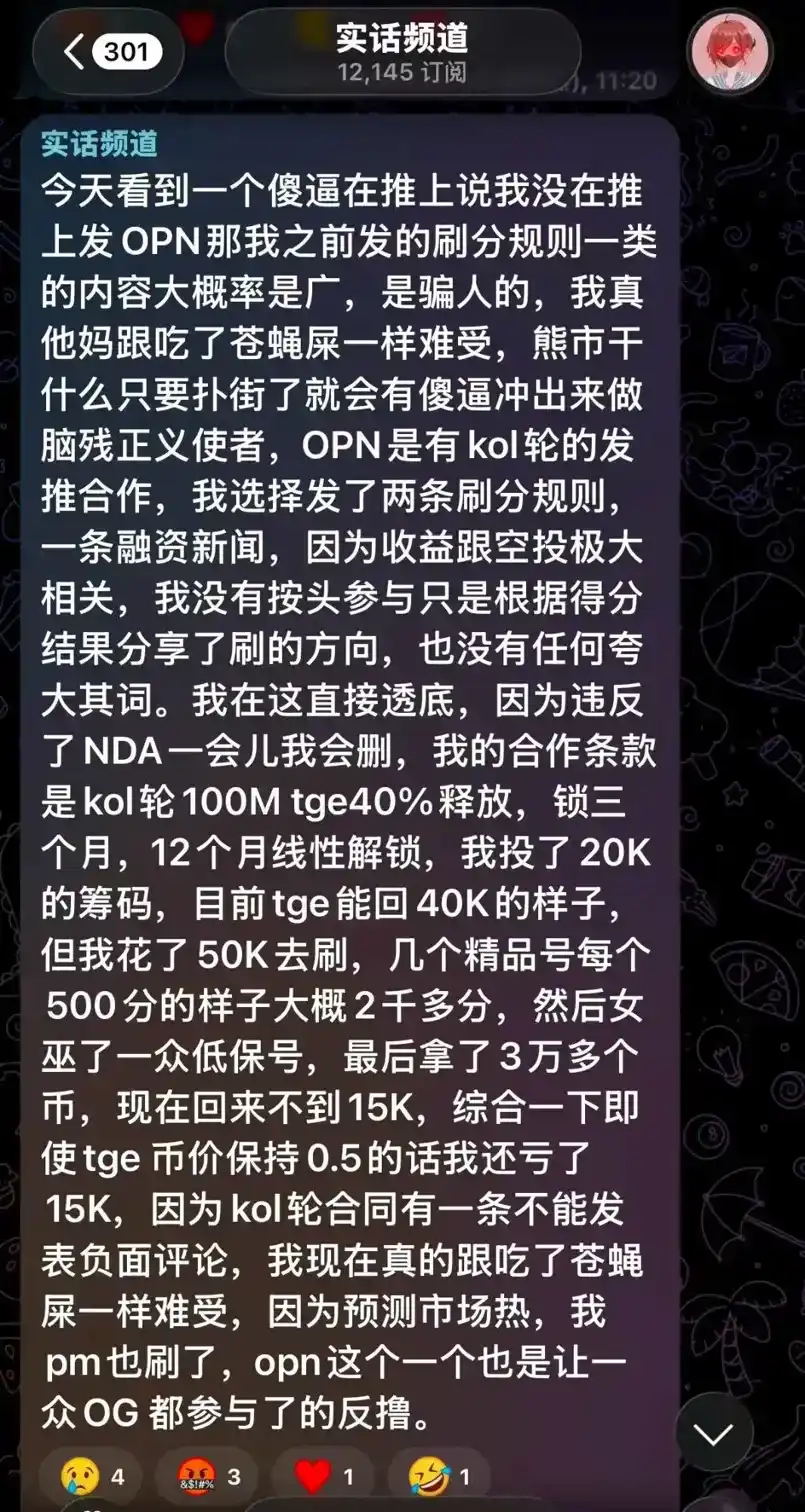
HongKongDoll, who has participated in many crypto projects, complained about her Telegram channel regarding her KOL round cooperation terms and farming data. Although the KOL round cooperation yielded definite returns, she invested $50,000 in farming. Each premium account had about 500 points, and she ultimately received just over 30,000 OPN. Calculated at the TGE price of $0.5, she recouped less than $15,000. Even including the unlocked returns from the investment, she overall lost $15,000. She bluntly stated: "I feel as disgusted as if I’d eaten fly droppings."
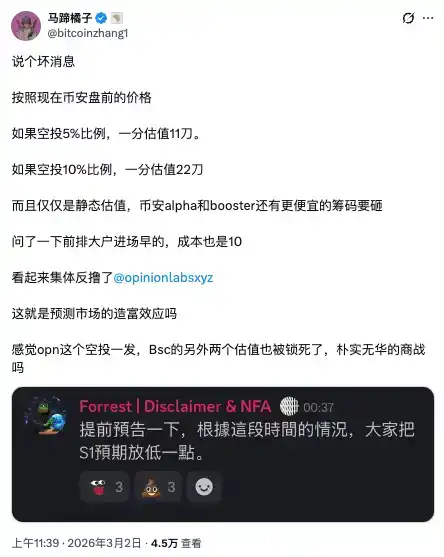
Another KOL, Mati Orange (@bitcoinzhang1), pointed out: "Based on Binance’s pre-listing price, if the airdrop ratio were 5%, one point would be valued at $11; if it were 10%, one point would be $22. And that’s just the static valuation; Binance alpha and booster have even cheaper筹码 to dump...... It seems like a collective rug."
Sybil attacks sparked a new wave of controversy. Beyond the allocation ratio itself, the project team’s large-scale crackdown on Sybil accounts and multi-account operations just before TGE led to many farming users having their points slashed or disqualified. While this move is justified in principle, the execution method and timing left the community feeling dissatisfied: during the farming period, the project team tacitly allowed or even encouraged high-frequency participation, only to start a concentrated crackdown on the eve of TGE. This was interpreted by many as a "use and discard" strategy, further deepening the impression of a "rug pull."

Binance’s allocation became a major point of criticism. Compared to the community’s mere 3.5% unlocked at TGE, the Binance Launchpool directly received 2% of the supply, with the marketing portion having a 7.7% TGE unlock ratio, and the liquidity portion being 100% unlocked. This contrast led many to conclude directly: "Opinion only airdropped 3% to users but gave a huge amount of筹码 to Binance." The community widely perceives this as a typical allocation method that "favors the exchange at the expense of the community."

On Discord and Twitter, discussions about Opinion were quickly filled with intense words like "scam" and "rug." The English-speaking community also erupted. KOLs publicly shared their loss statements, and negative sentiment continued to ferment.

It is worth noting that the project’s fundamentals are not fundamentally problematic—$25 million in funding, backing from Hack VC and Jump Crypto, and a leading position in the BSC prediction market are all objective advantages. However, even the strongest funding lineup can hardly弥补 the damage once community trust collapses.

When "welcoming data farming initially, then pulling the rug after launch" becomes the community consensus, the biggest challenge Opinion faces may no longer be market cap management, but how to rebuild basic trust with its users.


Perguntas relacionadas

QWhat is the total supply of Opinion (OPN) tokens and what percentage was allocated for the airdrop?

AThe total supply of Opinion (OPN) tokens is 1 billion. The airdrop allocation was 23.5% (235 million tokens).

QWhy did the community become angry about the OPN airdrop distribution?

AThe community was angry because only 3.5% (35 million tokens) of the total airdrop allocation was unlocked at TGE, with the rest vested over 7 months. This was a much lower immediate distribution than expected, especially compared to the 54% of tokens allocated to insiders (team, advisors, and investors) who received a larger share.

QWhich major venture capital firms invested in Opinion Labs?

AMajor venture capital firms that invested in Opinion Labs include YZi Labs (formerly Binance Labs), Hack VC, Jump Crypto, and Primitive Ventures.

QWhat was the financial outcome for the KOL HongKongDoll (玩偶姐姐) from her participation in the OPN airdrop?

AHongKongDoll invested $50,000 to farm points and received just over 30,000 OPN tokens. At the TGE price of $0.50 per token, her return was less than $15,000, resulting in an overall loss of approximately $15,000, even when including returns from her KOL partnership.

QWhat was a major point of controversy regarding Binance's role in the OPN token launch?

AA major controversy was the perceived unfair allocation favoring Binance. The Binance Launchpool received 2% of the total token supply, and the marketing allocation had a 7.7% TGE unlock, while the community airdrop only had a 3.5% unlock at TGE. This led to accusations that the project favored the exchange over its community users.

Leituras Relacionadas

Will the Fed Definitely Raise Interest Rates in September? How Will Crypto and U.S. Stocks Withstand the Pressure?

The market's expectation for a September Fed rate hike surged dramatically in early August, jumping from under 50% to over 80% within a week. This shift followed a contentious July FOMC meeting, where a 9-3 vote to hold rates revealed growing dissent from hawkish members advocating for an immediate hike to combat persistent inflation. The primary catalyst for this repricing is rising oil prices, driven by renewed geopolitical tensions around the Strait of Hormuz, which threaten global supply. Energy costs directly influence inflation metrics, making the upcoming July CPI report (due August 12th) a critical data point. If it shows inflation reaccelerating, the probability of a September hike will solidify. For Bitcoin and crypto assets, this is typically bearish news. Bitcoin continues to behave as a high-beta, liquidity-sensitive risk asset. A rate hike raises the opportunity cost of holding non-yielding assets and could drive capital toward money markets, pressuring crypto prices in the short term. However, historical patterns suggest that if a hike is perceived as the end of a tightening cycle rather than the start, any negative price impact may be brief. U.S. stocks, particularly crypto-linked equities like Coinbase and growth-oriented tech stocks, are also vulnerable. Higher rates increase discount rates in valuation models, putting pressure on high-multiple companies. This coincides with a pivotal tech earnings season where investor focus has shifted from massive AI capital expenditure to tangible revenue and cash flow generation. Companies with negative cash flow and weak growth narratives could face heightened volatility if borrowing costs rise in September. In summary, a September Fed hike has evolved into a mainstream market scenario. Key factors to watch are oil prices, the July CPI report, and Fed communications, which will determine the final decision and its impact on volatile crypto and equity markets.

marsbitHá 13m

Will the Fed Definitely Raise Interest Rates in September? How Will Crypto and U.S. Stocks Withstand the Pressure?

marsbitHá 13m

A 'Overlooked' Market Event: Joint US-Japan-South Korea Intervention, Rare US Treasury Involvement, and Bessent's Quiet 'Market Rescue'?

Summary: The United States, Japan, and South Korea executed their largest coordinated foreign exchange intervention in nearly 30 years. The action targeted depreciation pressure on the Japanese yen and South Korean won. This move is seen as a significant effort by the US to stabilize the financial markets of its key allies and prevent the spillover of risks. Key details: * Japan reportedly intervened on July 30 using approximately 8.45 trillion yen (about $52.8 billion). South Korean authorities also intervened that day, selling dollars to support the won. * Notably, the US Treasury Department intervened directly in yen markets for the first time in roughly 30 years. The New York Fed, reportedly acting on behalf of the Treasury, sold euros to buy yen via Goldman Sachs and Morgan Stanley on July 31. Analysts view the use of the euro-yen pair as a way to alleviate yen pressure without adding selling pressure to the US dollar. * Prior to the action, the New York Fed conducted "rate checks" on both USD/JPY and EUR/JPY, a newer signaling tool that falls between verbal and physical intervention. The intervention is interpreted as going beyond traditional currency stabilization. Analysts, such as Michael Hartnett of Bank of America, suggest it resembles a "Price Keeping Operation" for the AI era. The core US objectives are perceived to be: 1. Preventing rapid yen depreciation from triggering a sharp rise in Japanese government bond yields. 2. Containing financial stress from spreading across Asian markets like South Korea and Japan. 3. Reducing the risk of disorderly capital flows impacting the US bond market. This coordinated action underscores the importance of Japan and South Korea as critical partners in the US semiconductor and AI supply chain. Stabilizing their financial markets is seen as vital to mitigating risks to the broader tech industry and the US market itself. The intervention coincides with market pressures, including the KOSDAQ index hitting a low since October 2022. While seen as a move to control volatility, some analysts caution it may not fundamentally reverse existing market trends.

marsbitHá 17m

A 'Overlooked' Market Event: Joint US-Japan-South Korea Intervention, Rare US Treasury Involvement, and Bessent's Quiet 'Market Rescue'?

marsbitHá 17m

Will the Federal Reserve Definitely Raise Interest Rates in September? How Will Cryptocurrencies and US Stocks Bear the Pressure?

In early August 2024, market expectations for a September Federal Reserve rate hike surged dramatically, from below 50% to over 80%, driven by renewed inflation concerns. This shift followed a contentious July FOMC meeting where a 9-3 vote to hold rates revealed a growing hawkish faction advocating for an immediate hike, citing prolonged above-target inflation. The key catalyst is escalating conflict near the Strait of Hormuz, which has pushed oil prices up approximately 20% in July, threatening to reignite inflation. The next critical data point is the July CPI report on August 12th; a hot reading could solidify hike expectations. For crypto assets, particularly Bitcoin, this represents near-term pressure. Bitcoin continues to exhibit high-beta, risk-on characteristics, making it sensitive to tightening liquidity and higher opportunity costs. However, historical precedent suggests that if a hike is perceived as the cycle's end rather than its start, the negative impact may be brief, with markets quickly pivoting to anticipate future rate cuts. U.S. stocks, especially crypto-linked equities like Coinbase and high-valuation tech stocks, face amplified volatility. Higher rates increase discount rates in valuation models, pressuring growth stocks. This coincides with a pivotal tech earnings season where investor focus has shifted from massive AI capital expenditures to demonstrable revenue and cash flow generation. Companies with negative cash flows and weak growth narratives could see severe pressure if a September hike materializes, as financing costs would rise. Key indicators to watch include oil prices, upcoming inflation data, and Fed commentary at events like the Jackson Hole symposium.

Odaily星球日报Há 17m

Will the Federal Reserve Definitely Raise Interest Rates in September? How Will Cryptocurrencies and US Stocks Bear the Pressure?

Odaily星球日报Há 17m

Trading

Spot
活动图片




