Hidden Landmines Beneath the AI Boom: Hints of the Next 'Subprime' Crisis

marsbitPublicado em 2026-08-10Última atualização em 2026-08-10

Resumo

The article warns of a potential "AI subprime" crisis brewing beneath the rapid growth of AI infrastructure. Unlike the dot-com bubble fueled by equity, the current AI boom is largely debt-financed, resembling a real estate development cycle. Tech giants like OpenAI sign massive, multi-year "take-or-pay" contracts for computing power, which cloud providers then use as collateral to secure debt for building data centers. This creates a fragile chain reliant on continuous refinancing, as many AI labs are not yet profitable. The structure is dangerously similar to the 2008 financial crisis: long-term commitments ("shadow loans") are packaged into asset-backed securities, while underlying cash flows depend on unproven, future AI demand. Key players like Amazon and Google have seen free cash flow turn negative, shifting them toward debt-dependent financing models. The core risk is a mismatch: AI's rapid technological obsolescence and uncertain profitability are combined with the high leverage and cyclical risks of real estate. A slowdown in the growth *rate* (a negative second derivative) of AI demand could trigger a debt crisis, as lenders pull back when refinancing becomes unsustainable. The article concludes that while AI's long-term promise remains, its medium-term danger is a debt bubble inflated by capital expenditure outpacing genuine revenue.

The AI industry is still primarily driven by large-scale infrastructure build-out, funded largely by debt. This is a key difference from the Internet bubble era, which relied mainly on equity financing.

The bursting of the Internet bubble in 2000 triggered a stock market crisis. If a future AI bubble bursts, the initial shock would likely occur in the bond market. However, this doesn't mean the stock market would be immune, as the 2008 financial crisis was ignited by the subprime mortgage crisis.

The difference lies in the speed of the collapse.

The 2000 dot-com bust involved a valuation collapse—a linear process with massive daily trading volume, allowing investors to sell at any time. A bear market could last years. Equity is patient capital; investors can hold on, waiting for companies to recover.

In contrast, debt exhibits negative convexity. No matter how well a company performs, creditors only receive fixed interest payments. But if performance deteriorates, they face potentially unlimited losses. Therefore, debt covenants have binary, hard triggers—it's either 0 or 1, with no middle ground. Either a company can successfully refinance, appearing as if nothing is wrong, or it can quickly face asset seizures, with bond prices plummeting to zero in days.

A simple example: the accounting figure "Remaining Performance Obligations" (RPO). An equity investor might treat it as future revenue and assign some valuation. But a debt investor would scrutinize who will fulfill these future orders and how.

The current debt chain in AI infrastructure roughly follows this pattern:

Leading AI labs like OpenAI sign contracts with Microsoft, committing to pay hundreds of billions over several years for computing power. However, OpenAI lacks sufficient cash, so this is essentially a "financed order," similar to an airline's aircraft leasing financing.

The major cloud providers, data centers, and computing leasing companies then use these contracts as collateral to borrow from private institutions, raising funds for data center construction and GPU procurement.

Stripping away the AI hype, AI infrastructure is essentially a chain of credit leverage. Financial institutions advance capital for buildings full of chips, with data centers as collateral and AI lab contract payments as debt service. This structure functions only if the AI labs at the order's origin can continuously fund these payments.

But for an unprofitable company, where revenue (ARR) is less than expenditure (orders), it must rely on constant fundraising to survive.

If you were a bond analyst, seeing a company losing tens of billions annually, surviving only through continuous refinancing, these "remaining performance obligations" are essentially subprime commitments used to justify massive, not-yet-depreciated capital expenditures.

Naturally, this brings to mind the subprime mortgage crisis that triggered the 2008 financial crash.

In just a few years, OpenAI has committed to unprecedented computing costs, with total debt potentially reaching trillions—unprecedented in corporate history. Roughly half of the approximately $2.1 trillion in backlogged contracts held by the top five cloud platforms are commitments from OpenAI and Anthropic, an unprecedented level of concentration.
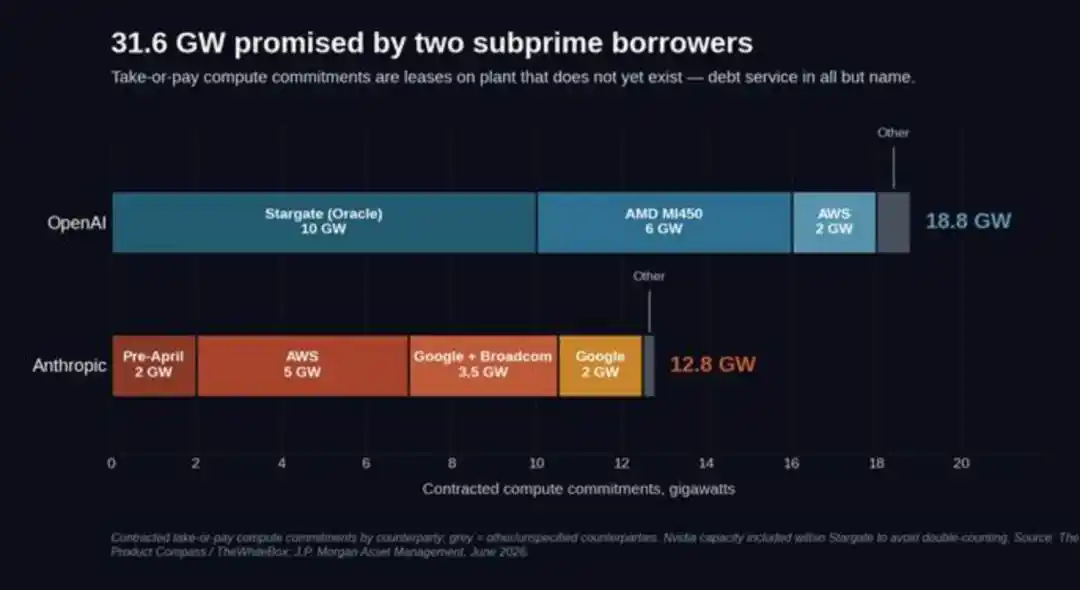
Corresponding to this debt is an operational business with unpredictable profitability. While its revenue is real, large, and growing rapidly, its only hope for success is continuously finding explosive growth avenues like coding. This is a century-spanning gamble dragging even tech giants into the fray.

Thus, the true root of this potential crisis is that AI, as a technological revolution, is being funded through a very traditional, credit-driven real estate finance model.

Yes, AI infrastructure is essentially real estate. That's why, after studying the 2000 dot-com bust in the previous piece "The Last 120 Days of the Tech Bubble," we now examine 2008.

2/4

The Real Estate Core of the AI Industry

Technological revolutions and real estate cycles should be worlds apart.

Tech revolutions are driven by innovation and adoption rates, high-risk with high potential rewards upon success, making them most suitable for equity financing like venture capital.

Real estate cycles are mechanical, value determined by land and space, with fixed profits. Future income can be locked in via commercial leases or pre-sales. Long investment horizons and massive capital requirements make them most suitable for debt financing.

But scrutinizing AI infrastructure reveals its every characteristic mirrors real estate development:

Building data centers on approved land requires massive upfront investment, necessitating debt financing from the start—akin to a development loan.

Then, signing "take-or-pay" contracts with large clients and using these contracts as collateral for more funding—akin to later-stage project financing.

"Take-or-pay" contracts: e.g., an AI company commits to buying $100 million in computing power annually for 5 years. Even if model training demand is lower or user growth lags, payment is mandatory. This is because data center investment is huge; builders need predictable future cash flow. It's similar to office towers or malls securing anchor tenants before applying for bank loans.

It doesn't end there. After purchasing and installing GPU racks, cloud providers mortgage them for GPU financing to support operations—akin to commercial real estate operational loans.

But the financing value isn't fully extracted. The final step for cloud providers and data centers is issuing "Asset-Backed Securities" (ABS), packaging future cash flows to sell to insurers, pension funds, and other conservative investors—somewhat similar to real estate REITs.

ABS-packaged assets were precisely what allowed subprime mortgage risks to spread from real estate to the entire financial system.

This is essentially the universal playbook for all capital-intensive industries: using layered collateral, packaging future cash flows, and completing construction with leveraged funds. It has nothing to do with being a tech company or a technological revolution.

But applying this to cutting-edge tech like AI creates problems.

Both real estate and tech experience bubbles, but their causes are entirely different.

Tech bubbles stem from new technologies being too far ahead of their time or lacking large-scale real demand, causing their value to plummet.

Real estate bubbles result from cyclical mismatches. Investment peaks typically occur during economic booms, with financing amounts based on linear extrapolations of boom-time cash flows. Long construction cycles mean projects often become operational when the market is already oversupplied, generating insufficient cash flow to service debt, triggering a crisis.

The associated risks are also completely different:

The primary risk in tech investment is product failure. High upfront R&D costs, but high barriers if successful.

The risk in real estate investment lies on the balance sheet—leverage risk. Land value depends on location, fluctuating but rarely disappearing entirely, with slow depreciation. The key is that leverage doesn't break before the next cycle arrives.

Therefore, "AI + infrastructure" is even more dangerous, combining the inherent technology risk of tech investment with the leverage risk of real estate. Its data centers are specialized assets with limited alternative uses. The mortgaged GPU clusters face rapid technological obsolescence, potentially losing significant value in just two years. ABS assets packaged from AI operating income are based on theoretical future revenue.

Moreover, amid the "arms race" of capital expenditure, the current financing pace mirrors real estate bubble dynamics. Assuming AI computing demand grows 50% annually, financing is also based on this cash flow projection.

This is similar to land auctions in recent years: with nearby二手房 (secondary housing) at 100,000 per square meter, developers dared bid 120,000 for land, believing prices would rise to 120,000 by project completion.

Cloud providers are increasingly becoming real estate companies in the computing business, at least in their financial structure, rather than traditional internet firms.

Of course, this risky financing game persists mainly because the top five cloud providers are among the world's highest-valued companies, each with a core business generating massive cash flow. Investors don't believe these tech giants could face a debt crisis.

But consider: why was China Vanke long considered a premium blue-chip stock in the A-share market? Because real estate's primary risk stems from debt, even off-balance-sheet debt. They rarely raise equity and compensate shareholders with high dividends (essentially a small compensation for high leverage). Their risk is non-linear: as long as debt doesn't blow up, they remain premium blue-chips; once debt implodes, they become worthless overnight.

We must understand that debt accumulation is a linearly increasing mathematical process. Greater strength only means a longer pre-crisis period. Technological revolution is a non-linear process, potentially accelerating suddenly or stalling abruptly. Expecting the latter to solve the former's problems is like assuming the hare, prone to naps, will always win the race against the tortoise.

Bond investors are the world's most pessimistic group. They become alert when the second derivative of growth declines, never waiting for the hare to fall asleep.

3/4

Why the Second Derivative Matters More

Conventionally, the 2008 subprime crisis is attributed to lax lending standards, falling home prices causing borrowers to become underwater, subsequent defaults, and the eventual blow-up of ABS securities based on these loans.

In reality, default rates began rising while home prices were still increasing, just at a slower pace. This is positive first-derivative growth, but a declining second derivative (rate of growth).

This relates to the mechanics of subprime mortgages. Borrowers enjoyed extremely low "teaser" rates for the first three years, making payments affordable. After three years, if home prices had risen, borrowers could refinance based on the increased equity, securing a new low teaser rate and restarting the cycle. Nearly four-fifths of subprime hybrid adjustable-rate mortgages issued in 2003 were refinanced by late 2006.

But this game required one premise: home prices must perpetually rise, ensuring loans never reached the interest rate reset point, or borrowers couldn't afford the payments.

By 2006, home prices were still rising, but the growth rate had slowed compared to previous years. This meant prices had stagnated in some areas. Some households couldn't refinance and couldn't afford the reset rates. Subprime loan delinquency rates began rising precisely then.
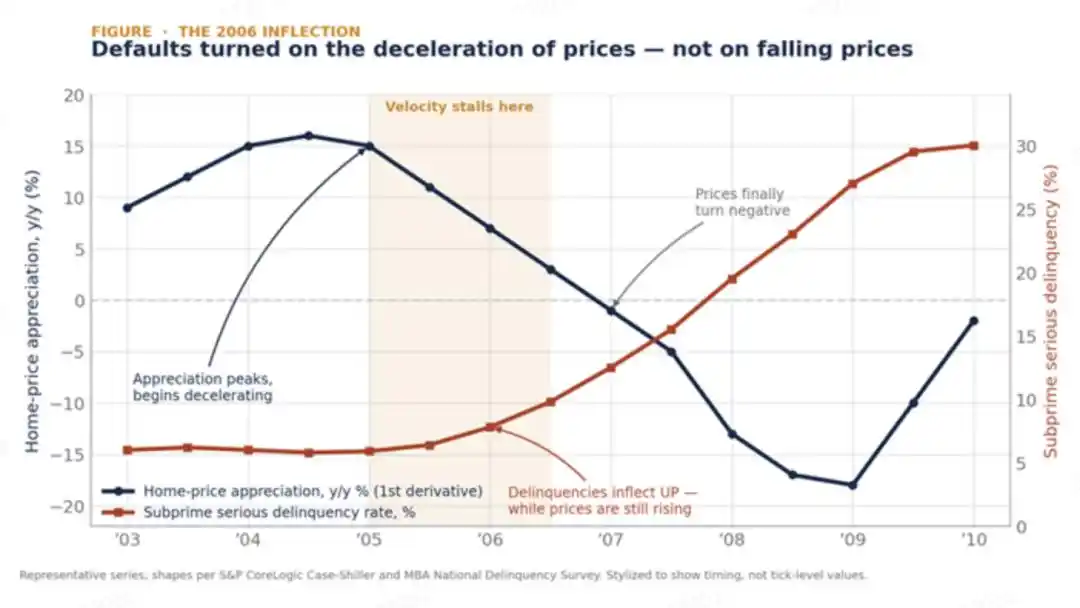
There exists a "borrowed time window" between the decline of the second derivative and the first derivative turning negative. During this window, everything appears rosy—revenue at record highs, growth still positive. Yet, a future crisis has already become inevitable.

Here, we can introduce Hyman Minsky's financial instability hypothesis. Minsky argued that "stability is destabilizing." Long periods of economic prosperity foster overly optimistic expectations, gradually shifting financing structures from robust to highly leveraged, refinance-dependent models, ultimately triggering a "Minsky Moment."

Based on a firm's debt-servicing ability, Minsky categorized financing into three regimes:

1. **Hedge financing:** Operating cash flow is sufficient to cover both principal and interest payments.

2. **Speculative financing:** Cash flow covers only interest, not principal. The firm must continuously roll over debt.

3. **Ponzi financing:** Operating cash flow is insufficient to cover even interest payments.

A decline in the second derivative of demand growth corresponds to a shift from Regime 1 to Regime 2. The first derivative turning negative signifies a full transition to Regime 2, making it difficult for the firm to return to Regime 1 through its own efforts.

Examining the top five cloud providers' Q2 reports reveals three categories:

Google and Amazon's free cash flow has turned negative, meaning AI capex growth has temporarily outpaced core business cash flow growth. They have just entered Regime 2 this quarter.

Microsoft and Meta remain in Regime 1, but risk entering Regime 2 soon if capex isn't controlled.

Oracle has long been a Regime 2 firm. Its debt service coverage ratio (present value of debt principal & interest / operating cash flow) is only 48%, resembling a capital-intensive real estate company more than a high-tech firm.

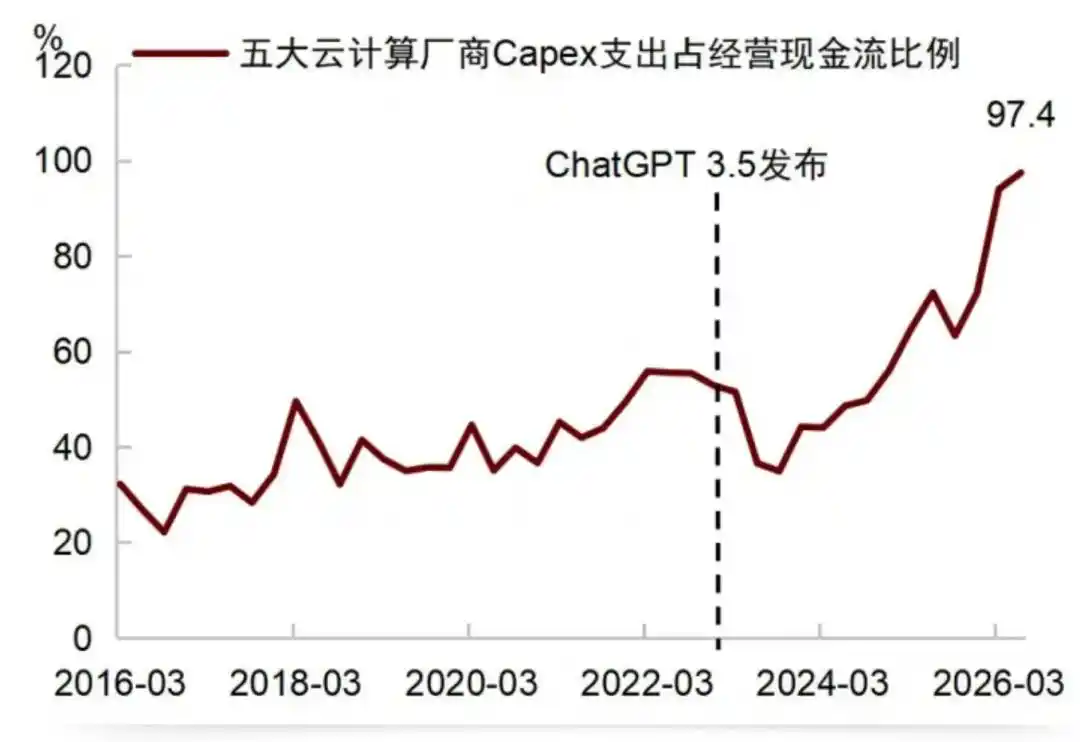
The conclusion is stark: when capital expenditure exceeds 100% of operating cash flow, further accelerated expansion means borrowing more money at an even faster pace each quarter. Over the next year, hyperscale cloud providers must dramatically increase debt issuance. The entire AI infrastructure build-out will become entirely dependent on the bond market for marginal funding.

The situation might be worse than these numbers suggest. AI infrastructure shares another trait with real estate: much of its debt is hidden off-balance-sheet as "shadow loans."

4/4

Shadow Loans

A report from the Bank for International Settlements notes that large cloud providers are rapidly increasing their use of "shadow loans" to finance AI data centers.

"Shadow lending" often occurs via private credit. For instance, a large cloud provider might first establish a Special Purpose Vehicle (SPV) or joint venture with a consortium to acquire or build data center assets, holding only a minority stake. The cloud provider commits to long-term operating leases or computing power purchase agreements and provides credit guarantees. Debt is serviced by lease cash flows.

This risk mirrors off-balance-sheet project financing by real estate companies. If, upon completion, AI computing demand is insufficient to cover long-term lease costs, the guaranteed contingent liabilities will surface, creating new debt.

Some institutions estimate this implicit debt at approximately $1.65 trillion. While these cloud providers emphasize that their cloud service backlogs remain ample and, if fulfilled as planned, should cover related lease liabilities, we have already analyzed what "unfulfilled orders" represent.
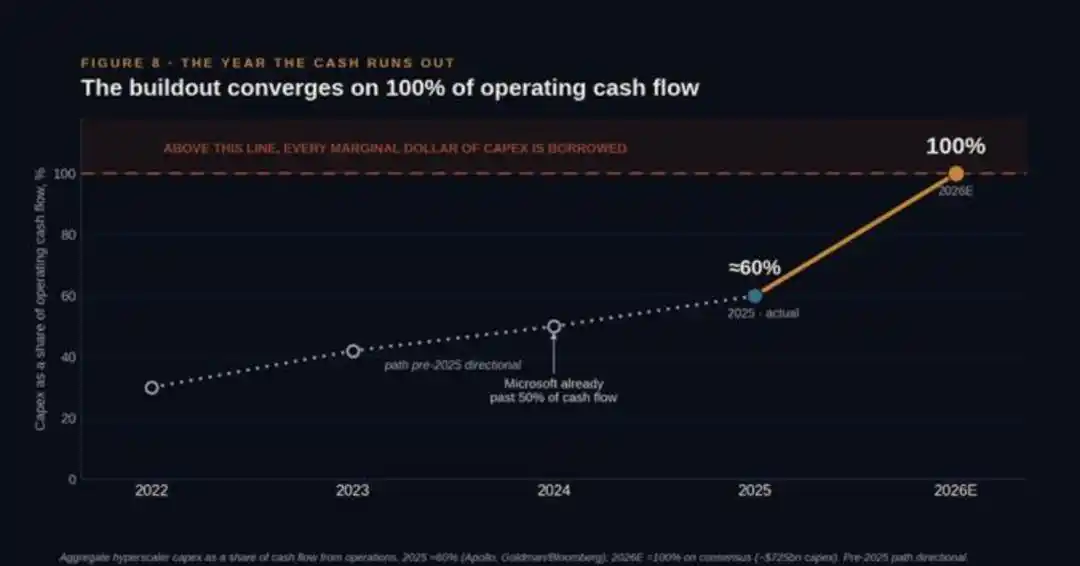
In summary, starting this year, with continued AI capex expansion, the financing structure of the top five cloud providers is shifting. Their financing mode is transitioning from internal to external funding, marking a metamorphosis from tech companies to real estate entities. They now possess "the capital intensity of real estate" and "the rapid depreciation of semiconductors," yet are still valued as tech stocks.

The Minsky Moment hasn't arrived, but a "financing migration" in the Minsky sense has begun. Most problems trace back to the two leading AI labs at the source. The next explosive demand will undoubtedly emerge, but the crucial factor is timing.

Finally, we return to the opening premise: don't conflate stock and bond risks.

Equity investors consider: Does AI have technological value? What future revenue and profits can it generate?

Creditors consider: Can the future cash flows from AI's massive fixed asset investments cover their capital costs?

AI's long-term risk is insufficient demand, but the mid-to-short-term accumulating risk is that the pace of capital expenditure is outstripping the pace of genuine cash flow generation.

In the next piece, I will analyze which of the two top AI labs is more vulnerable to crisis and identify the five most fragile moments when a debt crisis could emerge.

This article is from the WeChat public account "lig0624" (ID: sxgy9999), author: Thought Seal.

Criptomoedas em alta

Perguntas relacionadas

QWhat is the core argument about the funding structure of the AI industry presented in the article?

AThe core argument is that the current AI industry, particularly its infrastructure build-out (like data centers and compute power), is primarily funded by debt rather than equity. This structure resembles traditional real estate or heavy asset financing, where future cash flow promises (like AI service contracts) are leveraged through layered debt instruments. This creates a significant systemic risk similar to the 2008 subprime mortgage crisis, as the entire chain depends on continuous financing and the ability of AI labs (like OpenAI) to generate future revenue to pay for their massive commitments.

QHow does the financing structure of the current AI boom differ from that of the 2000 dot-com bubble?

ADuring the 2000 dot-com bubble, the primary source of funding was equity financing (venture capital and stock market investments). In contrast, the current AI infrastructure boom is largely driven by debt financing. The article argues this difference is crucial: a bubble burst in an equity-driven market leads to a linear decline in stock valuations, while a crisis in a debt-driven structure could trigger a sudden, non-linear collapse in bond markets due to the negative convexity and hard contractual triggers inherent in debt instruments.

QAccording to the article, why is the 'second derivative' (acceleration of growth) critically important in assessing the AI debt risk?

AThe article uses the concept of the 'second derivative' (the rate of change of the growth rate) to explain the early warning signs of a debt crisis. It draws a parallel to the 2008 subprime crisis, where mortgage defaults began rising not when housing prices fell, but when their rate of price *increase* slowed down (positive first derivative, negative second derivative). Similarly, for AI infrastructure debt, a slowdown in the *acceleration* of AI demand or cash flow growth could be the first sign of trouble. This is because the financing model often depends on constant refinancing based on the expectation of perpetually accelerating growth to cover obligations. A decline in the second derivative signals that this refinancing mechanism is becoming vulnerable, creating a 'borrowed time window' before a potential crisis.

QWhat does the article mean by stating that 'AI infrastructure is essentially real estate'?

AThe article asserts that AI infrastructure financing shares the fundamental characteristics of real estate development, not traditional tech venture financing. The process involves: securing capital (like development loans) to build specialized physical assets (data centers), signing long-term 'take-or-pay' contracts with tenants (AI labs/companies) to guarantee future cash flow, using those contracts as collateral for further loans, and potentially securitizing the future cash flows into asset-backed securities (ABS). This entire structure is capital-intensive, relies on long-term debt, and depends on predictable rental-like income. The risk, therefore, combines the technological uncertainty of AI with the high-leverage, cyclical risks typical of real estate.

QWhat is the role of 'shadow lending' in the AI infrastructure financing landscape described in the article?

A'Shadow lending' refers to off-balance-sheet financing methods used by major cloud providers to fund AI data centers. This often involves setting up Special Purpose Vehicles (SPVs) or joint ventures with investment consortia. The cloud provider holds a minority stake but provides credit guarantees and signs long-term leasing or compute purchase agreements. The debt is held by the SPV and repaid by the lease cash flows. This hides significant leverage from the cloud provider's main balance sheet. The risk is that if future AI demand doesn't materialize to cover these lease costs, the guaranteed liabilities will surface, potentially causing a sudden debt crisis similar to the off-balance-sheet risks that plagued some real estate companies.

Leituras Relacionadas

Chip Design: The 'Cash Flow Restructuring' and 'Capability Leap Window' of 'Institutional Rents'

Chip Design: The "Cash Flow Reconstruction" and "Capability Leap Window" of Institutional Rents The first half of 2026 saw extreme divergence in China's chip design sector. While companies like Jiangbolong and GigaDevice reported massive profit surges, others like StarPower saw sharp declines. This disparity stems not from market cycles, but from a fundamental "institutional rent" transfer—profits were systematically shifted from downstream manufacturers (the payers) to upstream design firms (the recipients) due to supply constraints and policy-driven "domestic substitution" mandates. For decades, China's chip design industry was trapped in a vicious cycle: no revenue without customers, no R&D without revenue, and no competitive products without sustained R&D, leading to perpetual cash flow crises. Crucially, this institutional rent, though distorting short-term competition, has inadvertently broken this deadlock. It has created a "cash flow reconstruction," funneling steady, policy-backed income to design houses for the first time. This generates a critical "capability leap window"—a structural, long-term opportunity (potentially lasting over five years due to prolonged chip shortages and tightening export controls) for companies to invest rents into long-cycle R&D (e.g., automotive-grade, AI chips) rather than short-term speculation. Policy is also evolving from simple procurement subsidies to "ecosystem binding," forcing adoption and integration of domestic chips. Conversely, rent-paying downstream firms face a painful but necessary "market clearing," forced into genuine competition and efficiency drives, which may spur deeper industry collaboration. Importantly, companies like Montage Technology and Fudan Microelectronics show growth based on real technological breakthroughs and market demand, not just policy rents, signaling the potential for independent capability growth. The conclusion is that institutional rent is not an end but a means. The core investment thesis shifts from betting on rent persistence to identifying companies that successfully transform this reconstructed cash flow into proprietary technology and autonomous market viability. While a shakeout is imminent as certain mechanisms reverse, a new generation of technologically independent firms is quietly emerging under the cover of this rent-fueled window.

marsbitHá 31m

Chip Design: The 'Cash Flow Restructuring' and 'Capability Leap Window' of 'Institutional Rents'

marsbitHá 31m

Karpathy Says It Will Take Another Decade, But This Road Is Already Packed

The article discusses the intensifying focus on **Continual (or Lifelong) Learning** for large language models (LLMs), a capability seen as crucial for developing truly useful "AI colleagues." It references Andrej Karpathy's 2025 assessment that overcoming LLMs' lack of persistent memory and learning might take a decade. The core challenge is **catastrophic forgetting**, where learning new information erases previously acquired skills. Current research diverges into several technical paths: 1. **External Memory Systems:** Storing new knowledge in external databases (e.g., MemGPT, Letta's approach, Karpathy's "LLM Wiki"), akin to enhanced RAG. This is safe but doesn't "internalize" knowledge. 2. **Context Engineering:** Evolving the input context itself into a growing "playbook," as seen in ACE (Agentic Context Engineering), which uses execution feedback to refine instructions without weight updates. 3. **Continual Post-Training:** Carefully updating model weights (e.g., via LoRA) to internalize knowledge, using techniques like Self-Distillation Fine-Tuning (SDFT) to mitigate forgetting. 4. **Continual Pre-training:** Updating the base model with new corpus data, which is compute-intensive and prone to forgetting. 5. **Novel Paradigms:** More radical approaches redefining learning itself. These include models that generate their own training data and update instructions (e.g., SEAL), architectures with nested, multi-timescale learning (e.g., Google's Nested Learning/Hope), and the vision of an "Era of Experience" where AI learns from self-generated interaction data. The article suggests a pragmatic, hybrid future is likely: short-term, mutable knowledge handled by external memory/context, while long-term, solidified capabilities are encoded into model parameters via fine-tuning. While catastrophic forgetting remains unsolved, the field has evolved from a theoretical gap into an active arena with multiple competing approaches and emerging commercial products, all racing to bridge the gap to practical, continually learning AI agents.

marsbitHá 35m

Karpathy Says It Will Take Another Decade, But This Road Is Already Packed

marsbitHá 35m

U.S. Stocks Trend (August 10): Nonfarm Payrolls Drop by 23K, Inflation Takes Over to Test New Highs

US Stock Market Weekly Review (August 10th): Nonfarm Payrolls Drop by 23K, Inflation Takes Over Testing New Highs Last week, US stocks closed with their strongest weekly gains since mid-April, led by a tech rebound and adjusted rate expectations. The S&P 500 and Dow hit new record closing highs. Weekend developments centered on Strait of Hormuz negotiations, Berkshire Hathaway's capital deployment, and US government funding. The core focus this week shifts to whether incoming inflation data can justify current market pricing for interest rates. The July Nonfarm Payrolls report showed a loss of 23,000 jobs, missing expectations and leading to a decline in September rate hike probabilities. This eased pressure on tech valuations. However, discussions between Iran and Oman on Strait of Hormuz navigation are pending execution, and renewed attacks on energy facilities kept oil prices volatile, with potential implications for inflation. Berkshire Hathaway reported strong earnings and shifted its capital allocation strategy, ending a long streak of net stock sales and making significant new investments, including in Alphabet. The US Senate passed a stopgap funding bill, reducing near-term government shutdown risks. This week's calendar is dominated by key inflation readings (July CPI & PPI), retail sales data, and earnings from AI and tech infrastructure companies like CoreWeave, Lumentum, Cisco, and Applied Materials. The market expects CPI to show a moderation. If inflation data is benign, supporting stable or lower Treasury yields, and corporate earnings remain solid, indices may find further upside. Conversely, a resurgence in inflation or rising oil prices could trigger a swift reversal in interest rate expectations, testing the market's record highs.

marsbitHá 37m

U.S. Stocks Trend (August 10): Nonfarm Payrolls Drop by 23K, Inflation Takes Over to Test New Highs

marsbitHá 37m

Everyone Is Eyeing EUV Lithography Machines

The article "Everyone Has Their Eyes on EUV Lithography Machines" explores the ongoing expansion of EUV (Extreme Ultraviolet) lithography in semiconductor manufacturing. While EUV was once exclusive to giants like TSMC, Samsung, Intel, SK Hynix, and Micron, it's now appearing on the roadmaps of second-tier foundries like Nanya Technology and Winbond Electronics. This shift is driven by the diffusion of EUV into DRAM production, the economic boost from the AI boom making such investments viable, and the maturation of Low-NA EUV as a standard tool. Meanwhile, the "five-member club" of primary EUV users is seeing new entrants like Japan's Rapidus, a state-backed startup aiming for 2nm production. Concurrently, a wave of startups is challenging the traditional EUV model with alternative technologies. These challengers are categorized into four groups: those seeking to replace the light source (e.g., xLight's Free Electron Laser), those aiming to shorten the wavelength (e.g., Inversion Semiconductor, Substrate with BEUV/X-ray approaches), those promoting Nanoimprint Lithography (e.g., Canon), and those exploring maskless particle-based methods (e.g., Multibeam's multi-column e-beam, Lace's helium atom lithography). While these alternatives struggle with the throughput and stability required for high-volume manufacturing, they collectively signal a potential diversification of the future lithography landscape. The conclusion is that while EUV's technical and economic barriers remain high, its user base is broadening. The future may see a more competitive ecosystem, with Low-NA EUV serving mainstream needs, High-NA EUV for cutting-edge nodes, and novel technologies finding niches in specific applications.

marsbitHá 46m

Everyone Is Eyeing EUV Lithography Machines

marsbitHá 46m

Trading

Spot

Artigos em Destaque

O que é GROK AI

Grok AI: Revolucionar a Tecnologia Conversacional na Era Web3 Introdução No panorama em rápida evolução da inteligência artificial, a Grok AI destaca-se como um projeto notável que liga os domínios da tecnologia avançada e da interação com o utilizador. Desenvolvida pela xAI, uma empresa liderada pelo renomado empreendedor Elon Musk, a Grok AI procura redefinir a forma como interagimos com a inteligência artificial. À medida que o movimento Web3 continua a florescer, a Grok AI visa aproveitar o poder da IA conversacional para responder a consultas complexas, proporcionando aos utilizadores uma experiência que é não apenas informativa, mas também divertida. O que é a Grok AI? A Grok AI é um sofisticado chatbot de IA conversacional projetado para interagir com os utilizadores de forma dinâmica. Ao contrário de muitos sistemas de IA tradicionais, a Grok AI abraça uma gama mais ampla de perguntas, incluindo aquelas tipicamente consideradas inadequadas ou fora das respostas padrão. Os principais objetivos do projeto incluem: Raciocínio Fiável: A Grok AI enfatiza o raciocínio de senso comum para fornecer respostas lógicas com base na compreensão contextual. Supervisão Escalável: A integração de assistência de ferramentas garante que as interações dos utilizadores sejam monitorizadas e otimizadas para qualidade. Verificação Formal: A segurança é primordial; a Grok AI incorpora métodos de verificação formal para aumentar a fiabilidade das suas saídas. Compreensão de Longo Contexto: O modelo de IA destaca-se na retenção e recordação de um extenso histórico de conversas, facilitando discussões significativas e contextualizadas. Robustez Adversarial: Ao focar na melhoria das suas defesas contra entradas manipuladas ou maliciosas, a Grok AI visa manter a integridade das interações dos utilizadores. Em essência, a Grok AI não é apenas um dispositivo de recuperação de informações; é um parceiro conversacional imersivo que incentiva um diálogo dinâmico. Criador da Grok AI A mente por trás da Grok AI não é outra senão Elon Musk, um indivíduo sinónimo de inovação em vários campos, incluindo automóvel, viagens espaciais e tecnologia. Sob a égide da xAI, uma empresa focada em avançar a tecnologia de IA de maneiras benéficas, a visão de Musk visa reformular a compreensão das interações com a IA. A liderança e a ética fundacional são profundamente influenciadas pelo compromisso de Musk em ultrapassar os limites tecnológicos. Investidores da Grok AI Embora os detalhes específicos sobre os investidores que apoiam a Grok AI permaneçam limitados, é reconhecido publicamente que a xAI, a incubadora do projeto, é fundada e apoiada principalmente pelo próprio Elon Musk. As anteriores empreitadas e participações de Musk fornecem um forte apoio, reforçando ainda mais a credibilidade e o potencial de crescimento da Grok AI. No entanto, até agora, informações sobre fundações ou organizações de investimento adicionais que apoiam a Grok AI não estão prontamente acessíveis, marcando uma área para exploração futura potencial. Como Funciona a Grok AI? A mecânica operacional da Grok AI é tão inovadora quanto a sua estrutura conceptual. O projeto integra várias tecnologias de ponta que facilitam as suas funcionalidades únicas: Infraestrutura Robusta: A Grok AI é construída utilizando Kubernetes para orquestração de contêineres, Rust para desempenho e segurança, e JAX para computação numérica de alto desempenho. Este trio assegura que o chatbot opere de forma eficiente, escale eficazmente e sirva os utilizadores prontamente. Acesso a Conhecimento em Tempo Real: Uma das características distintivas da Grok AI é a sua capacidade de aceder a dados em tempo real através da plataforma X—anteriormente conhecida como Twitter. Esta capacidade concede à IA acesso às informações mais recentes, permitindo-lhe fornecer respostas e recomendações oportunas que outros modelos de IA poderiam perder. Dois Modos de Interação: A Grok AI oferece aos utilizadores a escolha entre “Modo Divertido” e “Modo Regular”. O Modo Divertido permite um estilo de interação mais lúdico e humorístico, enquanto o Modo Regular foca em fornecer respostas precisas e exatas. Esta versatilidade assegura uma experiência adaptada que atende a várias preferências dos utilizadores. Em essência, a Grok AI combina desempenho com envolvimento, criando uma experiência que é tanto enriquecedora quanto divertida. Cronologia da Grok AI A jornada da Grok AI é marcada por marcos fundamentais que refletem as suas fases de desenvolvimento e implementação: Desenvolvimento Inicial: A fase fundamental da Grok AI ocorreu ao longo de aproximadamente dois meses, durante os quais o treinamento inicial e o ajuste do modelo foram realizados. Lançamento Beta do Grok-2: Numa evolução significativa, o beta do Grok-2 foi anunciado. Este lançamento introduziu duas versões do chatbot—Grok-2 e Grok-2 mini—cada uma equipada com capacidades para conversar, programar e raciocinar. Acesso Público: Após o seu desenvolvimento beta, a Grok AI tornou-se disponível para os utilizadores da plataforma X. Aqueles com contas verificadas por um número de telefone e ativas há pelo menos sete dias podem aceder a uma versão limitada, tornando a tecnologia disponível para um público mais amplo. Esta cronologia encapsula o crescimento sistemático da Grok AI desde a sua concepção até ao envolvimento público, enfatizando o seu compromisso com a melhoria contínua e a interação com o utilizador. Principais Características da Grok AI A Grok AI abrange várias características principais que contribuem para a sua identidade inovadora: Integração de Conhecimento em Tempo Real: O acesso a informações atuais e relevantes diferencia a Grok AI de muitos modelos estáticos, permitindo uma experiência de utilizador envolvente e precisa. Estilos de Interação Versáteis: Ao oferecer modos de interação distintos, a Grok AI atende a várias preferências dos utilizadores, convidando à criatividade e personalização na conversa com a IA. Base Tecnológica Avançada: A utilização de Kubernetes, Rust e JAX fornece ao projeto uma estrutura sólida para garantir fiabilidade e desempenho ótimo. Consideração de Discurso Ético: A inclusão de uma função de geração de imagens demonstra o espírito inovador do projeto. No entanto, também levanta considerações éticas em torno dos direitos autorais e da representação respeitosa de figuras reconhecíveis—uma discussão em curso dentro da comunidade de IA. Conclusão Como uma entidade pioneira no domínio da IA conversacional, a Grok AI encapsula o potencial para experiências transformadoras do utilizador na era digital. Desenvolvida pela xAI e impulsionada pela abordagem visionária de Elon Musk, a Grok AI integra conhecimento em tempo real com capacidades avançadas de interação. Esforça-se por ultrapassar os limites do que a inteligência artificial pode alcançar, mantendo um foco nas considerações éticas e na segurança do utilizador. A Grok AI não apenas incorpora o avanço tecnológico, mas também representa um novo paradigma de conversas no panorama Web3, prometendo envolver os utilizadores com conhecimento hábil e interação lúdica. À medida que o projeto continua a evoluir, ele permanece como um testemunho do que a interseção da tecnologia, criatividade e interação humana pode alcançar.

642 Visualizações TotaisPublicado em {updateTime}Atualizado em 2024.12.26

O que é GROK AI

O que é ERC AI

Euruka Tech: Uma Visão Geral do $erc ai e as suas Ambições no Web3 Introdução No panorama em rápida evolução da tecnologia blockchain e das aplicações descentralizadas, novos projetos surgem frequentemente, cada um com objetivos e metodologias únicas. Um desses projetos é a Euruka Tech, que opera no vasto domínio das criptomoedas e do Web3. O foco principal da Euruka Tech, particularmente do seu token $erc ai, é apresentar soluções inovadoras concebidas para aproveitar as capacidades crescentes da tecnologia descentralizada. Este artigo tem como objetivo fornecer uma visão abrangente da Euruka Tech, uma exploração das suas metas, funcionalidade, a identidade do seu criador, potenciais investidores e a sua importância no contexto mais amplo do Web3. O que é a Euruka Tech, $erc ai? A Euruka Tech é caracterizada como um projeto que aproveita as ferramentas e funcionalidades oferecidas pelo ambiente Web3, focando na integração da inteligência artificial nas suas operações. Embora os detalhes específicos sobre a estrutura do projeto sejam um tanto elusivos, ele é concebido para melhorar o envolvimento dos utilizadores e automatizar processos no espaço cripto. O projeto visa criar um ecossistema descentralizado que não só facilita transações, mas também incorpora funcionalidades preditivas através da inteligência artificial, daí a designação do seu token, $erc ai. O objetivo é fornecer uma plataforma intuitiva que facilite interações mais inteligentes e um processamento eficiente de transações dentro da crescente esfera do Web3. Quem é o Criador da Euruka Tech, $erc ai? Neste momento, a informação sobre o criador ou a equipa fundadora da Euruka Tech permanece não especificada e algo opaca. Esta ausência de dados levanta preocupações, uma vez que o conhecimento sobre o histórico da equipa é frequentemente essencial para estabelecer credibilidade no setor blockchain. Portanto, categorizamos esta informação como desconhecida até que detalhes concretos sejam disponibilizados no domínio público. Quem são os Investidores da Euruka Tech, $erc ai? De forma semelhante, a identificação de investidores ou organizações de apoio para o projeto Euruka Tech não é prontamente fornecida através da pesquisa disponível. Um aspeto que é crucial para potenciais partes interessadas ou utilizadores que consideram envolver-se com a Euruka Tech é a garantia que vem de parcerias financeiras estabelecidas ou apoio de empresas de investimento respeitáveis. Sem divulgações sobre afiliações de investimento, é difícil tirar conclusões abrangentes sobre a segurança financeira ou a longevidade do projeto. Em linha com a informação encontrada, esta seção também se encontra no estado de desconhecido. Como funciona a Euruka Tech, $erc ai? Apesar da falta de especificações técnicas detalhadas para a Euruka Tech, é essencial considerar as suas ambições inovadoras. O projeto procura aproveitar o poder computacional da inteligência artificial para automatizar e melhorar a experiência do utilizador no ambiente das criptomoedas. Ao integrar IA com tecnologia blockchain, a Euruka Tech visa fornecer funcionalidades como negociações automatizadas, avaliações de risco e interfaces de utilizador personalizadas. A essência inovadora da Euruka Tech reside no seu objetivo de criar uma conexão fluida entre os utilizadores e as vastas possibilidades apresentadas pelas redes descentralizadas. Através da utilização de algoritmos de aprendizagem automática e IA, visa minimizar os desafios enfrentados por utilizadores de primeira viagem e agilizar as experiências transacionais dentro do quadro do Web3. Esta simbiose entre IA e blockchain sublinha a importância do token $erc ai, que se apresenta como uma ponte entre interfaces de utilizador tradicionais e as capacidades avançadas das tecnologias descentralizadas. Cronologia da Euruka Tech, $erc ai Infelizmente, devido à informação limitada disponível sobre a Euruka Tech, não conseguimos apresentar uma cronologia detalhada dos principais desenvolvimentos ou marcos na jornada do projeto. Esta cronologia, tipicamente inestimável para traçar a evolução de um projeto e compreender a sua trajetória de crescimento, não está atualmente disponível. À medida que informações sobre eventos notáveis, parcerias ou adições funcionais se tornem evidentes, atualizações certamente aumentarão a visibilidade da Euruka Tech na esfera cripto. Esclarecimento sobre Outros Projetos “Eureka” É importante abordar que múltiplos projetos e empresas partilham uma nomenclatura semelhante com “Eureka.” A pesquisa identificou iniciativas como um agente de IA da NVIDIA Research, que se concentra em ensinar robôs a realizar tarefas complexas utilizando métodos generativos, bem como a Eureka Labs e a Eureka AI, que melhoram a experiência do utilizador na educação e na análise de serviços ao cliente, respetivamente. No entanto, estes projetos são distintos da Euruka Tech e não devem ser confundidos com os seus objetivos ou funcionalidades. Conclusão A Euruka Tech, juntamente com o seu token $erc ai, representa um jogador promissor, mas atualmente obscuro, dentro do panorama do Web3. Embora os detalhes sobre o seu criador e investidores permaneçam não divulgados, a ambição central de combinar inteligência artificial com tecnologia blockchain destaca-se como um ponto focal de interesse. As abordagens únicas do projeto em promover o envolvimento do utilizador através da automação avançada podem diferenciá-lo à medida que o ecossistema Web3 avança. À medida que o mercado cripto continua a evoluir, as partes interessadas devem manter um olhar atento sobre os avanços em torno da Euruka Tech, uma vez que o desenvolvimento de inovações documentadas, parcerias ou um roteiro definido pode apresentar oportunidades significativas no futuro próximo. Neste momento, aguardamos por insights mais substanciais que possam desvendar o potencial da Euruka Tech e a sua posição no competitivo panorama cripto.

692 Visualizações TotaisPublicado em {updateTime}Atualizado em 2025.01.02

O que é ERC AI

O que é DUOLINGO AI

DUOLINGO AI: Integrar a Aprendizagem de Línguas com Inovação Web3 e IA Numa era em que a tecnologia transforma a educação, a integração da inteligência artificial (IA) e das redes blockchain anuncia uma nova fronteira para a aprendizagem de línguas. Apresentamos DUOLINGO AI e a sua criptomoeda associada, $DUOLINGO AI. Este projeto aspira a unir o poder educativo das principais plataformas de aprendizagem de línguas com os benefícios da tecnologia descentralizada Web3. Este artigo explora os principais aspectos do DUOLINGO AI, analisando os seus objetivos, estrutura tecnológica, desenvolvimento histórico e potencial futuro, mantendo a clareza entre o recurso educativo original e esta iniciativa independente de criptomoeda. Visão Geral do DUOLINGO AI No seu cerne, DUOLINGO AI procura estabelecer um ambiente descentralizado onde os alunos podem ganhar recompensas criptográficas por alcançar marcos educativos em proficiência linguística. Ao aplicar contratos inteligentes, o projeto visa automatizar processos de verificação de habilidades e alocação de tokens, aderindo aos princípios do Web3 que enfatizam a transparência e a propriedade do utilizador. O modelo diverge das abordagens tradicionais de aquisição de línguas ao apoiar-se fortemente numa estrutura de governança orientada pela comunidade, permitindo que os detentores de tokens sugiram melhorias ao conteúdo dos cursos e à distribuição de recompensas. Alguns dos objetivos notáveis do DUOLINGO AI incluem: Aprendizagem Gamificada: O projeto integra conquistas em blockchain e tokens não fungíveis (NFTs) para representar níveis de proficiência linguística, promovendo a motivação através de recompensas digitais envolventes. Criação de Conteúdo Descentralizada: Abre caminhos para educadores e entusiastas de línguas contribuírem com os seus cursos, facilitando um modelo de partilha de receitas que beneficia todos os colaboradores. Personalização Através de IA: Ao empregar modelos avançados de aprendizagem de máquina, o DUOLINGO AI personaliza as lições para se adaptar ao progresso de aprendizagem individual, semelhante às características adaptativas encontradas em plataformas estabelecidas. Criadores do Projeto e Governança A partir de abril de 2025, a equipa por trás do $DUOLINGO AI permanece pseudónima, uma prática frequente no panorama descentralizado das criptomoedas. Esta anonimidade visa promover o crescimento coletivo e o envolvimento das partes interessadas, em vez de se concentrar em desenvolvedores individuais. O contrato inteligente implementado na blockchain Solana indica o endereço da carteira do desenvolvedor, o que significa o compromisso com a transparência em relação às transações, apesar da identidade dos criadores ser desconhecida. De acordo com o seu roteiro, o DUOLINGO AI pretende evoluir para uma Organização Autónoma Descentralizada (DAO). Esta estrutura de governança permite que os detentores de tokens votem em questões críticas, como implementações de funcionalidades e alocação de tesouraria. Este modelo alinha-se com a ética de empoderamento comunitário encontrada em várias aplicações descentralizadas, enfatizando a importância da tomada de decisão coletiva. Investidores e Parcerias Estratégicas Atualmente, não existem investidores institucionais ou capitalistas de risco publicamente identificáveis ligados ao $DUOLINGO AI. Em vez disso, a liquidez do projeto origina-se principalmente de trocas descentralizadas (DEXs), marcando um contraste acentuado com as estratégias de financiamento das empresas tradicionais de tecnologia educacional. Este modelo de base indica uma abordagem orientada pela comunidade, refletindo o compromisso do projeto com a descentralização. No seu whitepaper, o DUOLINGO AI menciona a formação de colaborações com “plataformas de educação blockchain” não especificadas, com o objetivo de enriquecer a sua oferta de cursos. Embora parcerias específicas ainda não tenham sido divulgadas, estes esforços colaborativos sugerem uma estratégia para misturar inovação em blockchain com iniciativas educativas, expandindo o acesso e o envolvimento dos utilizadores em diversas vias de aprendizagem. Arquitetura Tecnológica Integração de IA O DUOLINGO AI incorpora dois componentes principais impulsionados por IA para melhorar as suas ofertas educativas: Motor de Aprendizagem Adaptativa: Este motor sofisticado aprende a partir das interações dos utilizadores, semelhante a modelos proprietários de grandes plataformas educativas. Ele ajusta dinamicamente a dificuldade das lições para abordar desafios específicos dos alunos, reforçando áreas fracas através de exercícios direcionados. Agentes Conversacionais: Ao empregar chatbots alimentados por GPT-4, o DUOLINGO AI oferece uma plataforma para os utilizadores se envolverem em conversas simuladas, promovendo uma experiência de aprendizagem de línguas mais interativa e prática. Infraestrutura Blockchain Construído na blockchain Solana, o $DUOLINGO AI utiliza uma estrutura tecnológica abrangente que inclui: Contratos Inteligentes de Verificação de Habilidades: Esta funcionalidade atribui automaticamente tokens aos utilizadores que passam com sucesso em testes de proficiência, reforçando a estrutura de incentivos para resultados de aprendizagem genuínos. Emblemas NFT: Estes tokens digitais significam vários marcos que os alunos alcançam, como completar uma seção do seu curso ou dominar habilidades específicas, permitindo-lhes negociar ou exibir as suas conquistas digitalmente. Governança DAO: Membros da comunidade com tokens podem participar na governança votando em propostas-chave, facilitando uma cultura participativa que incentiva a inovação nas ofertas de cursos e funcionalidades da plataforma. Cronologia Histórica 2022–2023: Conceituação O trabalho preliminar para o DUOLINGO AI começa com a criação de um whitepaper, destacando a sinergia entre os avanços em IA na aprendizagem de línguas e o potencial descentralizado da tecnologia blockchain. 2024: Lançamento Beta Um lançamento beta limitado introduz ofertas em línguas populares, recompensando os primeiros utilizadores com incentivos em tokens como parte da estratégia de envolvimento comunitário do projeto. 2025: Transição para DAO Em abril, ocorre um lançamento completo da mainnet com a circulação de tokens, promovendo discussões comunitárias sobre possíveis expansões para línguas asiáticas e outros desenvolvimentos de cursos. Desafios e Direções Futuras Obstáculos Técnicos Apesar dos seus objetivos ambiciosos, o DUOLINGO AI enfrenta desafios significativos. A escalabilidade continua a ser uma preocupação constante, particularmente no equilíbrio dos custos associados ao processamento de IA e à manutenção de uma rede descentralizada responsiva. Além disso, garantir a criação e moderação de conteúdo de qualidade num ambiente descentralizado apresenta complexidades na manutenção dos padrões educativos. Oportunidades Estratégicas Olhando para o futuro, o DUOLINGO AI tem o potencial de aproveitar parcerias de micro-certificação com instituições académicas, proporcionando validações verificadas em blockchain das habilidades linguísticas. Além disso, a expansão cross-chain poderia permitir que o projeto acedesse a bases de utilizadores mais amplas e a ecossistemas de blockchain adicionais, melhorando a sua interoperabilidade e alcance. Conclusão DUOLINGO AI representa uma fusão inovadora de inteligência artificial e tecnologia blockchain, apresentando uma alternativa focada na comunidade aos sistemas tradicionais de aprendizagem de línguas. Embora o seu desenvolvimento pseudónimo e o modelo económico emergente tragam certos riscos, o compromisso do projeto com a aprendizagem gamificada, educação personalizada e governança descentralizada ilumina um caminho a seguir para a tecnologia educativa no domínio do Web3. À medida que a IA continua a avançar e o ecossistema blockchain evolui, iniciativas como o DUOLINGO AI poderão redefinir a forma como os utilizadores interagem com a educação linguística, empoderando comunidades e recompensando o envolvimento através de mecanismos de aprendizagem inovadores.

620 Visualizações TotaisPublicado em {updateTime}Atualizado em 2025.04.11

O que é DUOLINGO AI

Discussões

Bem-vindo à Comunidade HTX. Aqui, pode manter-se informado sobre os mais recentes desenvolvimentos da plataforma e obter acesso a análises profissionais de mercado. As opiniões dos utilizadores sobre o preço de AI (AI) são apresentadas abaixo.

活动图片