Has the Era of Project Buyback Bonuses Really Come to an End?

marsbitPublicado em 2026-01-09Última atualização em 2026-01-09

Resumo

"Project Buybacks: The End of an Era?" In traditional finance, stock buybacks are often seen as a confidence booster. However, this strategy has largely failed to produce positive results in the Web3 space. Recently, Jupiter co-founder SIONG proposed halting $JUP's buyback program after the project spent over $70 million on repurchases with little positive impact on the token price. Similarly, Helium's founder Amir Haleem announced an end to their buyback, calling it "throwing money into a black hole." Data from 2025 shows a collective downturn for major projects that executed buybacks. Despite Hyperliquid spending $716 million and others like Pump.fun, LayerZero, Raydium, and Sky also making significant investments, most tokens continued to decline in value, raising questions about the efficacy of buybacks. The debate highlights a split in perspectives: some founders advocate reallocating funds towards user acquisition and product development to strengthen fundamentals. Others, like DeFi OG CM, argue that buybacks are inherently beneficial by reducing circulating supply, though they don't guarantee short-term price increases. Critics, including Helius CEO Mert Mumtaz, view buybacks as a pessimistic mechanism, signaling a lack of better growth opportunities. Former Aave executive Ajit Tripathi called the buyback narrative "the most value-destructive play after memecoins." Alternative strategies are emerging. Selini Capital's Jordi Alexander emphasizes the importance of ex...

Author: Chloe, ChainCatcher

In the world of traditional finance, stock buybacks are often seen as a "shot in the arm" for market confidence. When a company announces a share repurchase, it usually signifies that management believes the stock is undervalued or that the company has ample cash flow. However, applying a similar strategy to Web3 projects fails to yield positive results.

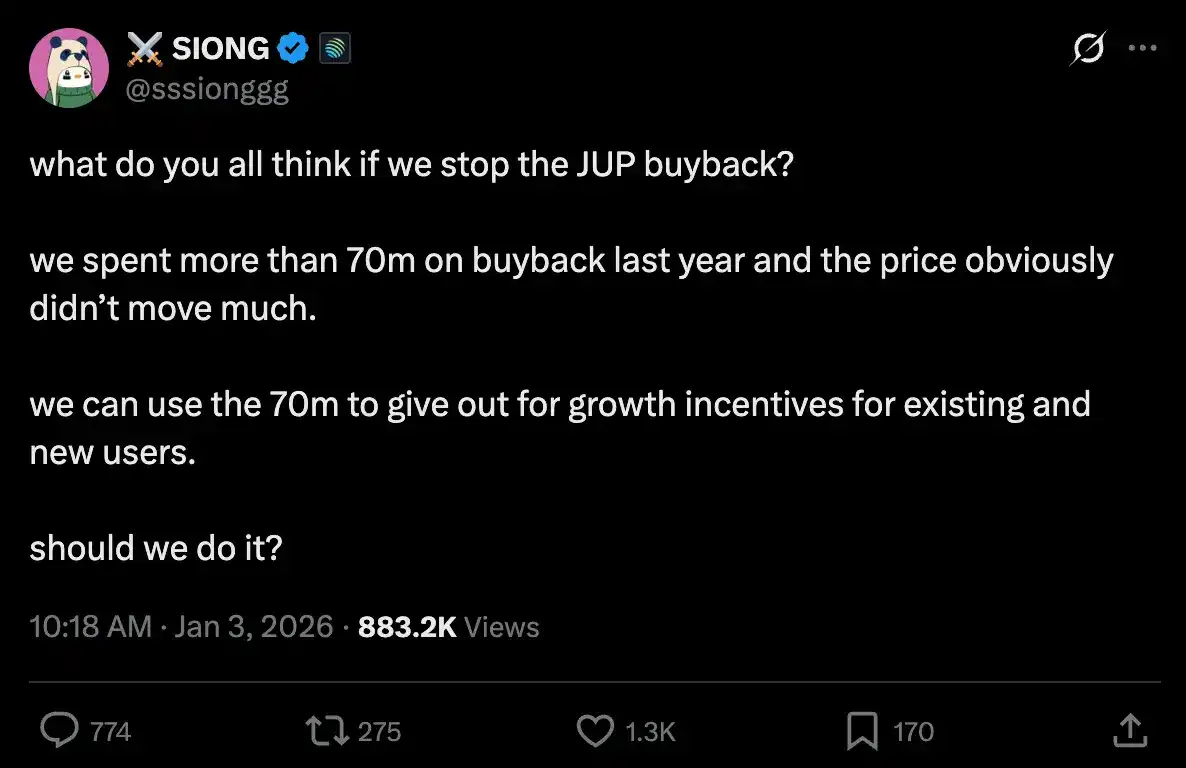
Recently, Jupiter co-founder SIONG initiated a discussion on X, proposing to halt the $JUP token buyback plan. He stated that Jupiter had invested over $70 million in token buybacks over the past year, but the token's performance has been lackluster. Meanwhile, Helium founder Amir Haleem directly announced the cessation of token buybacks, describing it as "throwing money into a black hole."

Why can tens of millions of dollars in real money not create even a ripple in the crypto market? Is the problem with the underlying design of the buyback strategy? Below is a summary of the performance data of project buybacks last year and market perspectives on project buybacks.
Data Performance: The Collective Waterloo of 2025's Buyback Projects

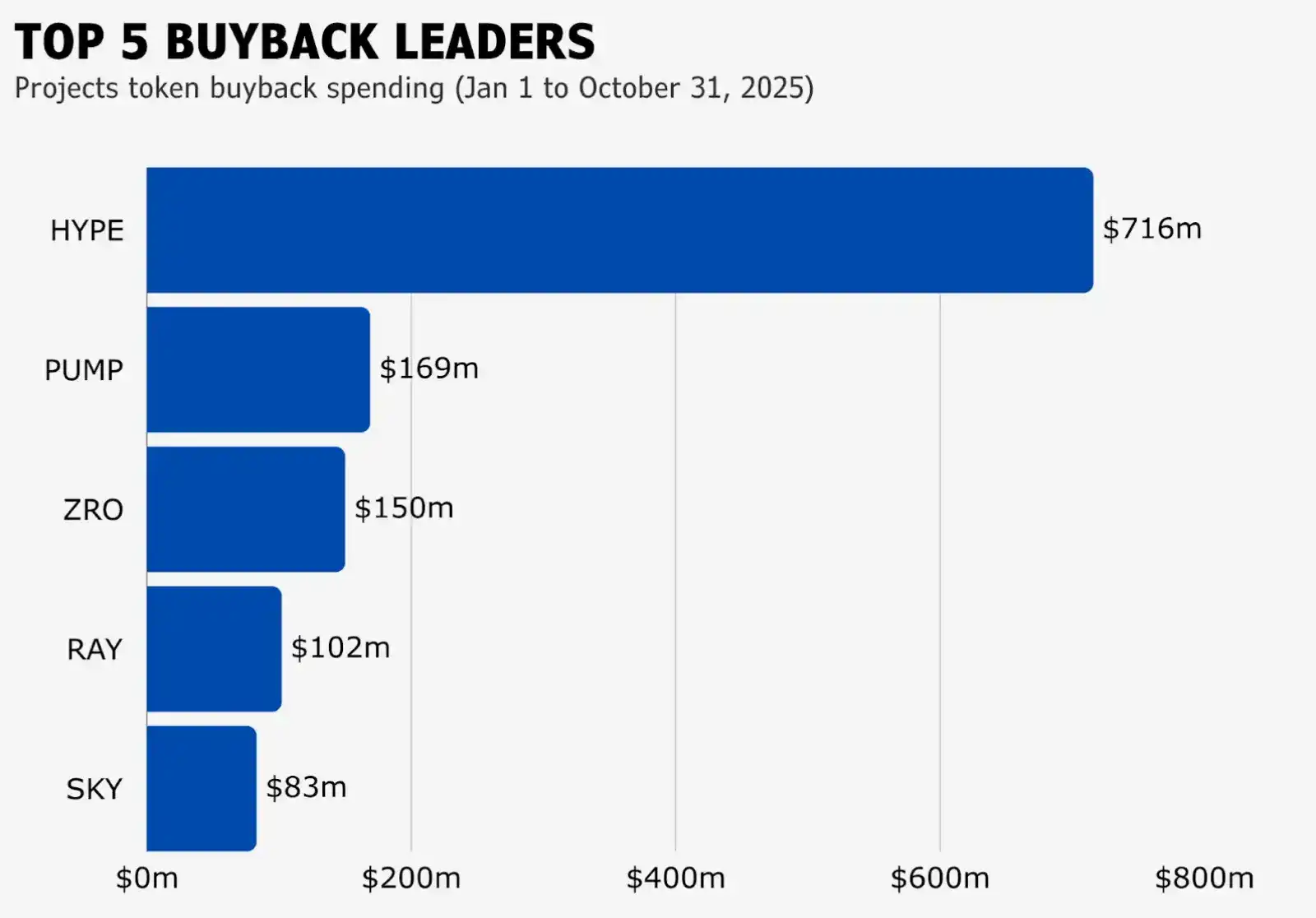
According to market research agency blockmates' tracking of buyback projects from January to October 2025, the top five projects were Hyperliquid, Pump.fun, LayerZero, Raydium, and Sky. Among them, Hyperliquid's buyback amount reached as high as $716 million, while Sky, at the bottom of the list, also invested $83 million.

However, the capital input did not yield proportional returns. Except for Hyperliquid's token price, which remained strong in the first three quarters (it has since fallen from $45.5 at the end of October to $25.94 at the time of writing), almost all other projects experienced continuous declines. This phenomenon has led the market to question: if buybacks cannot enhance token value, is this money essentially wasted?
Viewpoint Debate: The Trade-off Between Buybacks, Staking, and Growth Incentives

Regarding whether projects should stop buybacks, there are starkly different voices in the market:

The founders of Jupiter and Helium lean towards stopping token buybacks and instead using the funds to "acquire users," potentially through subsidizing transaction fees, rewarding new users, or enhancing product features to strengthen fundamentals. However, this shift still faces challenges: tokens will continue to unlock, and users might choose to sell due to a lack of long-term confidence, creating sustained selling pressure and risking a further significant drop in token price.

DeFi OG CM stated that the core meaning of buybacks lies in reducing the circulating supply and establishing a "regular deflation" model. Token price ultimately depends on market supply and demand and project fundamentals, not the buyback action itself. Buybacks are necessarily beneficial for token holders but are not equivalent to a short-term "guaranteed rise." Project teams should not easily halt execution due to low token prices or high buyback costs.

Helius CEO Mert Mumtaz expressed that buybacks are inherently a pessimistic mechanism, implicitly signaling that the project team cannot find a better use for the funds than short-term price boosting, attempting to initiate a growth cycle through price reflexivity rather than product growth. Buybacks are not the optimal strategy in a highly competitive market; the only effective edge case is opportunistic buybacks during market crashes (when equity is irrationally undervalued), combined with aggressive reinvestment during normal times. This is a judgment from a founder's perspective, not an investor's.

Ajit Tripathi, former Head of Institutional Business at Aave and FinTech Partner at ConsenSys, stated that the buyback narrative is the most value-destructive play after meme coins. This logic was initially a marketing tactic by Solana to boast its superiority over Ethereum, but it ended up harming all tokens, even those with revenue, forcing everyone to play pure financial games in the end.

Many other viewpoints have proposed alternative solutions. For example, Selini Capital founder Jordi Alexander observed that the failure of many projects lies not in the mechanism but in the "execution timing" of token buybacks. Some star projects of this cycle (e.g., HYPE, ENA, $JUP) executed large-scale buybacks during the market's most frenzied period when token valuations were most unreasonable. When the price-to-earnings ratio of tokens inflated due to excessive hype, project teams continued buybacks, essentially buying at the peak for sellers, which was a wrong decision. Therefore, Jordi suggests that project teams need more complex "financial engineering," and an ideal model should be dynamic buybacks based on the price-to-earnings ratio.

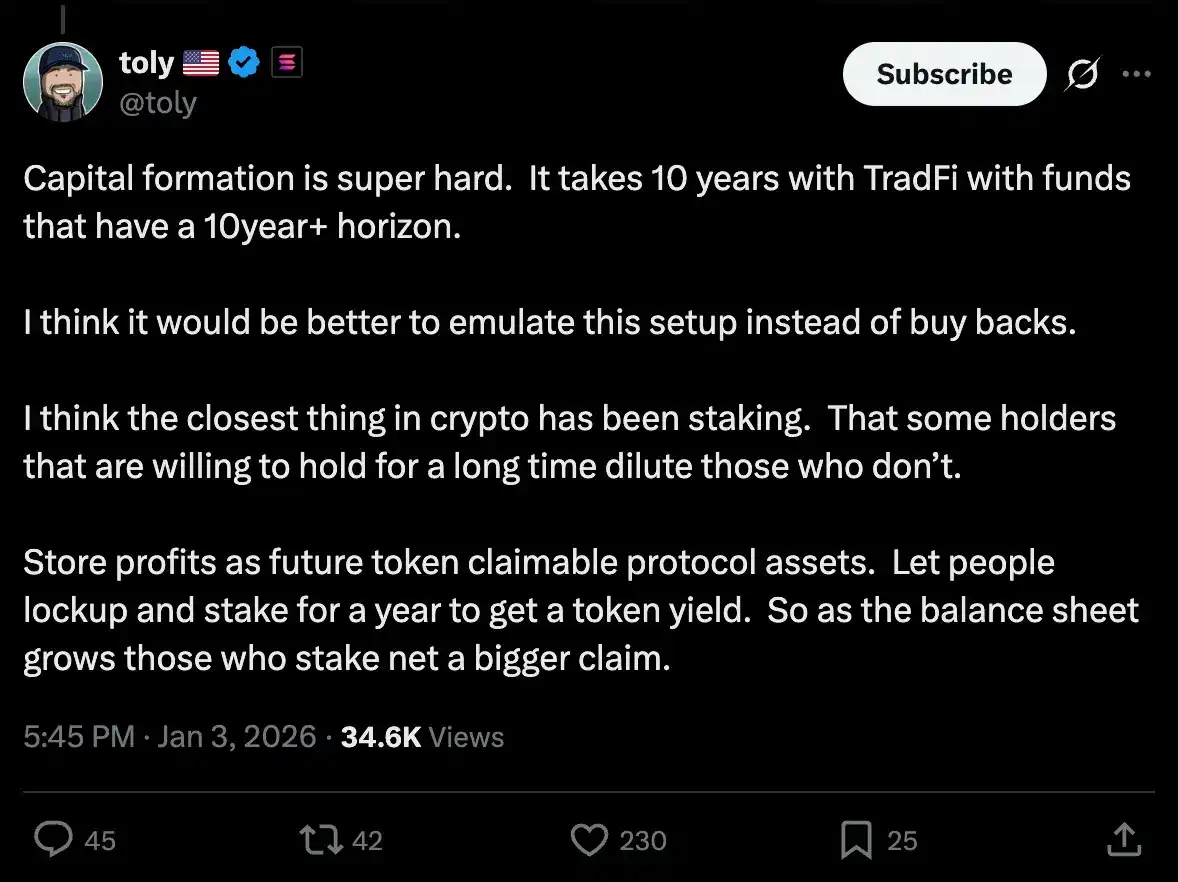
Solana founder Anatoly believes that projects should not pursue short-term price stimulation (buybacks) but should learn from traditional finance and establish a capital accumulation process spanning 10 years. He favors staking mechanisms more, allowing long-term lockers to obtain more shares, thereby diluting short-term speculators. He believes profits should be stored as "future token claims" rather than consumed in market fluctuations.
Represented by Selini Capital founder Jordi Alexander, some believe the buyback itself is not wrong, but the "amateur execution" is. Projects should hire professional financial advisors to adjust buyback strategies based on the token's price-to-earnings ratio and market cycles, rather than blindly repurchasing, leading to the dilemma of depleting the treasury at the bull market peak and having no funds to protect the price when entering a trough.

Evolution from "Blind Buybacks" to "Strategic Value Management"

Token buybacks are essentially a "deflation tool," not a guarantee of price increase. Amid various market fluctuations, buybacks more often play a role of "passive defense." They can reduce supply and establish a bottom support for the token price, but they cannot single-handedly reverse complex trends formed by macro conditions, unlocking pressure, or market sentiment.

The path to token value growth should evolve from单一的 buyback actions to strategic value management. First, projects need to establish execution strategies with better financial judgment, such as following the logic of "buying low valuation, reserving high valuation": firmly executing buybacks when the token price is far below intrinsic value to maximize capital return; and halting buybacks when market heat is excessive and valuation is unreasonable, instead depositing profits into the treasury as reserve funds or using them to fuel product growth.

Furthermore, buybacks can only address the "supply" issue but cannot create "demand." A project must give users a reason to hold tokens continuously. These reasons may come from the expectation of protocol revenue distribution, the power of ecosystem governance, or the irreplaceable competitiveness of the product itself. Without solid fundamental support, any form of buyback will ultimately become an exit channel for arbitrageurs.


Perguntas relacionadas

QWhy are some Web3 project founders, like those from Jupiter and Helium, proposing to stop token buybacks?

AThey believe that spending millions on buybacks has not effectively supported the token price and view it as inefficient capital allocation, with one founder even comparing it to 'throwing money into a black hole'. They suggest reallocating these funds towards user acquisition and product growth instead.

QAccording to the data from blockmates, what was the performance of major buyback projects in 2025?

AThe data showed a collective downturn. Despite significant investments, with Hyperliquid leading at $716 million in buybacks, most projects experienced continuous price declines. Only Hyperliquid maintained a strong performance initially, but its price also fell significantly later, dropping from $45.5 to $25.94 by the time of writing.

QWhat is the core argument in favor of continuing token buybacks, as presented by DeFi OG CM?

ACM argues that the core value of a buyback is to reduce circulating supply and establish a 'regular deflation' model. While buybacks are beneficial for token holders by creating a supply shock, they do not guarantee short-term price increases. The ultimate token price depends on market supply-demand dynamics and project basics, not the buyback action itself.

QWhat alternative to buybacks does Solana founder Anatoly Yakovenko propose for long-term value creation?

AAnatoly Yakovenko advocates for a long-term capital accumulation process over 10 years, similar to traditional finance, rather than short-term price stimulation via buybacks. He favors a staking mechanism that rewards long-term holders with more tokens, thereby diluting short-term speculators, and suggests storing profits as 'future token claims' instead of spending them on market volatility.

QWhat key flaw in the execution of buyback strategies does Jordi Alexander, founder of Selini Capital, identify?

AJordi Alexander identifies the flaw as 'amateur execution', not the mechanism itself. He observes that many projects conducted large-scale buybacks at the peak of market frenzy when token valuations were most inflated, essentially buying at the top for sellers. He recommends a more sophisticated 'financial engineering' approach with a dynamic buyback model based on the token's price-to-earnings ratio and market cycles.

Leituras Relacionadas

Understanding CPO (Co-Packaged Optics) in One Article: Why Nvidia Is Willing to Spend $3.2 Billion on a Fiber?

NVIDIA and Corning announced a multi-year strategic partnership on May 6, 2026, with NVIDIA committing up to $3.2 billion to support Corning's U.S. expansion. This investment will triple Corning's manufacturing plants and significantly boost its optical fiber and communications production capacity. The core driver behind this massive investment is the fundamental shift from copper to optical interconnect technology within AI data centers. As GPU clusters scale, copper wires face critical limitations: severe signal attenuation over distance, high energy consumption for signal integrity, and excessive heat generation. Optical fiber, transmitting light instead of electrical signals, solves these issues with minimal loss, near-light speed, and lower power needs. The article outlines a three-stage evolution of data center interconnect: 1. **Traditional Copper Interconnects:** The mainstream solution of the 2010s, now being phased out due to scaling bottlenecks. 2. **Pluggable Optical Modules:** The current mainstream, where modules convert electrical signals to light externally. This process still introduces energy loss and latency. 3. **CPO (Co-Packaged Optics):** The next-generation technology where the optical engine is integrated directly with the GPU chip package. This drastically reduces the electrical signal travel distance to mere millimeters, slashing power consumption and latency while boosting data density. NVIDIA CEO Jensen Huang has identified CPO as an essential core technology for AI infrastructure. NVIDIA's investment signifies a strategic shift from being a buyer to actively controlling its supply chain for critical components. With demand for specialized optical fiber far outstripping supply—evidenced by soaring prices—securing long-term manufacturing capacity has become a competitive necessity. While Corning's expansion may pressure some suppliers, a projected global fiber supply gap of 5-15% over the next few years creates a significant opportunity window, particularly for Chinese manufacturers competitive in optical preforms, chips, and modules. Ultimately, NVIDIA's move is not about chasing a trend but an engineering imperative. The transition to light-based interconnects like CPO is driven by the physical limits of copper, marking a definitive step in the ongoing AI computing revolution.

marsbitHá 7m

Understanding CPO (Co-Packaged Optics) in One Article: Why Nvidia Is Willing to Spend $3.2 Billion on a Fiber?

marsbitHá 7m

KOL's Perspective: Why Is SOL Set to Rise from This Point?

**Summary: Why SOL is Positioned for Growth at This Level** The article argues that SOL is poised for an upward move from its current price point, citing several key factors. Primarily, SOL has just broken out of a 4-month consolidation phase. This breakout signals a return of risk appetite to the broader crypto market, as SOL is seen as a key indicator of overall crypto health. The token's ownership has reportedly shifted from short-term traders and tourists to long-term accumulators, leading to low volume. Any meaningful increase in trading activity could thus trigger significant upward momentum. Fundamental strengths include strong institutional adoption, integration with DeFi and RWAs (Real-World Assets), and the potential benefits from the Clarity Act. Despite its high volatility—having dropped 70% from its all-time high but still up 12x from its bear market low—SOL is highlighted as one of the few tokens from the last cycle to reach new highs. It boasts a robust ecosystem of applications, users, and protocols. Future catalysts include the expected influx of AI developers following the Miami Accelerate conference, which focused on AI on Solana. Furthermore, Solana is positioned as the premier chain for memecoin activity, a trend expected to continue and drive network usage and fees. The article concludes that recent price action reflects a healthy transfer to long-term holders, setting the stage for growth.

marsbitHá 57m

KOL's Perspective: Why Is SOL Set to Rise from This Point?

marsbitHá 57m

Those Pre-Bitcoin PoW Protocols Have Recently Been Reimplemented

This article details a recent surge in replicating pre-Bitcoin Proof-of-Work (PoW) protocols, specifically focusing on Hal Finney's 2004 RPOW (Reusable Proofs of Work). Within five days in May 2026, multiple independent builders in the Bitcoin/cypherpunk community launched projects inspired by this early electronic cash proposal. The initiative began with Fred Krueger's `rpow2.com`, a centralized but auditable system that replaced RPOW's original IBM 4758 hardware with Ed25519 signatures. Initially a faithful replica, it later adopted Bitcoin-like features (21M supply cap, difficulty adjustment) and a controversial 5.24% founder allocation. This sparked rapid forks, including `rpow4.com` which incorporated full Bitcoin parameters, a prediction market (`rpowmarket.com`), and a DEX (`rpow2swap.com`). Concurrently, Mike In Space created a prototype of Wei Dai's 1998 b-money proposal (`b-money.replit.app`), pushing the historical exploration even further back. The article contrasts these centralized, server-dependent experiments with Bitcoin's core innovation of decentralized, trustless consensus. It also highlights a parallel development: the `HASH` project on Ethereum, which uses smart contract hooks to enable a purely fair-launch, browser-mineable PoW token with 0% allocations to team or VCs. The collective activity is framed as a meme-driven, educational exploration of cypherpunk history rather than a serious financial movement, with all projects heavily disclaiming any investment value.

marsbitHá 1h

Those Pre-Bitcoin PoW Protocols Have Recently Been Reimplemented

marsbitHá 1h

South Korean Exchanges 'Battle' Regulators, Challenging the Boundaries of Enforcement and Legislation

South Korea's cryptocurrency industry is engaged in a rare, direct confrontation with regulators. The Financial Intelligence Unit (FIU), the primary anti-money laundering (AML) watchdog, has recently imposed heavy penalties on major exchanges like Upbit and Bithumb for alleged violations involving unregistered overseas VASPs and AML procedures. However, exchanges are now actively challenging these actions in court and through industry associations. In a significant shift, the Seoul Administrative Court ruled in favor of Upbit's operator, Dunamu, overturning part of an FIU-ordered business suspension. The court found the FIU's penalty criteria and justification insufficiently clear. Similarly, the court suspended the enforcement of a six-month business suspension against Bithumb pending a final ruling, citing potential irreversible harm to the exchange. Beyond legal battles, the industry is contesting proposed legislative amendments. The Digital Asset eXchange Alliance (DAXA) strongly opposes a draft rule that would mandate Suspicious Transaction Reports (STRs) for all crypto transfers over 10 million KRW (~$6,800). DAXA argues this "poison pill" clause violates legal principles and would overwhelm the STR system, increasing reports from 63,000 to an estimated 5.45 million annually for major exchanges, thereby crippling effective AML monitoring. This conflict highlights a structural tension in South Korea's crypto governance: comprehensive digital asset laws are still developing, while regulators rely heavily on AML enforcement. The industry's move from passive compliance to active legal and legislative challenges signifies a new phase, pressing for clearer rules and more proportionate enforcement. While short-term disputes may intensify, this clash could ultimately lead to a more mature and sustainable regulatory framework for South Korea's vibrant crypto market.

marsbitHá 1h

South Korean Exchanges 'Battle' Regulators, Challenging the Boundaries of Enforcement and Legislation

marsbitHá 1h

Trading

Spot
Futuros

Artigos em Destaque

Como comprar ERA

Bem-vindo à HTX.com!Tornámos a compra de Caldera (ERA) simples e conveniente.Segue o nosso guia passo a passo para iniciar a tua jornada no mundo das criptos.Passo 1: cria a tua conta HTXUtiliza o teu e-mail ou número de telefone para te inscreveres numa conta gratuita na HTX.Desfruta de um processo de inscrição sem complicações e desbloqueia todas as funcionalidades.Obter a minha contaPasso 2: vai para Comprar Cripto e escolhe o teu método de pagamentoCartão de crédito/débito: usa o teu visa ou mastercard para comprar Caldera (ERA) instantaneamente.Saldo: usa os fundos da tua conta HTX para transacionar sem problemas.Terceiros: adicionamos métodos de pagamento populares, como Google Pay e Apple Pay, para aumentar a conveniência.P2P: transaciona diretamente com outros utilizadores na HTX.Mercado de balcão (OTC): oferecemos serviços personalizados e taxas de câmbio competitivas para os traders.Passo 3: armazena teu Caldera (ERA)Depois de comprar o teu Caldera (ERA), armazena-o na tua conta HTX.Alternativamente, podes enviá-lo para outro lugar através de transferência blockchain ou usá-lo para transacionar outras criptomoedas.Passo 4: transaciona Caldera (ERA)Transaciona facilmente Caldera (ERA) no mercado à vista da HTX.Acede simplesmente à tua conta, seleciona o teu par de trading, executa as tuas transações e monitoriza em tempo real.Oferecemos uma experiência de fácil utilização tanto para principiantes como para traders experientes.

452 Visualizações TotaisPublicado em {updateTime}Atualizado em 2025.07.17

Como comprar ERA

Discussões

Bem-vindo à Comunidade HTX. Aqui, pode manter-se informado sobre os mais recentes desenvolvimentos da plataforma e obter acesso a análises profissionais de mercado. As opiniões dos utilizadores sobre o preço de ERA (ERA) são apresentadas abaixo.

活动图片









