Grayscale Highlights Strengthening Correlation Between Bitcoin and Gold

cryptonews.ruPublicado em 2026-08-28Última atualização em 2026-08-28

Resumo

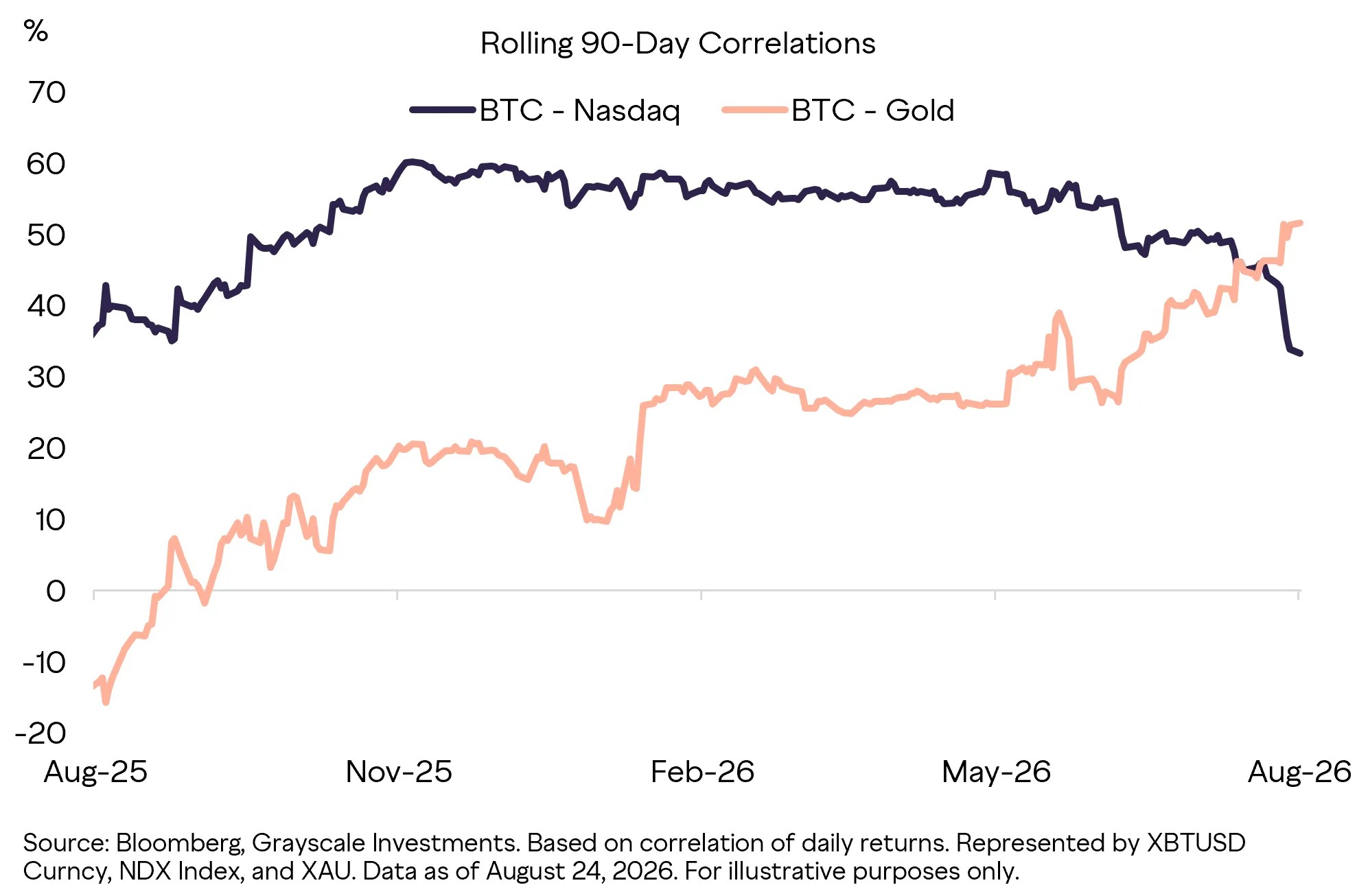
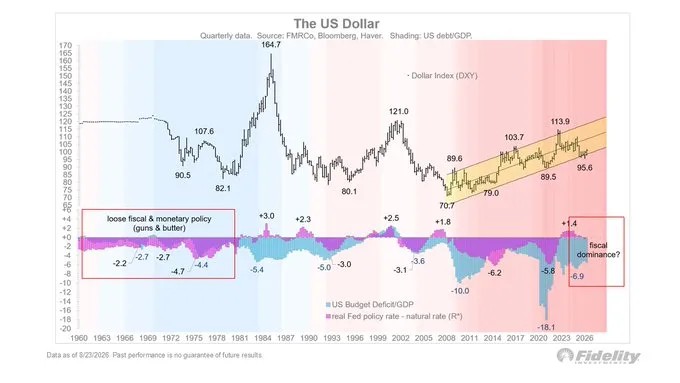
Grayscale's Head of Research, Zach Pandl, highlighted a significant shift in Bitcoin's correlation patterns. Over the past 90 days, Bitcoin's correlation with the Nasdaq 100 has fallen from 60% to 33%. Conversely, its correlation with gold has surged from near zero at the start of the year to over 50%. Pandl interprets this shift as the market beginning to perceive Bitcoin again as a defensive, safe-haven asset. He suggests it reflects renewed investor focus on Bitcoin's scarcity, financial independence, and utility as a store of value. This trend is supported by a macroeconomic backdrop featuring the U.S. national debt exceeding $40 trillion, rising deficits, and increasing Treasury yields, which are driving demand for assets that can protect capital from fiat currency devaluation. In this environment, Pandl posits Bitcoin could become a liquid alternative to gold, citing its capped supply of 21 million coins and transparent, decentralized issuance schedule. A similar view was echoed by Jurrien Timmer, Director of Global Macro at Fidelity. He linked the rise in both gold and Bitcoin to U.S. Treasury actions involving buying long-term bonds and increasing bill issuance. Timmer noted the market senses a "slippery slope toward fiscal dominance and a potential loss of Fed independence," conditions that are negative for the U.S. dollar but positive for assets like gold.

Over 90 days, the correlation between Bitcoin and the Nasdaq 100 has dropped from 60% to 33%, while its correlation with gold has risen from nearly zero at the start of the year to over 50%. This was noted by Zach Pandl, Head of Research at Grayscale.
Source: Grayscale.

According to Pandl, the market is once again beginning to perceive the first cryptocurrency as a safe-haven asset.

"This shift may reflect a renewed investor focus on Bitcoin's scarcity, its financial independence, and its utility as a store of value," he added.

The Grayscale executive also pointed out that U.S. national debt has exceeded $40 trillion, and growing deficits and rising Treasury yields are driving demand for assets that can protect capital from the weakening of fiat currencies. Grayscale referred to this as part of the macroeconomic backdrop for a "bet on currency debasement."

According to Pandl's assessment, in such conditions, Bitcoin could become a liquid alternative to gold. He reminded that the asset's supply is capped at 21 million coins, and its emission schedule is transparent and independent of a central issuer.

A similar position was voiced by Jurrien Timmer, Director of Global Macro at Fidelity. He linked the rise in gold and Bitcoin to actions by the U.S. Treasury to buy back long-term bonds and increase bill issuance.
Source: X/Jurrien Timmer.

"The market senses a slippery slope towards fiscal dominance and a potential loss of Federal Reserve independence," noted Timmer.

Loose fiscal and monetary policies are a clear negative for the U.S. dollar but a positive for gold, added the Fidelity representative.

Earlier, CryptoQuant analysts explained the reasons for Bitcoin's halt at $80,000.

BlackRock Links Demand for Bitcoin and Gold to U.S. Debt
end-content

Perguntas relacionadas

QWhat correlation shift between Bitcoin, Nasdaq 100, and gold was highlighted by Grayscale's research head?

AZach Pandl of Grayscale noted that over 90 days, Bitcoin's correlation with the Nasdaq 100 fell from 60% to 33%, while its correlation with gold rose from near zero at the start of the year to over 50%.

QWhat reason does Zach Pandl give for the market's renewed perception of Bitcoin as a defensive asset?

APandl suggests this shift reflects renewed investor focus on Bitcoin's scarcity, its financial independence, and its utility as a store of value.

QAccording to Grayscale, what part of the macroeconomic backdrop is fueling the 'bet on currency debasement'?

AGrayscale identifies the U.S. national debt exceeding $40 trillion, growing deficits, and rising Treasury yields as pushing demand for assets that can protect capital from the weakening of fiat currencies.

QWhy might Bitcoin serve as a liquid alternative to gold in the current environment, according to the Grayscale research head?

AZach Pandl points to Bitcoin's capped supply of 21 million coins and its transparent, issuer-independent emission schedule as key attributes making it a viable liquid alternative to gold.

QHow did Fidelity's Jurrien Timmer explain the concurrent rise in gold and Bitcoin prices?

AJurrien Timmer linked the rise in gold and Bitcoin to the U.S. Treasury's actions of buying back long-term bonds and increasing bill issuance, which the market perceives as a slippery slope toward fiscal dominance and a potential loss of Federal Reserve independence.

Leituras Relacionadas

The Pioneer of AI Boomerang Job-Hopping: No Ph.D., Fought Over by Top AI Labs in Silicon Valley

"AI's Boomerang Hire: The Unconventional Career of Barret Zoph Who is known as the first practitioner of 'boomerang hiring' in AI? Barret Zoph, now a Research VP at Google DeepMind, has an unconventional resume: former Senior Research Scientist at Google Brain, former VP of Post-Training Research at OpenAI, former co-founder/CTO of Thinking Machines Lab, former OpenAI Codex commercialization lead—all without a PhD. Zoph's career began at Google Brain in 2016 after his USC bachelor's degree. He co-authored the seminal "Neural Architecture Search with Reinforcement Learning," helping pioneer the NAS field. His later work included co-authoring the Switch Transformer, a key model for trillion-parameter scale training. He joined OpenAI in 2022, rising to VP focusing on reinforcement learning for post-training—a crucial step in aligning models like ChatGPT. USC later listed him among alumni who "paved the path for ChatGPT." In 2025, he co-founded Thinking Machines Lab with ex-OpenAI CTO Mira Murati but left under controversial circumstances less than a year later, returning briefly to OpenAI before his final move back to Google in 2026. His hiring coincides with significant talent churn at Google DeepMind. Data shows DeepMind's senior talent inflow/outflow ratio has sharply declined from 12:1 in 2023 to 2:1 in 2026, meaning for every two hires, one leaves—a stark contrast to Anthropic (22:1) and OpenAI (5.7:1). Key departures include founders and Nobel laureates moving to rivals. This fluid, sports-like transfer market for elite AI researchers is driven not just by pay but by competitive positioning, pre-IPO equity at startups, and concerns over shifting research priorities at large firms like Google as they focus more on commercial products like Gemini."

marsbitHá 28m

The Pioneer of AI Boomerang Job-Hopping: No Ph.D., Fought Over by Top AI Labs in Silicon Valley

marsbitHá 28m

Bitcoin Stabilizes at $80,000, How Do Institutions and Smart Money View the Future Market?

Bitcoin has consolidated around the $80,000 level following a record-breaking weekly dollar gain, pushing the price up 23.5% from August 17-23. Market focus is now on whether it can decisively overcome a significant resistance cluster between $81,000 and $86,000. This zone represents a critical supply wall, containing nearly 8% of the circulating supply and the average cost basis for major US spot Bitcoin ETFs. Analysis from Glassnode indicates the recent rally was fueled by substantial spot buying, evidenced by ETF inflows and declining exchange balances, rather than excessive leverage. Futures open interest has decreased, with cash/stablecoin margins dominating. While US ETF flows remain a key bullish driver, the market faces a crucial test. A successful break above the $81k-$82k resistance and the 50-week moving average (approx. $81,081) could signal a broader trend reversal. Failure may lead to a retracement toward the $75,000 support level. Institutional views are mixed but generally cautious. CryptoQuant highlights potential seasonal weakness in September, while CoinShares sees a likely trading range, requiring weaker jobs data for a sustained push toward $100k. K33 Research draws parallels to past cycle starts, and Bitwise suggests the bottoming process is advanced. Overall, the market is at a pivotal point, with the battle around $80k determining the near-term direction.

marsbitHá 43m

Bitcoin Stabilizes at $80,000, How Do Institutions and Smart Money View the Future Market?

marsbitHá 43m

Trading

Spot
活动图片