Original Author: ChandlerZ, Foresight News
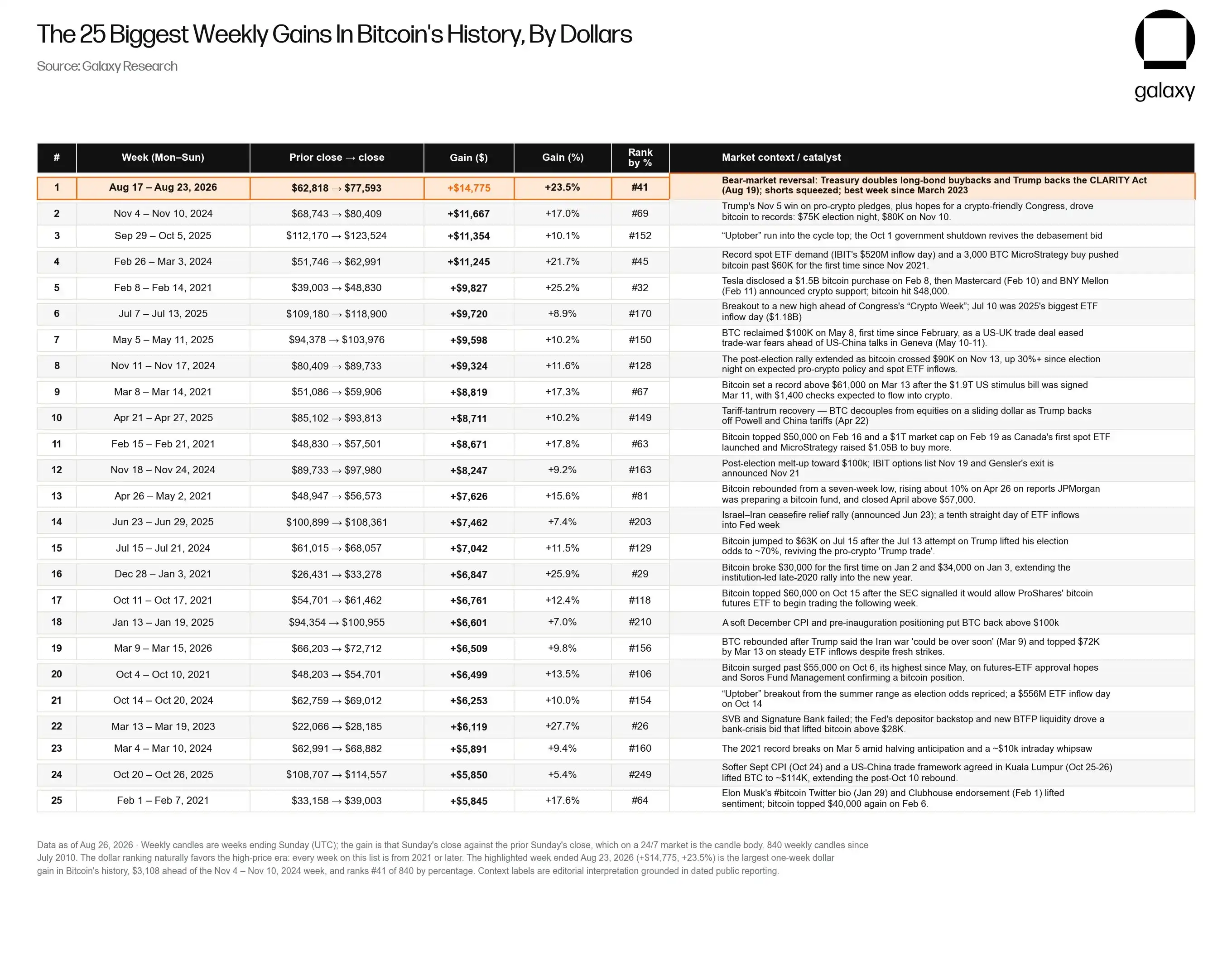
From August 17th to 23rd, Bitcoin rose from $62,818 to $77,593. According to Galaxy Research statistics, this weekly candlestick increased by $14,775, setting the largest single-week dollar gain in Bitcoin's history. In percentage terms, the 23.5% gain only ranks 41st among the 840 weekly candles since July 2010, but it is the highest since March 2023.
As Bitcoin's price base has risen, a gain ranking only 41st historically in terms of percentage is now capable of creating a dollar amount never seen before.
As of August 28th, after breaking through $81,500, Bitcoin turned downward and continues to struggle around the $80,000 level. U.S. spot Bitcoin ETFs have become a crucial variable in judging whether this rally can continue. According to Farside Investors' daily total calculations, there were eight consecutive trading days of net inflows from August 17th to 26th, totaling $2.8019 billion. Cumulative net inflows for August up to the 26th were approximately $3.282 billion.
Glassnode divides this market move into two stages: short liquidations triggered the rise on August 19th, followed by ETF subscriptions, declining exchange balances, and accumulation by wallets of various sizes providing spot capital. From August 14th to 25th, BTC-denominated futures open interest dropped from 645,760 BTC to 587,584 BTC, a decrease of about 9.0%, hitting a near five-month low. During the same period, open interest for contracts using BTC and other crypto assets as collateral fell to about 52,000 BTC, accounting for 11% of futures open interest. Cash and stablecoin collateral now constitute the vast majority.
Furthermore, the current perpetual swap funding rate is mostly near neutral, indicating that the liquidated shorts have not been immediately replaced by a large number of leveraged longs.
Synthesizing the available evidence, this rally has genuine capital support, and the $80,000 level is still in a stress-testing phase. Short-term debate centers on whether the supply zone between $81,000 and $86,000 can be absorbed. Medium-term debate focuses on whether this market move constitutes a cycle reversal or a rapid correction within a bear market framework.
On-Chain Holdings and Order Books Point to $81,000 - $86,000
On-chain data shows that the $80,000 level is currently forming one of the most concentrated resistance zones in its history. According to Glassnode's UTXO Realized Price Distribution (URPD) data, the $80,000 to $82,000 range clusters close to 8% of Bitcoin's circulating supply. At the $80,000 price point alone, about 5% of the supply is concentrated, the highest of any price level. This means that once the price returns to this zone, a large number of investors who bought previously will be back at their cost basis, potentially triggering concentrated selling and forming a so-called supply wall.
$78,000 is also a significant node, holding about 3.7% of the supply, while $82,000 ranks as the fourth most densely held price. These investors, who accumulated during the 2024-2025 uptrend, are now waiting for an opportunity to break even after the price correction from late 2025 to early 2026. Historical experience suggests that when the price returns to a zone with heavy trading volume, selling by short-term holders often amplifies the resistance effect.
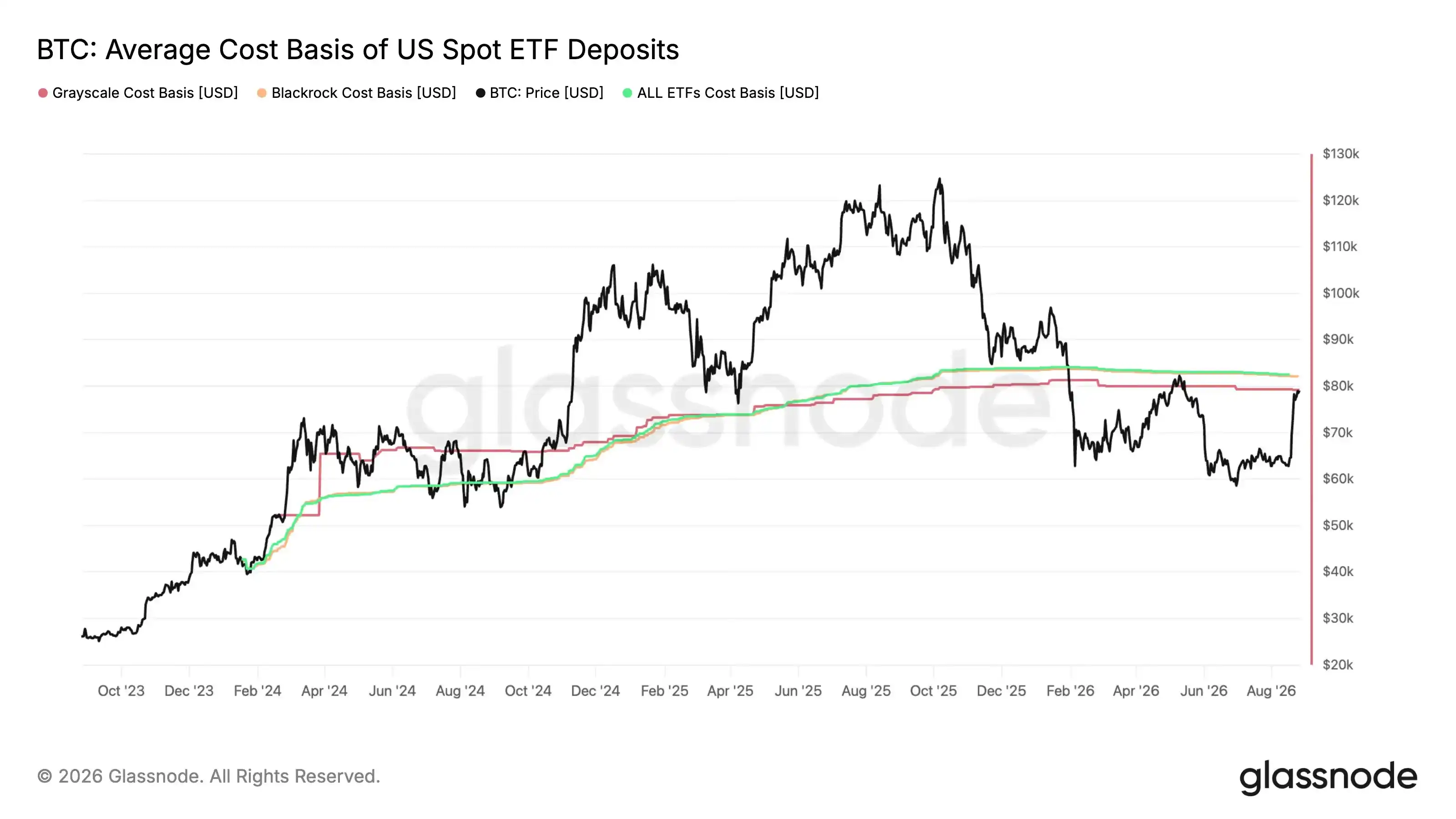
A separate metric tracked by Glassnode shows that the average cost basis for U.S. spot Bitcoin ETF holdings also falls within the $80,000 to $82,000 range. As ETFs are one of the most important sources of incremental funds for the market currently, the behavior of their holders significantly impacts the price. As the price approaches this "break-even line," some institutional or retail investors may choose to redeem or sell, further strengthening selling pressure in this zone.
From a technical perspective, Bitcoin is still trading below the 50-week moving average (currently around $81,081) and has failed to reclaim it effectively since November 2025. Looking back, in May 2020 and March 2023, Bitcoin initiated bull runs lasting several months after breaking through this long-term trend line. Therefore, the ability to stabilize above $81,000 is currently seen as a key signal for a shift in medium-term market strength.
However, the $60,000 to $63,000 range also clusters over 6% of the supply. But this zone has successfully transformed into strong support for most of 2026.
The institution believes Bitcoin is at a critical juncture for a tug-of-war between bulls and bears. If the bulls can leverage incremental funds to effectively break through the "triple resistance zone" of $80,000 to $82,000 and hold above the 50-week MA, it could open the door for a move towards higher prices, repeating the historical bull market script following a break above the long-term moving average. Conversely, if repeated upward attempts fail, it may trigger panic selling by short-term holders, causing the price to fall back to support zones around $75,000 or even lower to find balance.
Latest Views from Institutions and Smart Money
CryptoQuant Research:
September has historically been one of the weakest months for U.S. stocks, with the S&P 500 averaging a return of about -0.8% over the past 50 years. Bitcoin recorded negative returns in September for six consecutive years from 2017 to 2022, but posted gains in September for three consecutive years in 2023, 2024, and 2025, suggesting this seasonal pattern is weakening.
2026 coincides with U.S. midterm election uncertainty, which could increase volatility and prompt investors to reduce risk exposure. The core question is whether seasonal adjustments will evolve into broad-based risk aversion. Monitoring ETF flows and spot BTC demand is crucial. If risk aversion spreads across the entire market, Bitcoin will face pressure; conversely, if ETF and spot demand remain strong, the traditional September pattern may be broken again.
K33 Research:
BTC regained its position above the 50-day, 100-day, 200-day, and 200-week moving averages within four days. K33 views January and October 2023 as the closest historical references, believing that record-breaking short squeezes, recovering trading activity, and rotation into scarce assets resemble the early stages of past cyclical bull markets.
CoinShares:
The low for this cycle may have already occurred, and the next two to three months are more likely to be range-bound. BTC may move closer to $80,000, but sustaining above that level is difficult; a more sustained push towards $100,000 would require further weakening employment data, leading the market to significantly lower interest rate expectations.
Bitwise Europe:
Bitcoin's bottoming process has entered a later stage. Sustained trading above the $69,000 short-term holder cost basis will improve local market structure; with synchronized improvement in fund flows and market participation, a break and hold above the $76,000 realized market mean will confirm the return of macro risk appetite and signal the end of the bear market.
Trader "Set 10 Big Goals":
Has already re-entered two-thirds of the position in the $78,000-$79,800 range. Basically, it's hard to see a decent pullback before $100,000. $100,000 will arrive soon.
MN Capital Founder & CIO: Michaël van de Poppe:
The uptrend may last longer than expected, and we will also see Bitcoin push to at least $82,700, possibly even $90,000. Bitcoin is currently in a pretty decent consolidation range. Of course, the market is ever-changing, but given the current upward momentum, a retest of the highs seems inevitable. Any price below $74,000 is an excellent entry opportunity.