Original | Odaily Planet Daily (@OdailyChina)
Author | Wenser (@wenser 2010)
After enduring nearly six weeks of sudden shocks from the U.S.-Iran conflict, gold has returned above $4800 for the first time in nearly a month, following news related to a U.S.-Iran ceasefire agreement.
From the gold token XAUm mentioned as early as October 2024, to the accurate prediction of gold spot prices rising above $3900 when it was at $3500 in September last year, and later to the gold token XAUT mentioned when gold rose to around $4500 in January this year, I myself began a journey of fixed investment while following gold.
On the other hand, at the macro level, against the backdrop of intensifying geopolitical conflicts, central banks around the world continue to increase their gold holdings, with the Chinese central bank making large purchases for 17 consecutive months; major investment institutions and banks are also very confident about the gold price rally.
In view of this, this article from Odaily Planet Daily will explore a question from the perspectives of recent industry dynamics and changes in the political and economic situation: What is the upper limit for gold this year?
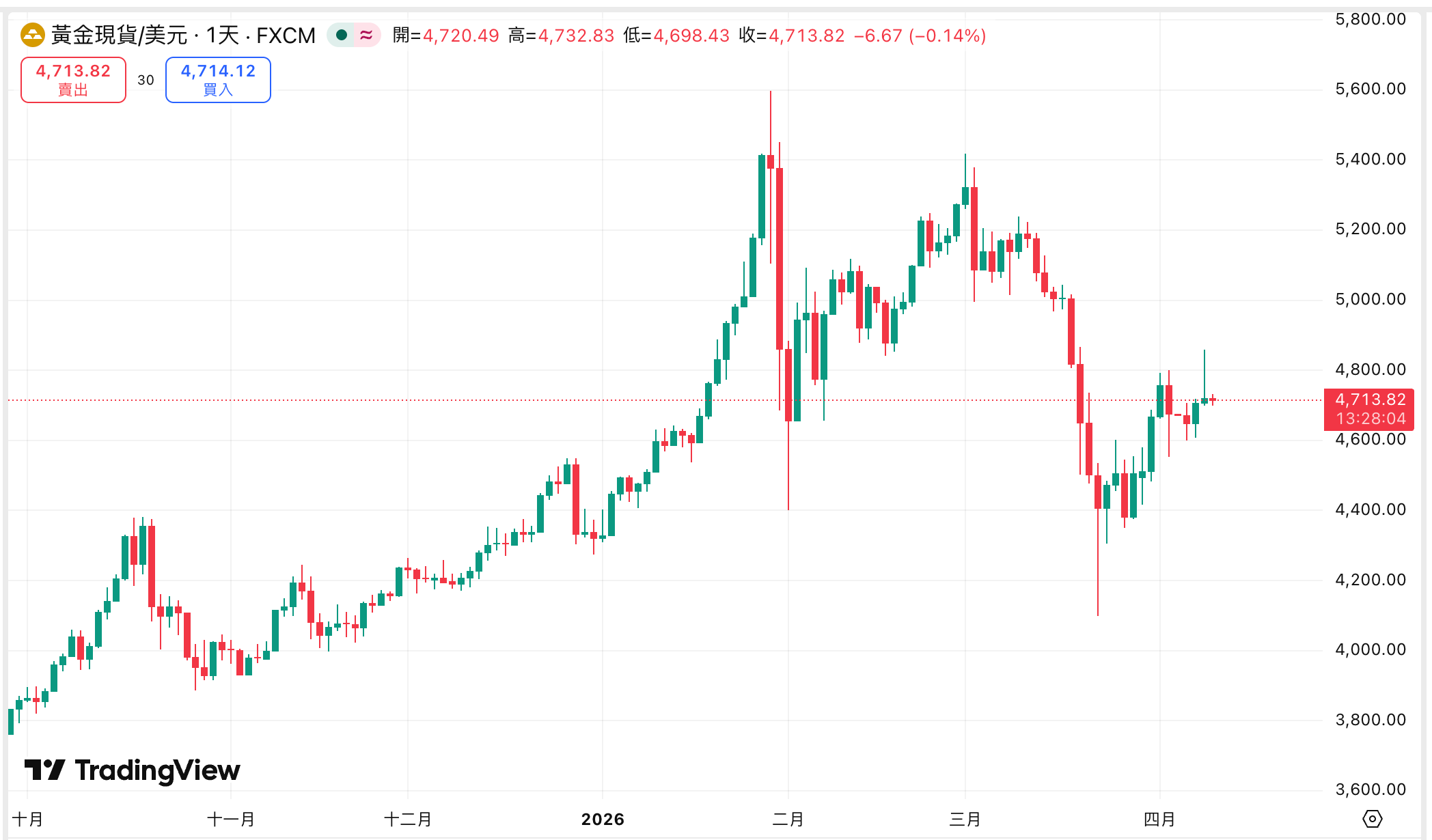
Gold price trend in the past six months
Views on gold price fluctuations in the prediction market: Price may be below $4200 before June, annual peak may exceed $6000
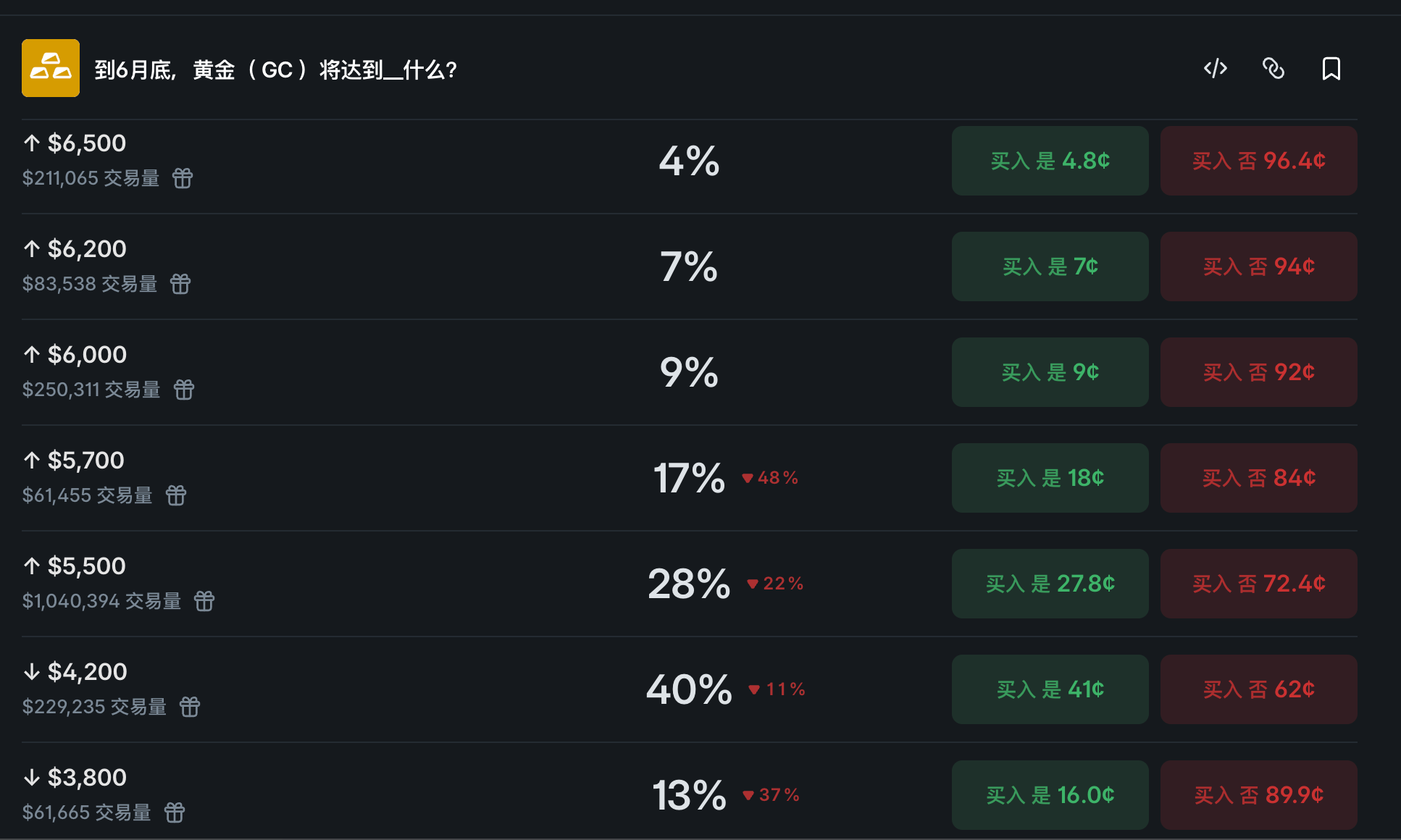
Since the emergence of prediction markets, thanks to factors such as real-money betting and "collective intelligence," they have become an important barometer for predicting asset prices. Currently, the annual price range for gold on Polymarket is around $3800-$6000.
On Polymarket, the betting volume for the mid-year gold price prediction currently exceeds $3.5 million, of which:
The probability of being below $4200 is the highest, at 40%;
The probability of being above $5500 is next, at 28%;
Followed by above $5700 (probability temporarily reported at 17%) and below $3800 (probability temporarily reported at 13%).
The betting volume for the annual gold price prediction on Polymarket is currently only nearly $200,000, of which:
The probability of being above $6000 is the highest, at 46%;
The probability of being above $7000 is next, at 25%;
The probability of being above $8000 is next, at 16%.
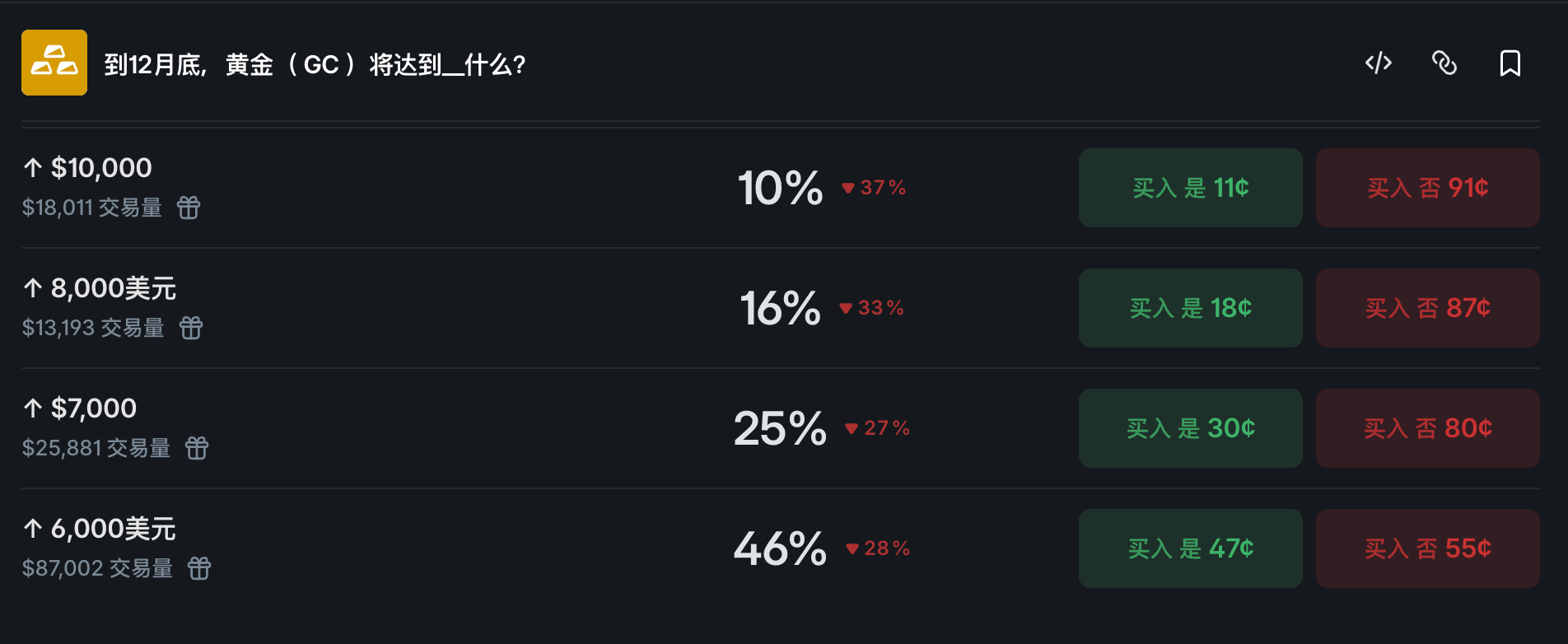
In other words, although the trading volume is relatively small, prediction market users still place the annual price above $6000, a difference of nearly 20%.
It is worth noting that the rules for gold price-related events on Polymarket use the official settlement price of the CME gold (GC) futures contract active month. Intraday trading, highest price, lowest price, bid, ask, or indicative prices are not counted.
Macro buying: Central banks continue to increase holdings, Turkish central bank exchanges gold for money
As the world's largest asset class by market value, the largest buyer of gold is naturally the central banks that control the fiat currency minting rights.
In early April, the World Gold Council released its February central bank gold buying monthly report. It pointed out that central banks net bought 19 tons of gold in February 2026, although still below the monthly average of 26 tons reported in 2025, it rebounded compared to the net purchase of 5 tons in January 2026. In addition, the report showed that some central banks maintained a continuous net buying record, with a cumulative gold purchase of 44 tons from November 2024 to February 2026, and the Czech Republic reported its 36th consecutive month of net buying. China increased its gold holdings for the 16th consecutive month (February data).
Goldman Sachs' research report at the end of March pointed out that supported by continued gold purchases by central banks and the expectation that the Federal Reserve will cut interest rates twice this year, the medium-term prospects for gold remain solid, and the gold price is expected to climb to $5400/ounce by the end of the year. UBS, at the end of March, expected the target price of gold to be $5900/ounce by early 2027.
On the 7th of this month, the Chinese central bank announced that China's gold reserves at the end of March were 74.38 million ounces (approximately 2313.48 tons), an increase of 160,000 ounces (approximately 4.98 tons) from the previous month. The figure at the end of February was 74.22 million ounces (approximately 2308.5 tons), marking the 17th consecutive month of increasing gold holdings.
On the other hand, traditional gold reserve powers have remained almost unchanged—such as the United States (approximately 8100 tons), Germany (approximately 3300 tons), Italy (approximately 2400 tons), and France (approximately 2400 tons).
As for the pressure on the fiat currency system in the Middle East due to the U.S.-Iran conflict, "the Turkish central bank sold over 120 tons of gold in the past 3 weeks, worth $20 billion." Many people only know one side of the story. In fact, most of this gold did not flow into the market but belonged to gold-currency swap futures. Simply put, the Turkish central bank only mortgaged its gold reserves to obtain U.S. dollar foreign exchange to stabilize the exchange rate of its domestic currency, the lira.
Structurally, the proportion of gold reserves to total reserves in emerging market central banks is still at a low level of just over 10%, and China is even in the single digits. This means that the room for central banks to increase holdings is far from saturated, and the strategic need for "de-dollarization" will provide rigid buying support for gold for many years to come.
Crypto buying: Stablecoin giant Tether's gold reserve scale ranks among the top 30 globally
In February, Wall Street investment bank Jefferies released a report stating that stablecoin issuer Tether continues to increase its gold holdings. As of January 31, its gold reserve scale has increased to about 148 tons, worth about $23 billion at current prices. Its holdings have exceeded those of many sovereign nations, ranking among the top 30 gold holders globally.
The report showed that Tether increased its gold holdings by about 26 tons in the fourth quarter of 2025 and continued to increase by about 6 tons in January this year. Its quarterly gold purchase scale was second only to a few central banks such as Poland and Brazil. Its current gold reserve scale has exceeded that of countries such as Australia, the UAE, Qatar, South Korea, and Greece.
The institution pointed out that the above gold is mainly used to support the dollar stablecoin USDT and the gold-pegged token XAUT (current FDV market value exceeds $3.3 billion). Since Tether is not a listed company, its disclosed data may only be the minimum level, and the actual gold holdings may be higher than the published value. Tether CEO Paolo Ardoino previously stated that the company plans to allocate about 10%–15% of its investment portfolio to physical gold.
Retail buying: High-level套牢 determines holding stability
In 2026, retail participation in gold investment has significantly increased, especially Asian funds becoming the new main force in the gold market.
In January, Asian gold ETFs saw a single-month inflow of up to $10 billion.
In addition, Chinese investors purchased 432 tons of gold bars and coins throughout 2025, a record high. The scene of queues at domestic gold stores to purchase accumulated gold, and the frequent sold-out status of accumulated gold on bank apps, reflect ordinary investors' strong recognition of gold's value preservation function.
However, the flip side of retail buying is the intensified two-way volatility of gold prices. In January, the news of Kevin Warsh being nominated as Fed chairman caused the gold price to plummet by more than 9% in a single day, the largest single-day drop in nearly 40 years; in March, the gold price once fell below $4200/ounce, and a large number of retail investors were套牢 at high levels. Combined with the action of the Chinese central bank buying heavily, it formed a sharp contrast of "retail panic selling, sovereign funds buying at lows."
As a result, a large amount of retail buying套牢 at high levels反而 means that the amount of gold sold within the year will not be too large.
Note: 套牢 (tào láo) is a Chinese term meaning to be trapped in a position (e.g., bought at a high price and now the price is lower, unable to sell without a loss). The translation uses "套牢" (tao lao) transliterated and explained as "trapped in a position" or simply "trapped" in context.
Institutional views: Gold will still hit new highs, price may be around $5200 by the end of June
At the institutional level, UBS, which has always paid much attention to the precious metals market, has frequently expressed views this year.
On January 21, UBS precious metals strategist Joni Teves said that diversification needs are the core driving force behind this round of gold price increases. Institutional investors, retail investors, and central banks are all increasing their gold holdings to cope with macro uncertainties. It is expected that the gold price will still have upward momentum in the first half of the year. If market concerns about the Fed's independence continue to heat up, the gold price is expected to hit the $5000/ounce mark in the first half of the year. Silver will benefit from the带动 of rising gold prices and its own narrowing supply-demand gap, and may challenge $100/ounce this year.
Subsequently, gold and silver both surged, with the former once rising to nearly $5600/ounce, and the latter once rising to $120/ounce.
On February 24, UBS Group said it expects the gold price to reach $6200 per ounce in the coming months because the key factors driving its strong rally over the past year remain.
Subsequently, on February 28, the U.S.-Iran conflict officially broke out, with Israel and the United States jointly attacking Iran, and regional hot war began.
On March 5, UBS Group analysts stated in a report that data since 1900 shows that for financial markets, economic risks have proven to be more significant than geopolitical risks. They said that in most cases, investors perform best if they can "see through" the noise of geopolitics.
At the end of March, UBS expected the target price of gold to be $5900/ounce by early 2027.
On April 2, UBS strategist Joni Teves预计, despite recent gold price fluctuations, the gold price will hit a new high this year, and views the recent回调 as a buying opportunity. UBS expects the average gold price in 2026 to be $5000 per ounce, and $4800 and $4250 in 2027 and 2028 respectively.
On April 7, UBS lowered its gold price expectation for the end of June to $5,200/ounce, due to cooling investor demand amid increased market volatility.
In addition, in early February, JPMorgan publicly firmly看好 gold, believing that the year-end target is up to $6300, with a remaining 34% increase.
Understanding the nature of gold: Safe-haven asset and core of the de-dollarized monetary system
Finally, let's briefly discuss the nature of gold investment.
In 1971, the United States亲手 dismantled the Bretton Woods system it had built. Subsequently, the gold price soared from $35/ounce to nearly $5000/ounce today, a cumulative increase of over 94 times in 55 years. Taking 4-5 years as an investment cycle, it has累计穿越 at least 10 bull and bear cycles.
After the outbreak of the Russia-Ukraine conflict in 2022, the economic process of "de-dollarization" suddenly accelerated, and global central banks thus started a new round of gold reserve competition, which step by step created the "super行情" of gold in the past 3 years.
Entering 2026, as the US Trump was挑拨 by Israel's Netanyahu to send troops to the Middle East (Odaily Planet Daily Note: It is rumored that Netanyahu personally lobbied before the US-Israel joint attack on Iran), although affected by AI, technology, local industrial回流 and other news and policies, the US political and economic situation will not collapse instantly, but the monetary credit system of the US dollar has already shown initial signs of decline.
In January this year,知名投行 Morgan Stanley said that the role of the US dollar in the global system is being continuously and gradually weakened, but since credible alternative currencies are still limited, in an increasingly multipolar world, gold has become the biggest challenger to the US dollar. According to Morgan Stanley's research, the international influence of the US dollar has declined on several indicators, including its share in central banks' foreign exchange reserves下滑, and its use in corporate and emerging market sovereign issuance减少. Nevertheless, the US dollar still accounts for the largest share of global reserves, indicating that there is currently no challenger of substantive significance. However, once gold is taken into account, the situation changes. The proportion of gold in central banks' held assets has risen from about 14% to 25%—28%, and this upward trend "shows no signs of slowing down." Risk premiums and hedging behavior will continue to put pressure on the US dollar while supporting gold demand.
Although in the chaos caused by the U.S.-Iran conflict in Dubai, gold's "safe-haven asset属性" was questioned due to its inconvenience to carry,但从 the current international situation, it is still the only hard currency recognized by the international community besides the US dollar.
As for Iran's guarding of the Strait of Hormuz and charging passage fees in RMB, BTC and other cryptocurrencies, it further exposed the reality of the declining credibility of the US dollar in the global economic system.
Therefore, although Bloomberg Intelligence senior market analyst Mike McGlone warned in his April metal market outlook report that gold and silver may have peaked, and the "once-in-a-generation" high may have passed. But given Trump's current首鼠两端、sometimes winning, sometimes winning political attitude, gold is still at a relative low for the year.
Based on the above multi-dimensional analysis, the trend of gold in 2026 can be summarized as a three-stage structure of "surging to the top in the first quarter, a shallow回调 in the second quarter, and bottoming out and rising in the third and fourth quarters". The core logic is still upward, but volatility will be significantly higher than in previous years.
At the current price level of $4800/ounce, gold may be in a修复性反弹 stage, and $4900 is the key resistance interval in the near term. The progress of the U.S.-Iran ceasefire talks, US CPI data, and Fed policy signals will be the most critical short-term price catalysts. If the ceasefire agreement continues and oil prices continue to fall, and rate cut expectations further heat up, the gold price is expected to challenge the $5200 mark by the end of the second quarter.
In the second half of the year, as US inflationary pressures ease with falling oil prices, the Fed's rate cut window reopens, and a weaker US dollar will provide more room for gold to rise. In addition, the unpredictable situation of the midterm elections will also provide certain political momentum for the rise of assets such as gold and BTC.
In terms of price上限, comprehensive institutional predictions and market trends, the reasonable upper limit prediction interval for the gold price in 2026 is $5400~$6000/ounce, and under optimistic conditions, it may rise to $6200-$6400/ounce.
In a nutshell, the United States is like the powerful but declining Qin Dynasty in the past, "When Qin loses its deer, all heroes chase it." At this time, among the大类 assets under heaven, if we talk about稳妥保障、保值增值, who else is there besides gold?
Recommended Reading
What's more worth paying attention to behind the gold回调: The loosening of the old system
Is Iran's talk of paying Strait passage fees with Bitcoin just hot air?