Global Shift Towards Easing, ETH May Have Taken the 'Best Offensive Position'

比推Publicado em 2025-12-12Última atualização em 2025-12-12

Resumo

Global monetary policy is shifting towards easing, creating a favorable environment for risk assets. Despite a significant market decline in October, the long-term trend of crypto integration with traditional finance continues. A key narrative is emerging: U.S. political and economic elites are building a capital network connecting U.S. Treasury bonds, stablecoins, and Ethereum-based RWA (Real World Assets) protocols. This chain funnels dollar credit into assets ultimately settled on Ethereum and its Layer 2s. Ethereum's recent Fusaka upgrade is a milestone, addressing the issue of L1 value capture diminished by L2 growth. By introducing a dynamic floor price for data blobs (EIP-7918), it ensures L2 activity consistently contributes to ETH burning. Post-upgrade, blob fees have become the primary source of ETH burn, potentially returning ETH to a deflationary state. Technically, ETH appears strong. Leverage in the market is at historically low levels (~4%), and the Long BTC/Short ETH trade has been failing since November. ETH exchange reserves are at a multi-year low, suggesting a potential short squeeze. With anticipated friendly monetary policy from both the U.S. and China, ETH is positioned in a favorable accumulation zone.

Author: Trend Research

Original Title: Under Global Easing Expectations, ETH Has Entered the Value 'Sweet Spot'


Since the market crash on October 11, the entire cryptocurrency market has been sluggish, with market makers and investors suffering heavy losses. The recovery of capital and sentiment will take time.

However, the cryptocurrency market is never short of new fluctuations and opportunities, and we remain optimistic about the future market.

This is because the trend of mainstream crypto assets integrating with traditional finance to form new ecosystems has not changed; instead, it has rapidly built moats during the market downturn.

I. Wall Street Consensus Strengthens

On December 3, U.S. SEC Chairman Paul Atkins stated in an exclusive interview with FOX on the New York Stock Exchange: "In the coming years, the entire U.S. financial market may migrate to the blockchain."

Atkins said:

  1. The core advantage of tokenization is that if assets exist on the blockchain, the ownership structure and asset attributes will be highly transparent. Currently, listed companies often do not know who their shareholders are, where they are located, or where the shares are held.

  2. Tokenization is also expected to achieve "T+0" settlement, replacing the current "T+1" trading settlement cycle. In principle, the delivery versus payment (DVP)/receive versus payment (RVP) mechanism on-chain can reduce market risks and improve transparency. The time gap between clearing, settlement, and fund delivery is currently a source of systemic risk.

  3. Tokenization is seen as an inevitable trend in financial services, with mainstream banks and brokerages already moving toward tokenization. The world may not even take 10 years... perhaps it will become a reality in just a few years. We are actively embracing new technologies to ensure the U.S. remains at the forefront in areas like cryptocurrency.

In reality, Wall Street and Washington have already built a capital network deeply embedded in crypto, forming a new narrative chain: U.S. political and economic elites → U.S. bonds (Treasury bonds) → Stablecoins / Crypto treasury companies → Ethereum + RWA + L2
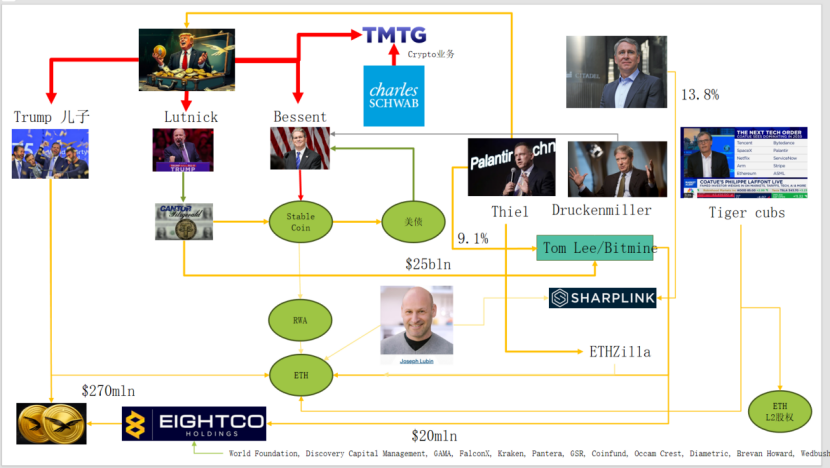
From this chart, we can see the intricate connections between the Trump family, traditional bond market makers, the Treasury, tech companies, and crypto companies, with the green elliptical links forming the backbone:

(1) Stable Coins (USDT, USDC, dollar assets behind WLD, etc.)

The majority of reserve assets are short-term U.S. bonds + bank deposits, held through brokers like Cantor.

(2) U.S. Bonds (U.S. Treasuries)

Issued and managed by the Treasury / Bessent side.

Used by Palantir, Druckenmiller, Tiger Cubs, etc., as low-risk interest rate base holdings.

Also the yield assets pursued by stablecoins / treasury companies.

(3) RWA (Real World Assets)

From U.S. bonds, mortgages, accounts receivable to housing finance.

Tokenized through Ethereum L1 / L2 protocols.

(4) ETH & ETH L2 Equity

Ethereum is the main chain承接 RWA, stablecoins, DeFi, and AI-DeFi.

L2 equity / Token represents a claim on future trading volume and fee cash flows.

This chain expresses:

U.S. dollar credit → U.S. bonds → Stablecoin reserves → Various crypto treasury / RWA protocols → Ultimately沉淀 on ETH / L2.

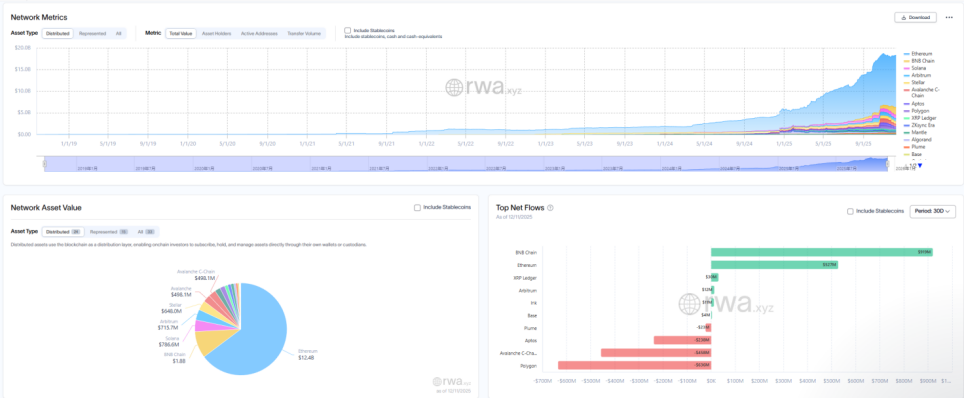
In terms of RWA TVL, compared to other public chains that declined after the October 11 crash, ETH is the only public chain that quickly recovered and rose. Its current TVL is $12.4 billion, accounting for 64.5% of the total crypto market.
II. Ethereum Explores Value Capture

The recent Ethereum Fusaka upgrade did not cause much stir in the market, but from the perspective of network structure and economic model evolution, it is a "milestone event." Fusaka is not just about scaling through EIPs like PeerDAS but also attempts to address the issue of insufficient value capture by the L1 mainnet due to L2 development.
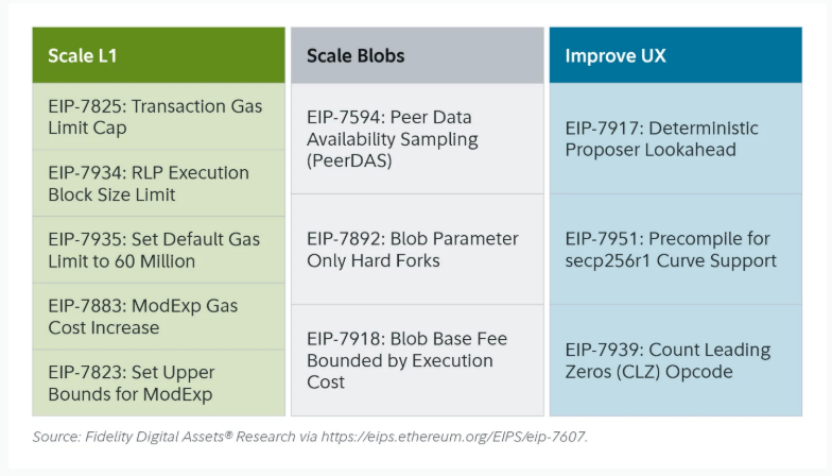
Through EIP-7918, ETH introduces a "dynamic floor price" for blob base fees, binding its lower limit to the L1 execution layer base fee, requiring blobs to pay at least about 1/16 of the L1 base fee unit price for DA fees. This means Rollups can no longer occupy blob bandwidth at near-zero cost for extended periods, and the corresponding fees will be burned and回流 to ETH holders.
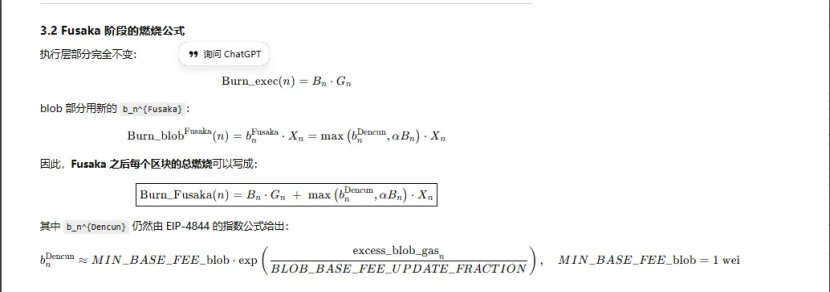
There have been three upgrades related to "burning" in Ethereum:

(1) London (Single-dimension): Only burned the execution layer; ETH began to experience structural burning due to L1 usage.

(2) Dencun (Dual-dimension + independent blob market): Burned execution layer + blob; L2 data写入 blob also burned ETH, but during low demand, the blob portion was almost 0.

(3) Fusaka (Dual-dimension + blob bound to L1): To use L2 (blob), one must pay at least a fixed proportion of the L1 base fee, which is burned. L2 activity is more stably mapped to ETH burning.
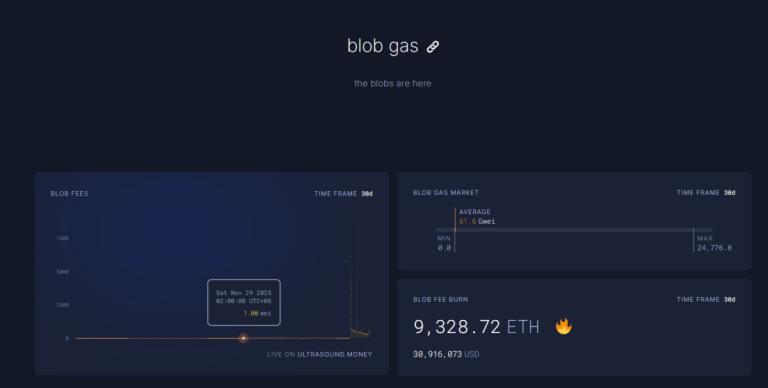
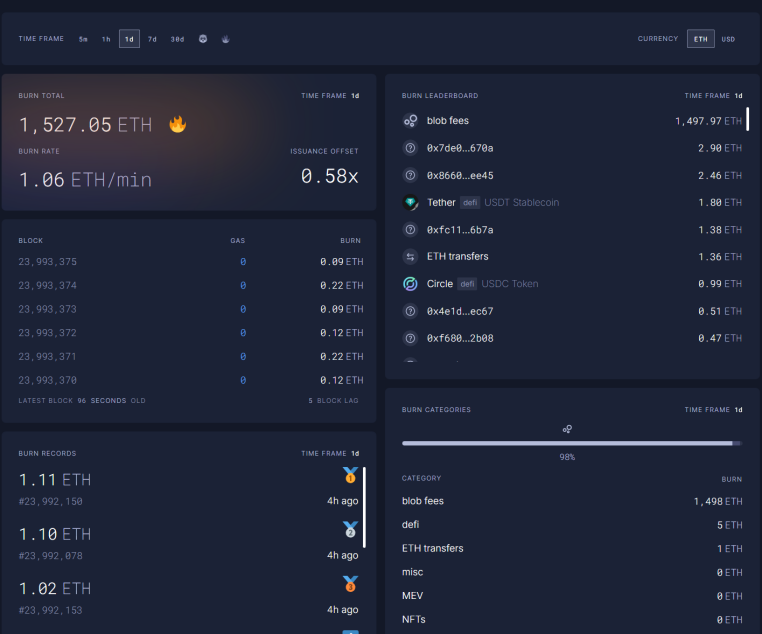
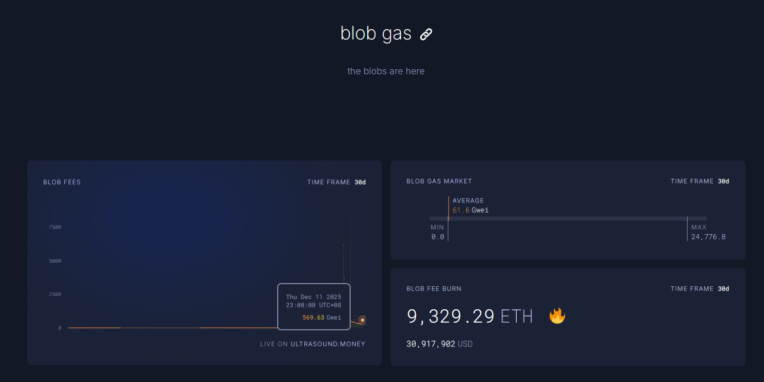
As of December 11, 23:00, the 1-hour blob fees have reached 569.63 billion times the pre-Fusaka upgrade level, burning 1,527 ETH in one day. Blob fees now contribute the highest proportion to burning,高达 98%. As ETH L2 becomes more active, this upgrade is expected to return ETH to deflation.

III. Ethereum Technicals Strengthen

During the October 11 crash, ETH's futures leverage was thoroughly cleared, eventually reaching the spot leverage盘. At the same time, many with insufficient faith in ETH led to many early OG investors reducing their holdings and fleeing. According to Coinbase data, speculative leverage in the crypto圈 has dropped to a historically low region of 4%.
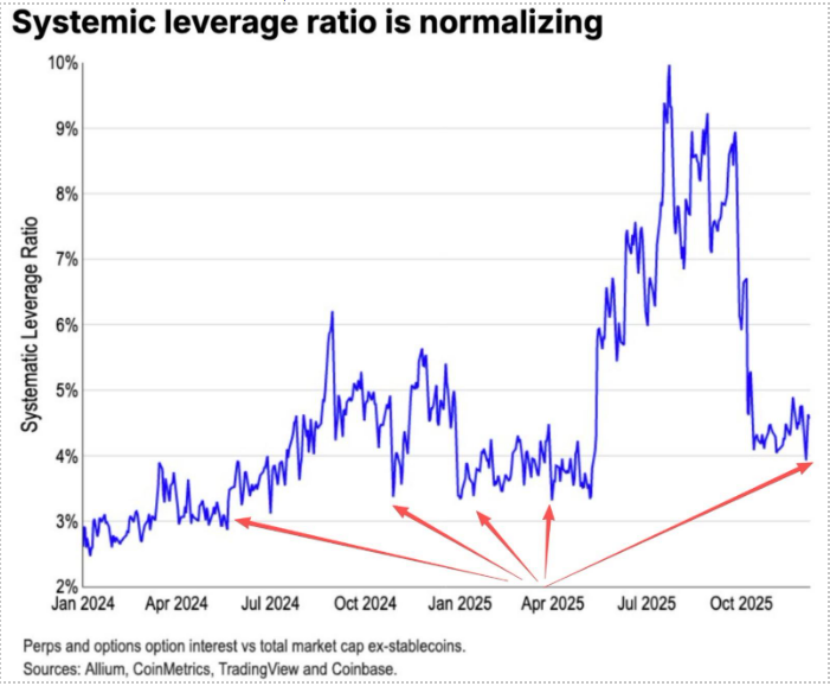
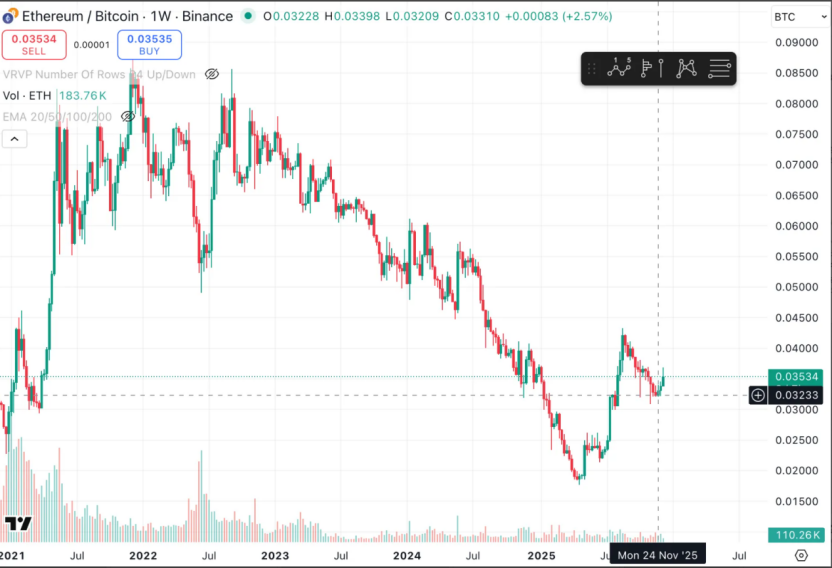
In the past, a significant portion of ETH short positions came from traditional Long BTC/Short ETH paired trades, which generally performed very well during bear markets. However, this time an意外 occurred. The ETH/BTC ratio has maintained a sideways resistance trend since November.
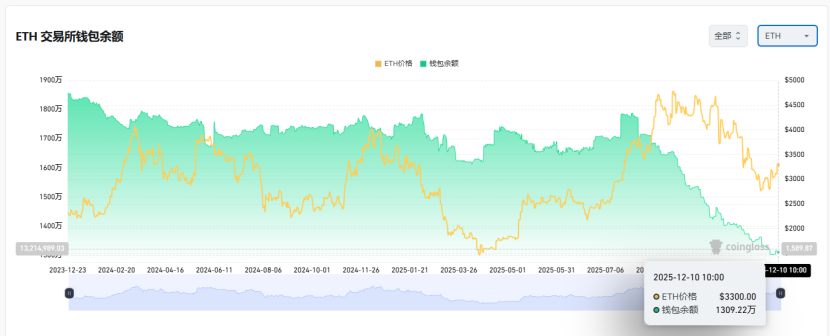
ETH's current存量 on exchanges is 13 million coins, about 10% of the total supply, at a historical low. As the Long BTC/Short ETH pairing has failed since November, during extreme panic, a "short squeeze" opportunity may gradually emerge.
As we approach the interaction between 2025 and 2026, future monetary and fiscal policies from both China and the U.S. have released friendly signals:

The U.S. will actively pursue tax cuts, interest rate reductions, and relaxed crypto regulations. China will implement appropriate easing and financial stability (suppressing volatility).

Under the expectations of relative easing in China and the U.S., and scenarios suppressing downward asset volatility, during extreme panic when capital and sentiment have not fully recovered, ETH is still in a good buying "sweet spot."


Twitter:https://twitter.com/BitpushNewsCN

Bitpush TG Discussion Group:https://t.me/BitPushCommunity

Bitpush TG Subscription: https://t.me/bitpush

Original Link:https://www.bitpush.news/articles/7595197

Perguntas relacionadas

QWhat is the new narrative chain formed by Wall Street and Washington in the crypto space according to the article?

AThe narrative chain is: U.S. political and economic elites → U.S. Treasury bonds (national debt) → Stablecoins / crypto treasury companies → Ethereum + RWA + L2.

QHow does the Fusaka upgrade aim to address the issue of L1 value capture on Ethereum?

AThe Fusaka upgrade introduces EIP-7918, which binds the blob base fee to a 'dynamic floor price' linked to the L1 execution layer base fee. This requires Rollups to pay at least approximately 1/16 of the L1 base fee for data availability, ensuring fees are burned and value flows back to ETH holders.

QWhat advantage does tokenization bring to asset ownership and settlement as highlighted by SEC Chairman Paul Atkins?

ATokenization provides high transparency in ownership structure and asset attributes, and enables 'T+0' settlement, replacing the current 'T+1' cycle, thereby reducing market risk and improving transparency.

QWhy is ETH considered to be in a good 'buying zone' or 'best offensive position' according to the article?

AETH is in a favorable position due to low leverage in the market (4%), reduced exchange supply (10% of total supply), the failure of Long BTC/Short ETH paired trades, and expectations of宽松 monetary policies from both the U.S. and China in 2025-2026.

QWhat role does Ethereum play in the RWA (Real World Assets) ecosystem based on the article?

AEthereum is the main chain hosting RWA protocols, stablecoins, and DeFi, with its L1/L2 used for tokenizing assets like U.S. Treasury bonds, mortgages, and accounts receivable. It holds 64.5% of the total crypto TVL in RWA.

Leituras Relacionadas

Is AI Creating a New Class of 'Information Poor'?

AI is generating a new kind of "information poverty." The core issue isn't that AI denies answers to the poor; it's that it provides abundant, cheap, and plausible-sounding answers to everyone. This availability shifts the true scarcity from obtaining answers to possessing the **judgment to evaluate them** and the access to turn them into real-world opportunities. New information poverty thus describes those who have AI tools and outputs, but lack the complementary skills, authorization, and contextual experience to critically assess and act on them. Research reveals a multi-layered divide: access to AI is stratified by income and platform design (e.g., premium vs. free, embedded tools). In workplaces, usage heavily favors higher-paid, more experienced, or formally trained employees, with AI often automating entry-level tasks that were traditional stepping stones. Crucially, the heaviest users are often mid-career professionals whose existing expertise allows them to effectively judge and leverage AI outputs, while novices risk over-relying on them without building judgment. While controlled experiments show AI can significantly boost low-skilled workers' performance, real-world adoption and benefit are constrained by unequal social and organizational structures. Historically, general-purpose technologies first reward those with existing complementary capital. AI, by affecting judgment-based work, may accelerate and deepen this initial inequality gap, even if it narrows over decades. The danger lies in the illusion of competence it creates, potentially stunting the very critical thinking needed in an era where judgment is paramount.

marsbitHá 3m

Is AI Creating a New Class of 'Information Poor'?

marsbitHá 3m

Jensen Huang 'Saves' South Korean Stock Market: Locks In SK Hynix Memory, Chip Shortage to Continue

On June 5th, South Korea's stock market experienced a sharp decline, with major chipmakers like Samsung and SK Hynix dropping nearly 10%. Amidst the turmoil, NVIDIA CEO Jensen Huang's visit to Seoul played a dramatic role in boosting market sentiment. Following a dinner meeting with SK Group Chairman Chey Tae-won and SK Hynix CEO Kwak Noh-Jung, Huang confirmed that NVIDIA's new Vera CPU will utilize SK Hynix DRAM. The companies announced a multi-year technical partnership to co-develop next-generation memory for NVIDIA's AI infrastructure, covering products from data centers to personal AI and robotics. This collaboration extends beyond memory supply. SK Hynix is integrating NVIDIA's AI and Omniverse platform into its own semiconductor design and manufacturing processes, including computational lithography and creating digital twins of its fabrication plants for autonomous operation. While strengthening ties with SK Hynix, NVIDIA is diversifying its supply chain for the upcoming HBM4 memory, with Samsung, SK Hynix, and Micron all certified as suppliers for its Vera Rubin platform. Despite this, Huang warned that the global chip shortage, driven by relentless demand from AI factory construction, is expected to persist for several years across the entire supply chain. His visit underscores NVIDIA's systematic effort to deepen integration with South Korea's broader tech industry.

marsbitHá 56m

Jensen Huang 'Saves' South Korean Stock Market: Locks In SK Hynix Memory, Chip Shortage to Continue

marsbitHá 56m

Nasdaq Plunges 4.2% in a Single Day: Does "Black Friday" Burst the U.S. Stock Market Bubble?

The Nasdaq plunged 4.18% on June 5, 2026, its worst single-day drop in over a year, as a much stronger-than-expected US jobs report triggered fears of economic overheating and delayed Federal Reserve interest rate cuts. The selloff, centered on high-valuation tech and AI stocks like Nvidia and Broadcom, spread across major indices. The article examines whether this signals a market top. The strong May non-farm payrolls data, nearly double expectations, pushed bond yields higher, directly hurting rate-sensitive tech stocks. This exposed vulnerabilities in the crowded AI trade, where valuations had soared on narratives of infinite growth, despite emerging signs of slowing order momentum and corporate AI monetization challenges. Prior to the drop, market indicators flashed warning signs: historically high valuations (e.g., Shiller CAPE ratio near 39.5), extreme bullish sentiment, and high levels of leverage. Technical charts showed key support levels being breached. Wall Street is divided on the outlook. Bears, citing risks of "stagflation" and AI bubble comparisons to the dot-com era, warn of a potential significant correction. Bulls view the drop as a healthy correction within a bull market, underpinned by a strong economy and expected corporate earnings growth of around 7% in 2026. The immediate future hinges on upcoming key events: the May CPI inflation data and the mid-June FOMC meeting. Their outcomes will critically shape market expectations for the Fed's rate path. The article concludes that conditions for a major market top are aligning, marking a fragile transition from narrative-driven gains to a phase demanding validation from macroeconomic data and corporate fundamentals. Caution is advised.

marsbitHá 1h

Nasdaq Plunges 4.2% in a Single Day: Does "Black Friday" Burst the U.S. Stock Market Bubble?

marsbitHá 1h

Nasdaq Plunges 4.2% in a Single Day, Did 'Black Friday' Pop the U.S. Stock Bubble?

The Nasdaq Composite plummeted 4.18% on June 5, its biggest single-day drop since April 2025, triggering widespread debate over whether the U.S. stock market has peaked. The sell-off was sparked by a stronger-than-expected U.S. non-farm payrolls report, which fueled fears of economic overheating and pushed back market expectations for Federal Reserve rate cuts, leading to a sharp rise in Treasury yields. The AI sector, the primary driver of the recent bull market, suffered severe losses, with the Philadelphia Semiconductor Index crashing over 10%. Stocks like Nvidia, Broadcom, and Micron led the decline. Concerns are mounting about the sustainability of AI capital expenditures and high valuations, with signs of order cuts for next-generation chips emerging. Analyses point to several warning signs: historically high market valuations (e.g., elevated Shiller CAPE ratio, Buffett Indicator), extreme bullish sentiment indicators, and significant insider selling. The sell-off also caused a key technical breakdown, with the S&P 500 breaking below its short-term moving average and testing its 200-day moving average. Wall Street is divided on the outlook. Bears warn this could be the start of a bubble deflation or a "stagflation" scenario, while bulls view it as a healthy, overdue correction within a bull market driven by solid corporate earnings growth. A more moderate view suggests the easy liquidity-driven rally is over, and markets are entering a phase of fundamental stock-picking with potential for consolidation. The immediate future hinges on key upcoming events: the May CPI report and the mid-June FOMC meeting. Their outcomes will be critical in determining whether this is a temporary pullback or the beginning of a more significant trend reversal. The consensus is that the era of one-directional market gains may be ending, requiring increased investor caution.

Odaily星球日报Há 1h

Nasdaq Plunges 4.2% in a Single Day, Did 'Black Friday' Pop the U.S. Stock Bubble?

Odaily星球日报Há 1h

The First Case on AI Agents: What Was Adjudicated?

"The First 'Agent' Ruling: What Was Decided?" On April 30, the Guangzhou Internet Court issued a ruling—China's first behavior preservation order in the intelligent agent (AI agent) field. The defendant, an open-source AI agent software, was ordered to stop downloads, cease actions that bypassed a platform's technical protection measures, and delete related tutorials and data. The core issue: the software used the operating system's "accessibility service" permissions to automate user interactions within other apps without those platforms' authorization. This mirrors a recent US case where Amazon sued Perplexity for similar reasons—bypassing Amazon's API to directly scrape and interact with its pages—and won a preliminary injunction. Both rulings establish a crucial legal boundary for the AI agent era: agents cannot operate unchecked. The article argues the fundamental legal principle emerging is one of **dual authorization**. An AI agent requires both **user consent** AND **platform consent** to operate legitimately within that platform's ecosystem. Bypassing platform rules through system-level permissions, even with user permission, undermines platform responsibilities for content moderation, data security, and user privacy, creating liability issues. The piece uses the evolution of "Doubao Phone" (an AI-integrated smartphone) as a case study. Its initial, aggressive version that bypassed platform controls faced roadblocks. Its upcoming 2.0 version is reportedly pivoting to negotiate API access and authorization deals with major platforms (like Alibaba's ecosystem), seen as a strategic adaptation to the new regulatory reality. A global trend is identified: the era of unregulated, "wild west" growth for AI agents is ending, replaced by a **compliance race**. This raises barriers to entry, as securing platform authorizations becomes a new cost. Open-source status is also not a legal shield if the code facilitates bypassing technical protections. In conclusion, these first rulings target not the largest, but the most **aggressive and representative** cases. By setting precedent with them, regulators are efficiently steering the entire industry towards a new, more regulated operating paradigm defined by dual authorization and platform cooperation.

marsbitHá 1h

The First Case on AI Agents: What Was Adjudicated?

marsbitHá 1h

Trading

Spot
Futuros

Artigos em Destaque

Como comprar MAY

Bem-vindo à HTX.com!Tornámos a compra de Mayflower (MAY) simples e conveniente.Segue o nosso guia passo a passo para iniciar a tua jornada no mundo das criptos.Passo 1: cria a tua conta HTXUtiliza o teu e-mail ou número de telefone para te inscreveres numa conta gratuita na HTX.Desfruta de um processo de inscrição sem complicações e desbloqueia todas as funcionalidades.Obter a minha contaPasso 2: vai para Comprar Cripto e escolhe o teu método de pagamentoCartão de crédito/débito: usa o teu visa ou mastercard para comprar Mayflower (MAY) instantaneamente.Saldo: usa os fundos da tua conta HTX para transacionar sem problemas.Terceiros: adicionamos métodos de pagamento populares, como Google Pay e Apple Pay, para aumentar a conveniência.P2P: transaciona diretamente com outros utilizadores na HTX.Mercado de balcão (OTC): oferecemos serviços personalizados e taxas de câmbio competitivas para os traders.Passo 3: armazena teu Mayflower (MAY)Depois de comprar o teu Mayflower (MAY), armazena-o na tua conta HTX.Alternativamente, podes enviá-lo para outro lugar através de transferência blockchain ou usá-lo para transacionar outras criptomoedas.Passo 4: transaciona Mayflower (MAY)Transaciona facilmente Mayflower (MAY) no mercado à vista da HTX.Acede simplesmente à tua conta, seleciona o teu par de trading, executa as tuas transações e monitoriza em tempo real.Oferecemos uma experiência de fácil utilização tanto para principiantes como para traders experientes.

263 Visualizações TotaisPublicado em {updateTime}Atualizado em 2026.06.02

Como comprar MAY

Discussões

Bem-vindo à Comunidade HTX. Aqui, pode manter-se informado sobre os mais recentes desenvolvimentos da plataforma e obter acesso a análises profissionais de mercado. As opiniões dos utilizadores sobre o preço de MAY (MAY) são apresentadas abaixo.

活动图片