Gemini Leaves For USA Market Dominance As MAXI Emerges As A Top Contender

bitcoinistPublicado em 2026-02-05Última atualização em 2026-02-05

Resumo

Gemini exchange is strategically withdrawing from secondary markets like Canada, the Netherlands, and France to focus on dominating the U.S. market and capturing institutional capital. This shift creates a divergence: regulated platforms target safety and compliance, while retail traders seek high-risk, high-reward opportunities on-chain. Maxi Doge ($MAXI) emerges as a meme token catering to this demand, offering gamified trading, leverage-like features, and staking rewards. Its presale has raised over $4.5M, reflecting strong retail interest as on-chain volumes grow. The project represents a cultural shift toward aggressive, community-driven trading amid increasing central exchange regulation.

The crypto regulatory map is changing fast. Gemini, the Winklevoss-led exchange, is accelerating its withdrawal from secondary jurisdictions to double down on the United States of America.

After leaving the Netherlands and France, they’ve just told Canadian users to close accounts by year-end. Is this a retreat? Hardly. It’s a cold calculation.

By cutting loose fragmented markets, Gemini is clearing the runway to become the primary gateway for the massive wave of U.S. institutional capital heading our way. The market is effectively splitting in two.

On one side, you have regulated giants like Gemini chasing safety and ‘slow’ institutional money. On the other? An insatiable retail hunger for high-variance plays. While institutions stick to the ‘boring’ infrastructure, retail liquidity is flowing aggressively on-chain, hunting for outsized returns.

As exchanges get ‘suit-ified,’ a vacuum for risk-on assets is opening up. New meme tokens are filling the gap, offering the volatility regulated giants can’t touch.

That explains why on-chain volumes are hitting fresh highs even as exchanges shrink their global footprints. It’s in this divergence that Maxi Doge ($MAXI) has surfaced, not just as a token, but as a vehicle for the aggressive trading culture traditional exchanges are regulating out of existence.

Institutional Safety Versus The Retail Hunger For Alpha

The narrative is defined by a tension between compliance and degeneracy. Gemini exiting Canada to focus on U.S. dominance might be great for Bitcoin’s long-term legitimacy, but frankly, it leaves a void for traders craving the raw energy of early crypto.

The ‘Leverage King’ culture of Maxi Doge targets that exact crowd, traders who see volatility as a feature, not a bug.

Maxi Doge isn’t just another static meme coin relying on a cute dog picture. It gamifies the experience, baking a 1000x leverage mentality right into the project. With planned features like Holder-Only Trading Competitions and a Maxi Fund treasury, community activity actually influences liquidity. It doesn’t avoid the mascot play altogether, though, instead leaning into a fitting, ‘gym-bro’ canine stack with muscles and chugging energy drinks.
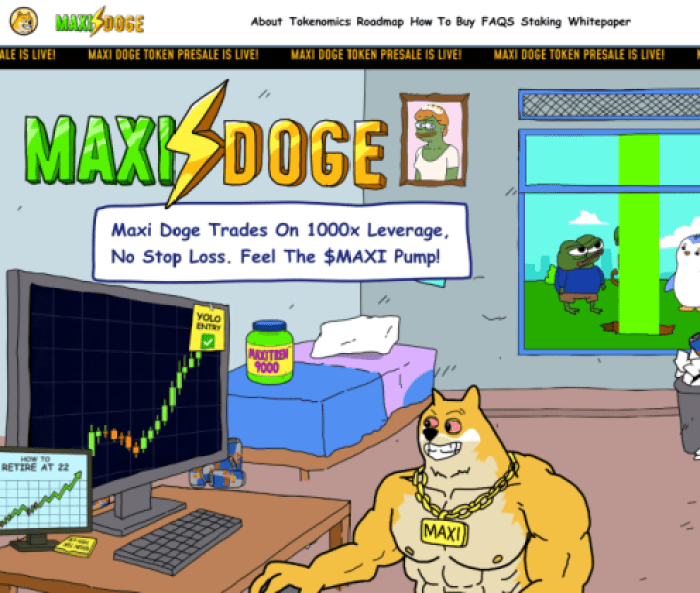
It’s a feedback loop that mirrors a broader trend: utility-adjacent memes are simply outperforming pure speculative assets right now.

Smart money seems to be watching this setup. On-chain data from Etherscan highlights whale wallets scooping up purchases as high as $314K. It suggests high-net-worth players are hedging the institutional bets with high-upside meme plays.

That barbell strategy holding Bitcoin while hunting alpha is quickly becoming the standard for sophisticated portfolios.

BUY $MAXI ON ITS OFFICIAL PRESALE PAGE

Presale Metrics Signal A Shift In Risk Appetite

While Gemini sanitizes its platform for ETF issuers and pension funds, the speculative capital driving viral cycles is moving on-chain. The Maxi Doge presale proves the point. $MAXI has already raised over $4.5M. That figure signals massive demand, arguably because retail excitement on centralized exchanges is cooling off.

At the current price of $0.0002802, the token is sitting in a spot to capture entry-level liquidity before potential listing premiums hit. But there’s more to it than just price action. The project offers a dynamic APY staking model (rewards planned to be paid daily from a 5% pool). It encourages holding, ‘never skipping leg day,’ while the treasury builds out partnerships.

The contrast couldn’t be starker. Gemini offers safety and modest yields (wealth preservation). Maxi Doge offers a high-risk, high-reward arena (wealth creation).

For the retail trader priced out of owning a whole Bitcoin, the ‘lift, trade, repeat’ ethos of $MAXI just hits harder than regulatory compliance. The data backs it up, too: as centralized friction grows, decentralized volume explodes.

EXPLORE $MAXI ON ITS OFFICIAL PRESALE PAGE

This article is for informational purposes only and does not constitute financial advice. Cryptocurrency investments, especially in presale and meme tokens, carry high risks, including the potential loss of principal. Always conduct independent research.


Perguntas relacionadas

QWhy is Gemini withdrawing from secondary markets like Canada, the Netherlands, and France?

AGemini is withdrawing from these secondary jurisdictions to focus its resources and double down on the United States market, aiming to become the primary gateway for the massive wave of U.S. institutional capital entering the crypto space.

QWhat is the core difference between the strategy of regulated giants like Gemini and the on-chain retail activity described in the article?

ARegulated giants like Gemini are chasing safety and 'slow' institutional money, focusing on compliance and wealth preservation. In contrast, retail liquidity is flowing on-chain, aggressively hunting for high-variance, high-return assets that offer outsized gains, which regulated exchanges often cannot provide.

QWhat is the unique value proposition of Maxi Doge ($MAXI) according to the article?

AMaxi Doge ($MAXI) is not just a meme token; it gamifies the trading experience by baking a 1000x leverage mentality into the project. It offers features like Holder-Only Trading Competitions and a treasury fund, creating a feedback loop where community activity influences liquidity, targeting traders who see volatility as a feature.

QWhat does the article suggest about the current trend of 'smart money' or high-net-worth players in crypto?

AThe article suggests that smart money is employing a 'barbell strategy': they are hedging their institutional bets (like holding Bitcoin) with high-upside meme plays (like $MAXI), as indicated by whale wallets making large purchases to capture alpha while maintaining a base of safer assets.

QWhat does the success of the Maxi Doge presale (raising over $4.5M) indicate about the current market?

AThe successful presale indicates a massive demand and a shift in risk appetite, showing that speculative capital is moving on-chain as retail excitement on centralized exchanges cools off, and traders are seeking high-risk, high-reward opportunities in decentralized environments.

Leituras Relacionadas

Anthropic and OpenAI Have Single-Handedly Severed the Logic of Pre-IPO Stock Tokenization

The pre-IPO stock token market is experiencing significant turmoil following strong statements from AI giants Anthropic and OpenAI. Both companies have updated their official policies, declaring that any transfer of their company shares—including sales, transfers, or assignments of share interests—without prior board approval is "invalid" and will not be recognized in their corporate records. This means buyers in such unauthorized transactions would not be recognized as shareholders and would have no shareholder rights. A major point of contention is the use of Special Purpose Vehicles (SPVs), which are legal entities commonly used by pre-IPO token platforms to pool investor funds and indirectly acquire shares from employees or early investors. The companies explicitly state they do not permit SPVs to acquire their shares, and any such transfer violates their restrictions. They warn that third parties selling shares through SPVs, direct sales, forward contracts, or stock tokens are likely engaged in fraud or are offering worthless investments due to these transfer limits. This stance directly threatens the core model of many pre-IPO token platforms, which rely on SPV structures. The announcement revealed additional risks within this model, such as complex "SPV-within-SPV" layering that obscures legal transparency, increases management fees, and creates a chain reaction risk of invalidation. Following the news, tokens like ANTHROPIC and OPENAI on platforms like PreStocks fell sharply (over 20%). The market reaction highlights a divergence: while asset-backed pre-IPO tokens plummeted, purely speculative pre-IPO futures contracts, which are bilateral bets on future IPO prices with no claim to actual shares, remained relatively stable as they are unaffected by the transfer restrictions. The industry is split on the implications. Some believe the fundamental logic of pre-IPO token trading is broken if leading companies reject SPV-held shares, potentially causing a domino effect. Others, like Rivet founder Nick Abouzeid, argue that buyers of such unofficial tokens always knowingly accepted the risk of non-recognition by the company. The statements serve as a stark risk warning and a corrective measure for a market where valuations for some AI-related pre-IPO tokens had soared to irrational levels, far exceeding recent funding round valuations.

marsbitHá 37m

Anthropic and OpenAI Have Single-Handedly Severed the Logic of Pre-IPO Stock Tokenization

marsbitHá 37m

Anthropic and OpenAI Personally Sever the Logic of Pre-IPO Crypto-Stocks

The pre-IPO token market has been rocked by strong statements from Anthropic and OpenAI. Both AI giants have updated official warnings, declaring that any sale or transfer of their company shares without explicit board approval is "invalid" and will not be recognized on their corporate records. This directly targets Special Purpose Vehicles (SPVs), the common legal structure used by pre-IPO token platforms. These platforms typically use an SPV to acquire shares from employees or early investors, then issue blockchain-based tokens representing a claim on the SPV's economic benefits. Anthropic and OpenAI's position means that if an SPV's share purchase lacked authorization, the underlying asset could be deemed worthless, nullifying the token's value. Anthropic explicitly warned that any third party selling its shares—via direct sales, forwards, or tokens—is likely fraudulent or offering a valueless investment. The crackdown highlights risks in the popular SPV model, including complex multi-layered "Russian doll" SPV structures that obscure legal ownership, add fees, and concentrate risk. If one layer is invalidated, the entire chain could collapse. Following the announcements, tokens like ANTHROPIC and OPENAI on platforms like PreStocks fell sharply (over 20%). In contrast, purely speculative pre-IPO prediction contracts remained stable, as they involve no actual share ownership. The move is seen as a corrective measure amid a market frenzy where some pre-IPO token valuations (e.g., Anthropic's token hitting a $1.4 trillion implied valuation) far exceeded recent official funding rounds. Opinions are split: some believe this undermines the core logic of pre-IPO token trading if top companies reject SPVs, while others argue buyers always assumed this legal risk when accessing unofficial channels. The statements serve as a stark warning and a potential catalyst for market de-leveraging and clearer boundaries.

Odaily星球日报Há 41m

Anthropic and OpenAI Personally Sever the Logic of Pre-IPO Crypto-Stocks

Odaily星球日报Há 41m

The Waged Worker Driven to Poverty by AI Subscriptions

"AI Membership: The Hidden Cost Pushing Workers Toward 'Poverty'" The widespread corporate push for AI adoption is creating a hidden financial burden for employees. Companies, from giants like Alibaba to small firms, are mandating AI use, often tying token consumption to KPIs, but frequently refuse to cover the costs. Workers are forced to pay for subscriptions out of pocket to stay competitive and avoid being replaced. Front-end developer Long Shen spends up to 2000 RMB monthly on tools like Cursor and ChatGPT Plus, seeing it as a necessary 3% salary investment to handle 90% of his coding tasks. While it boosted his performance and led to promotions, he now faces idle time at work, pretending to be busy. Designer Peng Peng navigates strict company firewalls by using personal devices and accounts for AI image generation tools like Midjourney, spending hundreds monthly without reimbursement, while her boss demands faster, more numerous revisions. The pressure creates workplace anxiety and suspicion. Programmer Li Huahua, after a friend's experience of raised KPIs following AI success, fears being branded a "traitor" for using it yet worries about falling behind if she doesn't. The dynamic allows management to demand results without understanding the tools or covering expenses, treating employees like AI "agents." While some, like entrepreneur Jin Tu, find high value in paid AI, building entire systems and winning competitions, for most, it's a trap. Free tools like Kimi and Doubao are introducing fees, closing off alternatives. The initial efficiency gains individual advantage, but as AI becomes ubiquitous, the personal edge disappears, workloads increase, and a cycle of dependency begins. Workers like Long Shen realize they cannot maintain AI-generated code without AI, making stopping harder than continuing to pay. The tool promising liberation is instead becoming a compulsory, costly chain in the modern workplace.

marsbitHá 1h

The Waged Worker Driven to Poverty by AI Subscriptions

marsbitHá 1h

SK Hynix's Trillion-Won Empire: The Successors

"SK Hynix's Trillion-Won Empire and Its Heirs" explores the unconventional succession narrative within SK Group, South Korea's second-largest conglomerate, following SK Hynix's dramatic market rise. Unlike traditional chaebol scripts prioritizing the eldest son, ownership, and political marriages, Chairman Choi Tae-won's three children from his first marriage are charting distinct paths. The eldest daughter, Choi Yun-jeong, is considered the most visible candidate. With a background in biology, consulting, and a PhD, she holds executive roles at SK Bioscience and SK Inc.'s growth strategy unit, focusing on biopharma and new businesses. Her marriage is to an AI infrastructure entrepreneur, not a traditional chaebol heir. The second daughter, Choi Min-jeong, took a unique route by voluntarily serving as a South Korean naval officer, including a tour in the Gulf of Aden. She later worked on policy and strategy for SK Hynix in Washington D.C. before co-founding an AI-driven healthcare startup in San Francisco. She married a former U.S. Marine Corps officer, connecting the family to U.S. defense and policy networks. The son, Choi In-geun, who has Type 1 diabetes, followed a more classic preparatory path with a physics degree and a stint at SK E&S but left to join McKinsey's Seoul office. He remains publicly silent and holds no SK shares, defying the traditional "crown prince" archetype. Their paths unfold against the backdrop of their parents' high-profile, contentious divorce and a record-setting asset division lawsuit. The article argues that as SK Hynix becomes a geopolitical asset in the AI era, the conventional rules of chaebol inheritance are changing. The heirs are being groomed not simply to take over, but to navigate a complex global landscape defined by AI, biotech, geopolitics, and policy, forging legitimacy through their own expertise and networks rather than birth order alone.

marsbitHá 1h

SK Hynix's Trillion-Won Empire: The Successors

marsbitHá 1h

Trading

Spot
Futuros
活动图片