Frontline Insights | Web3 Lawyer Deciphers the Latest Developments in U.S. Stock Tokenization!

深潮Publicado em 2025-12-18Última atualização em 2025-12-18

Resumo

Summary: On December 15, 2025, Nasdaq submitted a proposal to the SEC to extend U.S. stock trading hours to 23/5, sparking speculation about tokenization, though the filing did not mention it. More significantly, on December 11, the SEC issued a No-Action Letter (NAL) to DTCC, allowing its subsidiary DTC to conduct a pilot for tokenizing traditional securities under strict conditions. The NAL exempts DTC from certain procedural filing requirements but does not constitute a full regulatory endorsement. DTC's pilot involves creating tokenized representations of securities on a permissioned blockchain, allowing direct transfers between approved wallets while maintaining central oversight through its LedgerScan system. This move signals cautious regulatory openness to blockchain efficiency improvements in settlement and asset tracking, without altering the fundamental nature of securities. The development represents a step toward modernizing market infrastructure, with two parallel paths emerging: backend efficiency gains led by institutions like DTCC, and front-end user-facing innovations from brokers and trading platforms, all within evolving regulatory boundaries.

On December 15, 2025, U.S. time, Nasdaq officially submitted Form 19b-4 to the SEC, applying to extend the trading hours for U.S. stocks and exchange products to 23/5 (23 hours per day, 5 days per week).

However, Nasdaq's application for extended trading hours is not a simple extension but rather a change to two formal trading sessions:

Day Session (ET 4:00-20:00) and Night Session (ET 21:00-4:00 the next day). Trading is suspended from 20:00-21:00, and all unfilled orders are canceled uniformly during this pause.

Many readers got excited upon seeing the news, wondering if this is the U.S. preparing for 24/7 tokenized stock trading? But after carefully studying the document, Crypto Salad wants to say, don't jump to conclusions just yet, because Nasdaq stated in the document that many traditional securities trading rules and complex orders do not apply to the night session, and some functions will also be limited.

We have been paying close attention to U.S. stock tokenization; it is one of the most important targets for real-world asset tokenization, especially with the various official moves from the U.S. SEC (Securities and Exchange Commission) recently, which have been层出不穷 (emerging one after another).

This application document has sparked renewed anticipation for U.S. stock tokenization because it represents a significant step by the U.S. to align securities trading hours closer to the 24/7 nature of digital asset markets.However, upon closer look:

This Nasdaq document doesn't mention tokenization at all; it's solely about reforms to the traditional securities system.

If you want a deeper understanding of Nasdaq's move, Crypto Salad can write another article for a detailed interpretation. But today, we want to talk about the tangible news related to U.S. stock tokenization—

The SEC has formally "allowed" attempts by a major U.S. securities depository giant to provide tokenization services.

------【Dividing Line】------

On December 11, 2025, U.S. time, the SEC's Division of Trading and Markets staff issued a<极span style="color:#000000">《No-Action Letter (NAL)》 to DTCC, which was subsequently published on the SEC website. The letter clearly states that, subject to specific conditions, the SEC will not take enforcement action against DTC for conducting tokenization services related to the securities it custodies.

At first glance, many readers felt the SEC had officially "exempted" the use of tokenization technology on U.S. stocks. But upon closer examination, the reality is quite different.

So,what exactly does this letter say? How far has the latest development in U.S. stock tokenization actually progressed? Let's start with the main character of the letter:

1. Who are DTCC and DTC?

DTCC, full name Depository Trust & Clearing Corporation, is a U.S. group company comprising different institutions responsible for custody, stock clearing, and bond clearing.

DTC, full name Depository Trust Company, is a subsidiary of DTCC and the largest securities central depository in the U.S., responsible for the centralized custody of stocks, bonds, and other securities, as well as settlement and transfer. It currently custodies and accounts for over $100 trillion in securities assets. You can think of DTC as the ledger administrator for the entire U.S. stock market.

2. What is the relationship between DTC and U.S. stock tokenization?

Remember the news in early September 2025 about Nasdaq applying to the SEC to issue stocks in tokenized form? DTC already appeared in that application.

Nasdaq stated that the only difference between tokenized stocks and traditional stocks lies in the clearing and settlement of orders at DTC.
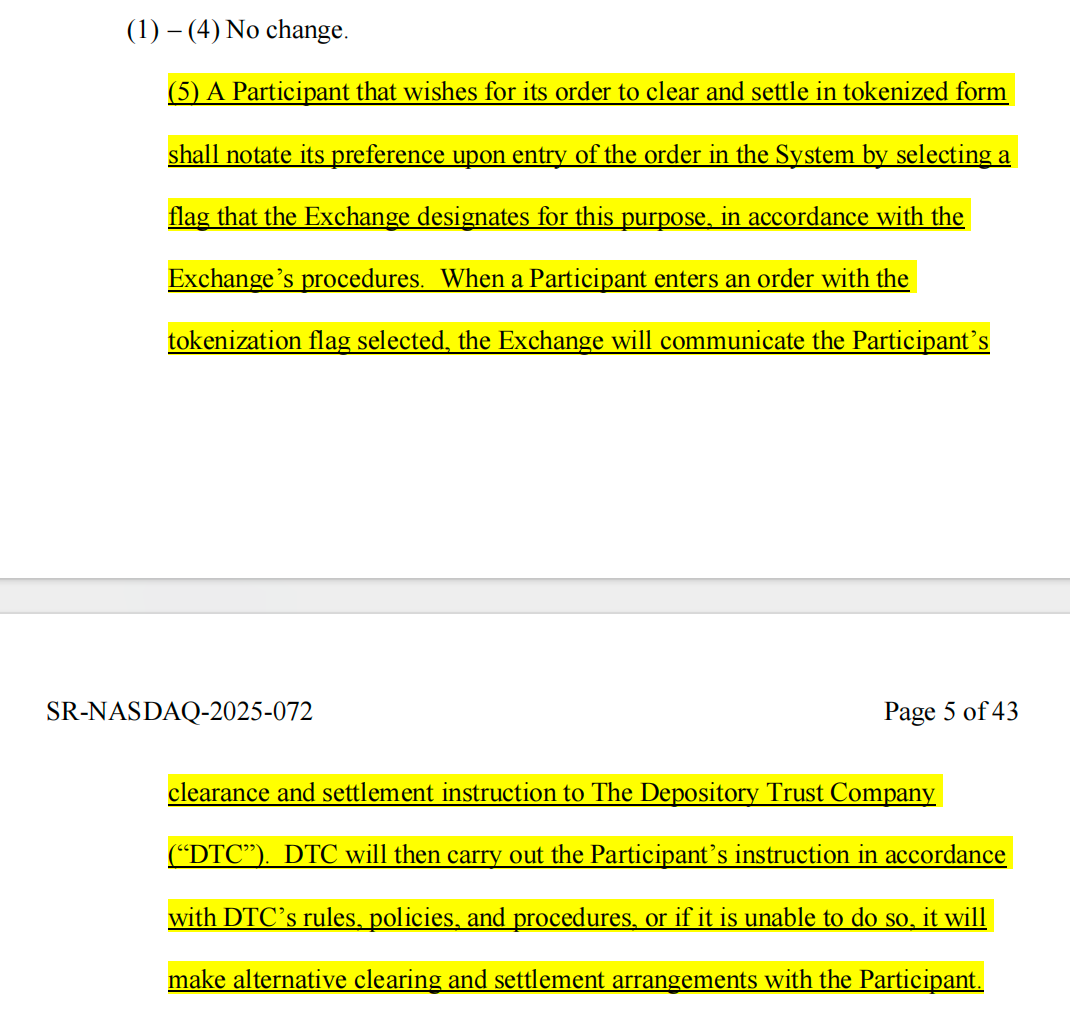
(The above image is截自 (screenshot from) Nasdaq's application proposal)

To make this easier to understand, we've drawn a flowchart. The blue part represents the changes Nasdaq applied for in its September proposal. It's clear that DTC is the key implementation and operational institution for U.S. stock tokenization.

3. What does the newly published《No-Action Letter》say?

Many people directly equate this document with the SEC approving DTC's use of blockchain for U.S. stock record-keeping, which is not entirely accurate. To understand this correctly, we must recognize a clause in the U.S. Securities Exchange Act:

Section 19(b) of the《Securities Exchange Act of 1934》 stipulates that any self-regulatory organization (including clearing agencies) must submit a rule change application to the SEC and obtain approval before changing its rules or significant business arrangements.

Nasdaq's two proposals were submitted based on this provision.

However, the rule申报 (filing) process is usually very long, potentially拖延 (delayed) for months, up to 240 days at maximum. If every single change requires application and approval, the time cost would be too high. Therefore, to ensure its securities tokenization pilot activities can proceed smoothly, DTC applied for an exemption from its obligation to fully comply with the 19b filing process during the pilot period, and the SEC granted its agreement.

In other words, the SEC has only temporarily exempted DTC from certain procedural filing obligations; it is not a substantive permission for the application of tokenization technology in the securities market.

---【Dividing Line】---

So, how will U.S. stock tokenization develop next? We need to clarify the following two questions:

(1) What pilot activities can DTC conduct without filing?

Currently, the custody and bookkeeping of U.S. stocks operate in this mode:假设 (Assuming) a broker has an account at DTC, DTC uses a centralized system to record every buy and sell order and share. This time, DTC proposed: could we provide brokers with an option to also record these stock holdings using blockchain tokens?

In practice, participants would first register a qualified, DTC-approved Registered Wallet. When a participant issues a tokenization instruction to DTC, DTC will do three things:

a) Move this portion of stocks from the original account to a general ledger pool;

b) Mint tokens on the blockchain;

c) Transfer the tokens to the participant's wallet, representing the participant's权益 (interest/rights) in these securities.

After this, these tokens can be transferred directly between these brokers without needing to go through DTC's centralized ledger for every single transfer. However, all token transfers will be monitored and recorded in real-time by DTC through an off-chain system called LedgerScan, and the records of LedgerScan will constitute DTC's official books. If a participant wishes to exit the tokenized state, they can随时 (at any time) issue a "de-tokenization" instruction to DTC, which will destroy the tokens and re-record the securities权益 (interest) back into the traditional account.

The NAL also details technical and risk control limitations, including: tokens can only be transferred between DTC-approved wallets, so DTC even has the authority to强制转移 (forcibly transfer) or destroy tokens in wallets under specific circumstances; the token system is strictly isolated from DTC's core clearing system, etc.

(2) What is the significance of this letter?

From a legal perspective, Crypto Salad must emphasize that an NAL is not equivalent to legal authorization or a rule change; it does not have universally applicable legal force and only represents the enforcement attitude of the SEC staff under given facts and assumed conditions.

The U.S. securities law system does not have a separate provision "prohibiting the use of blockchain for bookkeeping." Regulation is more concerned with whether the existing market structure, custody responsibilities, risk controls, and filing obligations are still met after adopting new technology.

Furthermore, in the U.S. securities regulatory system, letters like NAL have long been regarded as important indicators of regulatory stance, especially when the recipient is a systemically important financial institution like DTC; its symbolic significance is actually greater than the specific business itself.

------【Dividing Line】------

Judging from the disclosed content, the premise of the SEC's exemption is very clear: DTC is not directly issuing or trading securities on-chain but is creating a tokenized representation of the existing securities权益 (interests) within its custody system.

This kind of token is essentially an "interest mapping" or "ledger expression" used to improve back-office processing efficiency, not to change the legal attributes or ownership structure of the securities. The related services run on a controlled environment and a permissioned blockchain, with participants, scope of use, and technical architecture all subject to strict limitations.

Crypto Salad believes this regulatory attitude is very reasonable. On-chain assets are most susceptible to financial crimes like money laundering and illegal fundraising. Tokenization technology is new, but it must not become an accomplice to crime. Regulation needs to affirm the application potential of blockchain in securities infrastructure while坚守 (adhering to) the boundaries of the existing securities law and custody system.

4. The Latest Development Progress of U.S. Stock Tokenization

The discussion around U.S. stock tokenization has begun to shift from "is it compliant" to "how to implement it." If we拆解 (deconstruct) the current market practices, we can see at least two parallel but logically different paths forming:

· Represented by DTCC and DTC, is the official opinion-led tokenization path. Its core goal is to improve settlement, reconciliation, and asset transfer efficiency, serving mainly institutional and wholesale market participants. In this model, tokenization is almost "invisible"; for end investors, stocks remain stocks, only the backend system has undergone a technical upgrade.

· In contrast is the potential front-end role played by brokers and trading platforms. Taking Robinhood and MSX (Maiton) as examples, they have持续进行 (continuously conducted) product exploration in recent years regarding crypto assets, fractional stock trading, and extended trading hours. If U.S. stock tokenization matures regulatory-wise, such platforms naturally have the advantage of becoming user entry points. For them, tokenization does not mean重塑 (reshaping) the business model but is more likely a technical extension of the existing investment experience, such as near-real-time settlement, more flexible asset splitting, and the integration of cross-market product forms. Of course, the prerequisite for all this is the gradual clarification of the regulatory framework. This type of exploration often walks near the regulatory boundary, with risk and innovation coexisting. Its value lies not in short-term scale but in validating the next-generation securities market形态 (form). From a practical perspective, they更像是 (are more like) providing samples for institutional evolution rather than directly replacing the existing U.S. stock market.

To help everyone understand more intuitively, refer to the following comparison chart:

From a broader perspective, what U.S. stock tokenization真正试图解决 (is really trying to solve) is not "turning stocks into coins" but how to improve asset transfer efficiency, reduce operational costs, and reserve interfaces for future cross-market collaboration while maintaining legal certainty and system security. In this process, compliance, technology, and market structure will博弈 (game) in parallel for a long time, and the evolutionary path will必然 (inevitably) be gradual rather than radical.

It can be expected that U.S. stock tokenization will not fundamentally change how Wall Street operates in the short term, but it is already an important item on the U.S. financial infrastructure agenda. This interaction between the SEC and DTCC is more like a制度层面的 (institutional level) "test of the waters," delineating preliminary boundaries for subsequent broader exploration. For market participants, this is perhaps not the终点 (end point) but a真正值得持续观察的起点 (truly worthwhile starting point for持续 observation).


Perguntas relacionadas

QWhat is the significance of Nasdaq's Form 19b-4 filing regarding extended trading hours, and does it directly relate to stock tokenization?

ANasdaq's Form 19b-4 filing proposes extending trading hours to 23/5 (23 hours a day, 5 days a week) with two distinct sessions: a day session (4:00-20:00 ET) and a night session (21:00-4:00 ET), with a one-hour break. However, the filing explicitly states that it is a reform for traditional securities and does not mention tokenization. It is not a direct preparation for 24/7 tokenized stock trading, as many traditional rules and complex orders do not apply to the night session, and some functions are limited.

QWhat did the SEC's No-Action Letter (NAL) to DTCC allow regarding tokenization services?

AThe SEC's No-Action Letter to DTCC stated that, under specific conditions, the SEC would not take enforcement action against DTC (a DTCC subsidiary) for providing tokenization services related to the securities it custodies. This is not a formal authorization or rule change but a temporary exemption from certain procedural filing requirements under Section 19(b) of the Securities Exchange Act of 1934, allowing DTC to conduct a pilot program without lengthy approval processes for each change.

QHow does DTC's proposed tokenization pilot work technically?

AIn DTC's pilot, participants can register a DTC-approved wallet. Upon instruction, DTC will: a) move the specified securities to a general ledger pool, b) mint tokens on a blockchain representing the securities, and c) transfer the tokens to the participant's wallet. These tokens can then be transferred directly between approved participants without DTC's centralized ledger for each transaction, though all transfers are monitored and recorded by DTC's LedgerScan system. Participants can reverse the process by requesting 'detokenization,' where tokens are burned and securities are returned to the traditional account.

QWhat are the key limitations or controls mentioned in the NAL for DTC's tokenization services?

AThe NAL imposes strict controls: tokens can only be transferred between DTC-approved wallets, DTC has the authority to forcibly transfer or destroy tokens in specific circumstances, the token system is strictly isolated from DTC's core clearing systems, and the pilot operates on a permissioned blockchain with limited participants and scope. This ensures the tokenization is a 'mapping of权益' for efficiency without altering the legal attributes or ownership structure of the securities.

QWhat are the two main paths for stock tokenization development mentioned in the article?

AThe two paths are: 1) The DTCC/DTC-led path, which is regulator-guided and focuses on improving back-office efficiency (e.g., settlement, asset transfer) for institutional and wholesale markets, making tokenization 'invisible' to end investors. 2) The broker and trading platform path (e.g., Robinhood, MSX MaiTong), which explores front-end user experiences like fractional trading and extended hours. This path extends existing services with tokenization technology, pending regulatory clarity, and serves as a testing ground for future market structures without replacing the current stock market.

Leituras Relacionadas

a16z: AI's 'Amnesia', Can Continuous Learning Cure It?

The article "a16z: AI's 'Amnesia' – Can Continual Learning Cure It?" explores the limitations of current large language models (LLMs), which, like the protagonist in the film *Memento*, are trapped in a perpetual present—unable to form new memories after training. While methods like in-context learning (ICL), retrieval-augmented generation (RAG), and external scaffolding (e.g., chat history, prompts) provide temporary solutions, they fail to enable true internalization of new knowledge. The authors argue that compression—the core of learning during training—is halted at deployment, preventing models from generalizing, discovering novel solutions (e.g., mathematical proofs), or handling adversarial scenarios. The piece introduces *continual learning* as a critical research direction to address this, categorizing approaches into three paths: 1. **Context**: Scaling external memory via longer context windows, multi-agent systems, and smarter retrieval. 2. **Modules**: Using pluggable adapters or external memory layers for specialization without full retraining. 3. **Weights**: Enabling parameter updates through sparse training, test-time training, meta-learning, distillation, and reinforcement learning from feedback. Challenges include catastrophic forgetting, safety risks, and auditability, but overcoming these could unlock models that learn iteratively from experience. The conclusion emphasizes that while context-based methods are effective, true breakthroughs require models to compress new information into weights post-deployment, moving from mere retrieval to genuine learning.

marsbitHá 3h

a16z: AI's 'Amnesia', Can Continuous Learning Cure It?

marsbitHá 3h

Trading

Spot
Futuros

Artigos em Destaque

O que é $S$

Compreender o SPERO: Uma Visão Abrangente Introdução ao SPERO À medida que o panorama da inovação continua a evoluir, o surgimento de tecnologias web3 e projetos de criptomoeda desempenha um papel fundamental na formação do futuro digital. Um projeto que tem atraído atenção neste campo dinâmico é o SPERO, denotado como SPERO,$$s$. Este artigo tem como objetivo reunir e apresentar informações detalhadas sobre o SPERO, para ajudar entusiastas e investidores a compreender as suas bases, objetivos e inovações nos domínios web3 e cripto. O que é o SPERO,$$s$? O SPERO,$$s$ é um projeto único dentro do espaço cripto que procura aproveitar os princípios da descentralização e da tecnologia blockchain para criar um ecossistema que promove o envolvimento, a utilidade e a inclusão financeira. O projeto é concebido para facilitar interações peer-to-peer de novas maneiras, proporcionando aos utilizadores soluções e serviços financeiros inovadores. No seu núcleo, o SPERO,$$s$ visa capacitar indivíduos ao fornecer ferramentas e plataformas que melhoram a experiência do utilizador no espaço das criptomoedas. Isso inclui a possibilidade de métodos de transação mais flexíveis, a promoção de iniciativas impulsionadas pela comunidade e a criação de caminhos para oportunidades financeiras através de aplicações descentralizadas (dApps). A visão subjacente do SPERO,$$s$ gira em torno da inclusão, visando fechar lacunas dentro das finanças tradicionais enquanto aproveita os benefícios da tecnologia blockchain. Quem é o Criador do SPERO,$$s$? A identidade do criador do SPERO,$$s$ permanece algo obscura, uma vez que existem recursos publicamente disponíveis limitados que fornecem informações detalhadas sobre o(s) seu(s) fundador(es). Esta falta de transparência pode resultar do compromisso do projeto com a descentralização—uma ética que muitos projetos web3 partilham, priorizando contribuições coletivas em vez de reconhecimento individual. Ao centrar as discussões em torno da comunidade e dos seus objetivos coletivos, o SPERO,$$s$ incorpora a essência do empoderamento sem destacar indivíduos específicos. Assim, compreender a ética e a missão do SPERO é mais importante do que identificar um criador singular. Quem são os Investidores do SPERO,$$s$? O SPERO,$$s$ é apoiado por uma diversidade de investidores que vão desde capitalistas de risco a investidores-anjo dedicados a promover a inovação no setor cripto. O foco desses investidores geralmente alinha-se com a missão do SPERO—priorizando projetos que prometem avanço tecnológico social, inclusão financeira e governança descentralizada. Essas fundações de investidores estão tipicamente interessadas em projetos que não apenas oferecem produtos inovadores, mas que também contribuem positivamente para a comunidade blockchain e os seus ecossistemas. O apoio desses investidores reforça o SPERO,$$s$ como um concorrente notável no domínio em rápida evolução dos projetos cripto. Como Funciona o SPERO,$$s$? O SPERO,$$s$ emprega uma estrutura multifacetada que o distingue de projetos de criptomoeda convencionais. Aqui estão algumas das características-chave que sublinham a sua singularidade e inovação: Governança Descentralizada: O SPERO,$$s$ integra modelos de governança descentralizada, capacitando os utilizadores a participar ativamente nos processos de tomada de decisão sobre o futuro do projeto. Esta abordagem promove um sentido de propriedade e responsabilidade entre os membros da comunidade. Utilidade do Token: O SPERO,$$s$ utiliza o seu próprio token de criptomoeda, concebido para servir várias funções dentro do ecossistema. Esses tokens permitem transações, recompensas e a facilitação de serviços oferecidos na plataforma, melhorando o envolvimento e a utilidade gerais. Arquitetura em Camadas: A arquitetura técnica do SPERO,$$s$ suporta modularidade e escalabilidade, permitindo a integração contínua de funcionalidades e aplicações adicionais à medida que o projeto evolui. Esta adaptabilidade é fundamental para manter a relevância no panorama cripto em constante mudança. Envolvimento da Comunidade: O projeto enfatiza iniciativas impulsionadas pela comunidade, empregando mecanismos que incentivam a colaboração e o feedback. Ao nutrir uma comunidade forte, o SPERO,$$s$ pode melhor atender às necessidades dos utilizadores e adaptar-se às tendências do mercado. Foco na Inclusão: Ao oferecer taxas de transação baixas e interfaces amigáveis, o SPERO,$$s$ visa atrair uma base de utilizadores diversificada, incluindo indivíduos que anteriormente podem não ter participado no espaço cripto. Este compromisso com a inclusão alinha-se com a sua missão abrangente de empoderamento através da acessibilidade. Cronologia do SPERO,$$s$ Compreender a história de um projeto fornece insights cruciais sobre a sua trajetória de desenvolvimento e marcos. Abaixo está uma cronologia sugerida que mapeia eventos significativos na evolução do SPERO,$$s$: Fase de Conceituação e Ideação: As ideias iniciais que formam a base do SPERO,$$s$ foram concebidas, alinhando-se de perto com os princípios de descentralização e foco na comunidade dentro da indústria blockchain. Lançamento do Whitepaper do Projeto: Após a fase conceitual, um whitepaper abrangente detalhando a visão, os objetivos e a infraestrutura tecnológica do SPERO,$$s$ foi lançado para atrair o interesse e o feedback da comunidade. Construção da Comunidade e Primeiros Envolvimentos: Esforços ativos de divulgação foram feitos para construir uma comunidade de primeiros adotantes e investidores potenciais, facilitando discussões em torno dos objetivos do projeto e angariando apoio. Evento de Geração de Tokens: O SPERO,$$s$ realizou um evento de geração de tokens (TGE) para distribuir os seus tokens nativos a apoiantes iniciais e estabelecer liquidez inicial dentro do ecossistema. Lançamento da dApp Inicial: A primeira aplicação descentralizada (dApp) associada ao SPERO,$$s$ foi lançada, permitindo que os utilizadores interagissem com as funcionalidades principais da plataforma. Desenvolvimento Contínuo e Parcerias: Atualizações e melhorias contínuas nas ofertas do projeto, incluindo parcerias estratégicas com outros players no espaço blockchain, moldaram o SPERO,$$s$ em um jogador competitivo e em evolução no mercado cripto. Conclusão O SPERO,$$s$ é um testemunho do potencial do web3 e das criptomoedas para revolucionar os sistemas financeiros e capacitar indivíduos. Com um compromisso com a governança descentralizada, o envolvimento da comunidade e funcionalidades inovadoras, abre caminho para um panorama financeiro mais inclusivo. Como em qualquer investimento no espaço cripto em rápida evolução, potenciais investidores e utilizadores são incentivados a pesquisar minuciosamente e a envolver-se de forma ponderada com os desenvolvimentos em curso dentro do SPERO,$$s$. O projeto demonstra o espírito inovador da indústria cripto, convidando a uma exploração mais aprofundada das suas inúmeras possibilidades. Embora a jornada do SPERO,$$s$ ainda esteja a desenrolar-se, os seus princípios fundamentais podem, de facto, influenciar o futuro de como interagimos com a tecnologia, as finanças e uns com os outros em ecossistemas digitais interconectados.

69 Visualizações TotaisPublicado em {updateTime}Atualizado em 2024.12.17

O que é $S$

O que é AGENT S

Agent S: O Futuro da Interação Autónoma no Web3 Introdução No panorama em constante evolução do Web3 e das criptomoedas, as inovações estão constantemente a redefinir a forma como os indivíduos interagem com plataformas digitais. Um projeto pioneiro, o Agent S, promete revolucionar a interação humano-computador através do seu framework aberto e agente. Ao abrir caminho para interações autónomas, o Agent S visa simplificar tarefas complexas, oferecendo aplicações transformadoras em inteligência artificial (IA). Esta exploração detalhada irá aprofundar-se nas complexidades do projeto, nas suas características únicas e nas implicações para o domínio das criptomoedas. O que é o Agent S? O Agent S é um framework aberto e agente, especificamente concebido para abordar três desafios fundamentais na automação de tarefas computacionais: Aquisição de Conhecimento Específico de Domínio: O framework aprende inteligentemente a partir de várias fontes de conhecimento externas e experiências internas. Esta abordagem dupla capacita-o a construir um rico repositório de conhecimento específico de domínio, melhorando o seu desempenho na execução de tarefas. Planeamento ao Longo de Longos Horizontes de Tarefas: O Agent S emprega planeamento hierárquico aumentado por experiência, uma abordagem estratégica que facilita a decomposição e execução eficientes de tarefas intrincadas. Esta característica melhora significativamente a sua capacidade de gerir múltiplas subtarefas de forma eficiente e eficaz. Gestão de Interfaces Dinâmicas e Não Uniformes: O projeto introduz a Interface Agente-Computador (ACI), uma solução inovadora que melhora a interação entre agentes e utilizadores. Utilizando Modelos de Linguagem Multimodais de Grande Escala (MLLMs), o Agent S pode navegar e manipular diversas interfaces gráficas de utilizador de forma fluida. Através destas características pioneiras, o Agent S fornece um framework robusto que aborda as complexidades envolvidas na automação da interação humana com máquinas, preparando o terreno para uma infinidade de aplicações em IA e além. Quem é o Criador do Agent S? Embora o conceito de Agent S seja fundamentalmente inovador, informações específicas sobre o seu criador permanecem elusivas. O criador é atualmente desconhecido, o que destaca ou o estágio nascente do projeto ou a escolha estratégica de manter os membros fundadores em anonimato. Independentemente da anonimidade, o foco permanece nas capacidades e no potencial do framework. Quem são os Investidores do Agent S? Como o Agent S é relativamente novo no ecossistema criptográfico, informações detalhadas sobre os seus investidores e financiadores não estão explicitamente documentadas. A falta de informações disponíveis publicamente sobre as fundações de investimento ou organizações que apoiam o projeto levanta questões sobre a sua estrutura de financiamento e roteiro de desenvolvimento. Compreender o apoio é crucial para avaliar a sustentabilidade do projeto e o seu impacto potencial no mercado. Como Funciona o Agent S? No núcleo do Agent S reside uma tecnologia de ponta que lhe permite funcionar eficazmente em diversos ambientes. O seu modelo operacional é construído em torno de várias características-chave: Interação Humano-Computador Semelhante: O framework oferece planeamento avançado em IA, esforçando-se para tornar as interações com computadores mais intuitivas. Ao imitar o comportamento humano na execução de tarefas, promete elevar as experiências dos utilizadores. Memória Narrativa: Utilizada para aproveitar experiências de alto nível, o Agent S utiliza memória narrativa para acompanhar os históricos de tarefas, melhorando assim os seus processos de tomada de decisão. Memória Episódica: Esta característica fornece aos utilizadores orientações passo a passo, permitindo que o framework ofereça suporte contextual à medida que as tarefas se desenrolam. Suporte para OpenACI: Com a capacidade de funcionar localmente, o Agent S permite que os utilizadores mantenham o controlo sobre as suas interações e fluxos de trabalho, alinhando-se com a ética descentralizada do Web3. Fácil Integração com APIs Externas: A sua versatilidade e compatibilidade com várias plataformas de IA garantem que o Agent S possa integrar-se perfeitamente em ecossistemas tecnológicos existentes, tornando-o uma escolha apelativa para desenvolvedores e organizações. Estas funcionalidades contribuem coletivamente para a posição única do Agent S no espaço cripto, à medida que automatiza tarefas complexas e em múltiplos passos com mínima intervenção humana. À medida que o projeto evolui, as suas potenciais aplicações no Web3 podem redefinir a forma como as interações digitais se desenrolam. Cronologia do Agent S O desenvolvimento e os marcos do Agent S podem ser encapsulados numa cronologia que destaca os seus eventos significativos: 27 de Setembro de 2024: O conceito de Agent S foi lançado num artigo de pesquisa abrangente intitulado “Um Framework Agente Aberto que Usa Computadores como um Humano”, mostrando a base para o projeto. 10 de Outubro de 2024: O artigo de pesquisa foi disponibilizado publicamente no arXiv, oferecendo uma exploração aprofundada do framework e da sua avaliação de desempenho com base no benchmark OSWorld. 12 de Outubro de 2024: Uma apresentação em vídeo foi lançada, proporcionando uma visão visual das capacidades e características do Agent S, envolvendo ainda mais potenciais utilizadores e investidores. Estes marcos na cronologia não apenas ilustram o progresso do Agent S, mas também indicam o seu compromisso com a transparência e o envolvimento da comunidade. Pontos-Chave Sobre o Agent S À medida que o framework Agent S continua a evoluir, várias características-chave destacam-se, sublinhando a sua natureza inovadora e potencial: Framework Inovador: Concebido para proporcionar um uso intuitivo de computadores semelhante à interação humana, o Agent S traz uma abordagem nova à automação de tarefas. Interação Autónoma: A capacidade de interagir autonomamente com computadores através de GUI significa um avanço em direção a soluções computacionais mais inteligentes e eficientes. Automação de Tarefas Complexas: Com a sua metodologia robusta, pode automatizar tarefas complexas e em múltiplos passos, tornando os processos mais rápidos e menos propensos a erros. Melhoria Contínua: Os mecanismos de aprendizagem permitem que o Agent S melhore a partir de experiências passadas, aprimorando continuamente o seu desempenho e eficácia. Versatilidade: A sua adaptabilidade em diferentes ambientes operacionais, como OSWorld e WindowsAgentArena, garante que pode servir uma ampla gama de aplicações. À medida que o Agent S se posiciona no panorama do Web3 e das criptomoedas, o seu potencial para melhorar as capacidades de interação e automatizar processos significa um avanço significativo nas tecnologias de IA. Através do seu framework inovador, o Agent S exemplifica o futuro das interações digitais, prometendo uma experiência mais fluida e eficiente para os utilizadores em diversas indústrias. Conclusão O Agent S representa um ousado avanço na união da IA e do Web3, com a capacidade de redefinir a forma como interagimos com a tecnologia. Embora ainda esteja nas suas fases iniciais, as possibilidades para a sua aplicação são vastas e cativantes. Através do seu framework abrangente que aborda desafios críticos, o Agent S visa trazer interações autónomas para o primeiro plano da experiência digital. À medida que avançamos mais profundamente nos domínios das criptomoedas e da descentralização, projetos como o Agent S desempenharão, sem dúvida, um papel crucial na formação do futuro da tecnologia e da colaboração humano-computador.

532 Visualizações TotaisPublicado em {updateTime}Atualizado em 2025.01.14

O que é AGENT S

Como comprar S

Bem-vindo à HTX.com!Tornámos a compra de Sonic (S) simples e conveniente.Segue o nosso guia passo a passo para iniciar a tua jornada no mundo das criptos.Passo 1: cria a tua conta HTXUtiliza o teu e-mail ou número de telefone para te inscreveres numa conta gratuita na HTX.Desfruta de um processo de inscrição sem complicações e desbloqueia todas as funcionalidades.Obter a minha contaPasso 2: vai para Comprar Cripto e escolhe o teu método de pagamentoCartão de crédito/débito: usa o teu visa ou mastercard para comprar Sonic (S) instantaneamente.Saldo: usa os fundos da tua conta HTX para transacionar sem problemas.Terceiros: adicionamos métodos de pagamento populares, como Google Pay e Apple Pay, para aumentar a conveniência.P2P: transaciona diretamente com outros utilizadores na HTX.Mercado de balcão (OTC): oferecemos serviços personalizados e taxas de câmbio competitivas para os traders.Passo 3: armazena teu Sonic (S)Depois de comprar o teu Sonic (S), armazena-o na tua conta HTX.Alternativamente, podes enviá-lo para outro lugar através de transferência blockchain ou usá-lo para transacionar outras criptomoedas.Passo 4: transaciona Sonic (S)Transaciona facilmente Sonic (S) no mercado à vista da HTX.Acede simplesmente à tua conta, seleciona o teu par de trading, executa as tuas transações e monitoriza em tempo real.Oferecemos uma experiência de fácil utilização tanto para principiantes como para traders experientes.

1.0k Visualizações TotaisPublicado em {updateTime}Atualizado em 2025.03.21

Como comprar S

Discussões

Bem-vindo à Comunidade HTX. Aqui, pode manter-se informado sobre os mais recentes desenvolvimentos da plataforma e obter acesso a análises profissionais de mercado. As opiniões dos utilizadores sobre o preço de S (S) são apresentadas abaixo.

活动图片













