Author: Golem
Original Title: Earning $100,000 in 10 Days: An Interview with OpenClaw's Practical Experience in Prediction Markets
Currently, "raising lobsters" is no longer difficult, but how to master OpenClaw and actually use it to make money still troubles many lobster farmers.
Last week, I spoke with some deep users of OpenClaw in the crypto circle. Some mentioned that OpenClaw's heartbeat mechanism and scheduled tasks can improve the efficiency of news trading, but more interviewees believe that using OpenClaw to trade cryptocurrencies for profit is challenging. (Related reading: Odaily Editorial Team Tea Party)
However, where there's a will, there's a way. A trader named Kevin, with the assistance of OpenClaw, turned a $30,000 principal into a fourfold increase in 10 days, with a net profit of $100,000 (currently slightly retraced to $82,000). Kevin himself stated that this was initially just an experiment, but he didn't expect to actually make money.
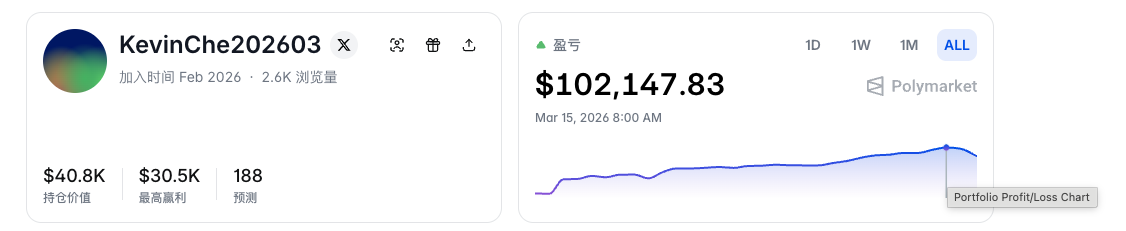
So how did Kevin transform OpenClaw from a toy that only burns tokens into a money-making machine? Odaily Planet Daily spoke with Kevin, who shared his personal crypto journey and how he leveraged OpenClaw in prediction markets, hoping readers can gain some inspiration.
The Transition from 'Scientist' to 'Prophet'
Kevin's early career primarily involved designing ERP architectures for enterprises. Later, he joined a Top 3 domestic internet company to build a sports betting software system from scratch. This professional experience laid the foundation for Kevin's current achievements in prediction markets. After 2018, Kevin entered the Web3 investment sector, mainly incubating and accelerating startups.
However, Kevin's first real bucket of gold was earned five years after entering the circle. In 2023, ordi emerged, ushering in the "Inscription Summer" for the crypto market. With a background in computers and code, Kevin became one of the highly sought-after "scientists" at the time (Odaily Note: Scientists refer to those who can write programs and code to quickly participate in new asset deployments during inscription launches).
"The period when ordi was listed on Binance was when my account assets were at their highest. I eventually cashed out about over 2 million RMB," Kevin said, noting that he was also among the first batch of people to participate in the ordi launch, with a cost of less than 1 RMB per coin, later enjoying a thousand-fold increase.
After inscriptions completely cooled down, Kevin began searching for other opportunities and finally started seriously researching and participating in the prediction market Polymarket in the summer of 2025. "I had played Polymarket before, but the liquidity was poor, so I ignored it," said Kevin, who had previously worked in traditional sports betting. For him, the early Polymarket's trading depth fell far short of requirements.
However, after Polymarket successfully predicted Trump becoming the 47th President of the United States in 2025, Kevin's attention returned to Polymarket. "After 2025, Polymarket's reputation grew, its liquidity could handle large orders, and more importantly, deposits and withdrawals became very convenient," so Kevin began experimenting with algorithms on Polymarket, becoming a "prophet."
Kevin's journey in prediction markets is divided into two stages: before using OpenClaw assistance and after using OpenClaw assistance. For clarity, Odaily Planet Daily has condensed Kevin's sharing as follows, enjoy~
How to Play Prediction Markets Before Using OpenClaw
Odaily Planet Daily: In the summer of 2025 when you started playing Polymarket, how much money did you invest, and what was the final profit?
Kevin: I invested about $100,000 at that time, and the total profit by this year was roughly double the principal.
Odaily Planet Daily: What strategy did you mainly adopt?
Kevin: I don't bet directly; I made profits through automated arbitrage using programs. When I worked on the sports betting system at the Web3 internet company, I was also involved in the design of order matching. This experience was very helpful for understanding Polymarket's order book. So I used programs to capture spreads between order books, especially in sports events, where a lot of emotional arbitrage can be done.
Odaily Planet Daily: Do you have a dedicated team, and is someone providing you with funds?
Kevin: I'm doing this alone; AI assistance is enough. Initially, I was afraid Polymarket might have withdrawal issues, so I ran dozens of accounts. But later, I found the deposit and withdrawal process very smooth, so I reduced the number of accounts. I mainly use my own money to run strategies, but indeed, some people provide funds for me to run strategies for them. However, this is just one way of making money.
How to Play Prediction Markets After Using OpenClaw
Odaily Planet Daily: When did you start using OpenClaw to play prediction markets?
Kevin: At the end of February. This was itself an experiment to see how much money OpenClaw could make at the trading level, but I didn't expect to actually make money. For example, the account KevinChe202603, I used $30,000 in cost and made up to $100,000 at its peak, in just 10 days.
Odaily Planet Daily: So what is your specific strategy?
Kevin: Frankly, this account's strategy is mixed. Currently, 60% is still running the previous automated arbitrage algorithm, and 40% is using the "lobster" for subjective betting. Compared to market making arbitrage, betting is a complex decision that requires considering factors such as smart money in prediction markets, public sentiment, lineups, player form, etc. OpenClaw's role here is to actively collect various factors that determine the outcome of events and turn them into an indicator. After training several times, it can also find other influencing factors that I might overlook, saving me a lot of time and mental effort.
Odaily Planet Daily: But isn't this just AI predicting events? Conversational AI can do that too, and some developers have even specifically created AI prediction tools for events. What's special about OpenClaw?
Kevin: Having an information advantage is just one of OpenClaw's strengths. It can also dig up new strategies by itself, conduct backtests on its own, and place automated bets during events. If the strategy is good, we just need to give the money to OpenClaw; everything else is automated, which AI prediction tools cannot do. For example, it can actively discover some smart money addresses and foolish addresses, either following the smart money's bets or using the foolish addresses as contrarian indicators.
Additionally, this is why Polymarket, among all prediction markets, integrates particularly well with OpenClaw—because Polymarket's API is the most AI-friendly, making data access very convenient for AI.
Odaily Planet Daily: In which areas is OpenClaw currently placing bets, and is it fully automated already?
Kevin: Based on my areas of expertise, OpenClaw is currently mainly experimenting in the field of sports competitions. But once mature, I will consider expanding OpenClaw to other areas. Right now, I give OpenClaw small amounts of funds for automated betting, around $1000. I still don't dare to put too much money into fully automated accounts.
Odaily Planet Daily: Is your strategy replicable, or will you write a Skills for the market in the future?
Kevin: I'm also trying because there is indeed user demand for this, to see if my methodology can be combined to allow everyone to build a money-making lobster. Later, I also plan to package some Skills for the market to use, which will definitely be paid, of course.







