From Precious Metals to U.S. Stocks: Crypto Platforms Are Reshaping Global Asset Pricing Power

marsbitPublicado em 2026-03-17Última atualização em 2026-03-17

Resumo

Amidst geopolitical tensions and attacks on Middle Eastern facilities, cryptocurrency platforms are rapidly gaining influence in global asset pricing, particularly for commodities like oil. While traditional markets were closed over a weekend, platforms such as MEXC saw surging activity in WTI oil perpetual futures, with prices to spike ahead of formal market reopenings. These crypto-based perpetual contracts—leveraged, speculative, and operating 24/7—allow instant reactions to breaking news, attracting a new generation of traders unwilling to wait for conventional exchanges. The trend extends beyond oil. Tokenized stocks and perpetual contracts for assets like gold, silver, and U.S. equities (e.g., AMD) are increasingly available on crypto exchanges, appealing to investors seeking real-time responsiveness. This shift highlights a broader movement toward digitized, continuous trading, challenging traditional market hours and structures. However, this high-leverage, always-on model carries significant risks, including extreme volatility and forced liquidations. Despite these challenges, the integration of crypto mechanisms into traditional finance appears inevitable, positioning crypto platforms at the forefront of a new, borderless financial paradigm.

When geopolitical black swans take flight on weekends, traditional financial market investors often find themselves helpless. Recently, attacks on facilities in the UAE and other regions have intensified oil price volatility. Since the U.S. and Israel launched airstrikes against Iran, numerous traders have flocked to crypto platforms to trade oil perpetual contracts. While traditional energy investors were counting down the hours last weekend, waiting for the futures market to reopen on Sunday, overseas cryptocurrency traders had already begun betting on oil price trends.
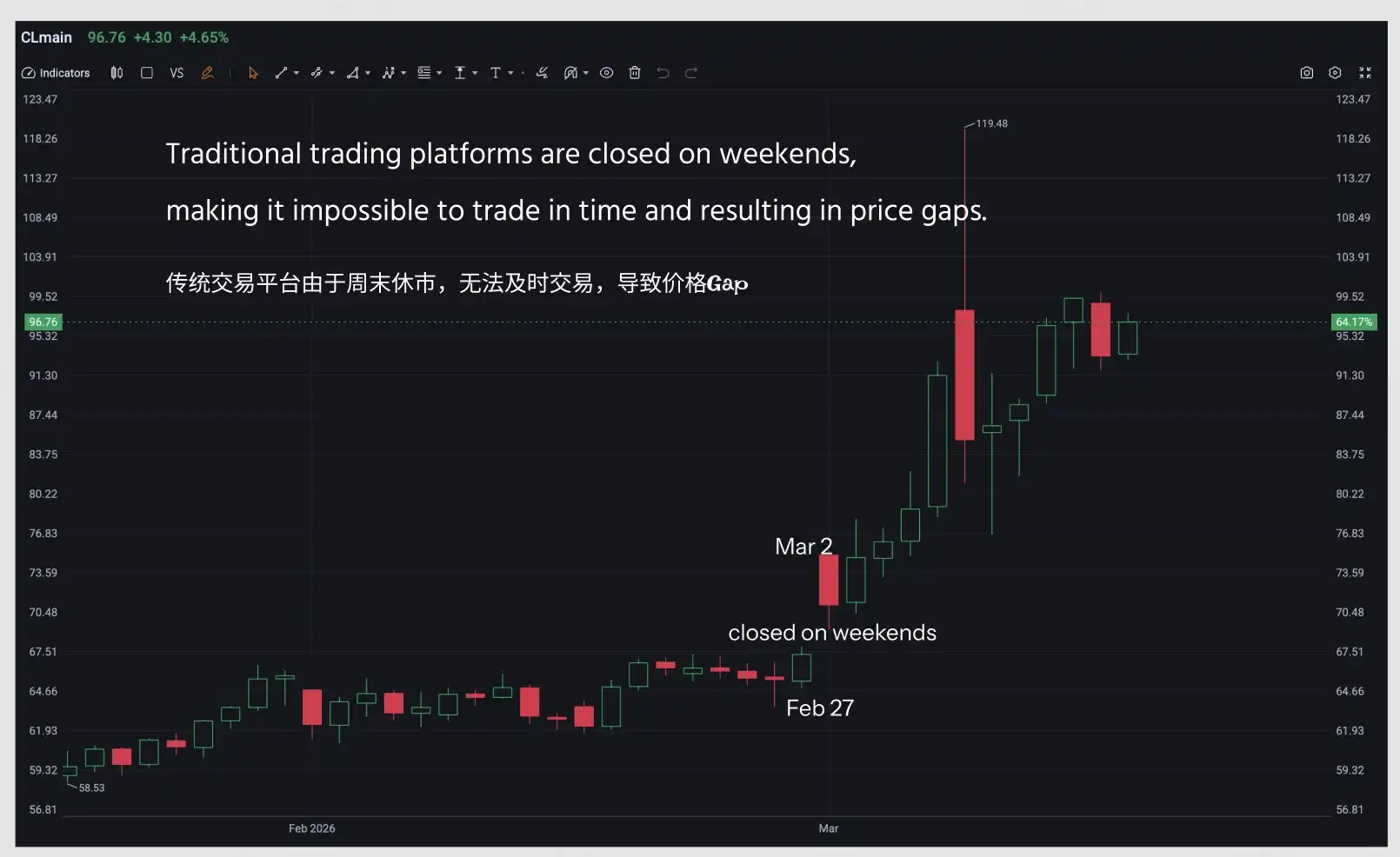
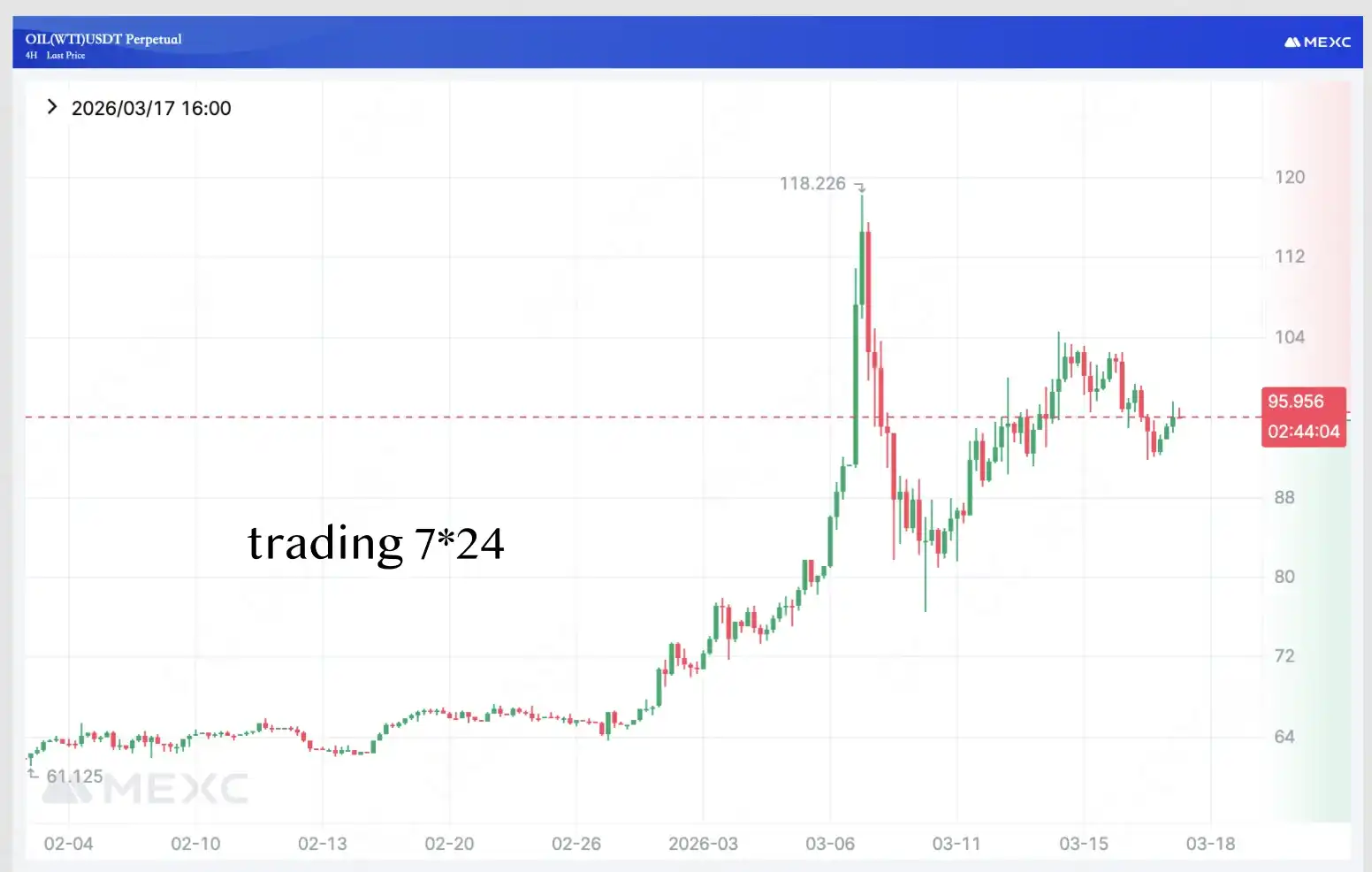
Last Saturday evening, about 20 hours before the opening of mainstream derivatives markets, the price of WTI crude oil perpetual futures on the MEXC platform surged to approximately $96 per barrel, higher than the regular crude oil futures closing price of $90.90 on Friday afternoon. In this market movement triggered by sudden conflict, crypto platforms were the first to complete the repricing of assets. Their seamless operating mechanisms made the fixed closing hours of traditional exchanges appear incredibly outdated.
The Wall Street Journal: Accelerating Integration of Traditional and Digital Finance

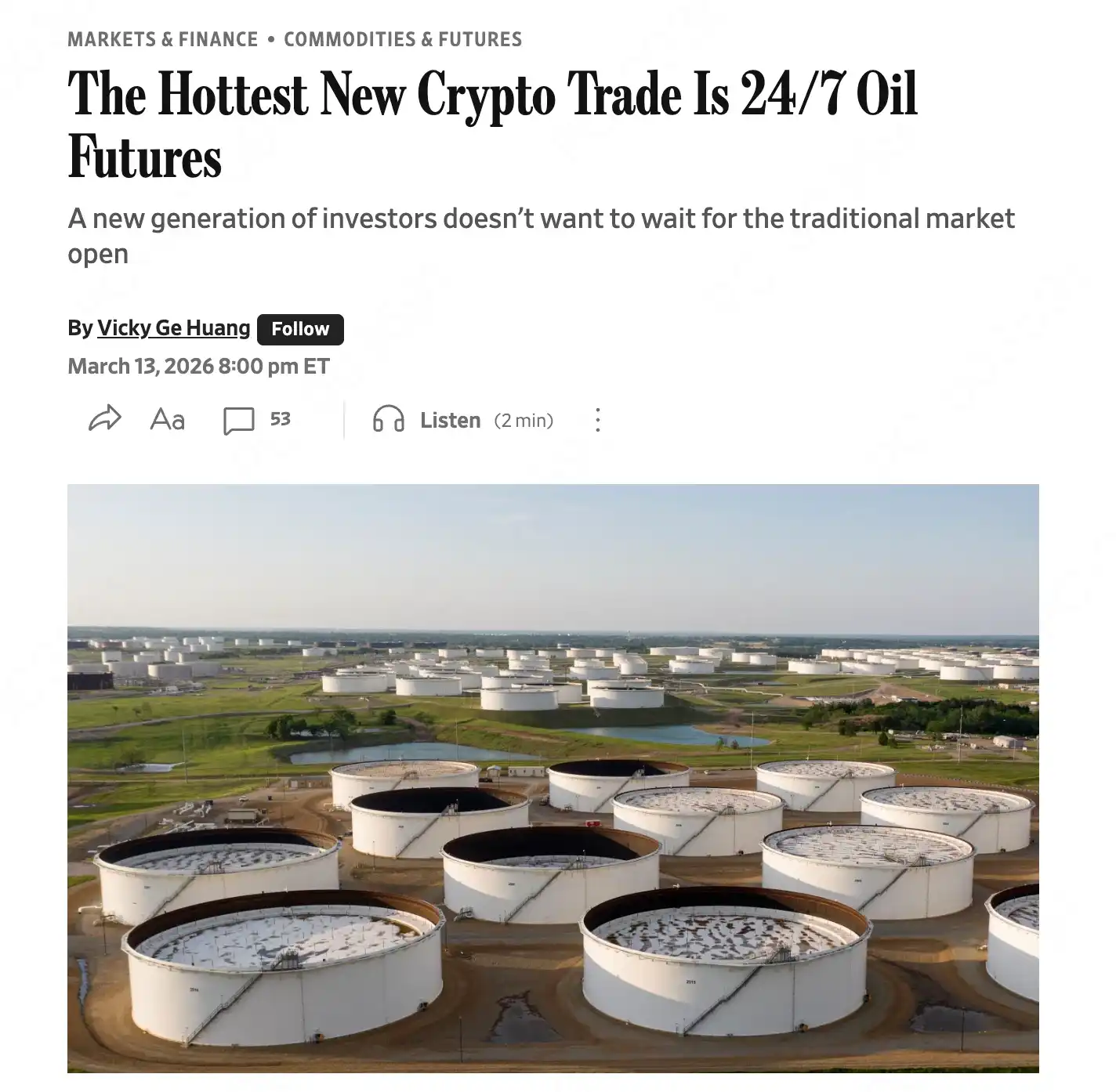
This disruptive market phenomenon quickly caught the attention of The Wall Street Journal. The report pointed out that a new generation of investors is no longer willing to wait for traditional markets to open. Crypto platforms now offer perpetual futures that track commodities, a highly speculative derivative.
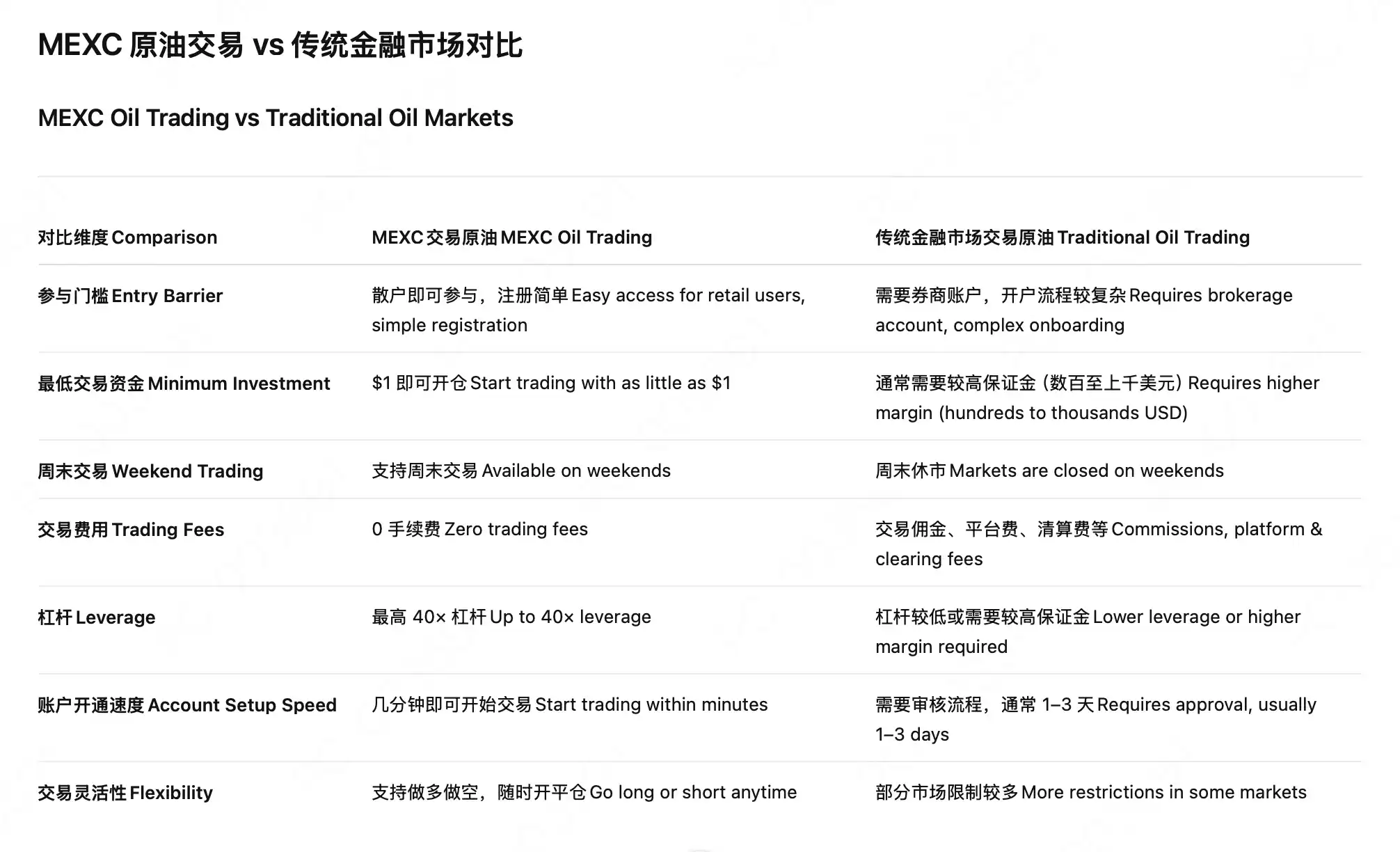
Perpetual contracts never expire and have no strike price (the point at which the contract becomes effective). They also allow traders to use extremely high leverage, which can amplify profits but also lead to the loss of the entire investment. As industry professionals have stated: "You don't need to wait until Monday for the market to open before everyone starts acting." This is changing the traditional model, enabling real participants to take action when weekend events occur.

Market data vividly reflects this vote of confidence with capital. In just a few days, the cumulative trading volume of oil futures surged from $339 million on February 28th to approximately $7.3 billion on Thursday.

Crossing Asset Boundaries: The 24/7 Wave from Crude Oil to U.S. Stocks

Time arbitrage in the oil market is just the beginning. Round-the-clock trading is already commonplace for cryptocurrency investors. For modern traders, the trading mechanisms provided by crypto platforms are demonstrating significant appeal for U.S. stocks and other commodities.

Wall Street is racing to utilize the digital ledger technology underpinning Bitcoin and other cryptocurrencies to tokenize stocks and other traditional assets. Similar to digital assets and prediction markets, so-called tokenized stocks are increasingly attracting the younger generation of investors who wish to trade 24/7 and react in real-time to geopolitical events and breaking company news. For example, investors can now trade contracts for popular U.S. stocks like AMD on crypto platforms at any time.
In addition to oil, crypto platforms have recently launched perpetual contracts for gold and silver, and the prices of these precious metals have also experienced abnormal volatility. Both metals saw their prices soar to historic highs, only to plummet subsequently.

As liquidity and trading habits migrate, an irreversible trend is emerging: Crypto platforms, with their advantages of seamless 24/7 trading, high capital efficiency, and disregard for geographical and time limitations, are continuously eating into the market share of traditional trading platforms. While traditional financial institutions remain constrained by rigid operating hours, the crypto ecosystem is gradually accommodating the trading needs of a massive volume of global assets, becoming the core hub for a new generation of pricing power.

A New Paradigm of Coexisting Opportunities and Challenges

Objectively speaking, this trading model combining high leverage and 24/7 operation is a double-edged sword. The author believes that cryptocurrency traders have short attention spans, so they desire quick returns and also crave volatility. On Sunday, the author observed that oil had reached unsustainable levels and began shorting—a judgment confirmed correct: On Monday, after President Trump stated that the war with Iran was "pretty much over," crude oil futures prices fell back below $100 per barrel.

This volatility can backfire once problems arise.

For many traders, the ability to trade these assets with leverage 24/7 is highly attractive, especially on weekends when traditional markets are closed. That said, trading highly volatile assets with leverage carries genuine market risks, and the author has also noted large-scale liquidations during sudden price swings.

Despite the challenges, the recent debut of oil futures contracts on multiple crypto platforms foreshadows a future of integration between traditional and digital finance—a time when all forms of assets can be traded at any time. In this historical process, crypto exchanges are at the forefront of this transformation. For traders eager to always maintain market initiative, a trading ecosystem that never sleeps is undoubtedly the most attractive battleground for the future.


Perguntas relacionadas

QWhat key advantage do cryptocurrency platforms offer over traditional financial markets for trading commodities like oil, according to the article?

ACryptocurrency platforms offer 24/7 trading, allowing investors to react to geopolitical events and market-moving news in real-time, even when traditional markets are closed, thus enabling faster asset repricing.

QWhat specific financial instrument on crypto platforms is highlighted as being used to speculate on oil prices during the recent Middle East conflict?

AOil perpetual futures contracts are the instrument used, which never expire, have no strike price, and allow for the use of high leverage.

QBesides oil, what other traditional assets are mentioned as being available for trading on crypto platforms?

AThe article mentions that crypto platforms also offer perpetual contracts for gold, silver, and tokenized stocks of companies like AMD.

QWhat is one of the major risks associated with the high-leverage, 24/7 trading model described in the article?

AA major risk is the potential for massive liquidations (forced closing of positions) during periods of sudden price volatility, which can lead to traders losing their entire investment.

QWhat broader trend does the article suggest is an irreversible shift in global finance?

AThe article suggests an irreversible trend of crypto platforms, with their 24/7 operation and high capital efficiency, reshaping global asset pricing power and eroding the market share of traditional trading platforms.

Leituras Relacionadas

Gensyn AI: Don't Let AI Repeat the Mistakes of the Internet

In recent months, the rapid growth of the AI industry has attracted significant talent from the crypto sector. A persistent question among researchers intersecting both fields is whether blockchain can become a foundational part of AI infrastructure. While many previous AI and Crypto projects focused on application layers (like AI Agents, on-chain reasoning, data markets, and compute rentals), few achieved viable commercial models. Gensyn differentiates itself by targeting the most critical and expensive layer of AI: model training. Gensyn aims to organize globally distributed GPU resources into an open AI training network. Developers can submit training tasks, nodes provide computational power, and the network verifies results while distributing incentives. The core issue addressed is not decentralization for its own sake, but the increasing centralization of compute power among tech giants. In the era of large models, access to GPUs (like the H100) has become a decisive bottleneck, dictating the pace of AI development. Major AI companies are heavily dependent on large cloud providers for compute resources. Gensyn's approach is significant for several reasons: 1) It operates at the core infrastructure layer (model training), the most resource-intensive and technically demanding part of the AI value chain. 2) It proposes a more open, collaborative model for compute, potentially increasing resource utilization by dynamically pooling idle GPUs, similar to early cloud computing logic. 3) Its technical moat lies in solving complex challenges like verifying training results, ensuring node honesty, and maintaining reliability in a distributed environment—making it more of a deep-tech infrastructure company. 4) It targets a validated, high-growth market with genuine demand, rather than pursuing blockchain integration without purpose. Ultimately, the boundaries between Crypto and AI are blurring. AI requires global resource coordination, incentive mechanisms, and collaborative systems—areas where crypto-native solutions excel. Gensyn represents a step toward making advanced training capabilities more accessible and collaborative, moving beyond a niche controlled by a few giants. If successful, it could evolve into a fundamental piece of AI infrastructure, where the most enduring value in the AI era is often created.

marsbitHá 12h

Gensyn AI: Don't Let AI Repeat the Mistakes of the Internet

marsbitHá 12h

Why is China's AI Developing So Fast? The Answer Lies Inside the Labs

A US researcher's visit to China's top AI labs reveals distinct cultural and organizational factors driving China's rapid AI development. While talent, data, and compute are similar to the West, Chinese labs excel through a pragmatic, execution-focused culture: less emphasis on individual stardom and conceptual debate, and more on teamwork, engineering optimization, and mastering the full tech stack. A key advantage is the integration of young students and researchers who approach model-building with fresh perspectives and low ego, prioritizing collective progress over personal credit. This contrasts with the US culture of self-promotion and "star scientist" narratives. Chinese labs also exhibit a strong "build, don't buy" mentality, preferring to develop core capabilities—like data pipelines and environments—in-house rather than relying on external services. The ecosystem feels more collaborative than tribal, with mutual respect among labs. While government support exists, its scale is unclear, and technical decisions appear driven by labs, not state mandates. Chinese companies across sectors, from platforms to consumer tech, are building their own foundational models to control their tech destiny, reflecting a broader cultural drive for technological sovereignty. Demand for AI is emerging, with spending patterns potentially mirroring cloud infrastructure more than traditional SaaS. Despite challenges like a less mature data industry and GPU shortages, Chinese labs are propelled by vast talent, rapid iteration, and deep integration with the open-source community. The competition is evolving beyond a pure model race into a contest of organizational execution, developer ecosystems, and industrial pragmatism.

marsbitHá 13h

Why is China's AI Developing So Fast? The Answer Lies Inside the Labs

marsbitHá 13h

3 Years, 5 Times: The Rebirth of a Century-Old Glass Factory

Corning, a 175-year-old glass company, is experiencing a dramatic revival as a key player in AI infrastructure, driven by surging demand for high-performance optical fiber in data centers. AI data centers require vastly more fiber than traditional ones—5 to 10 times as much per rack—to handle high-speed data transmission between GPUs. This structural demand shift, coupled with supply constraints from the lengthy expansion cycle for fiber preforms, has created a significant supply-demand gap. Nvidia has invested in Corning, along with Lumentum and Coherent, in a $4.5 billion total commitment to secure the optical supply chain for AI. Corning's competitive edge lies in its expertise in producing ultra-low-loss, high-density, and bend-resistant specialty fiber, which is critical for 800G+ and future 1.6T data rates. Its deep involvement in co-packaged optics (CPO) with partners like Nvidia further solidifies its position. While not the largest fiber manufacturer globally, Corning's revenue from enterprise/data center clients now exceeds 40% of its optical communications sales, and it has secured multi-year supply agreements with major hyperscalers including Meta and Nvidia. Financially, Corning's optical communications revenue has surged, doubling from $1.3 billion in 2023 to over $3 billion in 2025. Its stock price has risen nearly 6-fold since late 2023. Key future catalysts include the rollout of Nvidia's CPO products and the scale of undisclosed customer agreements. However, risks include high current valuations and potential disruption from next-generation technologies like hollow-core fiber. The company's long-term bet on light over electricity, maintained even through the telecom bubble crash, is now being validated by the AI boom.

marsbitHá 14h

3 Years, 5 Times: The Rebirth of a Century-Old Glass Factory

marsbitHá 14h

Trading

Spot
Futuros
活动图片




