From "Life K-line" to "Laozi": A Look at the Top 5 Hottest BSC "Chinese Memes" Right Now

marsbitPublicado em 2026-01-11Última atualização em 2026-01-11

Resumo

The article "From 'Life K-Line' to 'Laozi': A Review of the Top 5 Hottest Chinese Meme Tokens on BSC" discusses the resurgence of the crypto market in 2026, driven by the popularity of meme coins, particularly those with Chinese themes on the Binance Smart Chain (BSC). Key highlights include: - "I’m F*cking Coming" (我踏马来了), the new leading Chinese meme token with a market cap of around $36 million, which was recently listed on Binance Alpha. - "Life K-Line" (人生K线), an AI-themed metaphysical token that surged to nearly $42 million after being featured by CCTV and supported by key figures like Nina Rong, now at around $20 million. - "Laozi" (老子), a Sichuan dialect-based meme token with a cultural twist, currently valued at approximately $15 million, partly boosted by BSC Foundation’s purchase. - "Chuanpu" (川普), a meme playing on Sichuan-accented Mandarin and associations with Donald Trump, with a market cap of about $2 million. - "Super Cycle" (超级周期), inspired by a statement from Binance founder CZ, which briefly spiked to over $4 million and now sits at around $1.7 million. The article notes that the sustainability of this meme trend heavily depends on continued support from key figures like CZ, He Yi, and Binance’s listing strategies. Investors are cautioned about the high volatility of meme tokens.

Original|Odaily Planet Daily(@OdailyChina)

Author|Wenser(@wenser 2010)
The recovery of the crypto market in 2026 started with Meme coins. Overnight, "the whole world is speaking Chinese."

As established Meme coins led the initial surge, the BSC ecosystem quickly took over—a wave of Chinese Memes, leveraging simple yet highly viral concepts like "I'm fucking coming," emerged and spread like wildfire within days. In the current environment of scarce liquidity, each price increase is not accidental but the result of a battle for attention.

Odaily Planet Daily will provide a brief overview of the currently popular Chinese Meme projects on the BSC ecosystem for readers' reference (Odaily Note: Meme coin prices are highly volatile; the following is for informational purposes only and not investment advice).

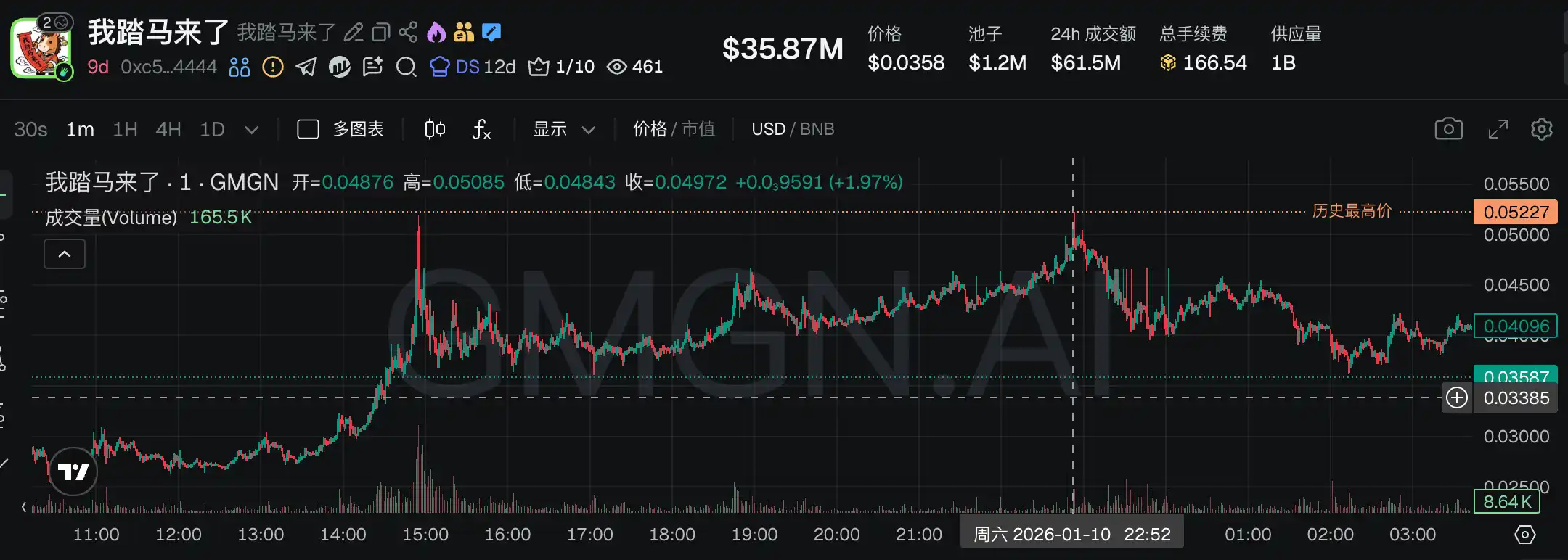
New Chinese Meme Leader: "I'm Fucking Coming", Market Cap Reported at $36 Million

As the "new Chinese Meme leader" of the past week, "I'm Fucking Coming" rapidly launched on Binance Alpha, injecting a shot of confidence into the Chinese Meme concept board. For related discussions on this Meme coin, we recommend reading "How to Evaluate the Listing of 'I'm Fucking Coming' on Binance?".

Previously, this Meme coin surged to around $52 million and has since retraced to approximately $36 million. Whether it can reach a new all-time high (ATH) again still depends on achieving milestone listings like Binance Futures and Spot.

GMGN Link: https://gmgn.ai/bsc/token/0xc51a9250795c0186a6fb4a7d20a90330651e4444
AI Mysticism Concept Coin: Life K-line, Market Cap Reported at $20 Million

As early as last month's "Odaily Editorial Tea Party (December 17)", we mentioned the AI mysticism product "Life K-line," while its同名 Meme coin had been relatively quiet.

Recently, the暴涨 (soaring rise) of Life K-line was primarily driven by two major events: 1) The product was featured in a report by CCTV (article link here); 2) Support from Nina Rong, a key figure in the BSC ecosystem and Binance, for Life K-line developer 0xSakura, coupled with the latter's update introducing the "Cyber Merit Box"—a product with a "donation" concept—jointly propelled Life K-line's market cap to skyrocket from a low of $2 million to nearly $42 million at its peak.

As of writing, Life K-line's market cap has retraced to around $20 million.

GMGN Link: https://gmgn.ai/bsc/token/0x1a1e69f1e6182e2f8b9e8987e83c016ac9444444
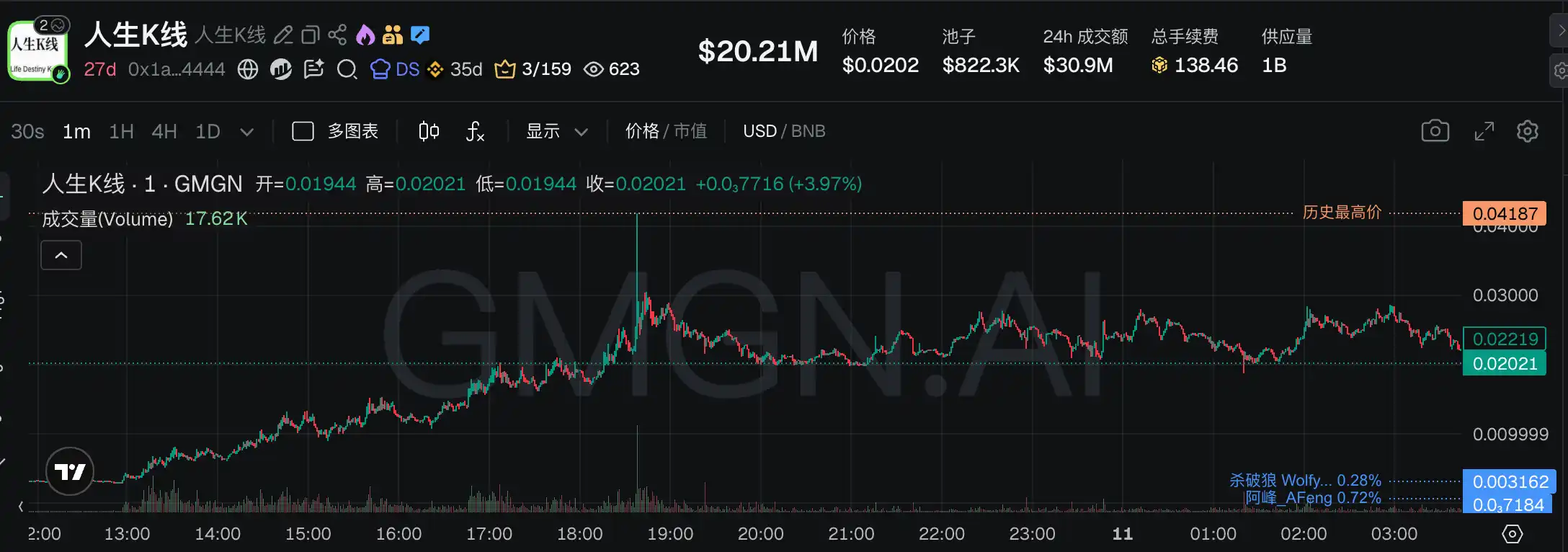
Sichuan Dialect Meme: Laozi, Market Cap Reported at $15 Million

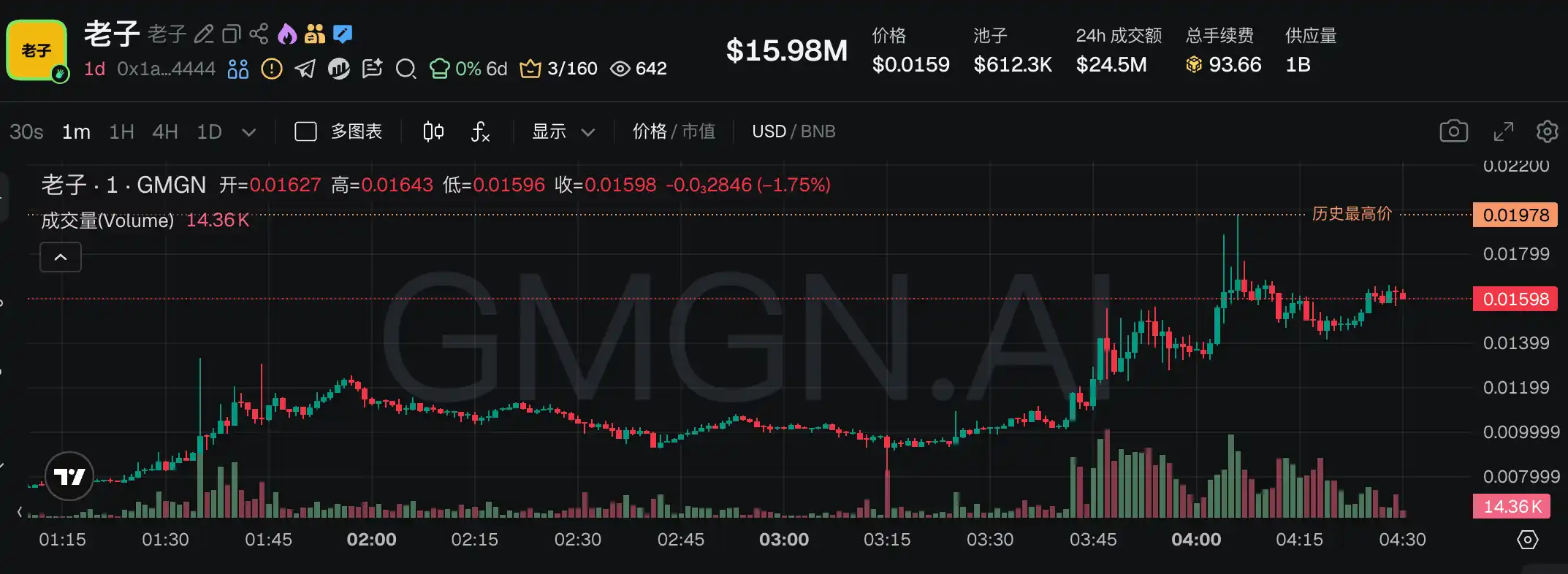
Since He Yi's hometown is Sichuan, Sichuan dialect-related Memes have also secured a place in this "BSC Ecosystem Chinese Meme热潮 (hot trend)." The Sichuan dialect colloquialism for "I"—"Laozi" (老子), which also shares its name with the ancient philosopher Laozi, carries cultural attributes that contributed to its rapid market cap increase, previously approaching $20 million.

Latest news indicates that the BSC Foundation spent $50,000 to purchase the Chinese Meme coins Hakimi and Laozi, providing消息面上的支撑 (support on the news front) for this Meme coin's rise.

GMGN Link: https://gmgn.ai/bsc/token/0x1a5f9d77ca46646cd4937fd8d093f460b66f4444
Sichuan Mandarin Concept Meme: Chuanpu, Market Cap Reported Around $2 Million

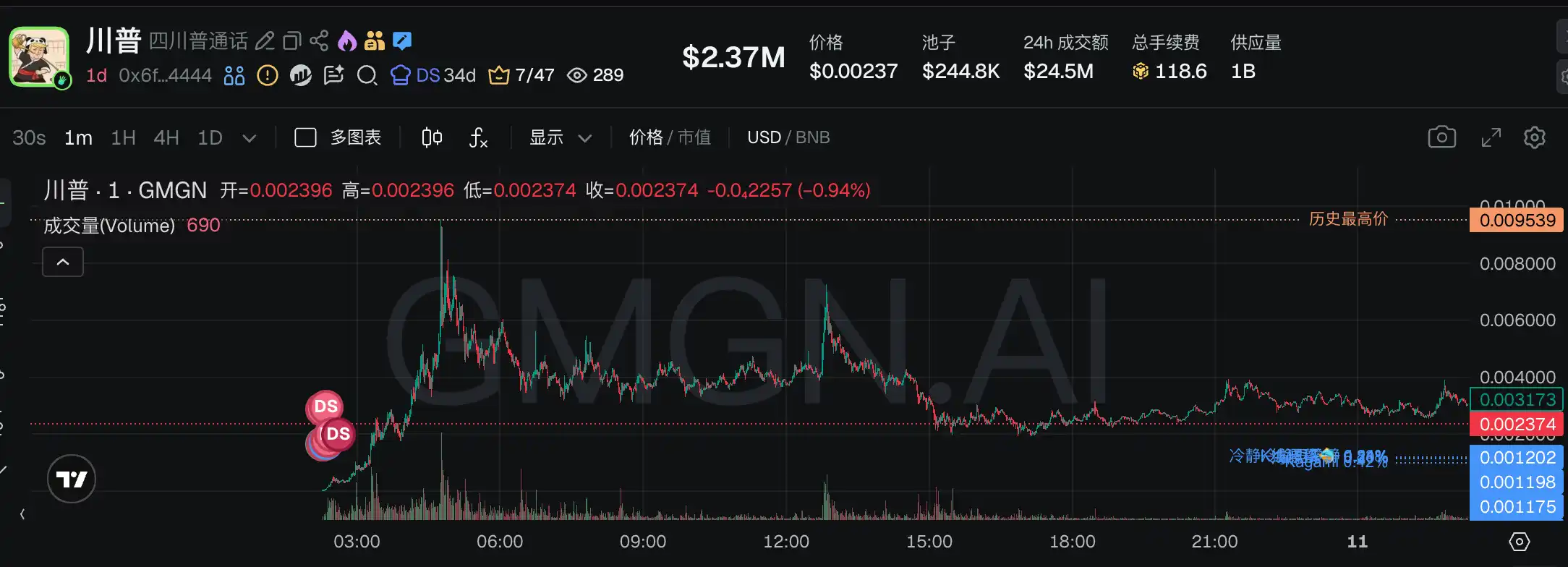
Similar to "Laozi," "Chuanpu" is an abbreviation for Sichuan Mandarin. It gained Meme属性 (Meme attributes) online previously due to its humorous expressions. Moreover, this Meme gained an additional "celebrity hue" as the name of former US President Donald Trump is also directly translated as "Chuanpu" (川普) in Chinese.

Previously,知名交易员冷静 (well-known trader Lengjing) even publicly endorsed it, stating: "Another January, another Saturday, another Chuanpu, another 10 o'clock," hinting that the "Chuanpu" Meme coin might even ride the coattails of the热度 (heat) from the legitimate Trump Meme coin TRUMP from last January. Of course, this is just one angle a trader found for buying; based on current market performance, this is just one among the fast-rising and fast-fading Meme coins, not a politically significant Meme coin like TRUMP.

GMGN Link: https://gmgn.ai/bsc/token/0x6fafec4730e0102d8ac82b00de460b9f31f44444
CZ Statement Concept Meme: Super Cycle, Market Cap Reported at $1.7 Million

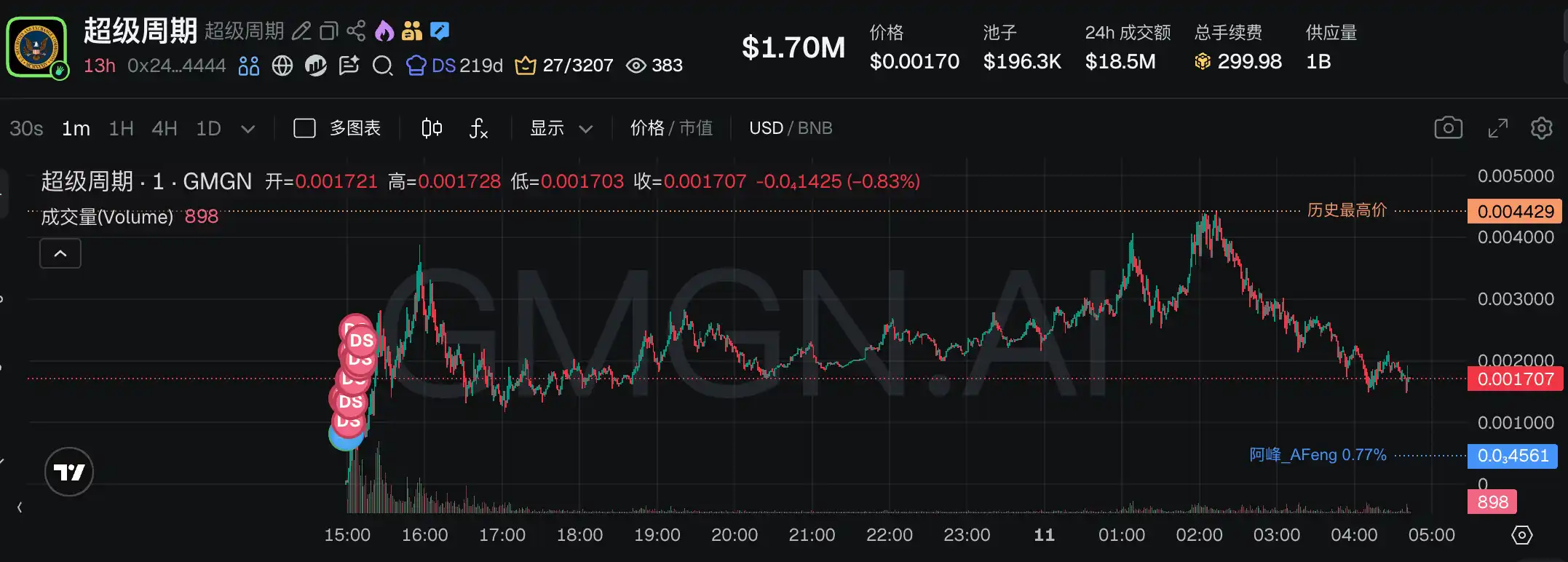
Unlike the mostly He Yi-related Meme coins above, Super Cycle is a Meme coin related to Binance founder CZ.

Last night, regarding the "US Securities and Exchange Commission removing cryptocurrency from its 2026 priority risk list," CZ posted: "The super cycle is coming, but I could be wrong." Influenced by this news, the Super Cycle Meme coin surged accordingly, with its market cap一度涨超 (once rising over) $4 million, and has now retraced to around $1.7 million.

GMGN Link: https://gmgn.ai/bsc/token/0x2433092b3554eefc154f5ee3a275ebf2a85f4444
Of course, as we mentioned in "How to Evaluate the Listing of 'I'm Fucking Coming' on Binance?", whether this "BSC Meme Heat" can continue still highly depends on how CZ, He Yi, and the Binance listing team "cooperate" afterwards.


Perguntas relacionadas

QWhat is the main theme of the article regarding the current crypto market?

AThe article discusses the resurgence of the crypto market in 2026, starting with Meme coins, and highlights the emergence of a trend where 'the whole world is speaking Chinese' with a surge in Chinese Meme coins on the BSC ecosystem.

QWhich Chinese Meme coin is referred to as the 'new leader' and what was its peak market capitalization?

AThe 'new leader' of Chinese Meme coins is '我踏马来了' (I'm Coming), which reached a peak market capitalization of approximately $52 million before falling back to around $36 million.

QWhat were the two main events that drove the surge in the market capitalization of the '人生 K线' (Life K-line) Meme coin?

AThe two main events were: 1) The product received coverage from CCTV (China Central Television), and 2) Support from BSC ecosystem and Binance key figure Nina Rong for the developer 0xSakura, along with the launch of the 'Cyber Merit Box' product update.

QWhy did the Sichuan dialect Meme coin '老子' (Laozi) gain popularity, and what recent purchase supported its price?

AThe coin gained popularity due to its connection to Sichuan dialect (where 'Laozi' is a colloquial term for 'I') and its cultural association with the ancient philosopher Laozi. Its price was recently supported by the BSC Foundation's purchase of $50,000 worth of the Meme coin.

QWhat event triggered the price increase of the '超级周期' (Super Cycle) Meme coin, and who is it associated with?

AThe price increase was triggered by a statement from Binance founder CZ, who said 'Super Cycle is coming, but I might be wrong' in response to the US SEC removing cryptocurrency from its 2026 priority risk list. The Meme coin is associated with CZ.

Leituras Relacionadas

Telegram Takes Direct Control of TON, Social Traffic Rewrites the Public Chain Narrative

Telegram founder Pavel Durov announced that Telegram will replace the TON Foundation as the core driver and largest validator of The Open Network (TON). Key initiatives include a sixfold reduction in transaction fees, performance upgrades, and improved developer tools within the next few weeks. This marks a strategic shift from Telegram merely providing user access to deeply integrating TON into its platform's core infrastructure. The goal is to transform Telegram's massive social traffic into sustainable on-chain activity. While viral mini-apps like Notcoin have demonstrated Telegram's ability to drive user adoption, TON aims to support frequent, low-value transactions inherent to social platforms—such as tipping, in-app payments, and game rewards. Ultra-low fees and sub-second finality (0.6 seconds) are crucial to making blockchain interactions seamless and nearly invisible within the Telegram user experience. However, Telegram's increased central role raises questions about network decentralization. Durov argues that Telegram's participation will attract more large validators, thereby enhancing decentralization. TON also offers high annual staking rewards (18.8%), aiming to retain capital within its ecosystem. The fundamental challenge for TON is no longer leveraging Telegram's user base, but becoming an indispensable, seamless infrastructure layer for Telegram's everyday applications—moving from an adjacent chain to an embedded utility.

marsbitHá 1m

Telegram Takes Direct Control of TON, Social Traffic Rewrites the Public Chain Narrative

marsbitHá 1m

OpenAI Post-Training Engineer Weng Jiayi Proposes a New Paradigm Hypothesis for Agentic AI

OpenAI engineer Weng Jiayi's "Heuristic Learning" experiments propose a new paradigm for Agentic AI, suggesting that intelligent agents can improve not just by training neural networks, but also by autonomously writing and refining code based on environmental feedback. In the experiment, a coding agent (powered by Codex) was tasked with developing and maintaining a programmatic strategy for the Atari game Breakout. Starting from a basic prompt, the agent iteratively wrote code, ran the game, analyzed logs and video replays to identify failures, and then modified the code. Through this engineering loop of "code-run-debug-update," it evolved a pure Python heuristic strategy that achieved a perfect score of 864 in Breakout and performed competitively with deep reinforcement learning (RL) algorithms in MuJoCo control tasks like Ant and HalfCheetah. This approach, termed Heuristic Learning (HL), contrasts with Deep RL. In HL, experience is captured in readable, modifiable code, tests, logs, and configurations—a software system—rather than being encoded solely into opaque neural network weights. This offers potential advantages in explainability, auditability for safety-critical applications, easier integration of regression tests to combat catastrophic forgetting, and more efficient sample use in early learning stages, as demonstrated in broader tests on 57 Atari games. However, the blog acknowledges clear limitations. Programmatic strategies struggle with tasks requiring long-horizon planning or complex perception (e.g., Montezuma's Revenge), areas where neural networks excel. The future vision is a hybrid architecture: specialized neural networks for fast perception (System 1), HL systems for rules, safety, and local recovery (also System 1), and LLM agents providing high-level feedback and learning from the HL system's data (System 2). The core proposition is that in the era of capable coding agents, a significant portion of an AI's learned experience could be maintained as an auditable, evolving software system.

marsbitHá 1h

OpenAI Post-Training Engineer Weng Jiayi Proposes a New Paradigm Hypothesis for Agentic AI

marsbitHá 1h

Your Claude Will Dream Tonight, Don't Disturb It

This article explores the recent phenomenon of AI companies increasingly using anthropomorphic language—like "thinking," "memory," "hallucination," and now "dreaming"—to describe machine learning processes. Focusing on Anthropic's newly announced "Dreaming" feature for its Claude Agent platform, the piece explains that this function is essentially an automated, offline batch processing of an agent's operational logs. It analyzes past task sessions to identify patterns, optimize future actions, and consolidate learnings into a persistent memory system, akin to a form of reinforcement learning and self-correction. The article draws parallels to similar features in other AI agent systems like Hermes Agent and OpenClaw, which also implement mechanisms for reviewing historical data, extracting reusable "skills," and strengthening long-term memory. It notes a key difference from human dreaming: these AI "dreams" still consume computational resources and user tokens. Further context is provided by discussing the technical challenges of managing AI "memory" or context, highlighting the computational expense of large context windows and innovations like Subquadratic's new model claiming drastically longer contexts. The core critique argues that this strategic use of human-centric vocabulary does more than market products; it subtly reshapes user perception. By framing algorithms with terms associated with consciousness, companies blur the line between tool and autonomous entity. This linguistic shift can influence user expectations, tolerance for errors, and even perceptions of responsibility when systems fail, potentially diverting scrutiny from the companies and engineers behind the technology. The article concludes by speculating that terms like "daydreaming" for predictive task simulation might be next, continuing this trend of embedding the idea of an "inner life" into computational processes.

marsbitHá 1h

Your Claude Will Dream Tonight, Don't Disturb It

marsbitHá 1h

Trading

Spot
Futuros
活动图片