From Bitcoin Core to Trump's Cabinet: Uncovering Epstein, Peter Thiel, and Putin's Crypto Power Network

marsbitPublicado em 2026-02-09Última atualização em 2026-02-09

Resumo

From Bitcoin Core to Trump's Cabinet: Uncovering Epstein, Peter Thiel, and Putin's Crypto Power Network This investigation reveals how Jeffrey Epstein leveraged his international connections to position cryptocurrency at the center of geopolitics. Through recently disclosed emails, the article traces the complex ties between Epstein, Silicon Valley billionaire Peter Thiel, former Trump strategist Steve Bannon, and high-ranking Russian officials. Epstein advised Russia to use Bitcoin to achieve a "leapfrog" reshaping of the global financial system, provided critical funding to Blockstream to sustain Bitcoin Core development, and was deeply involved in Thiel's venture capital firm. These early crypto-political maneuvers, now influencing global elections and state power through figures like J.D. Vance, represent Epstein's most隐秘 and damaging legacy. The network connected Kremlin interests, far-right populist movements, and Silicon Valley's anti-regulatory ideology, using cryptocurrency as a tool for political disruption and unaccountable financial influence.

Author: Byline Times

Translated by: Deep Tide TechFlow

Original Link:In Putin’s Orbit: The Crypto Politics of Jeffrey Epstein and Peter Thiel

Deep Tide Introduction: This article reveals how Jeffrey Epstein used his complex international network to push cryptocurrency to the center stage of geopolitics. Through recently disclosed emails, the article traces the intricate connections between Epstein, Silicon Valley magnate Peter Thiel, former Trump strategist Steve Bannon, and high-level Russian officials. Epstein not only advised Russia to use Bitcoin to 'leapfrog' and reshape the financial system but also injected capital into Blockstream at a critical moment to sustain Bitcoin Core development, and was deeply involved in Thiel's venture capital firm. These early crypto-political maneuvers are now, through the rise of figures like J.D. Vance, profoundly influencing global democratic elections and the contest for national power, becoming Epstein's most hidden and destructive legacy.

In 1957, when the Soviet Union launched the first artificial satellite, 'Sputnik,' into space, the Western world was caught off guard by a technological and cultural revolution that had been brewing for almost a decade.

In a 2013 email, Jeffrey Epstein invoked the 'Sputnik' analogy to a senior Russian official, stating that 'Russia taking the lead in finance, the same thing could happen now.' He argued that instead of merely imitating Silicon Valley and catching up with Microsoft, Apple, and Google, Russia could achieve a 'leapfrog development over global society by reinventing the 21st-century financial system' through a new type of currency and securitization.

This Russian official was Sergey Belyakov. After graduating from the FSB (Federal Security Service) spy academy, Belyakov served as a senior advisor to Oleg Deripaska, one of Vladimir Putin's most devoted oligarchs and international agents—Deripaska himself was a close associate of Epstein and Labour Party colleague Peter Mandelson. By 2013, he had become Deputy Minister of Economic Development of Russia.

Epstein reminded Belyakov that he had helped establish the US derivatives market in the 1970s, which was a precursor to the 'more advanced, disruptive securitization plans now made feasible by technology.'

Epstein insisted that Russia had a unique advantage in executing this 'grand vision of establishing a new global currency... which is larger than any single project conceived by any government, and its core is actually not difficult to achieve.'

He had reason to believe his words would be heard at the highest levels.

In a letter dated May 22, 2013, Epstein revealed: 'Putin asked me to be present at the economic conference in St. Petersburg. I refused him. If he wants to meet, he needs to set aside real, dedicated time and privacy.'
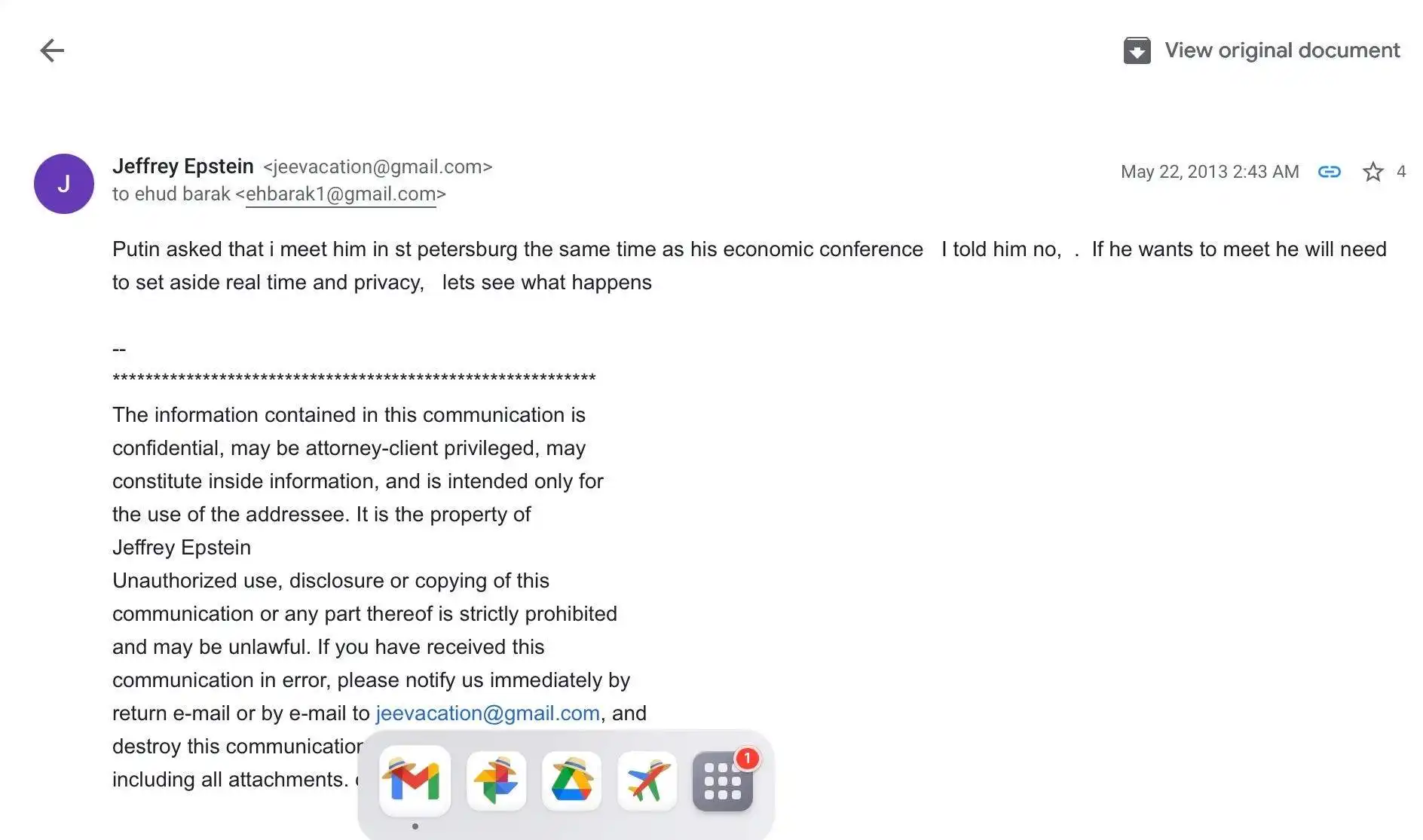
Caption: Clues to Epstein's relationship with the Kremlin

This was not baseless chatter. Epstein shared this information with former Israeli Prime Minister Ehud Barak, who was to meet Putin in person a few weeks later and could easily verify this claim through Kremlin channels.

In January 2014, Thorbjørn Jagland (then Secretary General of the Council of Europe) wrote to Epstein, stating he was planning to meet the Russian president in Sochi. Epstein told Jagland to 'explain to Putin that there should be a sophisticated Russian version of Bitcoin,' calling it 'the most advanced financial instrument globally.'

This is the prism through which to understand the rest of the crypto network built around Epstein, Vladimir Putin, Peter Thiel, and Steve Bannon.

Social Capital

Peter Thiel, co-founder of Palantir and a core member of the so-called 'PayPal Mafia' alongside Elon Musk, is an avid follower of cryptocurrency, valuing its ability to provide an alternative to government-controlled fiat currency. He once declared: 'Bitcoin is what PayPal should have been.'

He had long been a target of Epstein.

As early as 2012, Epstein received an email from fintech entrepreneur Ian Osborne suggesting they 'have a drink with Peter Thiel,' calling Thiel 'the best person to study currency,' and linking him to Abu Dhabi's sovereign wealth fund.

In 2013, Epstein urged former Israeli minister Ehud Barak to 'spend some real time with Peter Thiel.'

By July 2014, Thiel and Epstein were exchanging emails about Bitcoin regulation at the New York Stock Exchange. In September of the same year, Epstein hosted consecutive meetings with Thiel and William Burns, who was then Deputy Secretary of State in the Obama administration and is now the Director of the CIA (Central Intelligence Agency).

By 2015, Epstein proposed Thiel as one of the people Belyakov should meet. Following Epstein's advice, Belyakov contacted Thiel directly, and Thiel asked his executive assistant to schedule a face-to-face meeting for July 2015.

Epstein had multiple interests here. First was cryptocurrency. Emails from MIT (Massachusetts Institute of Technology) show that Joi Ito solicited and accepted donations from Epstein, which helped pay the salaries of Bitcoin Core developers after the Bitcoin Foundation collapsed. Another email thread shows Epstein was involved in the seed round financing of Bitcoin infrastructure development company Blockstream in 2014, increasing his allocation from $50,000 to $500,000 after Ito requested more shares in the oversubscribed deal.

But just as Thiel was interested in blockchain currency, surveillance, and data systems like Palantir, Epstein joined in, investing $40 million in Thiel's Valar Ventures. According to Ehud Barak, Thiel and Epstein 'co-owned' the firm and used it to take a share in the Israeli surveillance technology company Carbyne.

(A spokesperson for Peter Thiel later denied this, stating that Epstein was merely a 'limited partner (LP).')

As Epstein and Thiel aligned financially, their political inclinations also converged. Both were unusually important early supporters of Donald Trump's first presidential term. A brief exchange in the emails captures the tone of this relationship. Epstein wrote to Peter Thiel: 'I like your exaggeration about Trump, it's not a lie,' then suggested Thiel 'come see me in the Caribbean.'

Thiel broke with most of Silicon Valley, publicly supported Trump, and injected millions of dollars into pro-Trump super PACs. Epstein's communications show he closely followed Trump's polls against Hillary, campaign staff, and appointments related to Bitcoin and fintech.

In his speech at the 2016 Republican National Convention, Thiel used the platform of Trump's coronation to attack 'financial bubbles' and praise 'new forms of money,' later telling audiences that Bitcoin could be 'China's financial weapon' or a hedge against the dollar's reserve status.

As Russia's interference activities around the US election escalated through massive social media offensives and hacking of the Hillary campaign's emails, Epstein also arranged a luncheon at his New York townhouse, attended by Trump supporters Thiel, Tom Barrack, and Russia's Permanent Representative to the UN, Vitaly Churkin—a seasoned Kremlin operator.

After Churkin's sudden death in 2017, Epstein emailed Thiel: 'My Russian ambassador friend died. Life is short, eat dessert first.'

"Brexit is Just the Beginning"

Epstein was a frequent visitor to the UK, even beyond his connections to Ghislaine Maxwell and Andrew Mountbatten, and he closely watched British finance and politics.

In recently disclosed information and emails, he saw the UK's decision to leave the EU in the June 2016 vote as a political reshuffling and trading opportunity—something that could be shorted financially and leveraged politically. As he wrote to Peter Thiel about the chaos triggered by the referendum: 'Brexit is just the beginning.'

To achieve broader goals, beyond his maneuvers in Silicon Valley and Russia, Epstein invested significant time and intellectual capital in a major project led by former Trump campaign manager, White House Chief of Staff, Breitbart publisher, and Cambridge Analytica co-founder Steve Bannon, who had just lost his position as White House Chief of Staff and was looking for a new role.

He initially found opportunity in the pan-European populist 'Movement' (The Movement), founded in 2017 by allies like Nigel Farage's partner Laure Ferrari and People's Party leader Mischaël Modrikamen, initially led by Bannon's friend Nigel Farage himself.

Registered in Brussels, the organization's mission was to unite 'populist and conservative movements in Europe,' defending 'national sovereignty' and 'effective national borders.'

Behind the scenes, Jeffrey Epstein became a funder and strategist for Bannon's Movement, providing financial advice on how to circumvent financial regulations, offering transportation and accommodation, and introducing key figures in Europe.

During the turbulent Brexit transition, as Theresa May's government struggled to find a solution acceptable to the Brexit right wing, Bannon was flying to the UK to organize opposition.

In 2018, Bannon told Epstein he was meeting with Boris Johnson, Nigel Farage, and Jacob Rees-Mogg to organize them to overthrow Theresa May. Writer Michael Wolff wrote to Epstein, claiming to be an intermediary with leadership challenger Boris Johnson.

However, the UK was just one stop in Bannon's international populist plan. He soon texted Epstein about his broader European ambitions, claiming: 'My advisory role now covers Front National, Salvini's League, Germany's AfD, the Swiss People's Party, Orban, Land and Freedom Party, Farage—next May is the European Parliament election—we can increase from 92 seats to 200—block any crypto legislation or anything we want.'

By the time Theresa May was replaced by Boris Johnson in 2019, Bannon was ecstatic: 'May is gone... we really crushed them... we are on a roll.'

Even then, cryptocurrency never left the agenda, with Bannon agreeing: 'Crypto is currency, blockchain is equivalent to Internet 2.0.'

The Legacy of Crypto Politics

The UK left the EU in 2020. Epstein was arrested and subsequently died in prison. Farage's UKIP was replaced by his more domestically focused Reform UK. However, the lessons about fintech and its ability to reshape or disrupt democracy did not disappear.

When Farage's confidant, former UKIP MEP and Reform UK Wales leader Nathan Gill, was arrested in September 2021 on suspicion of accepting pro-Russian bribes, he was actually on his way to attend a Kremlin-backed forum on Russia's DEG electronic voting system.

He was scheduled to give a speech titled 'The Same Technology That Gives Us Crypto Will Also Change How We Vote,' explicitly linking blockchain to election infrastructure.

Subsequently, Farage's Reform UK became the first UK political party to solicit cryptocurrency donations through an overseas processor not fully regulated by the FCA (Financial Conduct Authority)—precisely the kind of opaque funding channel anti-corruption experts had warned about.

Meanwhile, Vice President J.D. Vance—whose Ohio Senate campaign was heavily funded by Thiel and who echoes Thiel's grievances against the 'Deep State' and globalism—is now at the core of Trump's plans as Vice President and the clearest advocate of national conservatism within the government.

Vance's rise implants Thiel's worldview into the executive branch: a politics that sees technology (from surveillance companies like Palantir to Bitcoin and other cryptocurrencies) as tools of national power and civilizational competition, rather than neutral infrastructure.

Against the backdrop of Epstein's 2013 Sputnik email to Moscow—urging Russia to 'reinvent the 21st-century financial system' by creating 'a new type of currency on a global scale'—the layers of the crypto-political project are exposed through Epstein's documents.

Although Epstein is no longer alive, the cryptocurrency infrastructure he helped save, Silicon Valley's ideological resistance to regulation, and the dark, unaccountable influence of crypto politics in democratic elections remain some of his most destructive legacies.

Updated on February 5, 2026, to include comments from Thiel's representative regarding Epstein's role in Valar Ventures.


Criptomoedas em alta

Perguntas relacionadas

QWhat was Jeffrey Epstein's proposal to Russian officials regarding the financial system in 2013?

AEpstein proposed that Russia should not just imitate Silicon Valley but instead achieve a 'leapfrog development' over global society by reinventing the 21st-century financial system through a new type of currency and securitization, suggesting that Russia had a unique advantage in creating a 'global new currency'.

QHow did Jeffrey Epstein influence the development of Bitcoin Core according to the disclosed emails?

AEpstein provided donations that helped pay the salaries of Bitcoin Core developers after the Bitcoin Foundation collapsed. He was also involved in the seed round financing of Blockstream in 2014, increasing his allocation from $50,000 to $500,000 upon request.

QWhat role did Peter Thiel play in the relationship between Epstein and Russian officials?

AEpstein recommended Peter Thiel as a key contact for Russian Deputy Minister Sergey Belyakov. Thiel subsequently arranged a face-to-face meeting with Belyakov in July 2015, facilitated by Epstein's influence and network.

QHow did Steve Bannon and Jeffrey Epstein collaborate in the context of European populist movements?

AEpstein became a funder and strategist for Bannon's 'The Movement,' a pan-European populist initiative. He provided financial advice on circumventing regulations, offered travel and accommodation support, and introduced key European figures to advance their political goals, including influencing elections and crypto legislation.

QWhat is the connection between Nigel Farage's Reform UK and cryptocurrency, as mentioned in the article?

AReform UK became the first UK political party to solicit cryptocurrency donations through an overseas processor not fully regulated by the UK's Financial Conduct Authority (FCA), creating an opaque channel for funds that raised concerns among anti-corruption experts.

Leituras Relacionadas

Must-Watch Events Next Week|CLARITY Act Could Face Senate Vote; SpaceX, Circle to Report Earnings (8.3-8.9)

**Summary: Key Events and Developments to Watch (August 3-9)** The upcoming week is marked by significant financial disclosures, key legislative deadlines, and notable product updates. **Major Financial Events:** Several companies are scheduled to release their Q2 2026 earnings. American Bitcoin (ABTC) will report on August 3, followed by SpaceX and Hut 8 Mining Corp. on August 4, and Circle on August 5. Notably, a significant portion of SpaceX shares (up to 12% of total shares) will be unlocked on August 6 following their earnings release. **Key Legislative Deadline:** The U.S. Senate faces an August 7 deadline to secure 60 votes for the CLARITY Act, a bipartisan bill aiming to establish a federal regulatory framework for cryptocurrencies. The Senate may hold a full vote on the bill during the week. **Economic Data:** The U.S. July Non-Farm Payrolls report will be released on August 7, providing crucial labor market data. **Technology & Product Updates:** * **Shutdowns:** DeFi portfolio tracker Zapper and wallet app Ctrl Wallet will cease operations on August 3. * **Upgrades:** LayerZero will deprecate its v1 relayers on August 3. XRP Ledger's new version 3.3.0, featuring five new functions, is expected next week. * **AI:** Elon Musk announced that the advanced Grok 4.6 AI model is set for release around August 7. * **Bitcoin:** The BIP-110 forced signaling for a potential Bitcoin network change is scheduled to begin around August 8. **Other Notable Events:** Chinese robotics firm Unitree Tech has set its preliminary price inquiry for its IPO for August 5. South Korean exchange Upbit will delist AQT and AERGO tokens on August 3.

marsbitHá 25m

Must-Watch Events Next Week|CLARITY Act Could Face Senate Vote; SpaceX, Circle to Report Earnings (8.3-8.9)

marsbitHá 25m

Stocks Are Plummeting More Sharply Than Cryptocurrencies. Where Has the Money Gone?

Stock Markets Plunge Deeper Than Cryptocurrencies: Where Did the Money Go? In late July, Seoul's Kospi index triggered circuit breakers for two consecutive days, plummeting over 40% from its June high. The collapse was led by heavyweight stocks like SK Hynix, whose record profits still disappointed investors, and devastating leveraged ETFs, with one major product losing over 83% of its value. This signaled a global, forced deleveraging targeting the most crowded trades. Interestingly, while stocks exhibited extreme volatility akin to crypto markets, Bitcoin rose nearly 15% in July after a prior steep drop. Analysis shows the money fleeing equities did not flow into Bitcoin. Instead, Bitcoin had already absorbed its sell-off in May-June, when U.S. spot Bitcoin ETFs saw historic outflows. The true safe-haven beneficiary was gold, whose price rose over 20% year-on-year, highlighting a decoupling between Bitcoin and gold as "digital gold." The sell-off was a targeted unwinding of leveraged positions in tech and semiconductors, accelerated by broker-dealer risk management and shifts in the AI narrative, including new competition from Chinese memory chipmakers. The retreat path was clear: from high-valuation tech stocks to cash and U.S. Treasuries, then to gold. For Bitcoin to attract sustained institutional inflows, conditions like eased global liquidity pressure, a "soft-landing" Fed rate cut, and U.S. regulatory clarity via legislation like the stalled CLARITY Act are needed. Currently, Bitcoin is not a safe haven but an already-cleared asset. Its low correlation with tech stocks, however, makes it a potential diversification play for institutional portfolios once the storm passes. The money isn't here yet, but the positioning is underway.

marsbitHá 25m

Stocks Are Plummeting More Sharply Than Cryptocurrencies. Where Has the Money Gone?

marsbitHá 25m

In Conversation with Ray Dalio: We Are Currently in an AI Bubble, with 1% of My Portfolio in Bitcoin

Ray Dalio, founder of Bridgewater Associates, warns in an interview that the current AI boom shows classic bubble characteristics, which could lead to significant economic downturns as seen in past cycles like 1929 or 2000. He explains that speculative enthusiasm, fueled by debt and overvaluation, often precedes a crash when rising rates or taxation force asset sales, causing widespread losses and recession. Dalio also outlines his "Big Cycle" theory, describing an approximate 80-year pattern where widening wealth gaps, massive government deficits, and shifting geopolitical power (like China's rise) create internal conflict and global instability. He emphasizes that we are in a late-cycle, transitional phase where traditional powers like the US and UK face decline. For personal wealth protection, Dalio advises diversification beyond cash into assets like stocks, bonds, real estate, and particularly gold, which he prefers over Bitcoin. While he holds about 1% of his portfolio in Bitcoin as a non-printable hard asset, he views gold as more secure from technological or governmental threats. Regarding AI's impact, Dalio believes it will disproportionately benefit capital owners, worsening inequality by replacing both physical and cognitive labor. He suggests that human intuition and emotional intelligence, combined with AI, will be key for future workers. On taxation, Dalio argues that wealth taxes are impractical and risk triggering asset sell-offs, reducing productive investment. He points to the UK as a cautionary example of debt, low productivity, and political strife. Geopolitically, Dalio foresees a more regionalized world, with the US showing weakness in prolonged conflicts like with Iran, akin to past imperial declines. The ideal outcome, he suggests, is coexisting powerful blocs (e.g., Americas, China-Asia Pacific) without major war.

marsbitHá 4h

In Conversation with Ray Dalio: We Are Currently in an AI Bubble, with 1% of My Portfolio in Bitcoin

marsbitHá 4h

Daily 7.2 Trillion KRW: Foreign Capital's Record Net Buying on Friday! Wall Street Says Headwinds for Korean Stock Fund Flows Have Subsided

South Korean stock market sees a dramatic shift in fund flows. On July 31, foreign investors made a record net purchase of approximately KRW 7.2 trillion in KOSPI stocks, marking a fundamental reversal from the persistent large-scale net outflows seen in previous months. This contributed to a significant narrowing of foreign net selling in July to KRW 9.8 trillion, down sharply from KRW 48.4 trillion in June and KRW 44.5 trillion in May. Simultaneously, domestic institutional pressure eased. South Korean pension funds and asset managers turned to a net buying position in July, purchasing KRW 1.0 trillion worth of KOSPI shares, contrasting with net sales in May and June. Market volatility is expected to be dampened by new financial regulations. Effective July 31, the Financial Services Commission tightened access for retail investors to single-stock leveraged ETFs by raising the minimum cash deposit requirement. Trading volumes for these products subsequently dropped to about 50% of their monthly average. Citigroup Research maintains its year-end KOSPI target of 10,000 points. The firm cites several supportive factors: the substantial easing of headwinds from capital outflows, a robust fundamental outlook for the semiconductor sector, historically low market valuations, strong economic fundamentals, and the potential for policy support from financial authorities if needed.

marsbitHá 4h

Daily 7.2 Trillion KRW: Foreign Capital's Record Net Buying on Friday! Wall Street Says Headwinds for Korean Stock Fund Flows Have Subsided

marsbitHá 4h

Trading

Spot

Artigos em Destaque

O que é $S$

Compreender o SPERO: Uma Visão Abrangente Introdução ao SPERO À medida que o panorama da inovação continua a evoluir, o surgimento de tecnologias web3 e projetos de criptomoeda desempenha um papel fundamental na formação do futuro digital. Um projeto que tem atraído atenção neste campo dinâmico é o SPERO, denotado como SPERO,$$s$. Este artigo tem como objetivo reunir e apresentar informações detalhadas sobre o SPERO, para ajudar entusiastas e investidores a compreender as suas bases, objetivos e inovações nos domínios web3 e cripto. O que é o SPERO,$$s$? O SPERO,$$s$ é um projeto único dentro do espaço cripto que procura aproveitar os princípios da descentralização e da tecnologia blockchain para criar um ecossistema que promove o envolvimento, a utilidade e a inclusão financeira. O projeto é concebido para facilitar interações peer-to-peer de novas maneiras, proporcionando aos utilizadores soluções e serviços financeiros inovadores. No seu núcleo, o SPERO,$$s$ visa capacitar indivíduos ao fornecer ferramentas e plataformas que melhoram a experiência do utilizador no espaço das criptomoedas. Isso inclui a possibilidade de métodos de transação mais flexíveis, a promoção de iniciativas impulsionadas pela comunidade e a criação de caminhos para oportunidades financeiras através de aplicações descentralizadas (dApps). A visão subjacente do SPERO,$$s$ gira em torno da inclusão, visando fechar lacunas dentro das finanças tradicionais enquanto aproveita os benefícios da tecnologia blockchain. Quem é o Criador do SPERO,$$s$? A identidade do criador do SPERO,$$s$ permanece algo obscura, uma vez que existem recursos publicamente disponíveis limitados que fornecem informações detalhadas sobre o(s) seu(s) fundador(es). Esta falta de transparência pode resultar do compromisso do projeto com a descentralização—uma ética que muitos projetos web3 partilham, priorizando contribuições coletivas em vez de reconhecimento individual. Ao centrar as discussões em torno da comunidade e dos seus objetivos coletivos, o SPERO,$$s$ incorpora a essência do empoderamento sem destacar indivíduos específicos. Assim, compreender a ética e a missão do SPERO é mais importante do que identificar um criador singular. Quem são os Investidores do SPERO,$$s$? O SPERO,$$s$ é apoiado por uma diversidade de investidores que vão desde capitalistas de risco a investidores-anjo dedicados a promover a inovação no setor cripto. O foco desses investidores geralmente alinha-se com a missão do SPERO—priorizando projetos que prometem avanço tecnológico social, inclusão financeira e governança descentralizada. Essas fundações de investidores estão tipicamente interessadas em projetos que não apenas oferecem produtos inovadores, mas que também contribuem positivamente para a comunidade blockchain e os seus ecossistemas. O apoio desses investidores reforça o SPERO,$$s$ como um concorrente notável no domínio em rápida evolução dos projetos cripto. Como Funciona o SPERO,$$s$? O SPERO,$$s$ emprega uma estrutura multifacetada que o distingue de projetos de criptomoeda convencionais. Aqui estão algumas das características-chave que sublinham a sua singularidade e inovação: Governança Descentralizada: O SPERO,$$s$ integra modelos de governança descentralizada, capacitando os utilizadores a participar ativamente nos processos de tomada de decisão sobre o futuro do projeto. Esta abordagem promove um sentido de propriedade e responsabilidade entre os membros da comunidade. Utilidade do Token: O SPERO,$$s$ utiliza o seu próprio token de criptomoeda, concebido para servir várias funções dentro do ecossistema. Esses tokens permitem transações, recompensas e a facilitação de serviços oferecidos na plataforma, melhorando o envolvimento e a utilidade gerais. Arquitetura em Camadas: A arquitetura técnica do SPERO,$$s$ suporta modularidade e escalabilidade, permitindo a integração contínua de funcionalidades e aplicações adicionais à medida que o projeto evolui. Esta adaptabilidade é fundamental para manter a relevância no panorama cripto em constante mudança. Envolvimento da Comunidade: O projeto enfatiza iniciativas impulsionadas pela comunidade, empregando mecanismos que incentivam a colaboração e o feedback. Ao nutrir uma comunidade forte, o SPERO,$$s$ pode melhor atender às necessidades dos utilizadores e adaptar-se às tendências do mercado. Foco na Inclusão: Ao oferecer taxas de transação baixas e interfaces amigáveis, o SPERO,$$s$ visa atrair uma base de utilizadores diversificada, incluindo indivíduos que anteriormente podem não ter participado no espaço cripto. Este compromisso com a inclusão alinha-se com a sua missão abrangente de empoderamento através da acessibilidade. Cronologia do SPERO,$$s$ Compreender a história de um projeto fornece insights cruciais sobre a sua trajetória de desenvolvimento e marcos. Abaixo está uma cronologia sugerida que mapeia eventos significativos na evolução do SPERO,$$s$: Fase de Conceituação e Ideação: As ideias iniciais que formam a base do SPERO,$$s$ foram concebidas, alinhando-se de perto com os princípios de descentralização e foco na comunidade dentro da indústria blockchain. Lançamento do Whitepaper do Projeto: Após a fase conceitual, um whitepaper abrangente detalhando a visão, os objetivos e a infraestrutura tecnológica do SPERO,$$s$ foi lançado para atrair o interesse e o feedback da comunidade. Construção da Comunidade e Primeiros Envolvimentos: Esforços ativos de divulgação foram feitos para construir uma comunidade de primeiros adotantes e investidores potenciais, facilitando discussões em torno dos objetivos do projeto e angariando apoio. Evento de Geração de Tokens: O SPERO,$$s$ realizou um evento de geração de tokens (TGE) para distribuir os seus tokens nativos a apoiantes iniciais e estabelecer liquidez inicial dentro do ecossistema. Lançamento da dApp Inicial: A primeira aplicação descentralizada (dApp) associada ao SPERO,$$s$ foi lançada, permitindo que os utilizadores interagissem com as funcionalidades principais da plataforma. Desenvolvimento Contínuo e Parcerias: Atualizações e melhorias contínuas nas ofertas do projeto, incluindo parcerias estratégicas com outros players no espaço blockchain, moldaram o SPERO,$$s$ em um jogador competitivo e em evolução no mercado cripto. Conclusão O SPERO,$$s$ é um testemunho do potencial do web3 e das criptomoedas para revolucionar os sistemas financeiros e capacitar indivíduos. Com um compromisso com a governança descentralizada, o envolvimento da comunidade e funcionalidades inovadoras, abre caminho para um panorama financeiro mais inclusivo. Como em qualquer investimento no espaço cripto em rápida evolução, potenciais investidores e utilizadores são incentivados a pesquisar minuciosamente e a envolver-se de forma ponderada com os desenvolvimentos em curso dentro do SPERO,$$s$. O projeto demonstra o espírito inovador da indústria cripto, convidando a uma exploração mais aprofundada das suas inúmeras possibilidades. Embora a jornada do SPERO,$$s$ ainda esteja a desenrolar-se, os seus princípios fundamentais podem, de facto, influenciar o futuro de como interagimos com a tecnologia, as finanças e uns com os outros em ecossistemas digitais interconectados.

182 Visualizações TotaisPublicado em {updateTime}Atualizado em 2024.12.17

O que é $S$

O que é AGENT S

Agent S: O Futuro da Interação Autónoma no Web3 Introdução No panorama em constante evolução do Web3 e das criptomoedas, as inovações estão constantemente a redefinir a forma como os indivíduos interagem com plataformas digitais. Um projeto pioneiro, o Agent S, promete revolucionar a interação humano-computador através do seu framework aberto e agente. Ao abrir caminho para interações autónomas, o Agent S visa simplificar tarefas complexas, oferecendo aplicações transformadoras em inteligência artificial (IA). Esta exploração detalhada irá aprofundar-se nas complexidades do projeto, nas suas características únicas e nas implicações para o domínio das criptomoedas. O que é o Agent S? O Agent S é um framework aberto e agente, especificamente concebido para abordar três desafios fundamentais na automação de tarefas computacionais: Aquisição de Conhecimento Específico de Domínio: O framework aprende inteligentemente a partir de várias fontes de conhecimento externas e experiências internas. Esta abordagem dupla capacita-o a construir um rico repositório de conhecimento específico de domínio, melhorando o seu desempenho na execução de tarefas. Planeamento ao Longo de Longos Horizontes de Tarefas: O Agent S emprega planeamento hierárquico aumentado por experiência, uma abordagem estratégica que facilita a decomposição e execução eficientes de tarefas intrincadas. Esta característica melhora significativamente a sua capacidade de gerir múltiplas subtarefas de forma eficiente e eficaz. Gestão de Interfaces Dinâmicas e Não Uniformes: O projeto introduz a Interface Agente-Computador (ACI), uma solução inovadora que melhora a interação entre agentes e utilizadores. Utilizando Modelos de Linguagem Multimodais de Grande Escala (MLLMs), o Agent S pode navegar e manipular diversas interfaces gráficas de utilizador de forma fluida. Através destas características pioneiras, o Agent S fornece um framework robusto que aborda as complexidades envolvidas na automação da interação humana com máquinas, preparando o terreno para uma infinidade de aplicações em IA e além. Quem é o Criador do Agent S? Embora o conceito de Agent S seja fundamentalmente inovador, informações específicas sobre o seu criador permanecem elusivas. O criador é atualmente desconhecido, o que destaca ou o estágio nascente do projeto ou a escolha estratégica de manter os membros fundadores em anonimato. Independentemente da anonimidade, o foco permanece nas capacidades e no potencial do framework. Quem são os Investidores do Agent S? Como o Agent S é relativamente novo no ecossistema criptográfico, informações detalhadas sobre os seus investidores e financiadores não estão explicitamente documentadas. A falta de informações disponíveis publicamente sobre as fundações de investimento ou organizações que apoiam o projeto levanta questões sobre a sua estrutura de financiamento e roteiro de desenvolvimento. Compreender o apoio é crucial para avaliar a sustentabilidade do projeto e o seu impacto potencial no mercado. Como Funciona o Agent S? No núcleo do Agent S reside uma tecnologia de ponta que lhe permite funcionar eficazmente em diversos ambientes. O seu modelo operacional é construído em torno de várias características-chave: Interação Humano-Computador Semelhante: O framework oferece planeamento avançado em IA, esforçando-se para tornar as interações com computadores mais intuitivas. Ao imitar o comportamento humano na execução de tarefas, promete elevar as experiências dos utilizadores. Memória Narrativa: Utilizada para aproveitar experiências de alto nível, o Agent S utiliza memória narrativa para acompanhar os históricos de tarefas, melhorando assim os seus processos de tomada de decisão. Memória Episódica: Esta característica fornece aos utilizadores orientações passo a passo, permitindo que o framework ofereça suporte contextual à medida que as tarefas se desenrolam. Suporte para OpenACI: Com a capacidade de funcionar localmente, o Agent S permite que os utilizadores mantenham o controlo sobre as suas interações e fluxos de trabalho, alinhando-se com a ética descentralizada do Web3. Fácil Integração com APIs Externas: A sua versatilidade e compatibilidade com várias plataformas de IA garantem que o Agent S possa integrar-se perfeitamente em ecossistemas tecnológicos existentes, tornando-o uma escolha apelativa para desenvolvedores e organizações. Estas funcionalidades contribuem coletivamente para a posição única do Agent S no espaço cripto, à medida que automatiza tarefas complexas e em múltiplos passos com mínima intervenção humana. À medida que o projeto evolui, as suas potenciais aplicações no Web3 podem redefinir a forma como as interações digitais se desenrolam. Cronologia do Agent S O desenvolvimento e os marcos do Agent S podem ser encapsulados numa cronologia que destaca os seus eventos significativos: 27 de Setembro de 2024: O conceito de Agent S foi lançado num artigo de pesquisa abrangente intitulado “Um Framework Agente Aberto que Usa Computadores como um Humano”, mostrando a base para o projeto. 10 de Outubro de 2024: O artigo de pesquisa foi disponibilizado publicamente no arXiv, oferecendo uma exploração aprofundada do framework e da sua avaliação de desempenho com base no benchmark OSWorld. 12 de Outubro de 2024: Uma apresentação em vídeo foi lançada, proporcionando uma visão visual das capacidades e características do Agent S, envolvendo ainda mais potenciais utilizadores e investidores. Estes marcos na cronologia não apenas ilustram o progresso do Agent S, mas também indicam o seu compromisso com a transparência e o envolvimento da comunidade. Pontos-Chave Sobre o Agent S À medida que o framework Agent S continua a evoluir, várias características-chave destacam-se, sublinhando a sua natureza inovadora e potencial: Framework Inovador: Concebido para proporcionar um uso intuitivo de computadores semelhante à interação humana, o Agent S traz uma abordagem nova à automação de tarefas. Interação Autónoma: A capacidade de interagir autonomamente com computadores através de GUI significa um avanço em direção a soluções computacionais mais inteligentes e eficientes. Automação de Tarefas Complexas: Com a sua metodologia robusta, pode automatizar tarefas complexas e em múltiplos passos, tornando os processos mais rápidos e menos propensos a erros. Melhoria Contínua: Os mecanismos de aprendizagem permitem que o Agent S melhore a partir de experiências passadas, aprimorando continuamente o seu desempenho e eficácia. Versatilidade: A sua adaptabilidade em diferentes ambientes operacionais, como OSWorld e WindowsAgentArena, garante que pode servir uma ampla gama de aplicações. À medida que o Agent S se posiciona no panorama do Web3 e das criptomoedas, o seu potencial para melhorar as capacidades de interação e automatizar processos significa um avanço significativo nas tecnologias de IA. Através do seu framework inovador, o Agent S exemplifica o futuro das interações digitais, prometendo uma experiência mais fluida e eficiente para os utilizadores em diversas indústrias. Conclusão O Agent S representa um ousado avanço na união da IA e do Web3, com a capacidade de redefinir a forma como interagimos com a tecnologia. Embora ainda esteja nas suas fases iniciais, as possibilidades para a sua aplicação são vastas e cativantes. Através do seu framework abrangente que aborda desafios críticos, o Agent S visa trazer interações autónomas para o primeiro plano da experiência digital. À medida que avançamos mais profundamente nos domínios das criptomoedas e da descentralização, projetos como o Agent S desempenharão, sem dúvida, um papel crucial na formação do futuro da tecnologia e da colaboração humano-computador.

800 Visualizações TotaisPublicado em {updateTime}Atualizado em 2025.01.14

O que é AGENT S

Como comprar S

Bem-vindo à HTX.com!Tornámos a compra de Sonic (S) simples e conveniente.Segue o nosso guia passo a passo para iniciar a tua jornada no mundo das criptos.Passo 1: cria a tua conta HTXUtiliza o teu e-mail ou número de telefone para te inscreveres numa conta gratuita na HTX.Desfruta de um processo de inscrição sem complicações e desbloqueia todas as funcionalidades.Obter a minha contaPasso 2: vai para Comprar Cripto e escolhe o teu método de pagamentoCartão de crédito/débito: usa o teu visa ou mastercard para comprar Sonic (S) instantaneamente.Saldo: usa os fundos da tua conta HTX para transacionar sem problemas.Terceiros: adicionamos métodos de pagamento populares, como Google Pay e Apple Pay, para aumentar a conveniência.P2P: transaciona diretamente com outros utilizadores na HTX.Mercado de balcão (OTC): oferecemos serviços personalizados e taxas de câmbio competitivas para os traders.Passo 3: armazena teu Sonic (S)Depois de comprar o teu Sonic (S), armazena-o na tua conta HTX.Alternativamente, podes enviá-lo para outro lugar através de transferência blockchain ou usá-lo para transacionar outras criptomoedas.Passo 4: transaciona Sonic (S)Transaciona facilmente Sonic (S) no mercado à vista da HTX.Acede simplesmente à tua conta, seleciona o teu par de trading, executa as tuas transações e monitoriza em tempo real.Oferecemos uma experiência de fácil utilização tanto para principiantes como para traders experientes.

1.4k Visualizações TotaisPublicado em {updateTime}Atualizado em 2026.06.02

Como comprar S

Discussões

Bem-vindo à Comunidade HTX. Aqui, pode manter-se informado sobre os mais recentes desenvolvimentos da plataforma e obter acesso a análises profissionais de mercado. As opiniões dos utilizadores sobre o preço de S (S) são apresentadas abaixo.

活动图片













