From Ban Threats To Bank Licenses: Russia’s New Crypto Play

bitcoinistPublicado em 2026-03-07Última atualização em 2026-03-07

Resumo

The Bank of Russia has proposed allowing banks and brokerage firms to obtain licenses to operate cryptocurrency exchanges through a simplified notification process based on existing licenses. Central Bank Governor Elvira Nabiullina stated that this move aims to leverage the banking sector’s experience in anti-money laundering and fraud prevention to protect digital asset market clients. Under the proposal, crypto and stablecoins would be classified as "currency valuables"—permissible for ownership and trading but restricted as a domestic payment method. Banks would face a temporary risk cap of 1% of their capital when dealing with crypto. Qualified investors may trade without limits, while non-qualified investors are restricted to purchasing up to 300,000 rubles annually per intermediary. This regulatory shift reflects Russia’s gradual move from hostility toward crypto to tightly managed acceptance, with the goal of bringing activity onshore, enforcing taxation, and sidelining unlicensed foreign platforms. The central bank aims to finalize the legal framework by mid-2026.

The Bank of Russia has proposed letting banks and brokerage firms obtain licenses to operate crypto exchanges.

A New Crypto Play

A report published by Interfax on March 5 states that The Central Bank of Russia (CBR) Governor Elvira Nabiullina has proposed to allow banks and brokers to obtain crypto exchange licenses via a notification process, as based on their current licenses. This statement was made at the annual meeting of lending institutions with the Central Bank.

According to Nabiullina, the proposal aims to leverage the banking sector’s infrastructure for fighting money laundering and countering the financing of terrorism and fraud in order to better protect digital assets market clients. In what appears to be a conciliatory move between regulators and digital asset’s traders, Nabiullina directly addresses some of the main concerns typically raised by TradFi when arguing against crypto assets:

We hope that your extensive banking experience in AML/CFT [anti-money laundering and countering the financing of terrorism], as well as your experience in countering fraud, will help protect your clients in the crypto market once it is legalized.

The Crypto Proposal

The exchange permissions being notification‐based means that institutions could bolt cryptocurrency services onto existing financial licenses instead of going through a separate, standalone approval process.

Under the draft rules, crypto and stablecoins would be treated as “currency valuables”: Russians could own and trade them but using them as a domestic means of payment would remain restricted.

Regarding the risk level, Naibullina remain cautious. She clarified that there would be a temporary threshold for banks’ involvement in the asset class:

However, we would still like to limit the level of risk a bank takes in this area to one percent of capital. Let’s start by seeing how banks operate within the one percent cap, and then see whether we need to move forward.

According to the Interfax report, qualified investors may acquire crypto assets without restrictions, while non-qualified investors are limited to purchasing up to 300,000 rubles per year through a single intermediary. The proposal effectively turns banks into the primary regulated gateways for digital asset trading.

Russia’s Back-And-Forth

Since 2020, Russia has recognized digital assets as property but banned them as a means of payment. Russia flirted with a full ban in 2022 and then shifted to “regulate, don’t ban.” By 2024–2025, Russia allowed limited cross‐border use, legalized mining, and opened the market only to banks and “super qualified” investors, keeping retail, P2P, and foreign platforms in a gray zone.

A Change In The Tide

Russia has slowly but surely moved from hostility to tightly managed acceptance: the new push to license banks and brokers as cryptocurrency intermediaries is about pulling activity onshore, taxing it, preserving capital controls, and sidelining unlicensed foreign exchanges rather than outlawing crypto itself.

The central bank is pushing to finish the broader legal framework by mid‐2026, after which penalties for unlicensed intermediaries and offshore platforms that do not localize in Russia are expected to kick in.
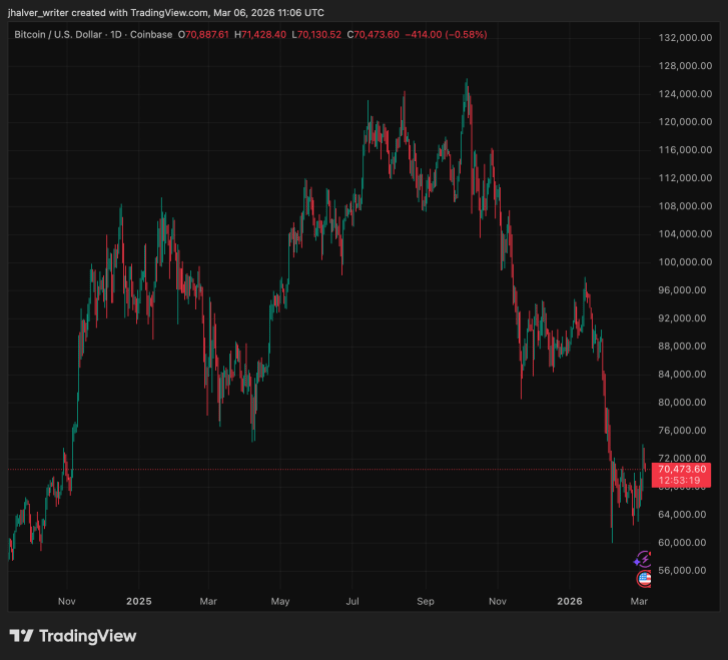
BTC's price trends to the downside on the daily chart. Source: BTCUSD on Tradingview

Cover image from ChatGPT, BTCUSD chart from Tradingview

Perguntas relacionadas

QWhat is the Bank of Russia's new proposal regarding cryptocurrency exchanges?

AThe Bank of Russia has proposed allowing banks and brokerage firms to obtain licenses to operate crypto exchanges through a notification process based on their existing licenses.

QWhat is the primary reason given by Governor Elvira Nabiullina for this new crypto proposal?

AThe proposal aims to leverage the banking sector's infrastructure for anti-money laundering (AML) and countering the financing of terrorism and fraud (CFT) to better protect clients in the digital assets market.

QHow would crypto assets be treated under the draft rules, and what key restriction remains?

ACrypto and stablecoins would be treated as 'currency valuables,' meaning Russians can own and trade them, but using them as a domestic means of payment would remain restricted.

QWhat risk limitation does the Central Bank propose for banks involved in crypto assets?

AThe Central Bank proposes to limit the level of risk a bank takes in this area to one percent of its capital as a temporary measure.

QHow has Russia's overall stance on cryptocurrency evolved from 2020 to the present, according to the article?

ARussia has evolved from recognizing digital assets as property but banning them as payment in 2020, to flirting with a full ban in 2022, and then shifting to a 'regulate, don't ban' approach. By 2024-2025, it allowed limited cross-border use, legalized mining, and is now opening the market to banks and qualified investors to pull activity onshore and tax it.

Leituras Relacionadas

Winter for Crypto IPOs: Consensys and Ledger Withdraw Applications

The crypto IPO window is tightening significantly in 2026, marked by prominent companies delaying or pausing their public listing plans. Following a successful 2025 "harvest year" that saw Circle, Bullish, and Gemini go public amidst a bull market, the tide has turned. Consensys, developer of MetaMask, recently postponed its IPO until at least fall 2026. Hardware wallet leader Ledger also suspended its planned US listing due to unfavorable market conditions, with Kraken having previously delayed its own plans. This shift is driven by a cooling market in 2026, characterized by a significant Bitcoin price correction, declining trading volumes, and reduced investor risk appetite for crypto stocks. The poor post-IPO performance of 2025 listings like Circle and Bullish, which saw major share price declines, has heightened investor caution. This contrasts sharply with the current AI sector, where companies like SpaceX, OpenAI, and Anthropic are commanding massive valuations and investor enthusiasm based on narratives of stable, exponential growth. Crypto companies now face pressure to transition from hype-driven models to demonstrating reliable cash flows and robust compliance. While the paused IPO plans may lead to valuation resets and affect ecosystem liquidity, they also accelerate industry consolidation toward stronger, more compliant infrastructure players. A potential recovery in Bitcoin's price and clearer regulations could reopen the IPO window in the latter half of 2026.

marsbitHá 1h

Winter for Crypto IPOs: Consensys and Ledger Withdraw Applications

marsbitHá 1h

ChatGPT Can Manage Your Money for You. Would You Trust It with Your Bank Account?

OpenAI has launched a personal finance tool for ChatGPT, currently in preview for US-based ChatGPT Pro users. This feature allows users to connect their bank and investment accounts (via Plaid, supporting over 12,000 institutions) directly to ChatGPT. It analyzes transactions, generates visual dashboards, and offers conversational financial advice—such as budgeting or planning for major purchases—based on the user's actual data. This move follows OpenAI's acquisitions of fintech startups Roi and Hiro Finance, signaling a strategic push into vertical "super assistant" applications, similar to its earlier health-focused feature. However, the launch has sparked significant privacy concerns. Critics question the safety of granting such sensitive financial access to an AI, especially amid ongoing lawsuits alleging OpenAI shared user chat data with third parties like Meta and Google. OpenAI emphasizes that ChatGPT only reads data (no transaction capabilities), deletes it within 30 days if disconnected, and offers opt-out options for model training. Yet, trust remains a major hurdle. The trend reflects a broader industry shift: AI companies like Anthropic and Perplexity are also targeting high-value, data-rich domains like finance and health. While technically promising, the tool operates in a regulatory gray area—it provides personalized guidance but disclaims formal financial advice or liability. Ultimately, OpenAI's challenge is convincing users to trust an AI with their most private financial information.

marsbitHá 1h

ChatGPT Can Manage Your Money for You. Would You Trust It with Your Bank Account?

marsbitHá 1h

Trading

Spot
Futuros

Artigos em Destaque

Como comprar BAN

Bem-vindo à HTX.com!Tornámos a compra de Comedian (BAN) simples e conveniente.Segue o nosso guia passo a passo para iniciar a tua jornada no mundo das criptos.Passo 1: cria a tua conta HTXUtiliza o teu e-mail ou número de telefone para te inscreveres numa conta gratuita na HTX.Desfruta de um processo de inscrição sem complicações e desbloqueia todas as funcionalidades.Obter a minha contaPasso 2: vai para Comprar Cripto e escolhe o teu método de pagamentoCartão de crédito/débito: usa o teu visa ou mastercard para comprar Comedian (BAN) instantaneamente.Saldo: usa os fundos da tua conta HTX para transacionar sem problemas.Terceiros: adicionamos métodos de pagamento populares, como Google Pay e Apple Pay, para aumentar a conveniência.P2P: transaciona diretamente com outros utilizadores na HTX.Mercado de balcão (OTC): oferecemos serviços personalizados e taxas de câmbio competitivas para os traders.Passo 3: armazena teu Comedian (BAN)Depois de comprar o teu Comedian (BAN), armazena-o na tua conta HTX.Alternativamente, podes enviá-lo para outro lugar através de transferência blockchain ou usá-lo para transacionar outras criptomoedas.Passo 4: transaciona Comedian (BAN)Transaciona facilmente Comedian (BAN) no mercado à vista da HTX.Acede simplesmente à tua conta, seleciona o teu par de trading, executa as tuas transações e monitoriza em tempo real.Oferecemos uma experiência de fácil utilização tanto para principiantes como para traders experientes.

557 Visualizações TotaisPublicado em {updateTime}Atualizado em 2025.03.21

Como comprar BAN

Discussões

Bem-vindo à Comunidade HTX. Aqui, pode manter-se informado sobre os mais recentes desenvolvimentos da plataforma e obter acesso a análises profissionais de mercado. As opiniões dos utilizadores sobre o preço de BAN (BAN) são apresentadas abaixo.

活动图片













