From $5 Billion Market Cap to the Brink of Delisting: Canan, the 'Blockchain Stock', Can No Longer Sell Its 'Shovels'?

marsbitPublicado em 2026-01-28Última atualização em 2026-01-28

Resumo

JiaNan Technology, once hailed as the "first blockchain stock," faces potential delisting from Nasdaq after receiving a notice on January 14, 2026, due to its stock trading below $1 for 30 consecutive days. The company has 180 days to regain compliance, possibly through a reverse stock split. This marks the second such warning in a year. As a major Bitcoin mining machine manufacturer, JiaNan’s market position has weakened amid intense competition, with its share dropping to 10-15% as MicroBT gained traction. From 2021 to 2024, its net profit plummeted from over $300 million to a loss of nearly $250 million, driven by inventory devaluation, high R&D costs, and shrinking demand. Despite an early move into AI chips—launching its first model in 2018—JiaNan struggled to compete with giants like NVIDIA, generating only $900,000 in AI revenue in 2024. The company shut down its non-core AI division in mid-2025 after failing to find a buyer. While JiaNan secured a large mining equipment order and $72 million in funding in late 2025, the broader market shift from cryptocurrency to AI investment continues to challenge its business model. The company’s story reflects wider struggles in the crypto hardware sector, where stagnant growth and fierce competition have led to declining valuations.

On January 16, 2026, Canan Technology announced that it had received a notice from the Nasdaq exchange on January 14. The notice indicated that Canan's stock price had been below $1 for the past 30 consecutive trading days, resulting in a warning. According to Nasdaq listing rules, if Canan cannot bring its stock price back to $1 or above within 180 days (by July 13, 2026), it may face delisting.

Canan Technology stated that, if necessary, the company will implement a reverse stock split to meet the requirement. A reverse stock split is an operation that reduces the total number of outstanding shares by consolidating existing shares, thereby increasing the price per share. The author contacted Canan Technology regarding the warning, but had not received a response by the time of publication.

This is the second delisting warning Canan has received in the past year. The first was in May 2025, after which the stock price rose above $1 due to an increase in Bitcoin's price, temporarily averting the crisis. However, the overall downturn in the cryptocurrency market in recent months has caused Canan's stock price to fall nearly 30% over the past 30 trading days.

On December 13, 2025, Bitcoin treasury company Kindly MD received a warning for the same reason, while BNB treasury company Windtree Therapeutics was delisted in August 2025. Unlike cryptocurrency treasury companies, as one of the leading players in the Bitcoin mining machine manufacturing sector, Canan's current situation is somewhat lamentable.

Canan Technology went public on the Nasdaq in November 2019, becoming the world's first pure blockchain concept company to complete an IPO. After listing, Canan's stock price remained below its IPO price for over a year. However, with the arrival of the cryptocurrency bull market, its stock price began to recover steadily from the end of 2020, reaching a historical high of nearly $40 in March 2021, with a market capitalization exceeding $5 billion.
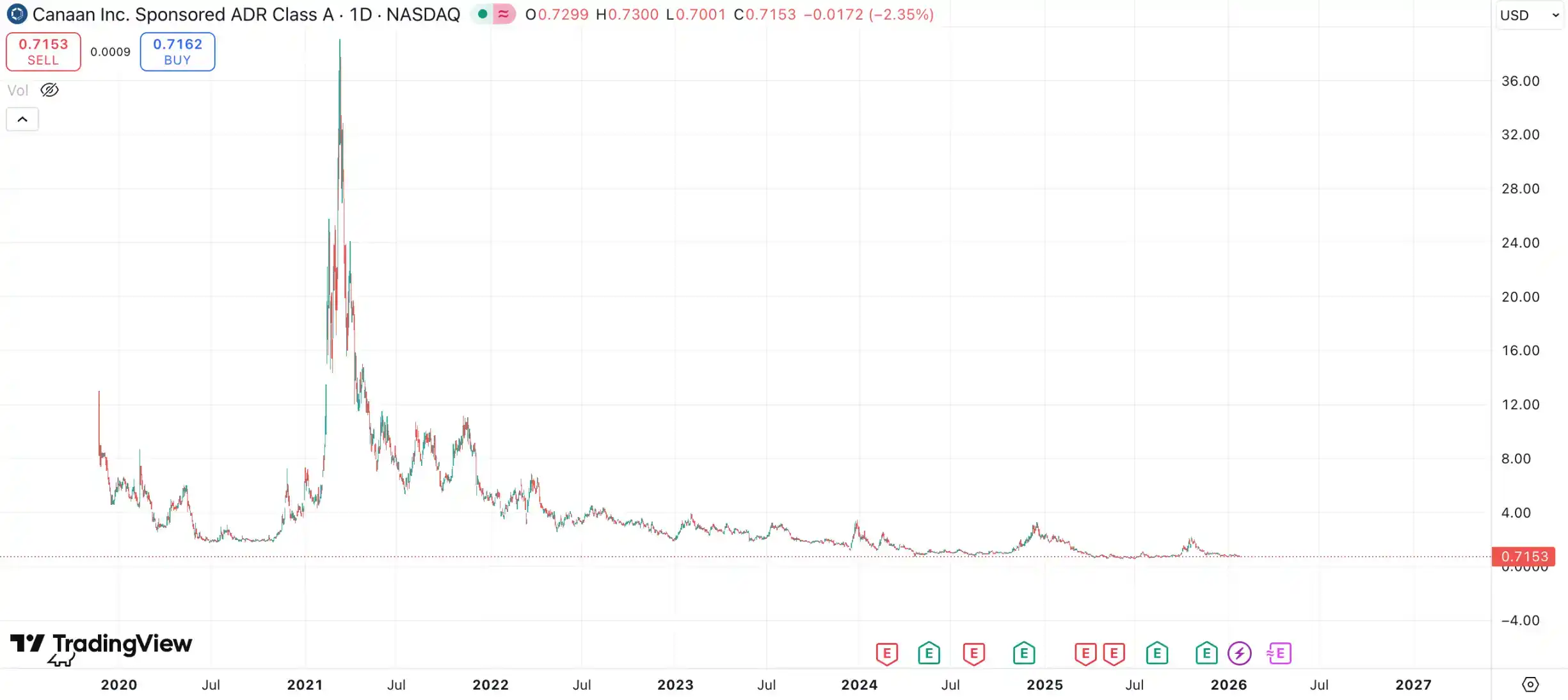
The good times did not last long. With the issuance of China's mining ban and the bear market that persisted throughout 2022, Canan's stock price continued to decline, returning to pre-bull market levels. In the current cycle, although Bitcoin's price reached new highs, even nearly double its 2021 peak at one point, Canan's stock price did not rise but instead fell, dropping below $1 for the first time in April 2024.

Aside from objective market conditions, the industry and Canan itself are also contributing factors to its poor performance in the capital markets.

In the Bitcoin mining machine market, Bitmain is the absolute leader. Canan consistently held the second position until 2021, when MicroBT rapidly rose to prominence with higher power efficiency, pushing Canan to third place. According to a report released by Intel Market Research in December 2025, MicroBT holds a market share of 15% to 20%, while Canan holds 10% to 15%.
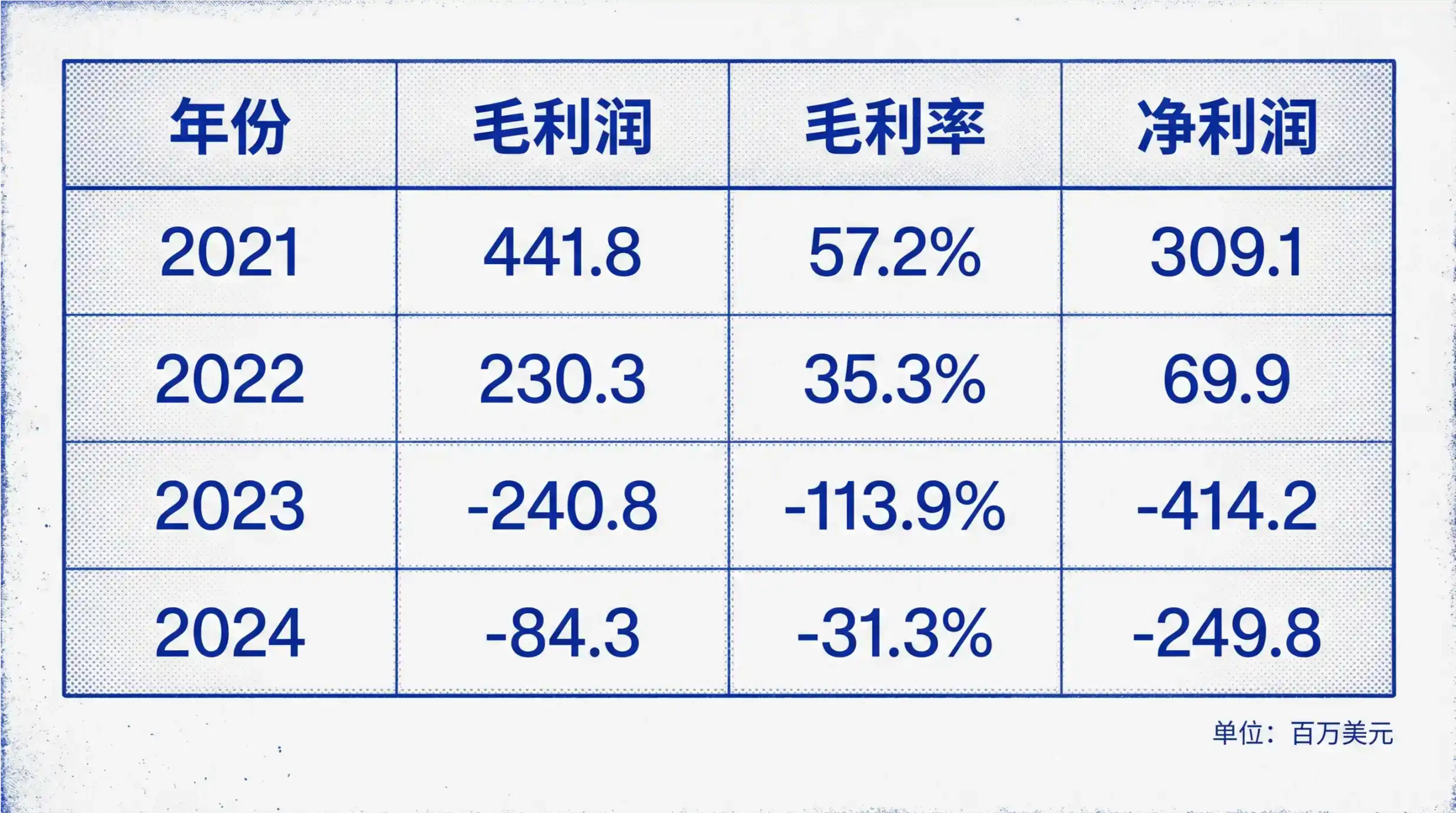
Canan's annual reports from 2021 to 2024 show a continuous decline in net profit over the four years, from earning over $300 million in 2021 to a loss of nearly $250 million in 2024. The reasons include inventory write-downs due to the 2022 bear market, which impacted profits, and fierce competition that kept R&D expenses and operating costs high without effectively increasing market share.

Amid these multiple challenges, a sharp drop in demand became the final straw. According to analysis by MSX researcher Frank, the overhyped expectations of Bitcoin mining narratives and visibly intensifying competition have led many Bitcoin mining companies to transition to AI computing infrastructure. Although "selling shovels" has always been a solid business model, in the current capital market, the Bitcoin story clearly lacks the certainty of AI, and capital has naturally voted with its feet, shifting toward AI-related companies.

In fact, Canan began developing AI chips nearly a decade ago. In 2018, it launched its first commercial edge AI chip based on the RISC-V architecture, the Kendryte K210, designed for edge computing and supporting AI vision and audio processing. Over the next six years, Canan released three more chips, each with significant innovations built on the previous generation.
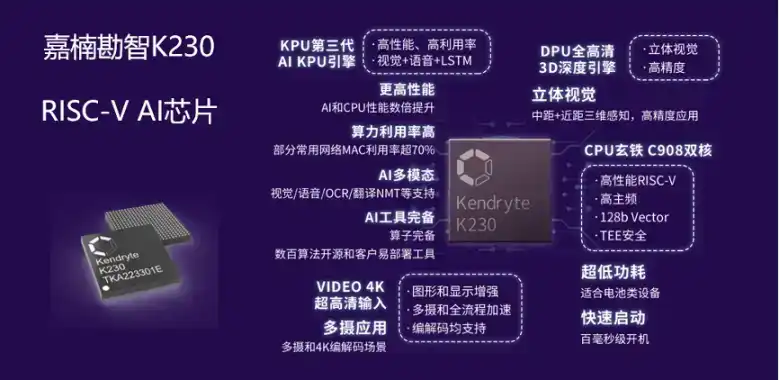
Although Canan's chips had technical highlights and an early start, they lacked the ecosystem support and large-scale demand compared to giants like NVIDIA and Intel. In 2024, its AI-related business revenue was only about $900,000, while operating expenses accounted for 15% of the entire company. In June 2025, Canan announced it would discontinue non-core AI semiconductor operations and shut down its AI chip division. The related announcement stated that the company had been exploring the sale of its AI business since March 2022 but failed to find a buyer, ultimately deciding to abandon it to focus on crypto mining machines and the North American market.

Canan Technology is a microcosm of the实体业务 (physical business) in the Web3 industry. Another listed Bitcoin mining machine manufacturer, Ebang International, has seen its stock price fall from nearly $450 at its 2020 peak to around $3, a drop of over 99%. For hardware manufacturers, there is a mature and fixed valuation model. If the industry they are in shows no clear growth prospects, it is easy to fall into a vicious cycle.

On a positive note, in late 2025, Canan first signed a large order for 4.5 MV in October, followed by completing a $72 million financing round in November. Clearly, there are still those in the market who believe that the former "Pumpkin Zhang" can overcome its difficulties. But to break free from its predicament, Canan Technology may need a new story.


Perguntas relacionadas

QWhy did Canaan Creative receive a delisting warning from Nasdaq in January 2026?

ACanaan Creative received a delisting warning because its stock price had been below $1 for 30 consecutive trading days, violating Nasdaq's listing rules.

QWhat was Canaan Creative's peak market capitalization, and how does it compare to its current situation?

ACanaan Creative's market capitalization peaked at over $5 billion in March 2021 when its stock price reached nearly $40. Currently, it faces potential delisting due to its stock trading below $1.

QWhat are the main reasons for Canaan Creative's financial decline from 2021 to 2024?

ACanaan's financial decline was due to the 2022 bear market causing inventory write-downs, intense competition leading to high R&D and operational costs without market share growth, and a sharp drop in demand.

QWhy did Canaan Creative decide to shut down its AI chip business in 2025?

ACanaan shut down its non-core AI semiconductor business due to a lack of ecosystem support, insufficient large-scale demand (only $900,000 in AI revenue in 2024), and high operational costs, after failing to find a buyer for the division.

QWhat recent developments indicate that some investors still have faith in Canaan Creative's future?

AIn late 2025, Canaan secured a large order for 4.5 megavolts of mining equipment and completed a $72 million financing round, showing that some investors believe the company can overcome its challenges.

Leituras Relacionadas

The AI Agent Era Accelerates Its Arrival: Questflow Defines a New Paradigm of Financial Intelligence with On-Chain AI Brokerage

The AI Agent era is accelerating, with the CB Insights AI 100 list highlighting global investment confidence. The focus has shifted from whether AI works to its speed of deployment and ability to manage complex workflows, with autonomous AI Agents driving this transformation. At the forefront is Questflow, a Singapore-based startup redefining financial intelligence through its on-chain AI brokerage. Unlike tools that merely provide data dashboards, Questflow deploys AI Agents that proactively scan markets, form judgments, and execute trades via a conversational interface—operating 24/7 without requiring manual confirmation for each decision. This embodies the new AI paradigm of agents capable of executing multi-step workflows autonomously. Questflow's mission is to democratize institutional-grade trading intelligence. Historically reserved for the ultra-wealthy, this capability is now accessible starting from just $1 through Questflow's "AI Clone + Copy Trade" model. The platform charges only a 1% execution fee, aligning its incentives directly with users and eliminating traditional management or performance fees. The timing is opportune, aligning with key trends identified by CB Insights: the scalable deployment of AI Agents, accelerated AI adoption in financial services, and the maturation of on-chain infrastructure. With robust liquidity on platforms like Hyperliquid and Polymarket, alongside advancements in AI reasoning and non-custodial wallet security, Questflow is positioned to merge the roles of broker, fund, and exchange into a single, accessible platform for millions.

链捕手Há 21m

The AI Agent Era Accelerates Its Arrival: Questflow Defines a New Paradigm of Financial Intelligence with On-Chain AI Brokerage

链捕手Há 21m

Why Pricing Social Interactions is Doomed to Fail?

Titled "Why Putting a Price on Social Interaction Is Doomed to Fail," this article critiques attempts to monetize social networks directly through SocialFi models, arguing their inevitable failure stems from a fundamental misunderstanding of media dynamics. Using Marshall McLuhan's theory of "hot" and "cold" media, the author posits that social networks are inherently "cold" media. Their value isn't contained in individual posts but is co-created through user participation, interpretation, and fragmented, ongoing interaction (e.g., replies, shares). This ambiguity and need for user involvement are core to their function. The article asserts that SocialFi projects like Friend.tech failed because introducing real-time, tradable financial pricing (a definitive "hot" signal) into this "cold" environment doesn't add a layer—it replaces the medium's essence. The unambiguous price signal overshadows and nullifies the nuanced, participatory social signal. Users become traders, not participants, and when speculative profits vanish, the underlying social ecosystem—never genuinely cultivated—collapses entirely. This principle extends beyond crypto. The author argues platforms like Twitter have gradually "heated up" through metrics (likes, retweets counts, algorithmically defined value), shifting users from participants to performers and eroding organic engagement. The solution isn't to abandon capital but to manage its entry point. Successful models like Substack, Patreon, or Bandcamp allow capital to "condense" at specific, isolated nodes (e.g., subscriptions, one-time payments) without permeating and "heating" every social interaction. They preserve the core "cold," participatory medium while enabling monetization at designated boundaries. The NFT boom and bust serves as a stark parallel: the ancient "cold" medium of collecting (valued for story, community, gradual accumulation) was rapidly destroyed by platforms that introduced real-time floor prices, rarity scores, and trading dashboards, transforming collectors into speculators and vaporizing cultural value when prices fell. The core lesson: "Liquidity equals heat." Injecting high liquidity and definitive pricing into a "cold" participatory medium doesn't optimize it; it fundamentally alters and destroys its value-creating mechanism. The future lies not in pricing every social gesture but in finding precise, non-invasive points for capital to condense without overheating the entire ecosystem.

marsbitHá 29m

Why Pricing Social Interactions is Doomed to Fail?

marsbitHá 29m

Jensen Huang's CMU Speech: In the AI Era, Don't Just Watch, Build

Jensen Huang, CEO of NVIDIA and a first-generation immigrant, delivered the commencement address to Carnegie Mellon University's class of 2026. He shared his personal journey from a humble background to founding NVIDIA, emphasizing resilience, learning from failure, and the responsibility that comes with leadership. Huang framed the present moment as the dawn of the AI revolution, a shift he believes is more profound than previous computing waves. He described AI as fundamentally resetting computing—moving from human-written software to machines that understand, reason, and use tools. This will create a new industry for generating intelligence and transform every sector. While acknowledging AI's potential to automate tasks and displace some jobs, Huang distinguished between the *tasks* of a job and its core *purpose*. He argued AI will augment human capability, not replace humans. The real risk, he stated, is not AI itself, but people being left behind by those who effectively use AI. He presented AI as a generational opportunity for massive infrastructure investment—in chip factories, data centers, energy grids, and advanced manufacturing—that could re-industrialize nations like the U.S. and bridge the digital divide by making computing and intelligent tools accessible to all. Huang called for a balanced approach: advancing AI safely and responsibly, establishing prudent policies, ensuring broad access, and encouraging universal participation. He urged the graduates not to fear the future but to engage with optimism and ambition, reminding them of CMU's motto, "My heart is in the work." His core message was clear: this is their moment to actively build and shape the AI-powered future, not merely observe it.

marsbitHá 1h

Jensen Huang's CMU Speech: In the AI Era, Don't Just Watch, Build

marsbitHá 1h

Trading

Spot
Futuros
活动图片




