Fortune Investigates Binance's Iran Fund Flow: $439 Million Chinese VIP Accounts Surface

marsbitPublicado em 2026-03-14Última atualização em 2026-03-14

Resumo

Binance, the world's largest cryptocurrency exchange, is facing renewed scrutiny over its compliance practices following a Fortune investigation. The report reveals that a VIP account, registered under the name of a 79-year-old Chinese resident, transferred $439 million in Tether stablecoins to external wallets. These funds were subsequently moved to wallets linked to Iranian entities, including the Islamic Revolutionary Guard Corps. Despite Binance's $4.3 billion plea deal with the U.S. government in 2023, which it committed to strengthen its compliance programs, these massive transactions did not trigger immediate alerts. A second Chinese VIP account, held by a 38-year-old woman, transferred nearly $200 million to the same Iranian-linked network. Internal investigators found that both accounts were likely accessed from the same device, suggesting possible common control. The funds were funneled through a Hong Kong-based entity, Blessed Trust, which also handled back-office operations for Binance. The exchange has denied that internal investigators were fired for uncovering these activities, stating their departures were due to violations of data policies. The U.S. Department of Justice is reportedly investigating whether Iran used Binance to evade sanctions, though the exchange says it is unaware of any such probe. These findings have prompted a U.S. Senate investigation and raised serious questions about the effectiveness of Binance's compliance program.

Author: Fortune

Compiled by: Deep Tide TechFlow

Deep Tide Introduction: This article is compiled from Fortune's investigative report on March 12. Readers are reminded to note the following background:

Since February this year, Western media outlets including Fortune, The Wall Street Journal, and The New York Times have reported that Binance's internal investigators discovered over $1 billion in funds flowing to entities linked to Iran, and were subsequently fired.

Binance denied firing employees due to compliance whistleblowing, stating that the departures were due to violations of internal data protection policies. On March 11, Binance filed a defamation lawsuit against The Wall Street Journal, demanding a retraction of the related reports.

Concurrently, Binance won two civil lawsuits filed under the U.S. Anti-Terrorism Act—federal courts in the Southern District of New York and Alabama dismissed all claims from the plaintiffs. However, these cases were civil claims by victims' families, which belong to a different legal category than the sanctions compliance disputes discussed in this article.

This article was written by Fortune author Leo Schwartz, who for the first time disclosed specific details of two Chinese VIP accounts: an account under the name of a 79-year-old individual transferred out $439 million, and the two accounts were suspected of sharing the same device.

Binance's stance is: platform accounts did not directly trade with sanctioned entities; the suspicious activity was discovered by Binance itself and reported to law enforcement agencies; the involved accounts have been taken offline. Currently, the U.S. Department of Justice is investigating whether Iran used Binance to evade sanctions, but it is unclear whether Binance itself is the target of the investigation.

Below is the full compilation of the Fortune article:

In early 2025, the embattled Iranian regime increasingly relied on cryptocurrency to circumvent economic sanctions. During this period, a VIP account on the Binance platform, registered under the name of a 79-year-old Chinese resident, transferred $439 million worth of digital tokens from the exchange to external wallets through a series of transactions. These wallets subsequently transferred most of the funds to other wallets—which Binance's internal investigators later identified as being associated with Iranian sanctioned entities, including the Islamic Revolutionary Guard Corps.

As noted in documents reviewed by Fortune, the transfer of hundreds of millions of dollars by an elderly individual was itself highly suspicious. More concerning was that the transactions involved transferring Tether stablecoins on the Tron blockchain—a preferred payment method for cybercriminals and money launderers.

Surprisingly, however, these transfers did not trigger any immediate alerts at Binance. This was despite Binance having reached a $4.3 billion plea agreement with the U.S. government in late 2023, promising to implement a series of stringent compliance procedures.

Amanda Wick, Head of Americas at crypto compliance software firm VerifyVASP and a former federal prosecutor, stated after learning the details of these transactions from Fortune: "This is not just a red flag; it's a trigger event that requires immediate reporting."

The details of this VIP account had not been publicly disclosed before, and its emergence is particularly sensitive for Binance. In February, a series of media reports revealed that Binance had dismissed internal investigators who had reported to senior management—these individuals had discovered that over $1 billion in funds flowed through the platform to wallets linked to Iran, and that a close business partner of Binance—a Hong Kong-based entity responsible for arranging conversions between cryptocurrency and fiat currency—was also involved in these transfers.

These reports have prompted an investigation by the U.S. Senate. Binance responded that the investigators' departures were unrelated to the discovery of Iranian transfers and that the company has been adhering to its 2023 compliance commitments. However, new details involving Chinese and Iranian accounts have again raised doubts about the effectiveness of this compliance program.

Binance did not deny the specific methods investigators used to trace the fund flows. The exchange defended the platform's handling of the违规 (non-compliant) transactions and stated that its compliance program is functioning normally. Meanwhile, according to The Wall Street Journal, the Department of Justice is investigating whether Iran used Binance to evade sanctions. A Binance spokesperson said the exchange is unaware of any such investigation. A DOJ spokesperson declined to comment.

Binance Chief Compliance Officer Noah Perlman said in a statement provided to Fortune: "Binance's compliance program is continuously improving and evolving, with the goal of constantly strengthening and preventing issues from recurring."

China-Linked Network

Like traditional financial institutions, crypto exchanges have specialized compliance procedures to verify user identities and screen for illegal activities. In a February blog post, Binance stated that its compliance program has nearly 600 full-time employees and is "industry-leading."

As part of this process, Binance required this 79-year-old Chinese man to upload identification documents to open a VIP account. (A Binance spokesperson said VIP status is automatically granted based on asset holdings and trading volume.) It was through this ID that the exchange's internal investigators ultimately determined that he had indirectly transferred approximately $400 million to a previously unidentified group of Iran-linked wallets outside Binance—which investigators referred to as "Entity A." Former prosecutor Wick said this type of activity should have been automatically flagged by the system.

"If nearly half a billion dollars moves from a customer account to a single non-custodial wallet and then quickly flows to wallets associated with a sanctioned jurisdiction... this is exactly the type of activity a compliance team should capture," she said.

However, Binance allowed this VIP account to trade freely for months. These transactions, which began in January 2025, were not flagged by the compliance department until August 11 of that year, after Seychelles law enforcement submitted a request to Binance regarding "a serious terrorism financing case." A Binance spokesperson told Fortune that the 79-year-old VIP user's account was blocked in September 2025 and fully taken offline by January 2026.

Other compliance experts expressed surprise that Binance did not handle the account more quickly. Robert Appleton, a partner at law firm Olshan and former head of the Iran sanctions task force at the DOJ, told Fortune that especially given Binance's checkered past and previous legal troubles over sanctions evasion, he would have expected the exchange to be more vigilant about any form of suspicious activity. "The agreement with the government changes everything because it raises their obligations," he said.

Meanwhile, the $439 million transfer in the name of this Chinese elderly individual was only part of the Iran-related activity. Documents reviewed by Fortune show that former Binance employees discovered in their investigation that the Iran-linked wallet cluster, referred to as "Entity A," received a total of $1.7 billion from companies and individuals holding Binance accounts. "Entity A" then transferred part of these funds to Nobitex, Iran's largest cryptocurrency exchange, and to digital wallets associated with U.S.-designated terrorist organizations such as the Islamic Revolutionary Guard Corps and the Houthis). The Binance spokesperson said that at the time of the transactions, none of these wallets were on sanctions lists maintained by global law enforcement agencies, so they did not trigger any alerts.

Although the wallets controlled by "Entity A" and related sanctioned entities were not on the Binance platform, crypto compliance experts told Fortune that the nature of the funds flowing out of Binance itself should have raised alarms.

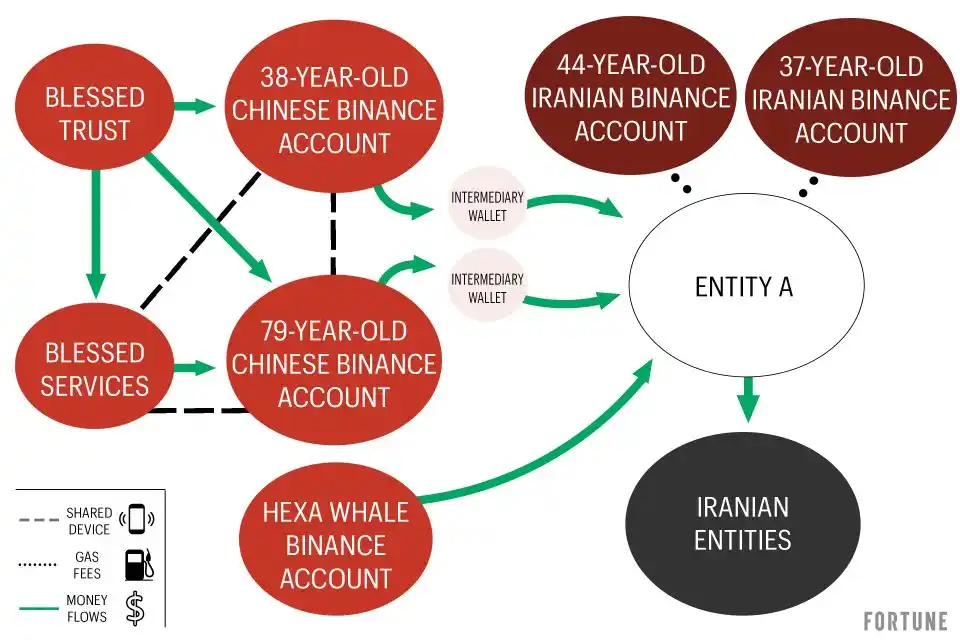
After receiving the request from Seychelles, Binance investigators opened a case and subsequently characterized this series of fund flows as part of a "China-Linked Network"—which also involved another VIP trader. This VIP client was a 38-year-old Chinese woman who transferred nearly $200 million in Tether stablecoins to an intermediate wallet between November and December 2024, which then transferred the funds to "Entity A." (The Binance spokesperson said the term "China-Linked Network" was "an internal, informal designation, not precise, and may have evolved over time," and stated that this VIP account was also taken offline by January 2026.)

More intriguingly, documents reviewed by Fortune indicate that these two VIP accounts were highly likely accessed from the same device—suggesting that the same person, or a third-party entity, might have controlled both accounts. Wick said: "If two ostensibly unrelated VIP clients are found accessing their accounts from the same device, it raises serious questions about beneficial ownership."

In any case, investigators found from blockchain data that both accounts had received funds from Blessed Trust. Blessed Trust is a Hong Kong-based enterprise that helps companies convert crypto funds into fiat currency and also handles back-office tasks like payroll and taxes for Binance. Investigators ultimately concluded that of the total $1.2 billion flowing through Blessed Trust into "Entity A," approximately half came from these two Chinese VIP traders.

Binance attempted to downplay the connection between the platform accounts and the Iran-linked wallets, stating in a recent blog post that there were multiple intermediaries between the exchange and the sanctioned wallets. The post also noted that $1.1 billion of the funds originated from "a large, regulated stablecoin issuer." Investigators concluded in their findings that most of the funds from the two Chinese VIP accounts likely came from stablecoins issued by Circle—a U.S.-listed crypto company. A Circle spokesperson told Fortune: "We take our regulatory obligations seriously," adding that Circle had designated Blessed Trust for termination in 2025.

However, Binance, in its blog post and responses to Fortune and other media, consistently avoided addressing the specific details of these two Chinese VIP accounts on its platform. Furthermore, investigators also found that these two accounts and Blessed Services (another company related to Blessed Trust, which was intermediary in the fund flow to "Entity A") also shared the same device. This evidence suggests the same group might have operated all these accounts. The Binance spokesperson declined to comment on the device-sharing details and stated that Blessed Services has no business relationship with the exchange.

Email addresses associated with Blessed Trust and Blessed Services did not respond to Fortune's requests for comment.

The "China-Linked Network" involved one final link: a Hong Kong-registered company, Hexa Whale Trading Limited, which operated on the Binance platform and transferred approximately $500 million to "Entity A." By the time Binance investigators discovered Hexa Whale's activity, other members of the company's compliance team had already taken the account offline. The Wall Street Journal and The New York Times had previously reported details related to Hexa Whale and Blessed Trust.

Fortune's attempts to contact Hexa Whale and the two Chinese VIP users were unsuccessful.

The investigators involved in the preliminary report were fired by Binance weeks after submitting their initial findings. Binance denied that these employees were dismissed for raising compliance issues and stated in a blog post that the departure of some personnel was decided "after an internal review found violations of company data protection and confidentiality policies." The exchange insisted that it continued the relevant investigation and completed the takedown of Blessed Trust in January 2026.

The investigators declined to comment.
Iran-Linked Clues

Another, smaller set of transaction records also caught the investigators' attention. These transactions were operated by two individuals suspected of Iranian nationality. Compliance experts stated that the mere fact that these two individuals were able to successfully open accounts on Binance and complete transfers already raises questions about the strictness of the company's screening procedures.

The first account was opened in 2021, held by a 44-year-old male whose Dominica ID indicated Iran as his place of birth, and whose name appeared in a 2020 UN Security Council report—a report concerning a gold and cash smuggling network serving Iran and North Korea. The second account was also opened in 2021, held by a 37-year-old male whose uploaded Iraqi ID also indicated Iran as his place of birth. By the time Binance investigators discovered these accounts, they had already been restricted.

The relevant transactions included: each of the two accounts transferring around $100 worth of TRX cryptocurrency to the Iran-linked wallet cluster in 2024—TRX is the native currency used to pay transaction fees on the Tron blockchain. Although the total amount was negligible, this TRX transfer was significant because it likely paid the fees for transfers between the "Entity A" wallet cluster. This situation is roughly analogous to tracking credit card records used to pay for car fuel: if the same card repeatedly pays for gas, it doesn't tell you who is driving, but it can reveal who is footing the bill for the journey.

Lex Fisun, Co-founder and CEO of blockchain analytics firm Global Ledger, said: "Most people only look at large transactions, but small transactions are equally important. On the blockchain, you often can't link a wallet to a real identity. However, when an address repeatedly sends TRX to another wallet to pay fees, it indicates a connection between the two."

Furthermore, Wick pointed out that the association of these accounts with Iran should have triggered more immediate scrutiny. After all, Binance had already pleaded guilty for similar transactions and promised to eradicate such behavior on its platform.

"When multiple high-risk indicators appear simultaneously—especially involving a heavily sanctioned jurisdiction like Iran, or individuals appearing in UN Security Council reports—a properly functioning compliance program should report in real-time," she said. "Account restrictions, enhanced due diligence, blockchain tracing, sanctions risk assessments, these measures should be triggered immediately when the issue occurs, not months later."

The Binance spokesperson said one of the Iranian accounts has been completely taken offline, and the other has been restricted from trading and is in the process of being taken offline. The exchange did not specify whether these accounts were restricted at the time the transactions occurred.

Fortune's attempts to contact the two relevant individuals were unsuccessful.

Exposure to sanctioned entities is a significant risk for any financial institution, and Binance has already paid a heavy price for it. In 2023, it reached a $4.3 billion plea agreement with the U.S. government, partly for failing to maintain an effective anti-money laundering and sanctions compliance program.

Under the plea agreement, co-founder Changpeng Zhao stepped down as CEO and spent four months in federal prison. Binance also agreed to cooperate with a monitor reporting to the Justice and Treasury Departments on its internal operations.

However, the recent dismissal of investigators and the potential Iranian exposure have raised concerns among members of Congress. In late February, Senator Richard Blumenthal (D-Conn.) launched a preliminary investigation into Binance and sent a letter to co-CEO Richard Teng requesting information on the findings of the dismissed investigators and other Iran-related activities.

Blumenthal also specifically mentioned President Trump's pardon of Changpeng Zhao in October—a move that raised conflict-of-interest allegations due to Binance's increasingly close ties to the Trump family's cryptocurrency business.

A White House spokesperson told Fortune: "President Trump's assets are held in a trust managed by his children, and there is no conflict of interest."

However, Blumenthal told Fortune that Binance's connection to the White House presents ongoing ethical concerns: "One of my biggest concerns is that the relationship between Binance and the administration could deter or discourage compliance monitors from exposing and reporting violations, or could hinder the Justice Department from pursuing prosecution."


Perguntas relacionadas

QWhat were the key findings of the Fortune investigation regarding Binance's VIP accounts linked to Iran?

AThe investigation revealed that a VIP account under the name of a 79-year-old Chinese resident transferred $439 million in digital tokens to external wallets, which were later linked to Iranian sanctioned entities, including the Islamic Revolutionary Guard Corps. Another VIP account, a 38-year-old Chinese woman, transferred nearly $200 million in Tether to the same network. Both accounts were suspected of being accessed from the same device, indicating potential common control.

QHow did Binance respond to the allegations of facilitating transactions linked to Iranian sanctions?

ABinance denied that employees were fired for compliance reporting, attributing their departures to violations of internal data protection policies. The exchange stated that its compliance program is continuously improving and that it had offboarded the involved accounts. Binance also filed a defamation lawsuit against The Wall Street Journal for related articles and emphasized that the sanctioned wallets were not on its platform at the time of transactions.

QWhat role did Blessed Trust and Hexa Whale Trading Limited play in the transactions?

ABlessed Trust, a Hong Kong-based entity, facilitated the conversion of crypto to fiat and handled backend operations for Binance. It was involved in transferring $1.2 billion to the Iranian-linked 'Entity A,' with about half originating from the two Chinese VIP accounts. Hexa Whale Trading Limited, another Hong Kong-registered firm, transferred approximately $500 million to Entity A. Both entities were part of the 'China-linked network' identified by investigators.

QWhat were the compliance failures highlighted in the investigation?

AThe investigation pointed out that Binance's compliance systems failed to automatically flag suspicious activities, such as large transfers to wallets linked to sanctioned jurisdictions, despite the 2023 plea agreement with the U.S. government. The exchange did not restrict the VIP accounts until months after the transactions, and it missed red flags like accounts with Iranian identifiers transferring small amounts of TRX to pay for transaction fees related to Entity A.

QWhat broader implications did the investigation have, including U.S. government actions?

AThe findings prompted a U.S. Senate investigation led by Senator Richard Blumenthal, who expressed concerns about Binance's compliance and potential conflicts of interest due to its ties with the Trump administration following the pardon of former CEO Changpeng Zhao. The U.S. Department of Justice is also investigating whether Iran used Binance to evade sanctions, though Binance claims no knowledge of such an investigation.

Leituras Relacionadas

Trading

Spot
Futuros

Artigos em Destaque

O que é $S$

Compreender o SPERO: Uma Visão Abrangente Introdução ao SPERO À medida que o panorama da inovação continua a evoluir, o surgimento de tecnologias web3 e projetos de criptomoeda desempenha um papel fundamental na formação do futuro digital. Um projeto que tem atraído atenção neste campo dinâmico é o SPERO, denotado como SPERO,$$s$. Este artigo tem como objetivo reunir e apresentar informações detalhadas sobre o SPERO, para ajudar entusiastas e investidores a compreender as suas bases, objetivos e inovações nos domínios web3 e cripto. O que é o SPERO,$$s$? O SPERO,$$s$ é um projeto único dentro do espaço cripto que procura aproveitar os princípios da descentralização e da tecnologia blockchain para criar um ecossistema que promove o envolvimento, a utilidade e a inclusão financeira. O projeto é concebido para facilitar interações peer-to-peer de novas maneiras, proporcionando aos utilizadores soluções e serviços financeiros inovadores. No seu núcleo, o SPERO,$$s$ visa capacitar indivíduos ao fornecer ferramentas e plataformas que melhoram a experiência do utilizador no espaço das criptomoedas. Isso inclui a possibilidade de métodos de transação mais flexíveis, a promoção de iniciativas impulsionadas pela comunidade e a criação de caminhos para oportunidades financeiras através de aplicações descentralizadas (dApps). A visão subjacente do SPERO,$$s$ gira em torno da inclusão, visando fechar lacunas dentro das finanças tradicionais enquanto aproveita os benefícios da tecnologia blockchain. Quem é o Criador do SPERO,$$s$? A identidade do criador do SPERO,$$s$ permanece algo obscura, uma vez que existem recursos publicamente disponíveis limitados que fornecem informações detalhadas sobre o(s) seu(s) fundador(es). Esta falta de transparência pode resultar do compromisso do projeto com a descentralização—uma ética que muitos projetos web3 partilham, priorizando contribuições coletivas em vez de reconhecimento individual. Ao centrar as discussões em torno da comunidade e dos seus objetivos coletivos, o SPERO,$$s$ incorpora a essência do empoderamento sem destacar indivíduos específicos. Assim, compreender a ética e a missão do SPERO é mais importante do que identificar um criador singular. Quem são os Investidores do SPERO,$$s$? O SPERO,$$s$ é apoiado por uma diversidade de investidores que vão desde capitalistas de risco a investidores-anjo dedicados a promover a inovação no setor cripto. O foco desses investidores geralmente alinha-se com a missão do SPERO—priorizando projetos que prometem avanço tecnológico social, inclusão financeira e governança descentralizada. Essas fundações de investidores estão tipicamente interessadas em projetos que não apenas oferecem produtos inovadores, mas que também contribuem positivamente para a comunidade blockchain e os seus ecossistemas. O apoio desses investidores reforça o SPERO,$$s$ como um concorrente notável no domínio em rápida evolução dos projetos cripto. Como Funciona o SPERO,$$s$? O SPERO,$$s$ emprega uma estrutura multifacetada que o distingue de projetos de criptomoeda convencionais. Aqui estão algumas das características-chave que sublinham a sua singularidade e inovação: Governança Descentralizada: O SPERO,$$s$ integra modelos de governança descentralizada, capacitando os utilizadores a participar ativamente nos processos de tomada de decisão sobre o futuro do projeto. Esta abordagem promove um sentido de propriedade e responsabilidade entre os membros da comunidade. Utilidade do Token: O SPERO,$$s$ utiliza o seu próprio token de criptomoeda, concebido para servir várias funções dentro do ecossistema. Esses tokens permitem transações, recompensas e a facilitação de serviços oferecidos na plataforma, melhorando o envolvimento e a utilidade gerais. Arquitetura em Camadas: A arquitetura técnica do SPERO,$$s$ suporta modularidade e escalabilidade, permitindo a integração contínua de funcionalidades e aplicações adicionais à medida que o projeto evolui. Esta adaptabilidade é fundamental para manter a relevância no panorama cripto em constante mudança. Envolvimento da Comunidade: O projeto enfatiza iniciativas impulsionadas pela comunidade, empregando mecanismos que incentivam a colaboração e o feedback. Ao nutrir uma comunidade forte, o SPERO,$$s$ pode melhor atender às necessidades dos utilizadores e adaptar-se às tendências do mercado. Foco na Inclusão: Ao oferecer taxas de transação baixas e interfaces amigáveis, o SPERO,$$s$ visa atrair uma base de utilizadores diversificada, incluindo indivíduos que anteriormente podem não ter participado no espaço cripto. Este compromisso com a inclusão alinha-se com a sua missão abrangente de empoderamento através da acessibilidade. Cronologia do SPERO,$$s$ Compreender a história de um projeto fornece insights cruciais sobre a sua trajetória de desenvolvimento e marcos. Abaixo está uma cronologia sugerida que mapeia eventos significativos na evolução do SPERO,$$s$: Fase de Conceituação e Ideação: As ideias iniciais que formam a base do SPERO,$$s$ foram concebidas, alinhando-se de perto com os princípios de descentralização e foco na comunidade dentro da indústria blockchain. Lançamento do Whitepaper do Projeto: Após a fase conceitual, um whitepaper abrangente detalhando a visão, os objetivos e a infraestrutura tecnológica do SPERO,$$s$ foi lançado para atrair o interesse e o feedback da comunidade. Construção da Comunidade e Primeiros Envolvimentos: Esforços ativos de divulgação foram feitos para construir uma comunidade de primeiros adotantes e investidores potenciais, facilitando discussões em torno dos objetivos do projeto e angariando apoio. Evento de Geração de Tokens: O SPERO,$$s$ realizou um evento de geração de tokens (TGE) para distribuir os seus tokens nativos a apoiantes iniciais e estabelecer liquidez inicial dentro do ecossistema. Lançamento da dApp Inicial: A primeira aplicação descentralizada (dApp) associada ao SPERO,$$s$ foi lançada, permitindo que os utilizadores interagissem com as funcionalidades principais da plataforma. Desenvolvimento Contínuo e Parcerias: Atualizações e melhorias contínuas nas ofertas do projeto, incluindo parcerias estratégicas com outros players no espaço blockchain, moldaram o SPERO,$$s$ em um jogador competitivo e em evolução no mercado cripto. Conclusão O SPERO,$$s$ é um testemunho do potencial do web3 e das criptomoedas para revolucionar os sistemas financeiros e capacitar indivíduos. Com um compromisso com a governança descentralizada, o envolvimento da comunidade e funcionalidades inovadoras, abre caminho para um panorama financeiro mais inclusivo. Como em qualquer investimento no espaço cripto em rápida evolução, potenciais investidores e utilizadores são incentivados a pesquisar minuciosamente e a envolver-se de forma ponderada com os desenvolvimentos em curso dentro do SPERO,$$s$. O projeto demonstra o espírito inovador da indústria cripto, convidando a uma exploração mais aprofundada das suas inúmeras possibilidades. Embora a jornada do SPERO,$$s$ ainda esteja a desenrolar-se, os seus princípios fundamentais podem, de facto, influenciar o futuro de como interagimos com a tecnologia, as finanças e uns com os outros em ecossistemas digitais interconectados.

69 Visualizações TotaisPublicado em {updateTime}Atualizado em 2024.12.17

O que é $S$

O que é AGENT S

Agent S: O Futuro da Interação Autónoma no Web3 Introdução No panorama em constante evolução do Web3 e das criptomoedas, as inovações estão constantemente a redefinir a forma como os indivíduos interagem com plataformas digitais. Um projeto pioneiro, o Agent S, promete revolucionar a interação humano-computador através do seu framework aberto e agente. Ao abrir caminho para interações autónomas, o Agent S visa simplificar tarefas complexas, oferecendo aplicações transformadoras em inteligência artificial (IA). Esta exploração detalhada irá aprofundar-se nas complexidades do projeto, nas suas características únicas e nas implicações para o domínio das criptomoedas. O que é o Agent S? O Agent S é um framework aberto e agente, especificamente concebido para abordar três desafios fundamentais na automação de tarefas computacionais: Aquisição de Conhecimento Específico de Domínio: O framework aprende inteligentemente a partir de várias fontes de conhecimento externas e experiências internas. Esta abordagem dupla capacita-o a construir um rico repositório de conhecimento específico de domínio, melhorando o seu desempenho na execução de tarefas. Planeamento ao Longo de Longos Horizontes de Tarefas: O Agent S emprega planeamento hierárquico aumentado por experiência, uma abordagem estratégica que facilita a decomposição e execução eficientes de tarefas intrincadas. Esta característica melhora significativamente a sua capacidade de gerir múltiplas subtarefas de forma eficiente e eficaz. Gestão de Interfaces Dinâmicas e Não Uniformes: O projeto introduz a Interface Agente-Computador (ACI), uma solução inovadora que melhora a interação entre agentes e utilizadores. Utilizando Modelos de Linguagem Multimodais de Grande Escala (MLLMs), o Agent S pode navegar e manipular diversas interfaces gráficas de utilizador de forma fluida. Através destas características pioneiras, o Agent S fornece um framework robusto que aborda as complexidades envolvidas na automação da interação humana com máquinas, preparando o terreno para uma infinidade de aplicações em IA e além. Quem é o Criador do Agent S? Embora o conceito de Agent S seja fundamentalmente inovador, informações específicas sobre o seu criador permanecem elusivas. O criador é atualmente desconhecido, o que destaca ou o estágio nascente do projeto ou a escolha estratégica de manter os membros fundadores em anonimato. Independentemente da anonimidade, o foco permanece nas capacidades e no potencial do framework. Quem são os Investidores do Agent S? Como o Agent S é relativamente novo no ecossistema criptográfico, informações detalhadas sobre os seus investidores e financiadores não estão explicitamente documentadas. A falta de informações disponíveis publicamente sobre as fundações de investimento ou organizações que apoiam o projeto levanta questões sobre a sua estrutura de financiamento e roteiro de desenvolvimento. Compreender o apoio é crucial para avaliar a sustentabilidade do projeto e o seu impacto potencial no mercado. Como Funciona o Agent S? No núcleo do Agent S reside uma tecnologia de ponta que lhe permite funcionar eficazmente em diversos ambientes. O seu modelo operacional é construído em torno de várias características-chave: Interação Humano-Computador Semelhante: O framework oferece planeamento avançado em IA, esforçando-se para tornar as interações com computadores mais intuitivas. Ao imitar o comportamento humano na execução de tarefas, promete elevar as experiências dos utilizadores. Memória Narrativa: Utilizada para aproveitar experiências de alto nível, o Agent S utiliza memória narrativa para acompanhar os históricos de tarefas, melhorando assim os seus processos de tomada de decisão. Memória Episódica: Esta característica fornece aos utilizadores orientações passo a passo, permitindo que o framework ofereça suporte contextual à medida que as tarefas se desenrolam. Suporte para OpenACI: Com a capacidade de funcionar localmente, o Agent S permite que os utilizadores mantenham o controlo sobre as suas interações e fluxos de trabalho, alinhando-se com a ética descentralizada do Web3. Fácil Integração com APIs Externas: A sua versatilidade e compatibilidade com várias plataformas de IA garantem que o Agent S possa integrar-se perfeitamente em ecossistemas tecnológicos existentes, tornando-o uma escolha apelativa para desenvolvedores e organizações. Estas funcionalidades contribuem coletivamente para a posição única do Agent S no espaço cripto, à medida que automatiza tarefas complexas e em múltiplos passos com mínima intervenção humana. À medida que o projeto evolui, as suas potenciais aplicações no Web3 podem redefinir a forma como as interações digitais se desenrolam. Cronologia do Agent S O desenvolvimento e os marcos do Agent S podem ser encapsulados numa cronologia que destaca os seus eventos significativos: 27 de Setembro de 2024: O conceito de Agent S foi lançado num artigo de pesquisa abrangente intitulado “Um Framework Agente Aberto que Usa Computadores como um Humano”, mostrando a base para o projeto. 10 de Outubro de 2024: O artigo de pesquisa foi disponibilizado publicamente no arXiv, oferecendo uma exploração aprofundada do framework e da sua avaliação de desempenho com base no benchmark OSWorld. 12 de Outubro de 2024: Uma apresentação em vídeo foi lançada, proporcionando uma visão visual das capacidades e características do Agent S, envolvendo ainda mais potenciais utilizadores e investidores. Estes marcos na cronologia não apenas ilustram o progresso do Agent S, mas também indicam o seu compromisso com a transparência e o envolvimento da comunidade. Pontos-Chave Sobre o Agent S À medida que o framework Agent S continua a evoluir, várias características-chave destacam-se, sublinhando a sua natureza inovadora e potencial: Framework Inovador: Concebido para proporcionar um uso intuitivo de computadores semelhante à interação humana, o Agent S traz uma abordagem nova à automação de tarefas. Interação Autónoma: A capacidade de interagir autonomamente com computadores através de GUI significa um avanço em direção a soluções computacionais mais inteligentes e eficientes. Automação de Tarefas Complexas: Com a sua metodologia robusta, pode automatizar tarefas complexas e em múltiplos passos, tornando os processos mais rápidos e menos propensos a erros. Melhoria Contínua: Os mecanismos de aprendizagem permitem que o Agent S melhore a partir de experiências passadas, aprimorando continuamente o seu desempenho e eficácia. Versatilidade: A sua adaptabilidade em diferentes ambientes operacionais, como OSWorld e WindowsAgentArena, garante que pode servir uma ampla gama de aplicações. À medida que o Agent S se posiciona no panorama do Web3 e das criptomoedas, o seu potencial para melhorar as capacidades de interação e automatizar processos significa um avanço significativo nas tecnologias de IA. Através do seu framework inovador, o Agent S exemplifica o futuro das interações digitais, prometendo uma experiência mais fluida e eficiente para os utilizadores em diversas indústrias. Conclusão O Agent S representa um ousado avanço na união da IA e do Web3, com a capacidade de redefinir a forma como interagimos com a tecnologia. Embora ainda esteja nas suas fases iniciais, as possibilidades para a sua aplicação são vastas e cativantes. Através do seu framework abrangente que aborda desafios críticos, o Agent S visa trazer interações autónomas para o primeiro plano da experiência digital. À medida que avançamos mais profundamente nos domínios das criptomoedas e da descentralização, projetos como o Agent S desempenharão, sem dúvida, um papel crucial na formação do futuro da tecnologia e da colaboração humano-computador.

529 Visualizações TotaisPublicado em {updateTime}Atualizado em 2025.01.14

O que é AGENT S

Como comprar S

Bem-vindo à HTX.com!Tornámos a compra de Sonic (S) simples e conveniente.Segue o nosso guia passo a passo para iniciar a tua jornada no mundo das criptos.Passo 1: cria a tua conta HTXUtiliza o teu e-mail ou número de telefone para te inscreveres numa conta gratuita na HTX.Desfruta de um processo de inscrição sem complicações e desbloqueia todas as funcionalidades.Obter a minha contaPasso 2: vai para Comprar Cripto e escolhe o teu método de pagamentoCartão de crédito/débito: usa o teu visa ou mastercard para comprar Sonic (S) instantaneamente.Saldo: usa os fundos da tua conta HTX para transacionar sem problemas.Terceiros: adicionamos métodos de pagamento populares, como Google Pay e Apple Pay, para aumentar a conveniência.P2P: transaciona diretamente com outros utilizadores na HTX.Mercado de balcão (OTC): oferecemos serviços personalizados e taxas de câmbio competitivas para os traders.Passo 3: armazena teu Sonic (S)Depois de comprar o teu Sonic (S), armazena-o na tua conta HTX.Alternativamente, podes enviá-lo para outro lugar através de transferência blockchain ou usá-lo para transacionar outras criptomoedas.Passo 4: transaciona Sonic (S)Transaciona facilmente Sonic (S) no mercado à vista da HTX.Acede simplesmente à tua conta, seleciona o teu par de trading, executa as tuas transações e monitoriza em tempo real.Oferecemos uma experiência de fácil utilização tanto para principiantes como para traders experientes.

968 Visualizações TotaisPublicado em {updateTime}Atualizado em 2025.03.21

Como comprar S

Discussões

Bem-vindo à Comunidade HTX. Aqui, pode manter-se informado sobre os mais recentes desenvolvimentos da plataforma e obter acesso a análises profissionais de mercado. As opiniões dos utilizadores sobre o preço de S (S) são apresentadas abaixo.

活动图片