Forbes Editorial: The Most Accurate Short Signal in the Crypto World?

marsbitPublicado em 2026-02-06Última atualização em 2026-02-06

Resumo

Forbes magazine covers have become an infamous bearish signal in the crypto world, often marking the peak of market cycles just before major crashes. The article highlights three key examples: 1. **CZ (2018)**: Featured on the cover during Bitcoin's downturn from its late-2017 high. Bitcoin fell 58% after the issue. 2. **SBF (2021)**: Called "crypto's most powerful man" before FTX collapsed 13 months later, wiping out billions. 3. **Michael Saylor (2025)**: Dubbed "The Bitcoin Alchemist" near Bitcoin's $104K peak. A year later, Bitcoin dropped 40%, and his company faced $6.5B in unrealized losses. The "magazine cover indicator" suggests mainstream media attention often coincides with market euphoria and impending reversals. While Sun Yuchen’s March 2025 cover briefly defied the trend (as Bitcoin continued rising), multiple crypto covers in quick succession were themselves a signal of overheated sentiment. The conclusion: bull markets don’t end in panic—they end on magazine covers. When a trend becomes too popular and even non-traders are talking about it, it may be time to reconsider positions.

Author: Curry, Deep Tide TechFlow
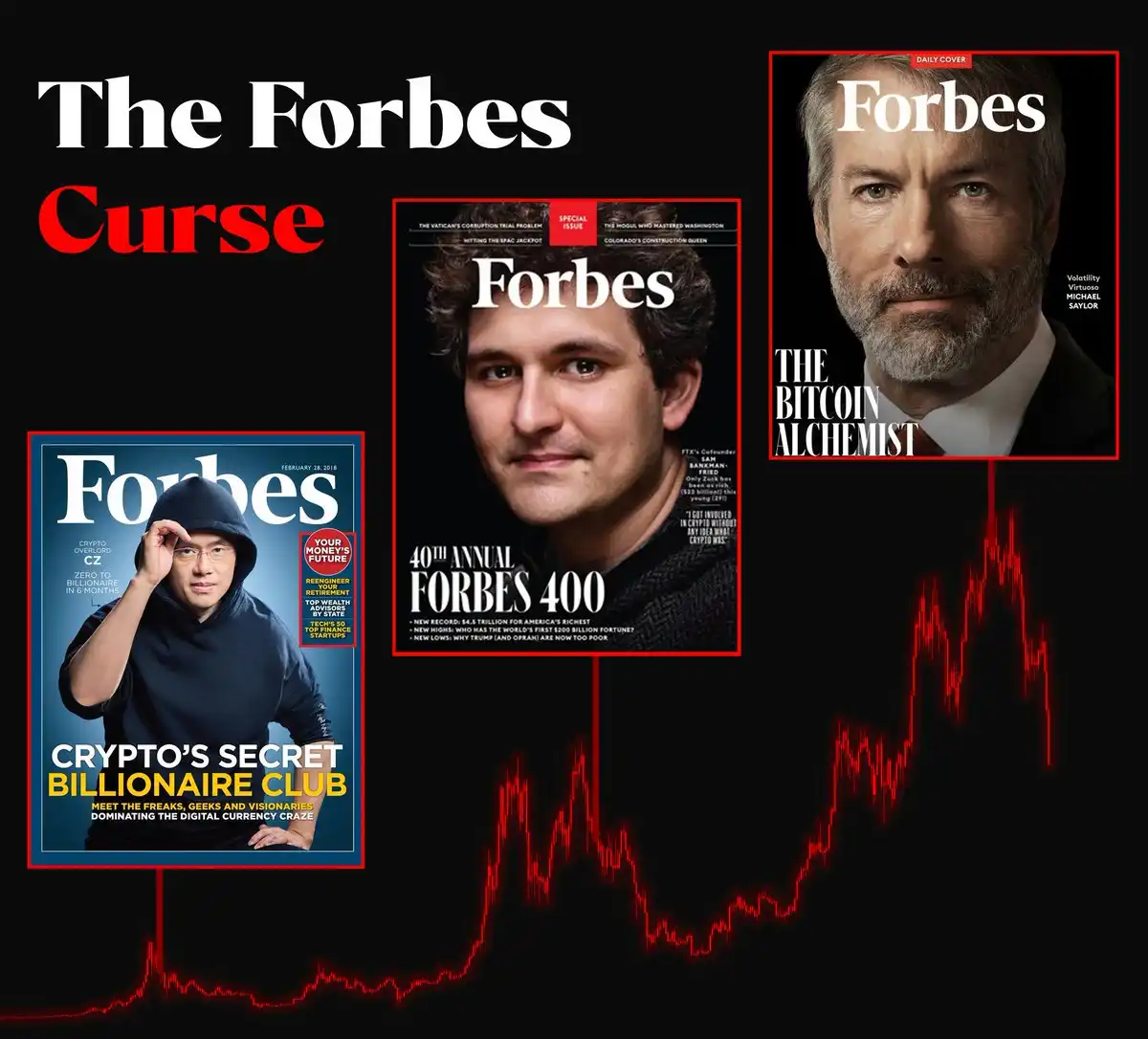
Bitcoin recently hit $60,000, marking the largest single-day drop since the FTX collapse.

Michael Saylor's company, Strategy (formerly MicroStrategy), holds 713,000 bitcoins with an average cost of $76,052. As of last night, the unrealized loss reached $6.5 billion. The stock price has plummeted from a high of $457 last year to $110, wiping out more than three-quarters of its value.

However, a year ago, Saylor graced the cover of the renowned magazine Forbes. The headline read:

The Bitcoin Alchemist. At that time, Bitcoin was priced at $104,000, and Saylor's net worth was $9.4 billion.

Now, a chart circulating on Twitter lines up three Forbes covers with Bitcoin's price chart. Each cover perfectly marks the starting point of a sharp decline.

Of these three individuals, one has been to prison, one is currently in prison, and the third just lost $6.5 billion.

The Cover: Captured at the Peak of Hype

The first crypto figure to appear on a Forbes cover was CZ.

In February 2018, Forbes featured a cover titled "Crypto's Secret Billionaire Club," with CZ standing in the center, hoodie on, exuding a rugged aura. The fine print read:

From zero to billionaire in just 6 months.

At that time, Bitcoin had just fallen from nearly $20,000 at the end of 2017 to around $7,600. Forbes estimated CZ's net worth to be at least $1.1 billion. Binance, only six months old, was already the world's largest exchange by trading volume.

After the cover was released, Bitcoin briefly rebounded to $10,000. Then, it went nowhere but down.

By December 2018, Bitcoin had fallen to $3,156. From the day the cover was published, the decline was:

58%.

CZ's later story is well-known. On Forbes' 2025 global billionaires list, CZ's net worth was $62.9 billion, ranking first in the crypto industry.

But he hasn't appeared on the cover since.

The second Forbes cover featured Sam Bankman-Fried.

In October 2021, Forbes released its 40th Forbes 400 Richest Americans list, with SBF as the cover star. Under 30 years old, with a net worth of $26.5 billion, he ranked as the 41st richest person in the U.S.

On the cover, he wore his signature gray T-shirt, with curly hair, looking like a college student who had just pulled an all-nighter playing League of Legends.

In hindsight, the magazine's tone was surreal. Forbes called him "the most powerful person in the crypto industry," praising him for building an exchange while donating to charity, a blend of Wall Street and Silicon Valley.

When the cover was released, Bitcoin was around $60,000, just a step away from its then-all-time high of $69,000.

Thirteen months later, FTX collapsed.

SBF had misappropriated over $8 billion in customer funds to cover losses at his other company, Alameda Research. In November 2022, users rushed to withdraw their assets, and FTX couldn't meet the demand. Within a week, the world's third-largest exchange went bankrupt. Bitcoin plummeted from $20,000 to $16,000.

Eventually, SBF was arrested in his luxury apartment in the Bahamas.

He was convicted on all seven charges and sentenced to 25 years in prison. Forbes later created a "30 Under 30 Hall of Shame," with SBF prominently featured.

From cover to handcuffs:

13 months.

The third was Michael Saylor.

On January 30, 2025, the Forbes cover featured "The Bitcoin Alchemist." Bitcoin had just broken through $100,000, and Saylor's net worth had surged from $1.9 billion the previous year to $9.4 billion, nearly a fivefold increase. His company, MicroStrategy, saw its stock price rise 700% in a year and was newly included in the Nasdaq 100 index.

The Forbes article recorded a detail:

On New Year's Eve, Saylor hosted a 500-person party at his estate in Miami. Dancers waved orange Bitcoin glow balls, and outside, a 154-foot yacht named Usher ferried institutional investors and crypto industry leaders to the event.

At the time, Saylor told Forbes:

"We've put a crypto reactor in the middle of the company, sucking in capital and spinning it. Volatility drives everything." This statement was, of course, sincere. Saylor's alchemy boils down to one thing: issuing debt to buy Bitcoin.

When the Forbes cover was released, Bitcoin was at $104,000. One year and six days later, it's at $63,000. A decline of:

40%.

Saylor said on an earnings call that Strategy had built a "digital fortress."

The last crypto mogul to call his company a "fortress" was SBF. That was in June 2022. Five months later, FTX went bankrupt.

The Cover: Both Praise and Curse

There's an old Wall Street concept called the "magazine cover indicator":

When a trend makes it to the cover of a mainstream magazine, that trend has often already peaked.

The reasoning is simple. Forbes editors aren't prophets; like all retail investors, they only notice a story when it's at its most hyped.

The moment a magazine deems "someone in some industry worthy of a cover" is precisely the moment when market frenzy has reached its peak.

The cover isn't the cause of the curse; it's a symptom of the bubble.

However, there was one brief exception to this rule.

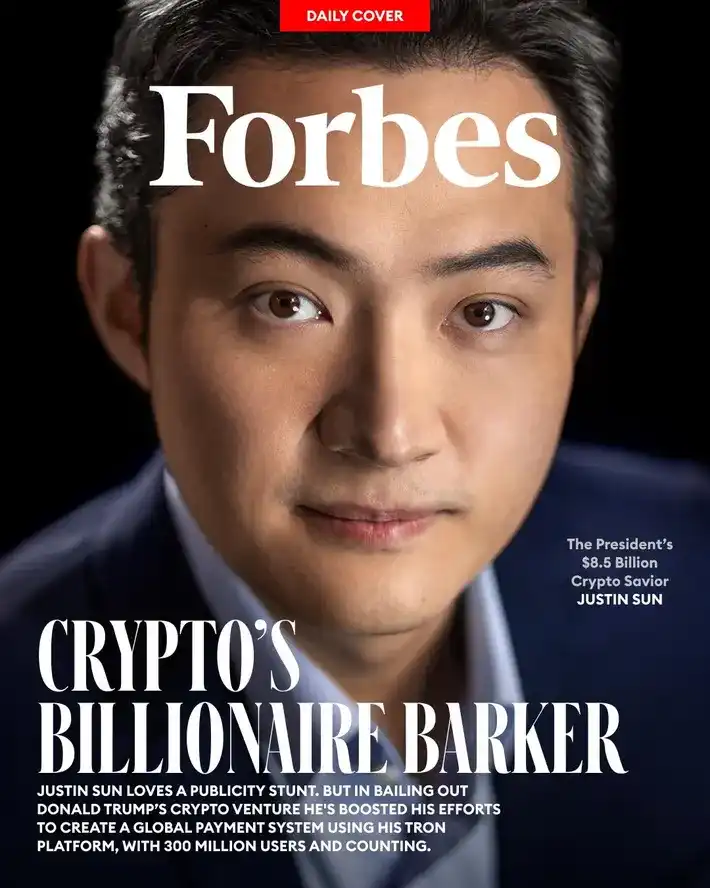
In March of last year, Justin Sun graced the Forbes cover with the headline "The Crypto Billionaire Who Helped the Trump Family Make $400 Million."

When the cover was released, Bitcoin was at $87,000. It didn't crash; instead, it rallied to a historic high of $126,000 in October.
Did the curse fail?

Not entirely. When Sun appeared on the cover, it was only two months after Saylor's. One cover in January, another in March—the密集 appearance of crypto figures on mainstream magazine covers was itself a signal. It indicated that the industry's narrative had become so hot that even Forbes editors felt one issue wasn't enough.

When covers start appearing in clusters, in hindsight, the peak of a bull market might have a checklist of symptoms:

Forbes covers, taxi drivers discussing crypto, relatives asking how to open an account... If two out of three signals appear, it's time to think about your position.

So, the real question isn't "Is the Forbes cover accurate?" but rather:

When everyone around you is telling the same story, when that story is so good that even people who don't trade crypto have heard of it, when mainstream media starts deifying figures in an industry...

Are you the one still buying, or the one already selling?

Bull markets don't end in panic. They end on magazine covers.

It's just that the cover stars may change, but the long bear market is always paid for by me.

Perguntas relacionadas

QWhat is the 'magazine Cover Indicator' mentioned in the article, and how does it relate to the cryptocurrency market?

AThe 'Magazine Cover Indicator' is an old Wall Street concept suggesting that when a trend or person makes the cover of a mainstream magazine like Forbes, it often signals that the trend has peaked and is about to reverse. In the context of the cryptocurrency market, the article argues that Forbes covers featuring crypto billionaires like CZ, SBF, and Michael Saylor have each coincided with the start of a major price crash, as the cover is a symptom of peak market euphoria and mainstream attention.

QAccording to the article, what happened to Bitcoin's price after Michael Saylor appeared on the cover of Forbes?

AAccording to the article, when Michael Saylor appeared on the cover of Forbes on January 30, 2025, Bitcoin was priced at $104,000. One year and six days later, the price had fallen to $63,000, representing a decline of 40%.

QWho were the three crypto figures featured on Forbes covers, and what were their respective outcomes?

AThe three crypto figures featured on Forbes covers were: 1. CZ (Changpeng Zhao): Featured in February 2018. Bitcoin fell 58% after his cover. He later became the wealthiest person in crypto but faced legal issues. 2. Sam Bankman-Fried (SBF): Featured in October 2021. FTX collapsed 13 months later, and SBF was arrested and sentenced to 25 years in prison. 3. Michael Saylor: Featured in January 2025. His company, MicroStrategy, faced billions in unrealized losses on its Bitcoin holdings, and the price fell 40% after the cover.

QWhy does the article claim that a Forbes cover is a symptom of a market top and not the cause of a crash?

AThe article claims that a Forbes cover is a symptom, not a cause, because magazine editors are not prophets. They only feature a trend or person on the cover when the story is at its most popular and mainstream attention is at its peak. This moment of maximum hype and widespread recognition often coincides with the top of a market cycle, making the cover an indicator of excessive euphoria rather than a catalyst for the subsequent decline.

QWhat exception to the 'Forbes cover curse' does the article mention, and how does it explain this anomaly?

AThe article mentions that Justin Sun (Sun Yuchen) appeared on the cover of Forbes in March of an unspecified year (likely 2025), and instead of crashing, Bitcoin's price continued to rise to a new all-time high of $126,000 by October. The article explains this anomaly by stating that the curse wasn't entirely broken. The fact that crypto figures appeared on Forbes covers so frequently (Saylor in January, Sun in March) was itself a signal that the market narrative was overheated. The high frequency of covers was a symptom of the peak, even if the immediate crash for one specific cover was delayed.

Leituras Relacionadas

South Korean Exchanges 'Battle' Regulators, Challenging the Boundaries of Enforcement and Legislation

South Korea's cryptocurrency industry is engaged in a rare, direct confrontation with regulators. The Financial Intelligence Unit (FIU), the primary anti-money laundering (AML) watchdog, has recently imposed heavy penalties on major exchanges like Upbit and Bithumb for alleged violations involving unregistered overseas VASPs and AML procedures. However, exchanges are now actively challenging these actions in court and through industry associations. In a significant shift, the Seoul Administrative Court ruled in favor of Upbit's operator, Dunamu, overturning part of an FIU-ordered business suspension. The court found the FIU's penalty criteria and justification insufficiently clear. Similarly, the court suspended the enforcement of a six-month business suspension against Bithumb pending a final ruling, citing potential irreversible harm to the exchange. Beyond legal battles, the industry is contesting proposed legislative amendments. The Digital Asset eXchange Alliance (DAXA) strongly opposes a draft rule that would mandate Suspicious Transaction Reports (STRs) for all crypto transfers over 10 million KRW (~$6,800). DAXA argues this "poison pill" clause violates legal principles and would overwhelm the STR system, increasing reports from 63,000 to an estimated 5.45 million annually for major exchanges, thereby crippling effective AML monitoring. This conflict highlights a structural tension in South Korea's crypto governance: comprehensive digital asset laws are still developing, while regulators rely heavily on AML enforcement. The industry's move from passive compliance to active legal and legislative challenges signifies a new phase, pressing for clearer rules and more proportionate enforcement. While short-term disputes may intensify, this clash could ultimately lead to a more mature and sustainable regulatory framework for South Korea's vibrant crypto market.

marsbitHá 25m

South Korean Exchanges 'Battle' Regulators, Challenging the Boundaries of Enforcement and Legislation

marsbitHá 25m

After 50x Storage Surge, Justin Sun Always Looks to the Next Decade

Sun Yuchen, known for his controversial stunts like a $30 million lunch with Warren Buffett (canceled due to a kidney stone) and eating a $6.2 million duct-taped banana, is often overshadowed by a significant fact: his decade-long track record of spotting major investment trends. In 2016, he famously advised young people to invest in Bitcoin, Nvidia, Tesla, and Tencent instead of buying property. A hypothetical $20,000 investment in Nvidia and Tesla from that list would now be worth over 50 million RMB. His latest major call was on November 6, 2025, predicting a "50x storage opportunity" tied to the AI boom, which materialized with Sandisk's stock surging nearly 50-fold by 2026. Looking ahead, Sun now focuses on the next frontier: Physical AI. He identifies four key areas: 1. **Embodied AI/Robotics**: He sees this reaching its "iPhone moment," with companies like UBTech and Galaxy General leading in commercialization. 2. **Drones**: Viewed as the first commercially viable form of Physical AI, revolutionizing sectors from warfare (e.g., AeroVironment's Switchblade) to logistics. 3. **Spatial Computing**: Beyond VR, it's about AI understanding physical space, a foundational technology for robotics and autonomous systems, exemplified by Apple's Vision Pro. 4. **Space Exploration**: After a 2025 suborbital flight with Blue Origin, Sun advocates for space as the ultimate frontier, discussing blockchain's potential role in space asset management and data transactions. His investment philosophy involves betting on entire, inevitable trends rather than single companies. For robotics, he sees Tesla (the body/manufacturer) and Nvidia (the brain/AI platform) as complementary plays. In defense drones, he highlights companies making tanks obsolete (AeroVironment) and those augmenting fighter jets (Kratos). For space, he participated in Blue Origin's flight and anticipates SpaceX's potential IPO to redefine the sector's valuation. Sun Yuchen's vision frames the next two decades not as a revolution in information flow (like the internet), but in the fundamental operation of the physical world through AI-powered robots, autonomous systems, and spatial intelligence, ultimately extending human and AI activity into space. While many still focus on conventional assets, he continues to look toward the next technological horizon.

marsbitHá 1h

After 50x Storage Surge, Justin Sun Always Looks to the Next Decade

marsbitHá 1h

The Billionaires Behind the Most Expensive Midterm Election in History

"The Most Expensive Midterm Elections and Their Billionaire Backers" This analysis details the unprecedented scale of spending in the 2026 midterm elections, highlighting the key billionaire donors shaping the political landscape. Jeff Yass, founder of Susquehanna International Group, has contributed over $81 million, ranking third among individual donors behind George Soros ($102.6M) and Elon Musk ($84.8M). Yass is a major donor to Trump's MAGA Inc. and supports school choice and various candidates. Overall, federal committees have raised over $4.7 billion this cycle, with political ad spending projected to reach $10.8 billion. Republican-aligned groups are significantly out-raising their Democratic counterparts. "Dark money" from undisclosed sources continues to grow. The core stakes involve control of Congress and policy direction for Trump's final term. Donors are also motivated by specific issues: Sergey Brin and Chris Larsen are funding opposition to a proposed California wealth tax and supporting crypto-friendly policies. Other top donors include OpenAI's Greg Brockman and his wife Anna ($50M total to MAGA Inc. and an AI-focused PAC), Richard Uihlein ($45.3M to conservative causes), venture capitalists Marc Andreessen and Ben Horowitz (each over $44M to crypto/AI PACs and MAGA Inc.), Miriam Adelson ($42.6M to GOP leadership PACs), Paul Singer ($33.9M), and Diane Hendricks ($25.8M to MAGA Inc.). The article notes that the peak fundraising period is still ahead, with major primaries approaching.

marsbitHá 1h

The Billionaires Behind the Most Expensive Midterm Election in History

marsbitHá 1h

The Largest IPO in History Is Approaching, Surpassing SpaceX, 28 Years of AI Self-Iteration, Countdown to Intelligence Explosion

"Anthropic Nears Trillion-Dollar IPO, Fueled by Explosive Growth and 2028 'Intelligence Explosion' Warning Anthropic is considering a deal valuing the AI company near $1 trillion, potentially leading to one of the largest IPOs ever and surpassing SpaceX. Its revenue has skyrocketed, with Annual Recurring Revenue (ARR) reaching $45 billion in May 2026—a 500% increase in just five months. This vertical growth curve is attributed to its key products, Claude Code and Cowork, dominating AI coding and enterprise collaboration. Beyond commercial success, co-founder Jack Clark issued a pivotal warning in an interview: there is a greater than 50% chance that by the end of 2028, AI systems will achieve recursive self-improvement—the ability to autonomously build a 'better version' of themselves, initiating an 'intelligence explosion.' This prophecy underpins the company's astronomical valuation, as the market prices in the potential for transformative and disruptive AI. Further signaling its ambition, Anthropic formed a $1.5 billion joint venture with Goldman Sachs and Blackstone, aiming to disrupt traditional consulting firms like McKinsey by deploying Claude AI for complex strategic work. This move tests AI's capacity to replace high-level cognitive labor, a precursor to its predicted autonomous evolution. The narrative presents a dual future: unprecedented economic opportunity alongside significant risks like economic restructuring and security threats. Anthropic's meteoric rise and Clark's 2028 prediction frame the coming years as a countdown to a potential technological singularity."

marsbitHá 1h

The Largest IPO in History Is Approaching, Surpassing SpaceX, 28 Years of AI Self-Iteration, Countdown to Intelligence Explosion

marsbitHá 1h

Trading

Spot
Futuros

Artigos em Destaque

Como comprar LA

Bem-vindo à HTX.com!Tornámos a compra de Lagrange (LA) simples e conveniente.Segue o nosso guia passo a passo para iniciar a tua jornada no mundo das criptos.Passo 1: cria a tua conta HTXUtiliza o teu e-mail ou número de telefone para te inscreveres numa conta gratuita na HTX.Desfruta de um processo de inscrição sem complicações e desbloqueia todas as funcionalidades.Obter a minha contaPasso 2: vai para Comprar Cripto e escolhe o teu método de pagamentoCartão de crédito/débito: usa o teu visa ou mastercard para comprar Lagrange (LA) instantaneamente.Saldo: usa os fundos da tua conta HTX para transacionar sem problemas.Terceiros: adicionamos métodos de pagamento populares, como Google Pay e Apple Pay, para aumentar a conveniência.P2P: transaciona diretamente com outros utilizadores na HTX.Mercado de balcão (OTC): oferecemos serviços personalizados e taxas de câmbio competitivas para os traders.Passo 3: armazena teu Lagrange (LA)Depois de comprar o teu Lagrange (LA), armazena-o na tua conta HTX.Alternativamente, podes enviá-lo para outro lugar através de transferência blockchain ou usá-lo para transacionar outras criptomoedas.Passo 4: transaciona Lagrange (LA)Transaciona facilmente Lagrange (LA) no mercado à vista da HTX.Acede simplesmente à tua conta, seleciona o teu par de trading, executa as tuas transações e monitoriza em tempo real.Oferecemos uma experiência de fácil utilização tanto para principiantes como para traders experientes.

268 Visualizações TotaisPublicado em {updateTime}Atualizado em 2025.06.04

Como comprar LA

Discussões

Bem-vindo à Comunidade HTX. Aqui, pode manter-se informado sobre os mais recentes desenvolvimentos da plataforma e obter acesso a análises profissionais de mercado. As opiniões dos utilizadores sobre o preço de LA (LA) são apresentadas abaixo.

活动图片













