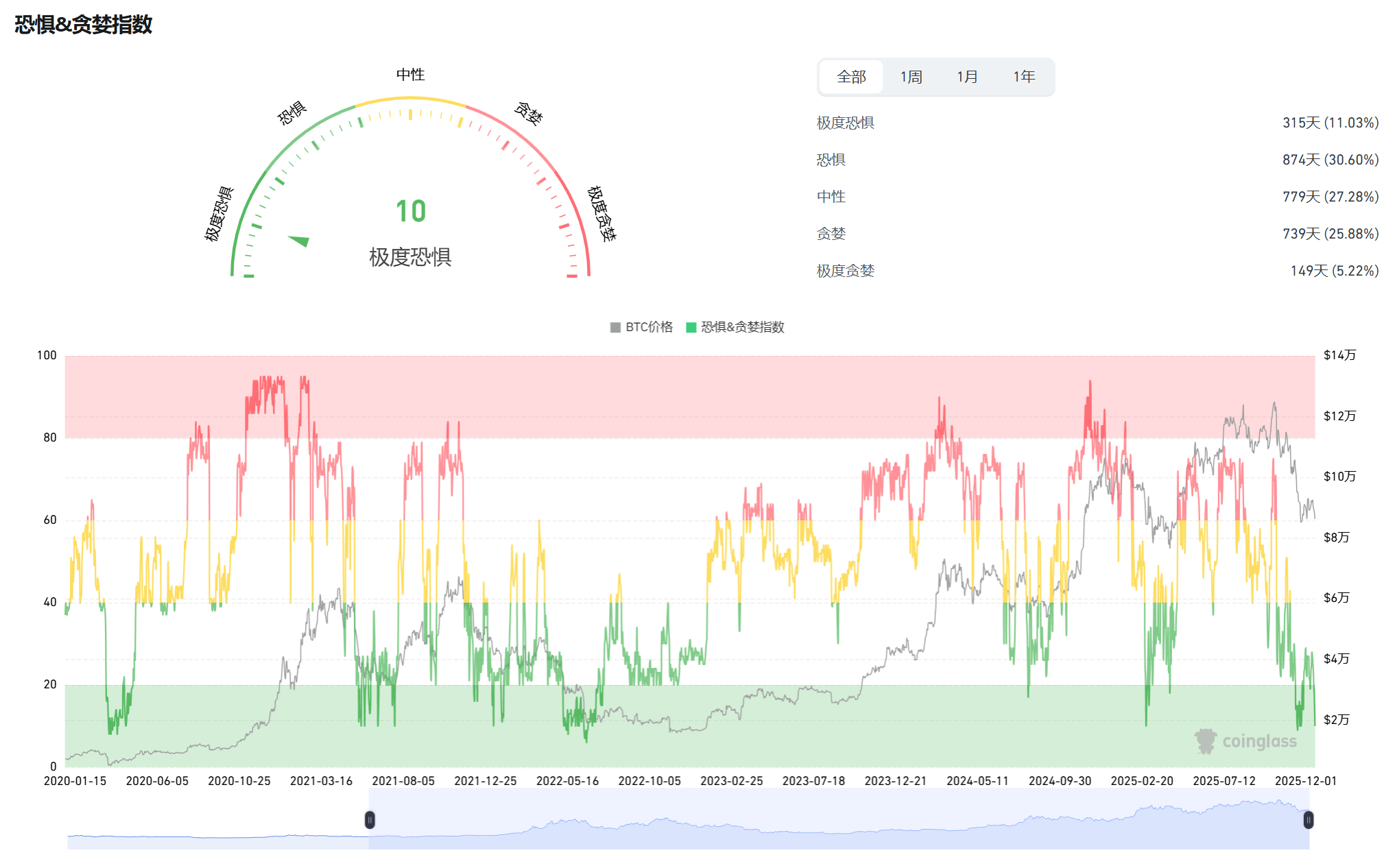
Fear & Greed Index Hits New Low of 10! Bitcoin Breaks Below $86K! Are All Blockchains Dead Except Tron, SOL, and BNB?

marsbitPublicado em 2025-12-16Última atualização em 2025-12-16

Resumo

The Crypto Fear & Greed Index has plummeted to a shocking 10, indicating "extreme fear" in the market—the lowest level since the COVID-19 crash of March 2020. Bitcoin fell to around $85,100, while Ethereum dropped to $2,880. On-chain data reveals a stark divergence among blockchains. Tron leads with $1.24 million in 24-hour fees, followed by Solana ($589,088) and BNB Chain ($435,075). Ethereum ranked fourth with just $418,425. Many once-popular chains like Celestia, Sui, and Algorand generated less than $50 in fees, raising serious concerns about their utility and sustainability. The panic stems from macro liquidity tightening—due to delayed Fed rate cuts and Bank of Japan hikes—and cracks in crypto’s core narratives. Bitcoin ETFs have seen net outflows of over $2.3 billion since November, and long-term holders are selling aggressively. Ethereum’s staking model faces scrutiny: with 27.89% of ETH staked, yields rely heavily on token inflation rather than organic fee revenue, creating economic vulnerability. Historically, such extreme fear has often marked market bottoms. While retail and mid-sized whales panic-sell, large entities continue accumulating Bitcoin. The current sell-off may present a long-term opportunity, echoing past cycles where despair preceded major rallies.

Today, the Crypto Fear & Greed Index has plummeted to a shocking value of 10, officially marking market sentiment as entering the "Extreme Fear" zone.

This is the lowest level since the global market crash triggered by the COVID-19 pandemic in March 2020, even surpassing the panic levels of the Terra/Luna collapse in 2022.

In this morning's sharp decline, Bitcoin briefly touched a low of $85,100, while Ethereum also fell to a low of $2,880.

Market participant sentiment has nearly frozen solid; this panic is not only reflected in prices but is deeply etched into every byte of on-chain data.

The Harsh Truth of On-Chain Fees: The "Survival Stress Test" for Blockchains

The ranking of fees generated across all blockchains in the past 24 hours presents an extremely polarized picture:
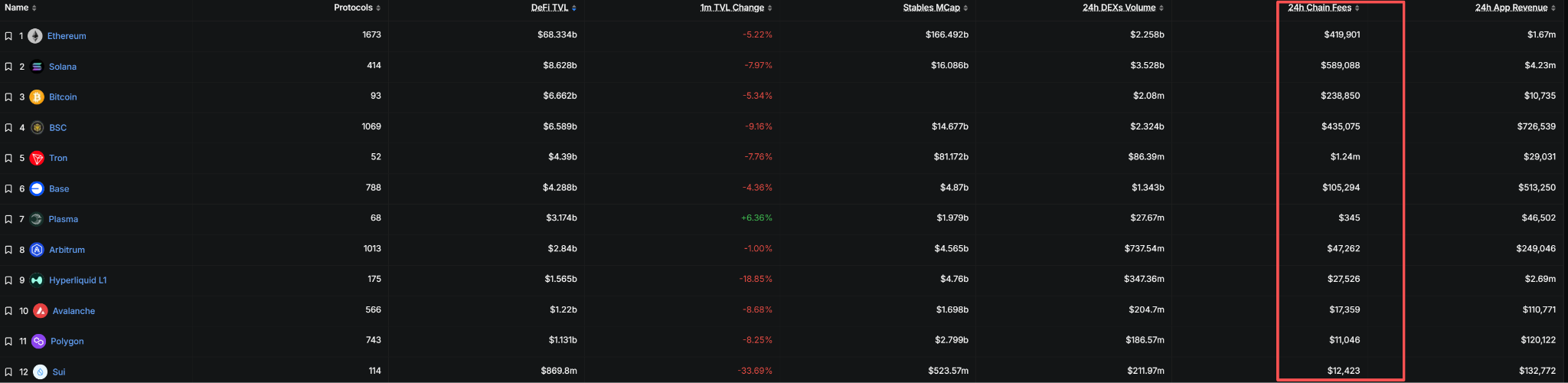
Tron leads with $1.24 million, SOL follows closely with $589,088, the BNB Chain ranks third with $435,075, while Ethereum trails in fourth place with only $418,425.

This data far exceeds general expectations, with several so-called star blockchains like SUI and Plasma generating less than 1/10th of Tron's fees.


However, the truly alarming situation is the survival state of the long-tail blockchains.
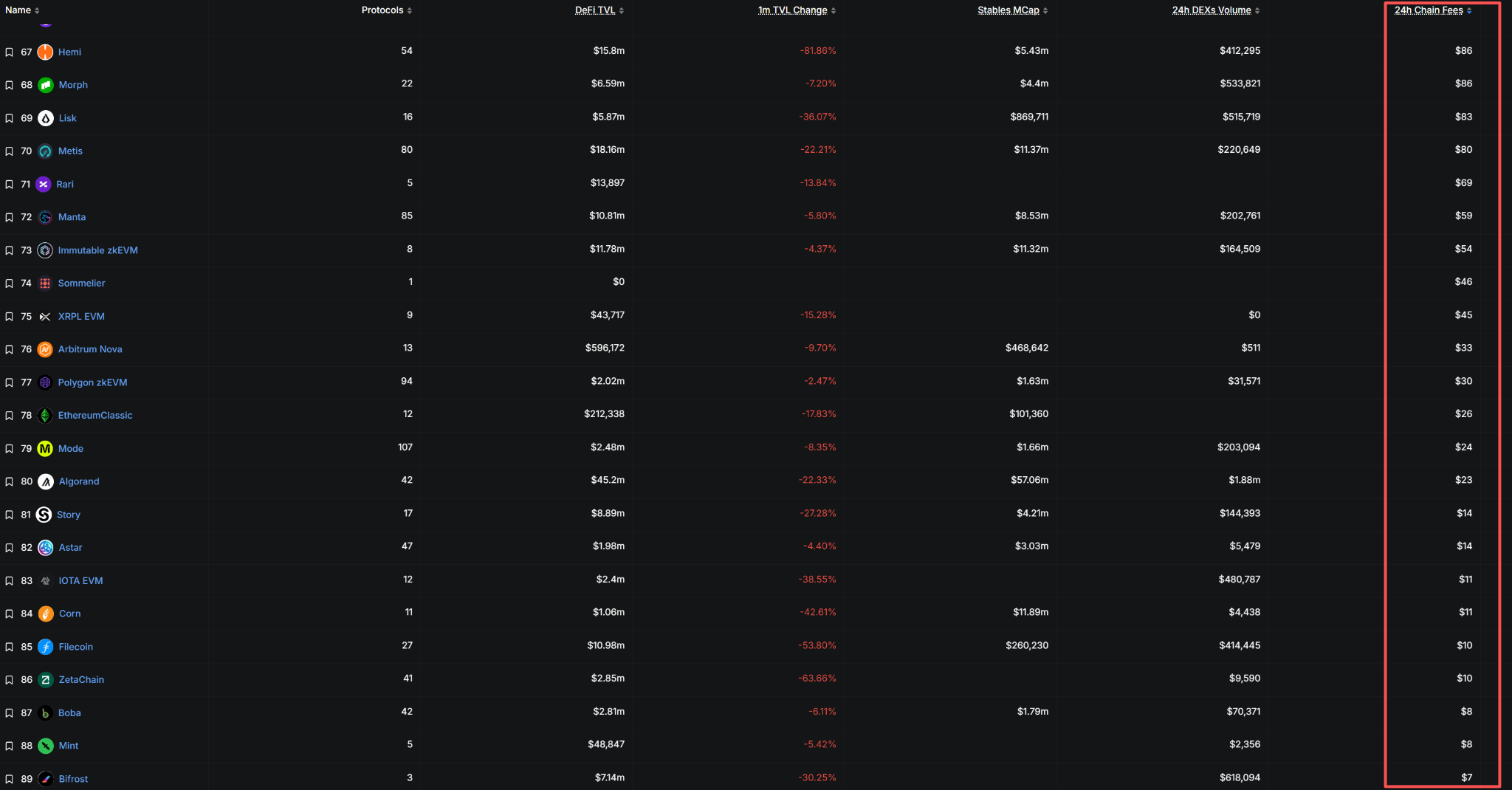
Blockchains that were once popular, such as Celestia, Hemi, Morph, Manta, Immutable zkEVM, EthereumClassic, Algorand, Story, and Filecoin, generated less than $50 in fees in the past 24 hours—less than a roadside stall.

This data undoubtedly indicates that the actual usage of these blockchains is nearing zero.

Fees are the direct "tax" of a blockchain's economy and a core metric for measuring network value.

When a blockchain's daily fees are less than $50, its network security, degree of decentralization, and long-term sustainability are all called into serious question.


The Macro Backdrop of Market Panic: Liquidity Crisis and Narrative Breakdown

This market panic is not due to a single factor but is the result of a combination of tightening global liquidity and the breakdown of internal crypto narratives.

On one hand, global USD liquidity is facing severe challenges. The Fed's maintained hawkish stance, delaying rate cut expectations, has led to a heavy blow to global risk assets.

The Bank of Japan's rate hike has further intensified global liquidity contraction. Historical data shows that BoJ hiking cycles often coincide with global liquidity tightening; the two rounds of hikes in March 2024 and January 2025 both caused Bitcoin to retreat by over 30%.

On the other hand, two core internal narratives of the crypto market are being severely tested.

Bitcoin spot ETFs have turned from an "engine" into a "pump," with net outflows exceeding $2.3 billion since November alone.
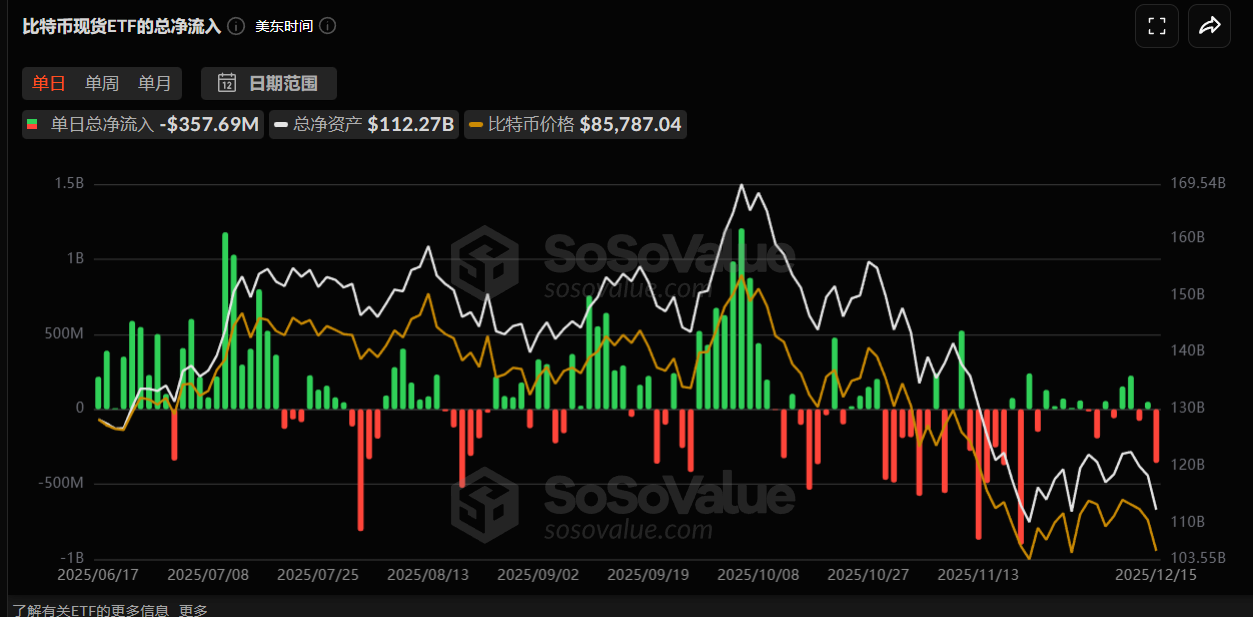
More worryingly, long-term holders have been selling Bitcoin on a large scale, a rare occurrence, selling approximately 815,000 BTC just in early November. When the two major narratives of "institutional adoption" and "long-term holding" show cracks simultaneously, market confidence collapses like an avalanche.

On-chain data shows the market just experienced "the largest realized loss day in the past six months," meaning a massive amount of assets were sold below their purchase price, and investors are纷纷 "cutting losses" and exiting.


The Economic Paradox of Ethereum Staking: Who is Paying for the Whales' Profits?

Against the bear market backdrop, Ethereum's economic model deserves particular scrutiny.

Ethereum's problem gets to the core: Big players staking Ethereum are taking so much money from the protocol every day; who is paying for that?

In reality, the Ethereum Beacon Chain staking annual yield is approximately 3.5%. These returns primarily come from two parts: block rewards (paid by the protocol issuing new tokens, effectively diluting the value for all token holders) and transaction fees (paid by users engaged in on-chain activity).

During a bull market, high Gas fees can be absorbed by active users through DeFi, NFT, and other applications;

but in a bear market, on-chain activity plummets, and staking rewards rely more on token issuance—this essentially means later participants are "transfusing" early stakers through inflation.
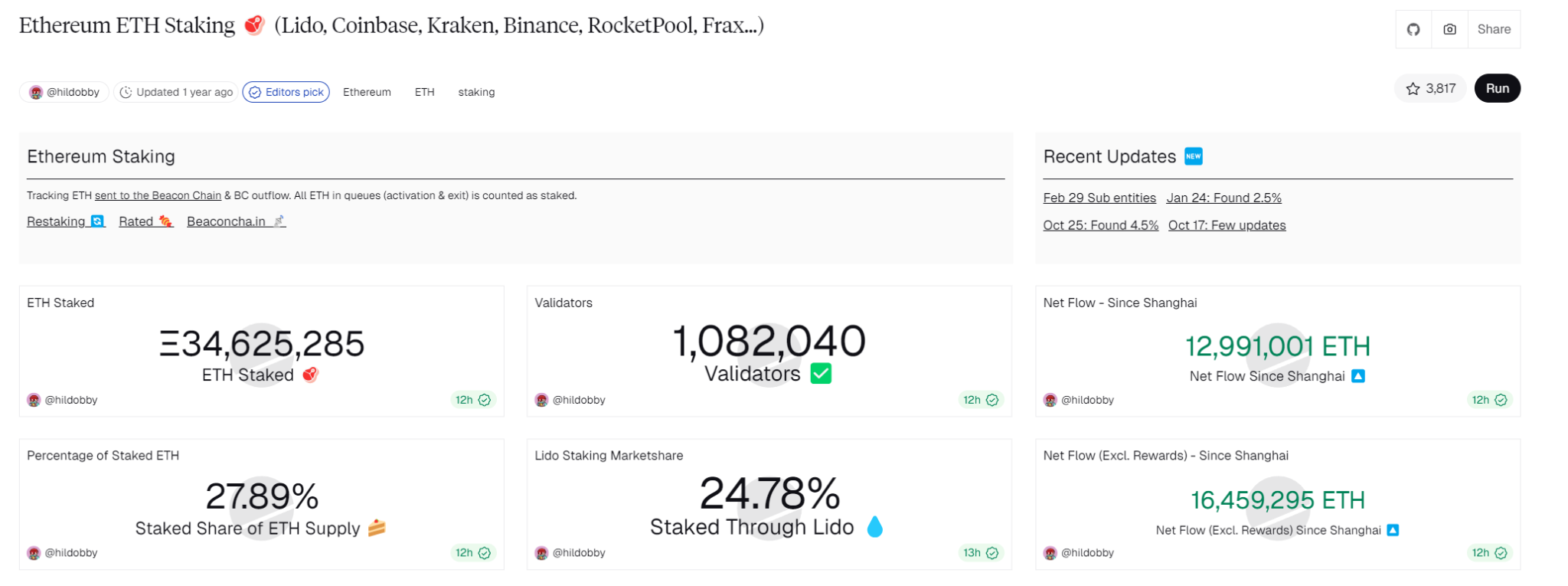

The current total amount staked on the Ethereum Beacon Chain accounts for 27.89% of the circulating supply. These stakers earn stable returns from the protocol daily. However, with fee revenue at only $418,000 (less than a third of Tron's), whether the Ethereum network can sustainably support such massive staking rewards is indeed worth pondering.

More seriously, when the Ethereum price falls, stakers may face a situation where "rewards are insufficient to cover the currency's depreciation," potentially triggering a negative feedback loop of unstaking and selling.

This does share similarities with Ponzi structures in traditional finance: any system reliant on new funds to maintain old returns exposes its fragility during liquidity contractions.


A Philosophical Question: After the Crypto "Red Pill" Takes Effect

"When people say Bitcoin is a Ponzi scheme, it's also the first time they realize the essence of any form of property rights in the real world is a Ponzi." This view touches the essence of the problem.

All value systems are built on consensus, whether fiat currency, gold, or cryptocurrency.

When people say the crypto space is a casino, it might be the first time they truly recognize the nature of the global financial system.

In traditional financial markets, central banks can print money indefinitely, governments can change rules arbitrarily, and insider trading and market manipulation are commonplace. Compared to these traditional financial markets hidden behind opaque rules, the crypto space at least presents the brutality of finance in an extremely transparent, real-time manner to all participants.

In today's market, the Bitcoin Fear & Greed Index is only 11, and on-chain data shows most blockchains are nearly "brain dead." Investors are not disappointed with crypto itself but are unable to accept the real world seen after swallowing the "red pill."

The cryptocurrency market is like a mirror, reflecting the nature of the global financial system: all asset prices are ultimately driven by liquidity, not intrinsic value. When the Fed "turns off the tap," everything from stocks and crypto to gold faces selling pressure.


Historical Perspective: Value Return After Extreme Fear

Looking back at cryptocurrency history, every period of extreme market fear has ultimately proven to be an excellent opportunity for long-term investment.

During the COVID-19 crash in March 2020, the Fear & Greed Index plummeted to 10-15, but Bitcoin subsequently embarked on a bull market that lasted over a year.

In June 2022, following the Terra/Luna collapse and macro-economic tightening, the index remained in "Extreme Fear" territory (8-15) for weeks. Although prices fell across the board, sustained panic actually marked the market bottom. Currently, although market sentiment is extremely pessimistic, on-chain data reveals another picture: behind the panic "surrender," a great "asset transfer" is quietly taking place. Medium-sized whales and panicked retail investors are selling, while large strategic entities and steadfast retail investors are actively accumulating.

Data shows that the largest strategic entities (holding >10,000 BTC) continued to accumulate throughout November, with a net increase of 10,700 BTC. Even Bitcoin's most famous evangelist, Michael Saylor's company, announced buying another $50 million worth of Bitcoin amidst the market panic.

Periods of extreme fear are the perfect time to "be greedy when others are fearful." Historically, choosing to sell when the Fear Index drops to single digits has often been the wrong move.


Perguntas relacionadas

QWhat does a Crypto Fear & Greed Index reading of 10 indicate about the current market sentiment?

AA reading of 10 indicates that the market sentiment has officially fallen into the 'Extreme Fear' zone, marking the lowest level of investor confidence since the global market crash triggered by the COVID-19 pandemic in March 2020.

QAccording to the article, which three blockchains lead in 24-hour fee generation, and what does this indicate?

ATron leads with $1.24 million, followed by Solana with $589,088, and BNB Chain with $435,075. This indicates a highly differentiated landscape where these few chains capture the vast majority of actual usage and economic activity, while many others are struggling.

QWhat two core internal narratives in the cryptocurrency market are being severely tested, according to the analysis?

AThe two core narratives being tested are: 1) Bitcoin spot ETFs, which have turned from an 'engine' of growth into a 'pump' draining liquidity, with a net outflow of over $2.3 billion since November. 2) The 'long-term holding' narrative, as long-term holders have been selling on a large scale, with approximately 815,000 BTC sold in early November.

QWhat economic paradox does the article highlight regarding Ethereum's staking model, especially in a bear market?

AThe paradox is that large stakeholders staking ETH earn yields (approx. 3.5% APY) that are paid through block rewards (new token issuance, diluting all holders) and transaction fees. In a bear market with reduced on-chain activity, the rewards rely more on inflation, meaning later participants are effectively 'transferring blood' to early stakers through dilution, creating a potentially unsustainable model.

QWhat historical pattern does the article suggest often follows periods when the Fear & Greed Index reaches extreme lows like 10?

AHistorically, periods of extreme fear, such as the index dropping to 10-15, have often proven to be excellent long-term investment opportunities. For example, the crash in March 2020 was followed by a bull market that lasted over a year, and the panic in June 2022 marked a market bottom.

Leituras Relacionadas

Borrowing Money from a Hundred Years Later, Building Incomprehensible AI

Tech giants like Alphabet, Amazon, Meta, and Microsoft are undergoing a radical financial transformation due to AI. Their traditional "light-asset, high-free-cash-flow" model is being dismantled by staggering capital expenditures on AI infrastructure—data centers, GPUs, and power. Combined 2026 guidance exceeds $700 billion, a 4.5x increase from 2022, causing free cash flow to plummet (e.g., Amazon's fell 95%). To fund this, they are borrowing unprecedented sums through long-dated, multi-currency bonds (e.g., Alphabet's 100-year bond). The world's most conservative capital—pensions, insurers—is now funding Silicon Valley's most speculative bet. This shift makes these companies resemble heavy-asset industrials (railroads, utilities) rather than software firms, threatening their premium valuations. Historically, such infrastructure booms (railroads, fiber optics) followed a pattern: genuine technology, overbuilding fueled by competitive frenzy, aggressive debt financing, and a crash triggered by financial conditions—not technology failure. The infrastructure remained, but many original builders and financiers did not survive. The core gamble is a "time arbitrage": using cheap debt today to build scale and lock in customers before AI capabilities commoditize. They are betting that AI revenue will materialize before debt comes due. Their positions vary: Amazon is under immediate cash pressure; Meta's path to monetization is unclear; Alphabet has a robust core business buffer; Microsoft has the shortest path from infrastructure to revenue. The contract is set: the most risk-averse global capital has lent its time to Silicon Valley, awaiting a future that is promised but uncertain.

marsbitHá 1h

Borrowing Money from a Hundred Years Later, Building Incomprehensible AI

marsbitHá 1h

The 'VVV' Concept Soars 9x in Half a Year, The New AI Narrative on Base Chain

"The article explores the 'VVV' concept as the new AI-focused narrative within the Base ecosystem, centered around the token $VVV of the privacy-focused, uncensored generative AI platform Venice, led by crypto veteran Erik Voorhees. Venice has seen significant growth in 2026, with its API users surging, partly attributed to exposure from OpenClaw. The platform now boasts over 2 million total users and 55,000 paid subscribers. Correspondingly, the $VVV token price has risen over 9x this year. Key to its performance are tokenomics designed for value accrual: reduced annual emissions, subscription revenue used for buyback-and-burn, and a unique staking mechanism. Staking $VVV yields $sVVV, which can be used to mint $DIEM tokens. Each staked $DIEM provides a daily $1 credit for using Venice's API services, creating tangible utility. The article also highlights other tokens associated with the 'VVV' narrative. $POD, the token of distributed AI network Dolphin (which co-developed Venice's default AI model), saw a massive price surge. $cyb3rwr3n, a project for a Venice credit auction market, gained attention due to perceived connections to Venice's team despite official denials. Finally, $SR of robotics platform STRIKEROBOT.AI rose after announcing a partnership with Venice for robot vision-language model development. Overall, the 'VVV' ecosystem combines AI platform growth, deflationary tokenomics, and innovative utility mechanisms, driving significant investor interest and price action in related tokens."

marsbitHá 1h

The 'VVV' Concept Soars 9x in Half a Year, The New AI Narrative on Base Chain

marsbitHá 1h

Anthropic and OpenAI Have Single-Handedly Severed the Logic of Pre-IPO Stock Tokenization

The pre-IPO stock token market is experiencing significant turmoil following strong statements from AI giants Anthropic and OpenAI. Both companies have updated their official policies, declaring that any transfer of their company shares—including sales, transfers, or assignments of share interests—without prior board approval is "invalid" and will not be recognized in their corporate records. This means buyers in such unauthorized transactions would not be recognized as shareholders and would have no shareholder rights. A major point of contention is the use of Special Purpose Vehicles (SPVs), which are legal entities commonly used by pre-IPO token platforms to pool investor funds and indirectly acquire shares from employees or early investors. The companies explicitly state they do not permit SPVs to acquire their shares, and any such transfer violates their restrictions. They warn that third parties selling shares through SPVs, direct sales, forward contracts, or stock tokens are likely engaged in fraud or are offering worthless investments due to these transfer limits. This stance directly threatens the core model of many pre-IPO token platforms, which rely on SPV structures. The announcement revealed additional risks within this model, such as complex "SPV-within-SPV" layering that obscures legal transparency, increases management fees, and creates a chain reaction risk of invalidation. Following the news, tokens like ANTHROPIC and OPENAI on platforms like PreStocks fell sharply (over 20%). The market reaction highlights a divergence: while asset-backed pre-IPO tokens plummeted, purely speculative pre-IPO futures contracts, which are bilateral bets on future IPO prices with no claim to actual shares, remained relatively stable as they are unaffected by the transfer restrictions. The industry is split on the implications. Some believe the fundamental logic of pre-IPO token trading is broken if leading companies reject SPV-held shares, potentially causing a domino effect. Others, like Rivet founder Nick Abouzeid, argue that buyers of such unofficial tokens always knowingly accepted the risk of non-recognition by the company. The statements serve as a stark risk warning and a corrective measure for a market where valuations for some AI-related pre-IPO tokens had soared to irrational levels, far exceeding recent funding round valuations.

marsbitHá 2h

Anthropic and OpenAI Have Single-Handedly Severed the Logic of Pre-IPO Stock Tokenization

marsbitHá 2h

Trading

Spot
Futuros

Artigos em Destaque

O que é BITCOIN

Compreender o HarryPotterObamaSonic10Inu (ERC-20) e a Sua Posição no Espaço Cripto Nos últimos anos, o mercado de criptomoedas assistiu a um aumento na popularidade das moedas meme, cativando não apenas os traders, mas também aqueles que procuram envolvimento comunitário e valor de entretenimento. Entre estes tokens únicos está o HarryPotterObamaSonic10Inu (ERC-20), um projeto intrigante que mistura referências culturais no tecido das criptomoedas. Este artigo explora os principais aspetos do HarryPotterObamaSonic10Inu, examinando os seus mecanismos, a sua ética orientada pela comunidade e o seu envolvimento com o vasto panorama cripto. O que é o HarryPotterObamaSonic10Inu (ERC-20)? Como o nome sugere, o HarryPotterObamaSonic10Inu é uma moeda meme construída na blockchain Ethereum, classificada sob o padrão ERC-20. Ao contrário das criptomoedas tradicionais, que podem enfatizar a utilidade prática ou o potencial de investimento, este token prospera no valor de entretenimento e na força da sua comunidade. O projeto visa promover um ambiente onde utilizadores envolvidos possam reunir-se, partilhar ideias e participar em atividades inspiradas por diversos fenómenos culturais. Uma característica notável do HarryPotterObamaSonic10Inu é a zero taxa sobre transações. Este elemento atraente visa encorajar a negociação e o envolvimento da comunidade, isento de encargos adicionais que podem desencorajar os traders de pequena escala. A oferta total da moeda está fixada em mil milhões de tokens, uma cifra que marca a sua intenção de manter uma circulação substancial dentro da comunidade. Criador do HarryPotterObamaSonic10Inu (ERC-20) As origens do HarryPotterObamaSonic10Inu estão um pouco envoltas em mistério; os detalhes sobre o criador permanecem desconhecidos. O desenvolvimento deste token carece de uma equipa identificável ou de um plano explícito, o que não é raro no setor das moedas meme. Em vez disso, o projeto surgiu de forma orgânica, com o seu progresso a depender fortemente do entusiasmo e da participação da sua comunidade. Investidores do HarryPotterObamaSonic10Inu (ERC-20) No que diz respeito a investimentos externos e apoios, o HarryPotterObamaSonic10Inu também permanece ambíguo. O token não lista quaisquer fundações de investimento conhecidas ou apoio organizacional significativo. Em vez disso, o “sangue vital” do projeto é a sua comunidade de base, que informa o seu crescimento e sustentabilidade através da ação coletiva e do envolvimento no espaço cripto. Como Funciona o HarryPotterObamaSonic10Inu (ERC-20)? Como uma moeda meme, o HarryPotterObamaSonic10Inu opera principalmente fora dos quadros tradicionais que muitas vezes governam o valor dos ativos. Existem vários aspetos distintivos que definem como o projeto funciona: Transações Sem Taxas: Sem taxas sobre transações, os utilizadores podem comprar e vender o token livremente, sem a preocupação de custos ocultos. Envolvimento da Comunidade: O projeto prospera na interação da comunidade, aproveitando plataformas de redes sociais para criar entusiasmo e facilitar a participação. Discussões, partilha de conteúdo e envolvimento são elementos cruciais que ajudam a expandir o seu alcance e a fomentar a lealdade entre os apoiantes. Sem Utilidade Prática: Deve ser notado que o HarryPotterObamaSonic10Inu não oferece utilidade concreta dentro do ecossistema financeiro. Em vez disso, é classificado como um token principalmente para entretenimento e atividades comunitárias. Referência Cultural: O token incorpora de forma inteligente elementos da cultura popular para atrair interesse, conectando-se tanto com entusiastas de memes como com seguidores de criptomoedas. HarryPotterObamaSonic10Inu exemplifica como as moedas meme operam de forma diferente de projetos de criptomoedas mais tradicionais, entrando no mercado como construções sociais inovadoras em vez de ativos utilitários. Linha do Tempo do HarryPotterObamaSonic10Inu (ERC-20) A história do HarryPotterObamaSonic10Inu é marcada por vários marcos notáveis: Criação: O token surgiu de um meme viral, capturando a imaginação de muitos entusiastas de criptomoedas. Datas específicas de criação não estão disponíveis, sublinhando a sua ascensão orgânica. Listagem em Exchanges: O HarryPotterObamaSonic10Inu conseguiu entrar em várias exchanges, permitindo um acesso e negociação mais fáceis pela comunidade. Iniciativas de Envolvimento da Comunidade: Atividades contínuas direcionadas a melhorar a interação comunitária, incluindo concursos, campanhas em redes sociais e geração de conteúdo por fãs e defensores. Planos de Expansão Futura: O roteiro do projeto inclui o lançamento de uma coleção de NFTs, mercadorias e um site de eCommerce relacionado aos seus temas culturais, envolvendo ainda mais a comunidade e tentando adicionar mais dimensões ao seu ecossistema. Pontos-Chave sobre o HarryPotterObamaSonic10Inu (ERC-20) Natureza Orientada pela Comunidade: O projeto prioriza a contribuição coletiva e a criatividade, assegurando que o envolvimento dos utilizadores está na vanguarda do seu desenvolvimento. Classificação como Moeda Meme: Representa o epítome da criptomoeda baseada em entretenimento, destacando-se dos veículos de investimento tradicionais. Sem Afiliação Direta com o Bitcoin: Apesar da semelhança no nome do ticker, o HarryPotterObamaSonic10Inu é distinto e não tem qualquer relação com o Bitcoin ou outras criptomoedas estabelecidas. Foco na Colaboração: O HarryPotterObamaSonic10Inu é projetado para criar um espaço de colaboração e partilha de histórias entre os seus detentores, proporcionando uma via para a criatividade e o fortalecimento da comunidade. Perspectivas Futuras: A ambição de expandir além da sua premissa inicial para NFTs e mercadorias delineia um caminho para o projeto potencialmente entrar em avenidas mais mainstream dentro da cultura digital. À medida que as moedas meme continuam a capturar a imaginação da comunidade cripto, HarryPotterObamaSonic10Inu (ERC-20) destaca-se devido aos seus laços culturais e abordagem centrada na comunidade. Embora possa não se encaixar no molde típico de um token orientado para utilidade, a sua essência reside na alegria e camaradagem fomentadas entre os seus apoiantes, destacando a natureza em evolução das criptomoedas em uma era cada vez mais digital. À medida que o projeto continua a desenvolver-se, será importante observar como as dinâmicas comunitárias influenciam a sua trajetória no panorama em constante mudança da tecnologia blockchain.

1.5k Visualizações TotaisPublicado em {updateTime}Atualizado em 2024.12.03

O que é BITCOIN

Como comprar BTC

Bem-vindo à HTX.com!Tornámos a compra de Bitcoin (BTC) simples e conveniente.Segue o nosso guia passo a passo para iniciar a tua jornada no mundo das criptos.Passo 1: cria a tua conta HTXUtiliza o teu e-mail ou número de telefone para te inscreveres numa conta gratuita na HTX.Desfruta de um processo de inscrição sem complicações e desbloqueia todas as funcionalidades.Obter a minha contaPasso 2: vai para Comprar Cripto e escolhe o teu método de pagamentoCartão de crédito/débito: usa o teu visa ou mastercard para comprar Bitcoin (BTC) instantaneamente.Saldo: usa os fundos da tua conta HTX para transacionar sem problemas.Terceiros: adicionamos métodos de pagamento populares, como Google Pay e Apple Pay, para aumentar a conveniência.P2P: transaciona diretamente com outros utilizadores na HTX.Mercado de balcão (OTC): oferecemos serviços personalizados e taxas de câmbio competitivas para os traders.Passo 3: armazena teu Bitcoin (BTC)Depois de comprar o teu Bitcoin (BTC), armazena-o na tua conta HTX.Alternativamente, podes enviá-lo para outro lugar através de transferência blockchain ou usá-lo para transacionar outras criptomoedas.Passo 4: transaciona Bitcoin (BTC)Transaciona facilmente Bitcoin (BTC) no mercado à vista da HTX.Acede simplesmente à tua conta, seleciona o teu par de trading, executa as tuas transações e monitoriza em tempo real.Oferecemos uma experiência de fácil utilização tanto para principiantes como para traders experientes.

4.0k Visualizações TotaisPublicado em {updateTime}Atualizado em 2025.03.21

Como comprar BTC

O que é $BITCOIN

OURO DIGITAL ($BITCOIN): Uma Análise Abrangente Introdução ao OURO DIGITAL ($BITCOIN) OURO DIGITAL ($BITCOIN) é um projeto baseado em blockchain que opera na rede Solana, com o objetivo de combinar as características dos metais preciosos tradicionais com a inovação das tecnologias descentralizadas. Embora partilhe um nome com o Bitcoin, frequentemente referido como “ouro digital” devido à sua percepção como uma reserva de valor, o OURO DIGITAL é um token separado projetado para criar um ecossistema único dentro da paisagem Web3. O seu objetivo é posicionar-se como um ativo digital alternativo viável, embora os detalhes sobre as suas aplicações e funcionalidades ainda estejam em desenvolvimento. O que é o OURO DIGITAL ($BITCOIN)? OURO DIGITAL ($BITCOIN) é um token de criptomoeda explicitamente projetado para uso na blockchain Solana. Em contraste com o Bitcoin, que fornece um papel amplamente reconhecido como armazenamento de valor, este token parece focar em aplicações e características mais amplas. Aspectos notáveis incluem: Infraestrutura Blockchain: O token é construído na blockchain Solana, conhecida pela sua capacidade de lidar com transações de alta velocidade e baixo custo. Dinâmicas de Oferta: O OURO DIGITAL tem um fornecimento máximo limitado a 100 quatrilhões de tokens (100P $BITCOIN), embora os detalhes sobre o seu fornecimento circulante ainda não tenham sido divulgados. Utilidade: Embora as funcionalidades precisas não estejam explicitamente delineadas, existem indicações de que o token poderia ser utilizado para várias aplicações, potencialmente envolvendo aplicações descentralizadas (dApps) ou estratégias de tokenização de ativos. Quem é o Criador do OURO DIGITAL ($BITCOIN)? Neste momento, a identidade dos criadores e da equipa de desenvolvimento por trás do OURO DIGITAL ($BITCOIN) permanece desconhecida. Esta situação é típica entre muitos projetos inovadores no espaço da blockchain, particularmente aqueles alinhados com finanças descentralizadas e fenómenos de moedas meme. Embora tal anonimato possa fomentar uma cultura orientada pela comunidade, intensifica as preocupações sobre governança e responsabilidade. Quem são os Investidores do OURO DIGITAL ($BITCOIN)? As informações disponíveis indicam que o OURO DIGITAL ($BITCOIN) não tem apoiantes institucionais conhecidos ou investimentos proeminentes de capital de risco. O projeto parece operar num modelo peer-to-peer focado no apoio e adoção da comunidade, em vez de rotas de financiamento tradicionais. A sua atividade e liquidez estão principalmente situadas em exchanges descentralizadas (DEXs), como a PumpSwap, em vez de plataformas de negociação centralizadas estabelecidas, destacando ainda mais a sua abordagem de base. Como Funciona o OURO DIGITAL ($BITCOIN) A mecânica operacional do OURO DIGITAL ($BITCOIN) pode ser elaborada com base no seu design de blockchain e nas características da rede: Mecanismo de Consenso: Ao aproveitar o exclusivo proof-of-history (PoH) da Solana combinado com um modelo de proof-of-stake (PoS), o projeto assegura uma validação eficiente das transações, contribuindo para o alto desempenho da rede. Tokenomics: Embora mecanismos deflacionários específicos não tenham sido extensivamente detalhados, o vasto fornecimento máximo de tokens implica que pode atender a microtransações ou casos de uso de nicho que ainda estão por definir. Interoperabilidade: Existe o potencial para integração com o ecossistema mais amplo da Solana, incluindo várias plataformas de finanças descentralizadas (DeFi). No entanto, os detalhes sobre integrações específicas permanecem não especificados. Cronologia de Eventos Chave Aqui está uma cronologia que destaca marcos significativos relacionados ao OURO DIGITAL ($BITCOIN): 2023: O lançamento inicial do token ocorre na blockchain Solana, marcado pelo seu endereço de contrato. 2024: O OURO DIGITAL ganha visibilidade ao tornar-se disponível para negociação em exchanges descentralizadas como a PumpSwap, permitindo que os utilizadores o negociem contra SOL. 2025: O projeto testemunha atividade de negociação esporádica e potencial interesse em envolvimentos liderados pela comunidade, embora não tenham sido documentadas parcerias ou avanços técnicos notáveis até ao momento. Análise Crítica Forças Escalabilidade: A infraestrutura subjacente da Solana suporta altos volumes de transações, o que pode aumentar a utilidade do $BITCOIN em vários cenários de transação. Acessibilidade: O potencial preço de negociação baixo por token pode atrair investidores de retalho, facilitando uma participação mais ampla devido a oportunidades de propriedade fracionada. Riscos Falta de Transparência: A ausência de apoiantes, desenvolvedores ou um processo de auditoria publicamente conhecidos pode gerar ceticismo em relação à sustentabilidade e confiabilidade do projeto. Volatilidade do Mercado: A atividade de negociação depende fortemente do comportamento especulativo, o que pode resultar em volatilidade significativa dos preços e incerteza para os investidores. Conclusão O OURO DIGITAL ($BITCOIN) surge como um projeto intrigante, mas ambíguo, dentro do ecossistema em rápida evolução da Solana. Embora tente aproveitar a narrativa do “ouro digital”, a sua divergência do papel estabelecido do Bitcoin como reserva de valor sublinha a necessidade de uma diferenciação mais clara da sua utilidade pretendida e estrutura de governança. A aceitação e adoção futuras dependerão provavelmente da abordagem da atual opacidade e da definição mais explícita das suas estratégias operacionais e económicas. Nota: Este relatório abrange informações sintetizadas disponíveis até outubro de 2023, e desenvolvimentos podem ter ocorrido além do período de pesquisa.

92 Visualizações TotaisPublicado em {updateTime}Atualizado em 2025.05.13

O que é $BITCOIN

Discussões

Bem-vindo à Comunidade HTX. Aqui, pode manter-se informado sobre os mais recentes desenvolvimentos da plataforma e obter acesso a análises profissionais de mercado. As opiniões dos utilizadores sobre o preço de BTC (BTC) são apresentadas abaixo.

活动图片













