Farewell to Traditional Bull and Bear Markets, Deciphering the Logic of Today's Bubble Rotation

Foresight NewsPublicado em 2026-06-08Última atualização em 2026-06-08

Resumo

"Farewell to Traditional Bulls and Bears: Understanding Today's Market Logic of Bubble Rotation" The article draws a parallel between modern financial markets and a meteorological chain of thunderstorms, contrasting it with the past's slower-moving, more predictable 'layered cloud' systems of long bull/bear cycles and gradual sector rotations. The author argues that today's market has undergone a permanent structural shift, creating an environment where discrete, intense thematic bubbles (e.g., AI, GLP-1 drugs, crypto, robotics, quantum tech) sequentially form, swell, and burst. These 'storm cells' are triggered when capital fleeing a dying bubble acts like a meteorological 'cold air wedge,' forcing the warm, moist capital of latent interest in a new sector to rapidly rise and condense into the next speculative frenzy. This new 'convective' market regime is driven by eight fundamental changes: 1. Democratization of speculation via zero-commission trading, gamified apps, and heavy retail participation in instruments like 0DTE options. 2. Permanent, price-insensitive buying pressure from defined-contribution retirement plans (e.g., 401(k)s). 3. Passive investing creating inelastic market participants that amplify momentum, especially into mega-cap stocks. 4. The dominance of multi-strategy funds and high-frequency trading (HFT), weakening price discovery and creating fragile microstructure prone to synchronized sell-offs. 5. Artificially suppressed volatility that eventually...


Author: Smac, Partner at Compound VC

Translation: Saoirse, Foresight News


Editor's Note: Market hotspots are emerging one after another, with the AI frenzy sweeping across the board, while some question whether it will repeat the bubble of the metaverse. Amidst the clamor, people are often swept up by current trends, unable to see the long-term picture. To make rational judgments, one must learn to elevate their perspective. Smac, a partner at Compound, uses a meteorological analogy to dissect the market logic behind the rotating bubbles.


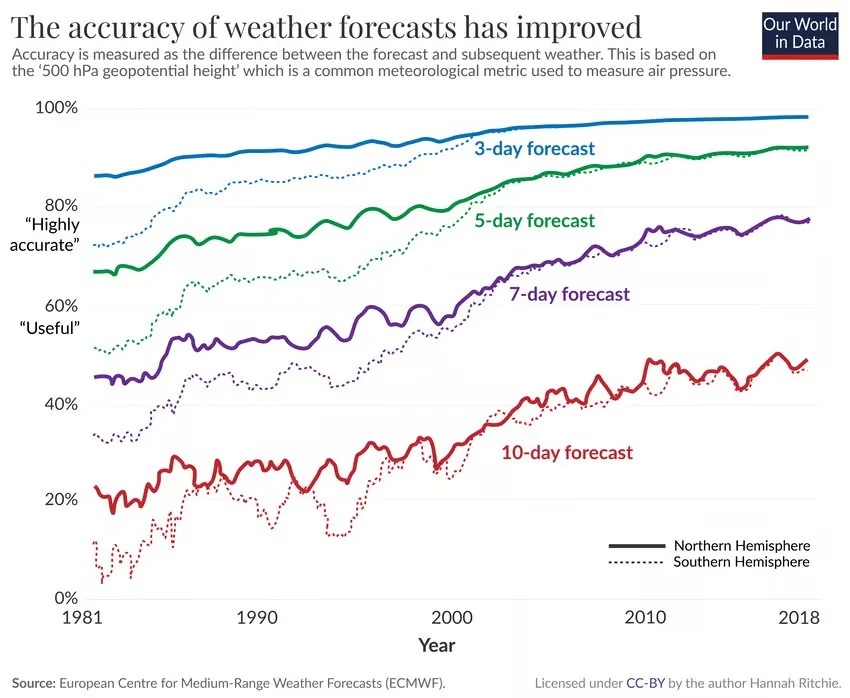
Meteorology is a fascinating field. Over the past fifty years, various forecasting tools have evolved, increasing the accuracy of weather predictions. Today's five-day forecast is as reliable as the single-day forecast from thirty years ago.


To most people, weather is a coherent, moving system: clouds roll in, rain falls, it stops, and it clears. Imagine a winter front arriving; the image that likely comes to mind is a vast, grey cloud cover stretching hundreds of miles, dumping heavy snow. Meteorologists call this stratiform weather, essentially like a layered cake, where the same weather experience unfolds across the covered area.


But weather isn't limited to this single form. If you've seen a summer thunderstorm in the plains, you'll notice it operates differently. First, an individual convective cell forms: warm, moist air near the ground rises, meets cold air aloft, condenses, and forms a towering, localized cumulonimbus cloud. Within an hour, hail, lightning, and torrential rain follow, visibility dropping to under a hundred meters.


Once the cell reaches its peak and releases its energy, it gradually dissipates. The storm's downdraft of cold air spreads outward at speeds up to 40 miles per hour. When this cold air collides with surrounding warm, moist air that hasn't yet formed a storm, it acts like a wedge, pushing the warm air upward again.


As long as sufficient atmospheric instability exists, this "cold air wedge" can trigger a new convective cell ten or more miles away from the original storm.
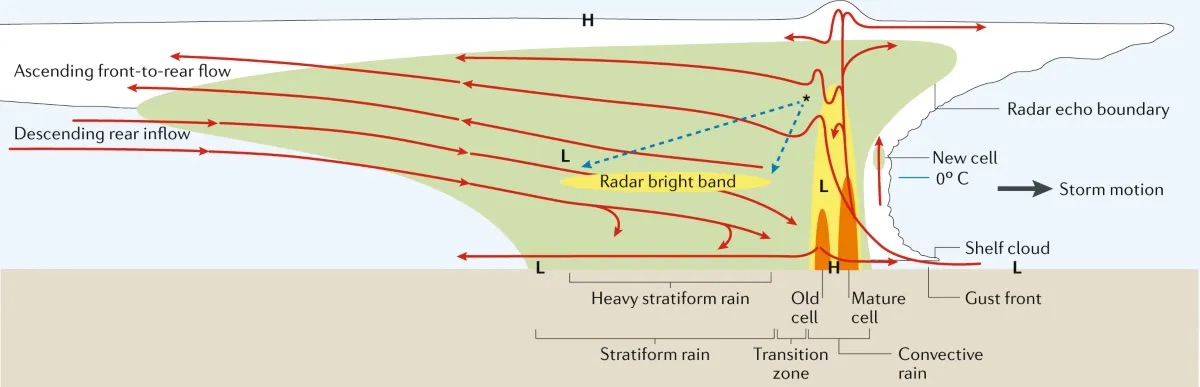


The new cell couldn't have formed on its own; the energy was already present in the atmosphere, lacking only a trigger, which the dying storm provided. Then, the new cell repeats the evolution of the previous storm.


When multiple convective cells form in sequence, they constitute a Mesoscale Convective System. From the ground, one only encounters each storm individually; each one feels like the entire weather system. On one side, all is calm, with people unaware of the coming storm; on the other side, the rain has already passed. But from a satellite's eye view, you see a series of separate cells linked in a line, each at a different stage of development, moving forward until it exhausts the warm, moist air along its path.


Supercell storm cloud near Amistad, New Mexico, at sunset


This sequential storm system requires vastly different atmospheric conditions than a single frontal system:

  • Warm, moist air near the surface acts as the storm's "fuel."
  • Dry, cold air aloft encourages the warm air to rise, creating atmospheric instability.
  • Winds varying with altitude cause the storm to rotate and move laterally, known as wind shear.


When these three conditions align, a parade of storms unfolds.


After all this meteorology, back to the point: the financial markets today operate almost exactly like this meteorological phenomenon.


The markets of the past were like stratiform weather systems: a multi-year bull market, followed by a multi-year bear market, with slow rotations of sector leadership. The 1982-2000 long bull market, followed by the internet bubble, then the 2003-2007 real estate and credit cycle. These cycles were long and clear. Even if investors' timing was off by years, understanding the major trend still led to profits.


But today's market is nothing like that. We are in a convective storm chain market: one hot sector after another hits like sequential storms. To those inside, each surge feels unstoppable and all-encompassing.


Capital flows out of fading narratives and ignites new frenzies in adjacent areas. The pace of leadership rotation has dramatically accelerated—AI infrastructure, GLP-1s (a class of diabetes drugs popular for weight loss, now a hot investment theme), stablecoins, quantum technology, nuclear energy, decentralized autonomous tech, robotics, space... Each undergoes a complete hype cycle, with its own cohort of true believers, a full narrative arc, and inevitably, a correction. The "cold air" from the dying bubble spreads out, igniting the next hotspot in a new area.


Refusing to acknowledge this fundamental market shift is self-delusion. People love to mock the phrase "this time is different," but ignoring permanent changes in the financial environment is either intellectual laziness or stubborn nostalgia for a market that no longer exists.


A Market Landscape Transformed


For a long time after WWII, financial markets moved at the pace of slow-moving weather systems. A bull market could last ten, fifteen, even twenty years, with rotations still anchored to long-term secular trends.
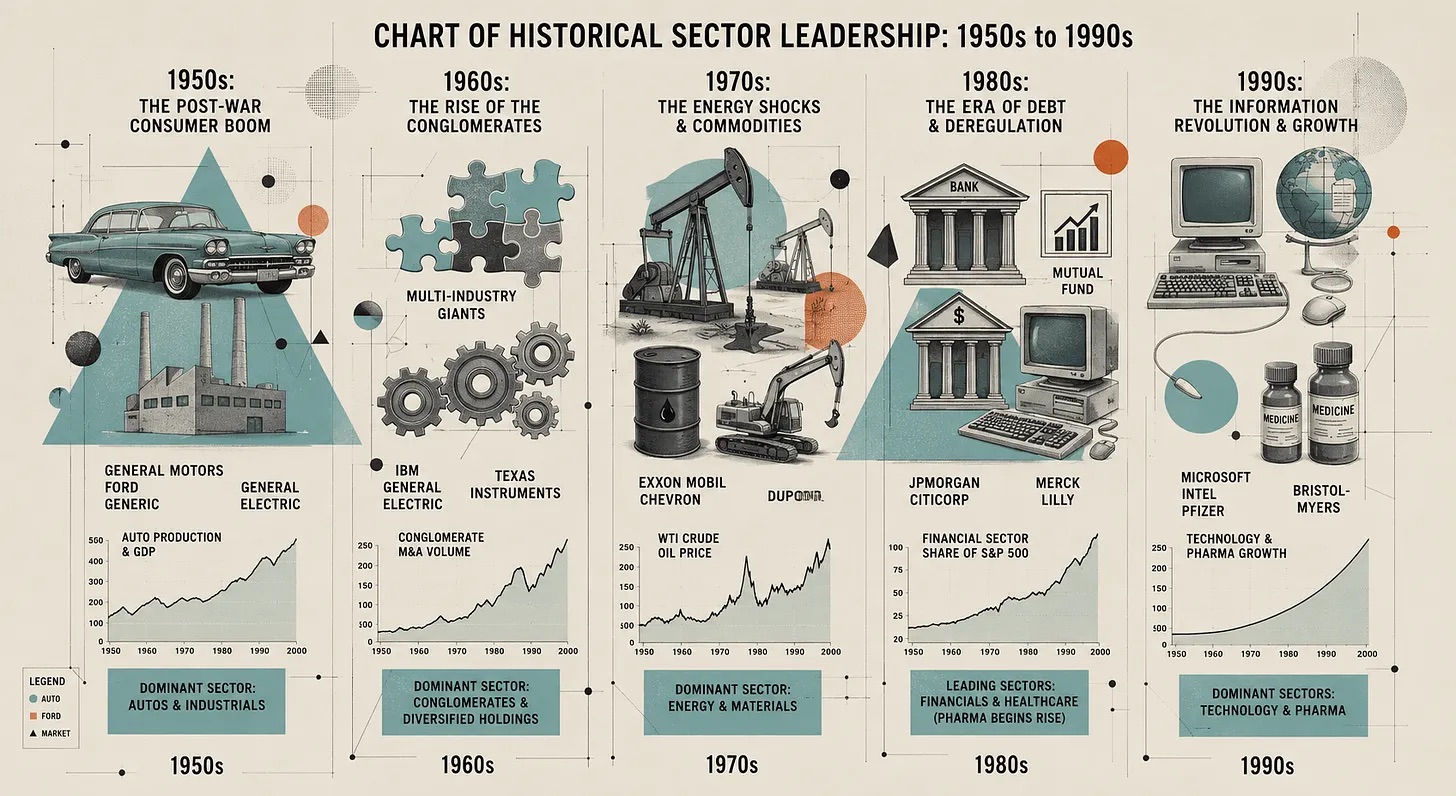

Approximate timeline of thematic sectors and leading market segments


Back then, sector rotations occurred within a unified macro backdrop. Only at major inflection points—the breakdown of Bretton Woods, Volcker's anti-inflation push, the peak of the dot-com bubble, the Global Financial Crisis—did the grand market regime truly shift.


This structure arose from many factors: high transaction costs, minimal retail participation forcing a long-term holding mindset, pension funds as the primary retirement vehicle. The S&P 500 was dominated by manufacturing, energy, banking, and retail—companies whose earnings grew roughly in line with the economy, stable and predictable. Information also moved slowly; an annual report might take weeks to be digested by most investors.


Volatility was also more symmetrical. Deep corrections followed bull markets, with leverage unwinding slowly over long periods. Rallies in bear markets were similarly gradual. The market lingered in different emotional states for long stretches, with regime changes measured in quarters or years.


In the weather analogy, the old market had: moderate fuel, high atmospheric stability, weak wind shear. Long, smooth waves. Investors could plan accordingly. Today, all environmental conditions have changed, some reversed, leading to a structural transformation.


Where Did the Change Come From?


Numerous shifts intertwine and amplify each other, each alone powerful enough to reshape markets. In summary, there are eight core transformations:


  1. The Democratization of Speculation
  2. The Formation of Perpetual Buyers
  3. Passive Investing Creates Inelastic Counterparties
  4. The Rise of Multi-Strategy & HFT, The Disappearance of the Middle
  5. Volatility Suppression
  6. A Complete Shift in Index Composition
  7. The End of Information Latency
  8. Fiscal & Monetary Regime Change


1. The Democratization of Speculation


The participant base has visibly changed. In the 1990s, retail trading accounted for only ~10% of US equity volume. High commissions meant retail mostly bought and held stocks, with little active speculation.


Robinhood pioneered zero-commission trades and payment for order flow. In Fall 2019, Schwab eliminated commissions, followed by Fidelity, TD Ameritrade, E*Trade—rewriting the rulebook.


Covid accelerated this: stimulus checks, idle time at home, gamified mobile trading apps. Retail's share of volume surged to ~25% in 2020-2021. Many thought it was temporary, but elevated retail participation persists. On April 29, 2025, amid market gyrations from tariff news, JPMorgan data showed retail order flow hitting a record 48% of volume. On normal days, it's over double pre-Covid levels; during big moves, it can reach 35%.


The deeper change is in *what* retail trades. Single-stock options dominate, with zero-day-to-expiration options exploding. The new cohort is younger, highly concentrated, trades narratives. Critically, they often use leverage not captured in margin data, and trade more on price action than fundamentals, heavily influenced by social signals.


In weather terms: the market's "warm, moist air" near the surface is more abundant than ever, with immense latent energy potential.


2. The Formation of Perpetual Buyers


I've written about this before. In short, the US retirement system shifted from Defined Benefit pensions to Defined Contribution plans. Individuals now must manage their own retirement savings. This translates to a massive, price-insensitive, passive flow of capital into equities every pay period—an automated, perpetual bid.


Traditional pensions operated differently: DB plans had to manage duration risk against liabilities. Managers made active judgments on valuation; if stocks were expensive, they could tilt towards bonds. Even if slow-moving, this was far more active than today's purely passive perpetual bid.


This is crucial: the marginal trading dollar today has far more price impact than before.


3. Passive Investing Creates Inelastic Counterparties


Passive index investing, by definition, buys and sells irrespective of price, purely based on index weight. The higher a stock's market cap, the more passive money flows in, and vice versa. This inherently embeds momentum into the market's plumbing. The Magnificent Seven's dominance is partly fueled by this.


Countless articles have detailed index concentration. Yes, these companies are exceptionally profitable and growing. But the core issue: there is no natural "sell" switch for passive flows.


4. The Rise of Multi-Strategy & HFT, The Disappearance of the Middle


While perpetual passive buyers formed, the active trading landscape also transformed. The hallmark is the rise of multi-strategy pod shops: Citadel, Millennium, Point72, Balyasny—housing hundreds of independent PMs running specific strategies under strict risk controls. AUM for these firms exploded, concentration mirroring index concentration.


Simultaneously, High-Frequency Trading now accounts for 50-60% of US equity volume, ~75% in futures. This combination creates a fragile market microstructure: funds trade against each other, weakening price discovery. Much of the volume is just capital churning within the system.


In normal times, bid-ask spreads are razor-thin—a good thing. But when a narrative breaks, positioning becomes extreme, or multiple firms' risk limits are breached, the microstructure fails. PMs' risk exposures are highly correlated, stop-loss rules similar. One firm's forced selling triggers others'. Think Feb 2018, Aug 2019, Mar 2020, Aug 2024. The structure enabling these events is now entrenched and will repeat.


Traditional fundamental long/short hedge funds are being squeezed out. These funds ran 20-40 stock books based on deep research, with investment horizons of quarters. Now, they're absorbed into larger platforms, move to private markets, family offices, or single-strategy funds. I believe there's still significant alpha in understanding narrative rotation and patience amidst short-term flows.


5. Volatility Suppression


Combining the above four points, today's volatility regime makes sense. Since 1990, the VIX has closed below 20 on about two-thirds of trading days. Volatility exhibits ~85% day-to-day correlation, meaning today's vol level heavily depends on yesterday's.


But regime shifts are extreme and asymmetrical. Numerous studies show suppressed volatility eventually breaks out violently over a few days, but decays back slowly over weeks.


The reasons are structural: a massive "short vol" industry exists. The rise of 0DTE options means market makers' hedging further suppresses intraday vol. Markets simmer at low volatility, risk builds, and when tail risks emerge, everyone rushes for the exits simultaneously.


Simply put, volatility distribution is now more pathological: long periods of compression lead to more violent decompressions.


6. A Complete Shift in Index Composition


The sixth change is the composition of the indices themselves. In 1980, the S&P 500 was dominated by manufacturers: Industrials, Materials, Energy, Financials, Staples. Their earnings grew roughly with GDP, stable, with valuation multiples mean-reverting. Forecasting P&G's earnings five years out wasn't wildly off.


Today is different. Information Technology, Communication Services, plus tech-heavy names in Consumer Discretionary like Amazon and Tesla, comprise over 40% of the S&P 500. These companies' earnings aren't linear. Software has near-zero marginal distribution costs. AI is profoundly uncertain—will AI labs become the core infrastructure for the next half-century, or money-losing science projects? Opinions diverge wildly.


For such companies, forecasting near-term earnings is hard; long-term value is highly speculative, leading to massive valuation swings. Valuation relies less on financial statements, more on narrative. For investors who can anticipate technological frontiers, competitive moats, and nascent markets, this creates massive alpha opportunities.


Traditional manufacturers expand capacity gradually, DCF models are stable, multiples mean-revert. Now, valuation often hinges on the market's belief in a story. This isn't to say traditional valuation is dead; it's the reality for these new asset types.


Today's major indices are packed with these long-duration, narrative-driven assets. The steeper the temperature gradient in the atmosphere, the more potential energy. Similarly, more of these assets mean more potential market energy, leading to more violent moves when triggered.


7. The End of Information Latency


Everyone feels this intuitively, but its impact is underrated. For most of financial history, market-relevant information traveled with the speed of its distribution medium. Now, information is virtually latency-free.


Especially positioning information travels faster than ever. Investors see real-time reactions of known figures. More people publicize their positions. A torrent of real-time info fuels FOMO. Gain screenshots abound, stories of turning $1k into millions go viral. The fear of missing out is perpetual.


8. Fiscal & Monetary Regime Change


This needs little elaboration. The summary:

  • Persistently accommodative US monetary policy, low real rates.
  • Quantitative Easing expanding the Fed's balance sheet.
  • Low discount rates elevating prices of all long-duration assets.
  • Activist fiscal policy—stimulus checks, industrial policy bills.
  • Full employment alongside wartime-sized deficits.
  • A K-shaped economy, decoupling financial markets from Main Street.


How the Storms Form


Combine all the above, and rotating market bubbles become an inevitable outcome.
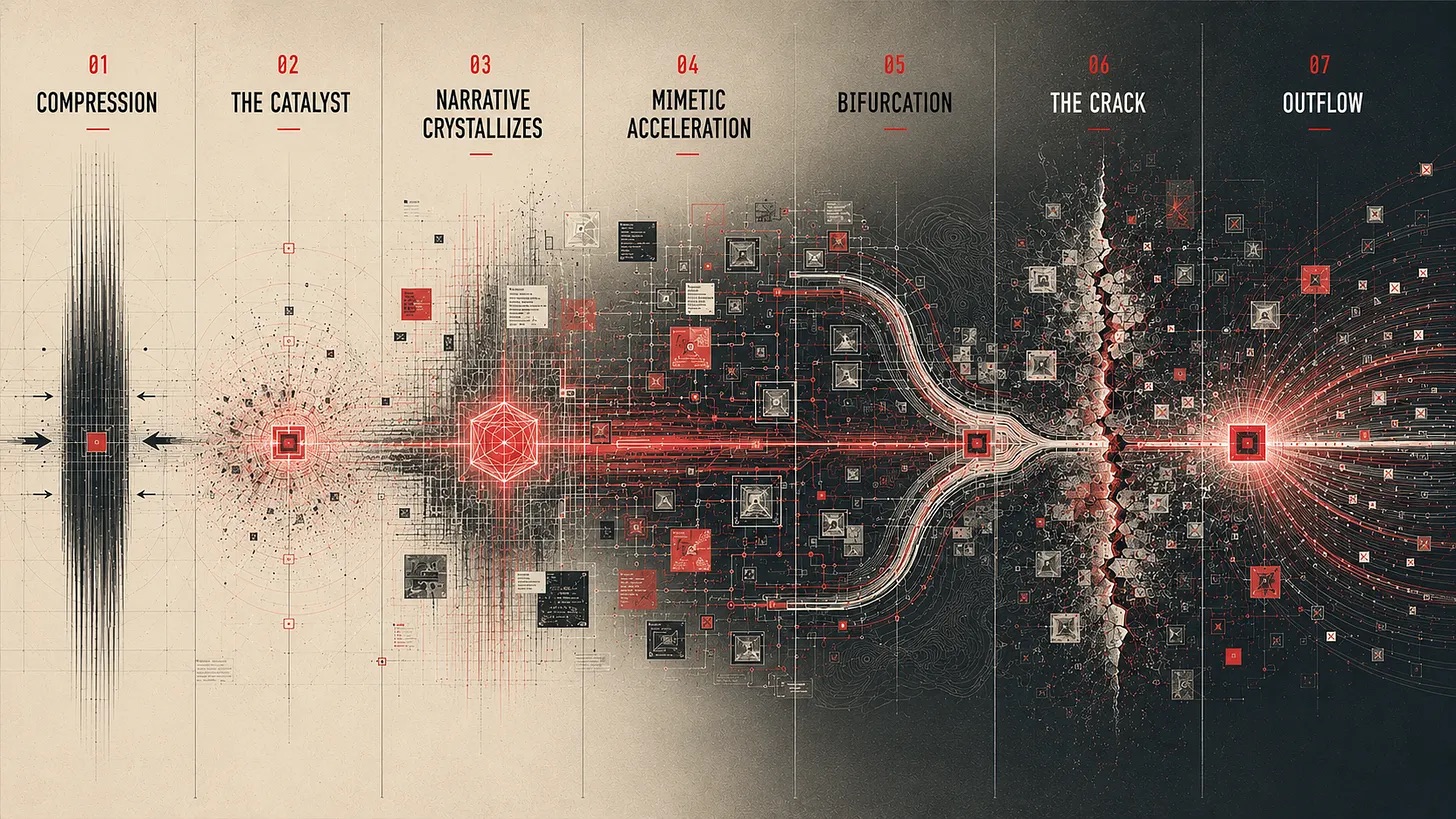


The lifecycle is multi-stage and logical:

  • Dormancy: Sectors fall out of favor, ignored. But work continues in obscurity.
  • Catalyst: A genuine breakthrough—technical, regulatory, earnings—noticed first by deep sector specialists.
  • Narrative Formation: A cohesive market narrative emerges, dramatically lowering the cognitive barrier to entry. Purists may hate the simplification, but simple stories enable mass participation.
  • Divergence of Opinion: Clear polarization occurs. Beyond true believers, the pool of potential marginal buyers shrinks. The gap between bulls' and bears' valuation estimates widens.
  • Break: In hindsight, the peak is always clear. Today's participants are eager to call tops, a natural outcome of the attention economy. Once the narrative cracks, concerted selling begins. Capital seeks a new home.
  • New Hotspot Emerges: The outflowing capital—the "cold air wedge"—triggers the next bubble in a new area.


Looking Ahead


The implications of this new regime are profound. We can predict the *shape* of the storm chain, but not the exact *location* of each cell.


Post-Covid, many believed market aberrations were temporary or unique to ZIRP. Some of that was true, but it's now clear the structural shift is permanent. None of the eight drivers are reversing:


  • Commissions aren't coming back.
  • Passive AUM isn't shrinking.
  • Traditional DB pensions are gone for good.
  • Social media and information speed will only increase.
  • Multi-strategy shops may evolve but, given their scale/profitability, aren't disappearing soon.
  • Information latency isn't getting longer.


This environment is the new "climate." Expecting a return to the slow, stratified markets of the 80s/90s is refusing to face reality.


Some argue the duration of each bubble will compress indefinitely. That's hard to say, as it becomes a game of anticipating others' anticipation. But one thing is certain: each cycle educates participants, potentially accelerating the next. Crypto traders now play by traditional market rules. However, narrative-driven cycles have a natural minimum duration; they can't accelerate infinitely.


This rotating bubble market primarily benefits two types of investors. First, **deep sector specialists** who understand the underlying tech, regulation, supply chains, unit economics, and can judge if the narrative can become reality. AI tools will make many think they belong here—a dangerous trap. Second, **regime observers**. Most investors fall here, tasked with identifying what the dominant sophisticated cohort is doing.


And the pipeline of future narratives is rich: AI infrastructure & apps, robotics, embodied AI, precision medicine, crypto, materials science, fusion & advanced fission, grid storage, space, brain-computer interfaces, quantum. Even within a megatrend, different segments (upstream/downstream, layers of the tech stack) will bubble sequentially.


Retail has innate advantages in this market: time flexibility, no investment committee meetings, no quarterly redemption pressures. The effective "buy the dip" strategy of recent years provided a baseline. With proper risk management, retail can thrive here.


Rising Above the Storm


Explaining the structure might sound like I'm making a value judgment. I have my opinions. In venture, we can choose not to fund projects with negative social externalities. But in public markets, the most common error is predicting the market you *wish* existed, not the one that does.


It's a human emotional bug; even Newton fell victim to it.


Emotion is the enemy of returns. Constantly, you see asset managers on TV calling for a crash, a recession. They are perma-bears, rarely right.


The market isn't going back. Is this storm-chain regime more pathological than the old one? I can't say. Objectively, many changes enabling it are positive: lower investment barriers, automated retirement savings, accessible passive vehicles, real-time information—democratizing finance.


On the ground, each storm feels all-encompassing, vision limited to the immediate squall. That's the experience inside each sector bubble: a gravitational pull absorbing all market attention. To see the full chain—one bubble dying, the next igniting—you must actively elevate your perspective. Participants in each cycle are lost in their own mania or despair.


Markets are fascinating because they constantly evolve, yet price discovery remains a human endeavor. Humans are emotional and repeat mistakes. This tension creates what we see: seeming chaos up close, but from a higher vantage, just a rolling sequence of bubbles.


The core intent here is to encourage stepping out of the immediate storm, observing from a higher plane, seeing where the chain is headed, and avoiding being swept away by the emotions of any single bubble.


Simple in theory, demanding immense discipline in practice. Easier said than done.

Perguntas relacionadas

QWhat core analogy does the author use to describe the modern financial market, and what are its key characteristics?

AThe author uses the meteorological analogy of a 'convective storm chain' or 'mesoscale convective system' to describe the modern market. Its key characteristics are the rapid, sequential formation of individual speculative 'bubbles' or 'storms' in different sectors (like AI, GLP-1s, crypto). Each storm feeds off market energy (capital/enthusiasm), reaches a peak, and then dissipates. The outflow from a fading bubble acts as a 'cold air wedge' that triggers the next bubble in an adjacent sector, creating a continuous chain of rolling speculation rather than a single, long-lasting 'front' of a traditional bull market.

QWhat are the three atmospheric conditions necessary for a convective storm chain, and how do they correspond to the author's view of the current market structure?

A1. Warm, moist air near the surface (Fuel) -> Corresponds to a massive, retail-driven speculative base using leverage and options. 2. Dry, cold air aloft (Instability) -> Corresponds to a market index full of long-duration, narrative-driven companies (like tech/AI) with high valuation uncertainty, creating potential energy. 3. Wind shear (directional wind change with altitude) -> Corresponds to the specific triggering mechanisms (e.g., a tech breakthrough, policy change) that force the warm speculative capital upward to initiate a new bubble, and the fast flow of information/capital that propels it sideways.

QList three of the eight fundamental market shifts the author identifies as creating the 'convective' environment.

A1. Democratization of Speculation: Zero-commission trading, gamified apps, and high retail participation (especially in options) have created a massive, energetic 'fuel' layer. 2. The Rise of Passive Perpetual Buying: The shift from defined-benefit pensions to defined-contribution plans (like 401(k)s) creates constant, price-insensitive inflows into the market, providing a persistent bid. 3. The Dominance of Multi-Strategy Funds and HFT: These actors, with correlated risk models, provide liquidity in calm times but can cause microstructural breakdowns during stress, as they all rush for exits simultaneously, amplifying volatility.

QAccording to the author, which two types of investors are best positioned to benefit in this new market regime?

A1. Deep Fundamental Analysts: Those who can truly understand the technology, regulatory landscape, supply chains, and unit economics behind a narrative to judge if expectations are realistic. 2. Flow/Trend Observers: Those who focus on identifying and following the momentum and actions of the dominant professional players and capital flows, rather than fighting the prevailing trend.

QWhy does the author believe the shift to this 'chain of rolling bubbles' market structure is permanent, not a temporary anomaly?

AThe author argues the eight underlying drivers are structural and unlikely to reverse: trading commissions won't go back up; passive investing will not shrink; defined-benefit pensions are gone for good; information flow will only get faster; large multi-strategy firms are entrenched; and low interest rates/fiscal deficits have become a persistent feature. Therefore, this new 'climate' is the enduring baseline for markets, not a transient weather pattern.

Leituras Relacionadas

Bitcoin Monthly Chart Adjustment Structure Established, HYPE Entry Opportunity Emerges | Exclusive Analysis

Bitcoin Monthly Correction Structure Confirmed, HYPE Entry Opportunity Emerges | Guest Analysis Last week's analysis correctly identified that the $60,000 level for Bitcoin was an intermediate point, not the bottom of the current correction. This was validated on June 5th when the price broke below this key support, dropping to around $59,100. The monthly-level a-b-c three-wave corrective structure from the October 2025 high of $126,200 is now fully established, with the market currently in the c-wave decline phase. The cumulative adjustment time is less than 35 days, indicating the structure is far from complete. This week's focus will be tracking the rebound's strength and resistance performance. The two key resistance zones of $65,000 and $69,500~$70,500 will be crucial observation points for determining the subsequent trend. For HYPE, last week's top warning signal was also validated, with the price falling up to 27% from its $75.87 high. The token has now entered a support zone, presenting a potential short-term entry opportunity. From a strategic standpoint, the medium-term outlook remains bearish, awaiting optimal timing to add short positions upon a rebound. **Key Trading Views Summary:** * **BTC:** The analysis maintains a bearish medium-term bias. Strategy involves building short positions on rebounds towards $65,000 or the $69,500~$70,500 resistance area. A break below the $59,000-$60,000 support could trigger additional short entries. Short-term trading (30% capital) focuses on range-bound opportunities. * **HYPE:** Following a confirmed correction from the $75.87 high, the short-term strategy shifts to "buying on dips." Consider light long positions (under 30%仓位) if the price finds support and shows stabilization signals in the $55-$57 or deeper $47-$49 support zones, contingent on confirming technical signals. The key resistance to watch is the $62.5-$64.57 area. **Risk Management Reminder:** Always set an initial stop-loss immediately upon opening a position. Move the stop-loss to breakeven upon achieving 1% profit, and subsequently trail it to lock in gains. Market conditions change rapidly; this analysis is for informational purposes only and not investment advice.

marsbitHá 23m

Bitcoin Monthly Chart Adjustment Structure Established, HYPE Entry Opportunity Emerges | Exclusive Analysis

marsbitHá 23m

Valuation Surpasses 200 Billion, Kimi Reportedly Raises 13.6 Billion More, Speeds Up Hong Kong IPO

Beijing-based AI unicoth MoonDark (Kimi) is reportedly in talks for a new funding round aiming to raise up to $20 billion (approximately RMB 136 billion), targeting a post-money valuation of $300 billion (approximately RMB 2.035 trillion). If successful, this would mark its third round in six months and a six-fold increase from its $43 billion valuation in December last year. Last month, the company completed a $20 billion funding round led by Meituan Longzhu, reaching a valuation exceeding $200 billion. According to reports, MoonDark has raised over RMB 376 billion across six rounds, making it the most funded large language model startup in China. Founded in 2023 by CEO Yang Zhilin, the company's core product is the Kimi AI Assistant. In April, it launched and open-sourced its flagship model, Kimi K2.6, which has demonstrated performance comparable to top models like GPT-5.4 in certain benchmarks. Recently, it began beta testing for Kimi Work, a local AI agent for knowledge workers. Commercially, the company's Annual Recurring Revenue (ARR) reportedly surpassed $2 billion in April. Regarding its IPO plans, Bloomberg reported in March that MoonDark is preparing for a listing in Hong Kong, though the process remains in early stages. The funding and IPO pace for leading Chinese AI firms has accelerated notably in 2026, mirroring global trends where companies like OpenAI and Anthropic are also setting new fundraising and valuation records. Securing substantial capital is becoming a critical factor in the competitive landscape alongside model capabilities.

marsbitHá 26m

Valuation Surpasses 200 Billion, Kimi Reportedly Raises 13.6 Billion More, Speeds Up Hong Kong IPO

marsbitHá 26m

South Korea's KOSPI Plunges 8.37% at Opening, Triggers Circuit Breaker: The 'Two Stocks' That Powered the Bull Market Recoil in a Single Day

On June 8th, South Korea's KOSPI index plunged 8.37% within minutes of market open, triggering a circuit breaker and halting trading. The crash was driven by a massive sell-off in heavyweight stocks Samsung Electronics and SK Hynix, which each fell 10%. These two chip giants alone account for over half of the KOSPI's total market capitalization and had contributed roughly 70% of the index's gains year-to-date, pushing it to become the world's sixth-largest stock market. The sell-off was ignited by negative guidance from U.S. chipmaker Broadcom on June 3rd, which sparked a global semiconductor stock rout. This shockwave hit South Korean markets on June 5th, with foreign investors leading a sustained exodus. The sharp decline on June 8th was exacerbated by high levels of retail margin debt (over 38 trillion KRW), forced liquidations, leveraged ETFs tied to the top stocks, and automated program trading, creating a vicious cycle. The Korean won also weakened significantly, further fueling foreign capital outflow. South Korean authorities issued emergency statements to calm markets, echoing recent warnings from the central bank governor about the risks of debt-driven investing. While some institutions like Goldman Sachs maintain long-term bullish targets for the KOSPI, the crash exposed the extreme market concentration and fragility behind its historic rally.

marsbitHá 28m

South Korea's KOSPI Plunges 8.37% at Opening, Triggers Circuit Breaker: The 'Two Stocks' That Powered the Bull Market Recoil in a Single Day

marsbitHá 28m

Trading

Spot
Futuros

Artigos em Destaque

O que é $S$

Compreender o SPERO: Uma Visão Abrangente Introdução ao SPERO À medida que o panorama da inovação continua a evoluir, o surgimento de tecnologias web3 e projetos de criptomoeda desempenha um papel fundamental na formação do futuro digital. Um projeto que tem atraído atenção neste campo dinâmico é o SPERO, denotado como SPERO,$$s$. Este artigo tem como objetivo reunir e apresentar informações detalhadas sobre o SPERO, para ajudar entusiastas e investidores a compreender as suas bases, objetivos e inovações nos domínios web3 e cripto. O que é o SPERO,$$s$? O SPERO,$$s$ é um projeto único dentro do espaço cripto que procura aproveitar os princípios da descentralização e da tecnologia blockchain para criar um ecossistema que promove o envolvimento, a utilidade e a inclusão financeira. O projeto é concebido para facilitar interações peer-to-peer de novas maneiras, proporcionando aos utilizadores soluções e serviços financeiros inovadores. No seu núcleo, o SPERO,$$s$ visa capacitar indivíduos ao fornecer ferramentas e plataformas que melhoram a experiência do utilizador no espaço das criptomoedas. Isso inclui a possibilidade de métodos de transação mais flexíveis, a promoção de iniciativas impulsionadas pela comunidade e a criação de caminhos para oportunidades financeiras através de aplicações descentralizadas (dApps). A visão subjacente do SPERO,$$s$ gira em torno da inclusão, visando fechar lacunas dentro das finanças tradicionais enquanto aproveita os benefícios da tecnologia blockchain. Quem é o Criador do SPERO,$$s$? A identidade do criador do SPERO,$$s$ permanece algo obscura, uma vez que existem recursos publicamente disponíveis limitados que fornecem informações detalhadas sobre o(s) seu(s) fundador(es). Esta falta de transparência pode resultar do compromisso do projeto com a descentralização—uma ética que muitos projetos web3 partilham, priorizando contribuições coletivas em vez de reconhecimento individual. Ao centrar as discussões em torno da comunidade e dos seus objetivos coletivos, o SPERO,$$s$ incorpora a essência do empoderamento sem destacar indivíduos específicos. Assim, compreender a ética e a missão do SPERO é mais importante do que identificar um criador singular. Quem são os Investidores do SPERO,$$s$? O SPERO,$$s$ é apoiado por uma diversidade de investidores que vão desde capitalistas de risco a investidores-anjo dedicados a promover a inovação no setor cripto. O foco desses investidores geralmente alinha-se com a missão do SPERO—priorizando projetos que prometem avanço tecnológico social, inclusão financeira e governança descentralizada. Essas fundações de investidores estão tipicamente interessadas em projetos que não apenas oferecem produtos inovadores, mas que também contribuem positivamente para a comunidade blockchain e os seus ecossistemas. O apoio desses investidores reforça o SPERO,$$s$ como um concorrente notável no domínio em rápida evolução dos projetos cripto. Como Funciona o SPERO,$$s$? O SPERO,$$s$ emprega uma estrutura multifacetada que o distingue de projetos de criptomoeda convencionais. Aqui estão algumas das características-chave que sublinham a sua singularidade e inovação: Governança Descentralizada: O SPERO,$$s$ integra modelos de governança descentralizada, capacitando os utilizadores a participar ativamente nos processos de tomada de decisão sobre o futuro do projeto. Esta abordagem promove um sentido de propriedade e responsabilidade entre os membros da comunidade. Utilidade do Token: O SPERO,$$s$ utiliza o seu próprio token de criptomoeda, concebido para servir várias funções dentro do ecossistema. Esses tokens permitem transações, recompensas e a facilitação de serviços oferecidos na plataforma, melhorando o envolvimento e a utilidade gerais. Arquitetura em Camadas: A arquitetura técnica do SPERO,$$s$ suporta modularidade e escalabilidade, permitindo a integração contínua de funcionalidades e aplicações adicionais à medida que o projeto evolui. Esta adaptabilidade é fundamental para manter a relevância no panorama cripto em constante mudança. Envolvimento da Comunidade: O projeto enfatiza iniciativas impulsionadas pela comunidade, empregando mecanismos que incentivam a colaboração e o feedback. Ao nutrir uma comunidade forte, o SPERO,$$s$ pode melhor atender às necessidades dos utilizadores e adaptar-se às tendências do mercado. Foco na Inclusão: Ao oferecer taxas de transação baixas e interfaces amigáveis, o SPERO,$$s$ visa atrair uma base de utilizadores diversificada, incluindo indivíduos que anteriormente podem não ter participado no espaço cripto. Este compromisso com a inclusão alinha-se com a sua missão abrangente de empoderamento através da acessibilidade. Cronologia do SPERO,$$s$ Compreender a história de um projeto fornece insights cruciais sobre a sua trajetória de desenvolvimento e marcos. Abaixo está uma cronologia sugerida que mapeia eventos significativos na evolução do SPERO,$$s$: Fase de Conceituação e Ideação: As ideias iniciais que formam a base do SPERO,$$s$ foram concebidas, alinhando-se de perto com os princípios de descentralização e foco na comunidade dentro da indústria blockchain. Lançamento do Whitepaper do Projeto: Após a fase conceitual, um whitepaper abrangente detalhando a visão, os objetivos e a infraestrutura tecnológica do SPERO,$$s$ foi lançado para atrair o interesse e o feedback da comunidade. Construção da Comunidade e Primeiros Envolvimentos: Esforços ativos de divulgação foram feitos para construir uma comunidade de primeiros adotantes e investidores potenciais, facilitando discussões em torno dos objetivos do projeto e angariando apoio. Evento de Geração de Tokens: O SPERO,$$s$ realizou um evento de geração de tokens (TGE) para distribuir os seus tokens nativos a apoiantes iniciais e estabelecer liquidez inicial dentro do ecossistema. Lançamento da dApp Inicial: A primeira aplicação descentralizada (dApp) associada ao SPERO,$$s$ foi lançada, permitindo que os utilizadores interagissem com as funcionalidades principais da plataforma. Desenvolvimento Contínuo e Parcerias: Atualizações e melhorias contínuas nas ofertas do projeto, incluindo parcerias estratégicas com outros players no espaço blockchain, moldaram o SPERO,$$s$ em um jogador competitivo e em evolução no mercado cripto. Conclusão O SPERO,$$s$ é um testemunho do potencial do web3 e das criptomoedas para revolucionar os sistemas financeiros e capacitar indivíduos. Com um compromisso com a governança descentralizada, o envolvimento da comunidade e funcionalidades inovadoras, abre caminho para um panorama financeiro mais inclusivo. Como em qualquer investimento no espaço cripto em rápida evolução, potenciais investidores e utilizadores são incentivados a pesquisar minuciosamente e a envolver-se de forma ponderada com os desenvolvimentos em curso dentro do SPERO,$$s$. O projeto demonstra o espírito inovador da indústria cripto, convidando a uma exploração mais aprofundada das suas inúmeras possibilidades. Embora a jornada do SPERO,$$s$ ainda esteja a desenrolar-se, os seus princípios fundamentais podem, de facto, influenciar o futuro de como interagimos com a tecnologia, as finanças e uns com os outros em ecossistemas digitais interconectados.

69 Visualizações TotaisPublicado em {updateTime}Atualizado em 2024.12.17

O que é $S$

O que é AGENT S

Agent S: O Futuro da Interação Autónoma no Web3 Introdução No panorama em constante evolução do Web3 e das criptomoedas, as inovações estão constantemente a redefinir a forma como os indivíduos interagem com plataformas digitais. Um projeto pioneiro, o Agent S, promete revolucionar a interação humano-computador através do seu framework aberto e agente. Ao abrir caminho para interações autónomas, o Agent S visa simplificar tarefas complexas, oferecendo aplicações transformadoras em inteligência artificial (IA). Esta exploração detalhada irá aprofundar-se nas complexidades do projeto, nas suas características únicas e nas implicações para o domínio das criptomoedas. O que é o Agent S? O Agent S é um framework aberto e agente, especificamente concebido para abordar três desafios fundamentais na automação de tarefas computacionais: Aquisição de Conhecimento Específico de Domínio: O framework aprende inteligentemente a partir de várias fontes de conhecimento externas e experiências internas. Esta abordagem dupla capacita-o a construir um rico repositório de conhecimento específico de domínio, melhorando o seu desempenho na execução de tarefas. Planeamento ao Longo de Longos Horizontes de Tarefas: O Agent S emprega planeamento hierárquico aumentado por experiência, uma abordagem estratégica que facilita a decomposição e execução eficientes de tarefas intrincadas. Esta característica melhora significativamente a sua capacidade de gerir múltiplas subtarefas de forma eficiente e eficaz. Gestão de Interfaces Dinâmicas e Não Uniformes: O projeto introduz a Interface Agente-Computador (ACI), uma solução inovadora que melhora a interação entre agentes e utilizadores. Utilizando Modelos de Linguagem Multimodais de Grande Escala (MLLMs), o Agent S pode navegar e manipular diversas interfaces gráficas de utilizador de forma fluida. Através destas características pioneiras, o Agent S fornece um framework robusto que aborda as complexidades envolvidas na automação da interação humana com máquinas, preparando o terreno para uma infinidade de aplicações em IA e além. Quem é o Criador do Agent S? Embora o conceito de Agent S seja fundamentalmente inovador, informações específicas sobre o seu criador permanecem elusivas. O criador é atualmente desconhecido, o que destaca ou o estágio nascente do projeto ou a escolha estratégica de manter os membros fundadores em anonimato. Independentemente da anonimidade, o foco permanece nas capacidades e no potencial do framework. Quem são os Investidores do Agent S? Como o Agent S é relativamente novo no ecossistema criptográfico, informações detalhadas sobre os seus investidores e financiadores não estão explicitamente documentadas. A falta de informações disponíveis publicamente sobre as fundações de investimento ou organizações que apoiam o projeto levanta questões sobre a sua estrutura de financiamento e roteiro de desenvolvimento. Compreender o apoio é crucial para avaliar a sustentabilidade do projeto e o seu impacto potencial no mercado. Como Funciona o Agent S? No núcleo do Agent S reside uma tecnologia de ponta que lhe permite funcionar eficazmente em diversos ambientes. O seu modelo operacional é construído em torno de várias características-chave: Interação Humano-Computador Semelhante: O framework oferece planeamento avançado em IA, esforçando-se para tornar as interações com computadores mais intuitivas. Ao imitar o comportamento humano na execução de tarefas, promete elevar as experiências dos utilizadores. Memória Narrativa: Utilizada para aproveitar experiências de alto nível, o Agent S utiliza memória narrativa para acompanhar os históricos de tarefas, melhorando assim os seus processos de tomada de decisão. Memória Episódica: Esta característica fornece aos utilizadores orientações passo a passo, permitindo que o framework ofereça suporte contextual à medida que as tarefas se desenrolam. Suporte para OpenACI: Com a capacidade de funcionar localmente, o Agent S permite que os utilizadores mantenham o controlo sobre as suas interações e fluxos de trabalho, alinhando-se com a ética descentralizada do Web3. Fácil Integração com APIs Externas: A sua versatilidade e compatibilidade com várias plataformas de IA garantem que o Agent S possa integrar-se perfeitamente em ecossistemas tecnológicos existentes, tornando-o uma escolha apelativa para desenvolvedores e organizações. Estas funcionalidades contribuem coletivamente para a posição única do Agent S no espaço cripto, à medida que automatiza tarefas complexas e em múltiplos passos com mínima intervenção humana. À medida que o projeto evolui, as suas potenciais aplicações no Web3 podem redefinir a forma como as interações digitais se desenrolam. Cronologia do Agent S O desenvolvimento e os marcos do Agent S podem ser encapsulados numa cronologia que destaca os seus eventos significativos: 27 de Setembro de 2024: O conceito de Agent S foi lançado num artigo de pesquisa abrangente intitulado “Um Framework Agente Aberto que Usa Computadores como um Humano”, mostrando a base para o projeto. 10 de Outubro de 2024: O artigo de pesquisa foi disponibilizado publicamente no arXiv, oferecendo uma exploração aprofundada do framework e da sua avaliação de desempenho com base no benchmark OSWorld. 12 de Outubro de 2024: Uma apresentação em vídeo foi lançada, proporcionando uma visão visual das capacidades e características do Agent S, envolvendo ainda mais potenciais utilizadores e investidores. Estes marcos na cronologia não apenas ilustram o progresso do Agent S, mas também indicam o seu compromisso com a transparência e o envolvimento da comunidade. Pontos-Chave Sobre o Agent S À medida que o framework Agent S continua a evoluir, várias características-chave destacam-se, sublinhando a sua natureza inovadora e potencial: Framework Inovador: Concebido para proporcionar um uso intuitivo de computadores semelhante à interação humana, o Agent S traz uma abordagem nova à automação de tarefas. Interação Autónoma: A capacidade de interagir autonomamente com computadores através de GUI significa um avanço em direção a soluções computacionais mais inteligentes e eficientes. Automação de Tarefas Complexas: Com a sua metodologia robusta, pode automatizar tarefas complexas e em múltiplos passos, tornando os processos mais rápidos e menos propensos a erros. Melhoria Contínua: Os mecanismos de aprendizagem permitem que o Agent S melhore a partir de experiências passadas, aprimorando continuamente o seu desempenho e eficácia. Versatilidade: A sua adaptabilidade em diferentes ambientes operacionais, como OSWorld e WindowsAgentArena, garante que pode servir uma ampla gama de aplicações. À medida que o Agent S se posiciona no panorama do Web3 e das criptomoedas, o seu potencial para melhorar as capacidades de interação e automatizar processos significa um avanço significativo nas tecnologias de IA. Através do seu framework inovador, o Agent S exemplifica o futuro das interações digitais, prometendo uma experiência mais fluida e eficiente para os utilizadores em diversas indústrias. Conclusão O Agent S representa um ousado avanço na união da IA e do Web3, com a capacidade de redefinir a forma como interagimos com a tecnologia. Embora ainda esteja nas suas fases iniciais, as possibilidades para a sua aplicação são vastas e cativantes. Através do seu framework abrangente que aborda desafios críticos, o Agent S visa trazer interações autónomas para o primeiro plano da experiência digital. À medida que avançamos mais profundamente nos domínios das criptomoedas e da descentralização, projetos como o Agent S desempenharão, sem dúvida, um papel crucial na formação do futuro da tecnologia e da colaboração humano-computador.

672 Visualizações TotaisPublicado em {updateTime}Atualizado em 2025.01.14

O que é AGENT S

Como comprar S

Bem-vindo à HTX.com!Tornámos a compra de Sonic (S) simples e conveniente.Segue o nosso guia passo a passo para iniciar a tua jornada no mundo das criptos.Passo 1: cria a tua conta HTXUtiliza o teu e-mail ou número de telefone para te inscreveres numa conta gratuita na HTX.Desfruta de um processo de inscrição sem complicações e desbloqueia todas as funcionalidades.Obter a minha contaPasso 2: vai para Comprar Cripto e escolhe o teu método de pagamentoCartão de crédito/débito: usa o teu visa ou mastercard para comprar Sonic (S) instantaneamente.Saldo: usa os fundos da tua conta HTX para transacionar sem problemas.Terceiros: adicionamos métodos de pagamento populares, como Google Pay e Apple Pay, para aumentar a conveniência.P2P: transaciona diretamente com outros utilizadores na HTX.Mercado de balcão (OTC): oferecemos serviços personalizados e taxas de câmbio competitivas para os traders.Passo 3: armazena teu Sonic (S)Depois de comprar o teu Sonic (S), armazena-o na tua conta HTX.Alternativamente, podes enviá-lo para outro lugar através de transferência blockchain ou usá-lo para transacionar outras criptomoedas.Passo 4: transaciona Sonic (S)Transaciona facilmente Sonic (S) no mercado à vista da HTX.Acede simplesmente à tua conta, seleciona o teu par de trading, executa as tuas transações e monitoriza em tempo real.Oferecemos uma experiência de fácil utilização tanto para principiantes como para traders experientes.

1.2k Visualizações TotaisPublicado em {updateTime}Atualizado em 2026.06.02

Como comprar S

Discussões

Bem-vindo à Comunidade HTX. Aqui, pode manter-se informado sobre os mais recentes desenvolvimentos da plataforma e obter acesso a análises profissionais de mercado. As opiniões dos utilizadores sobre o preço de S (S) são apresentadas abaixo.

活动图片














