Farewell to Buying Houses and Stocks: The Younger Generation Embraces Cryptocurrency as the Main Battlefield for Wealth

深潮Publicado em 2025-12-17Última atualização em 2025-12-17

Resumo

A new report by Coinbase reveals a significant generational shift in wealth-building strategies in the U.S. Younger investors, including Gen Z and millennials, are increasingly moving away from traditional paths like buying real estate and investing in stocks. Instead, they are turning to alternative assets, particularly cryptocurrencies, as a core component of their financial future. The study, conducted with Ipsos, found that 73% of young investors believe it's harder for their generation to build wealth through conventional means compared to their parents' generation. In response, they are actively diversifying their portfolios, allocating 25% to non-traditional assets like crypto, derivatives, and NFTs—three times the allocation of older investors. Nearly half (45%) of young investors already hold cryptocurrency, viewing it not as a speculative side investment but as a vital tool for catching up financially. They express strong optimism about crypto’s future, with 80% believing it offers financial opportunities outside the traditional system and will play a major role in the future of finance. This shift is driving demand for more innovative, internet-native financial products—such as crypto derivatives, DeFi, and 24/7 trading platforms—and reflects a broader move toward more active, risk-tolerant investment behavior among younger generations.

Written by: Coinbase

Compiled by: Chopper, Foresight News

For decades, the path to wealth accumulation for Americans has remained almost unchanged: find a good job, buy property, invest in stocks, and wait for the power of compound interest to yield returns. However, our latest "Cryptocurrency Industry Report" shows that the younger generation of investors no longer believes in this traditional path and is adjusting their investment behavior accordingly.

To understand how different generations respond to the market and the role cryptocurrency plays in their investment portfolios, Coinbase partnered with Ipsos to conduct a specialized survey. A total of 4,350 American adults were interviewed, including 2,005 investors with investment accounts. The core findings of the survey are as follows: younger investors, such as Gen Z and Millennials, are more inclined to actively manage their investments, more open to non-traditional assets, and more likely to view cryptocurrency as a core component of their financial future than any previous generation.
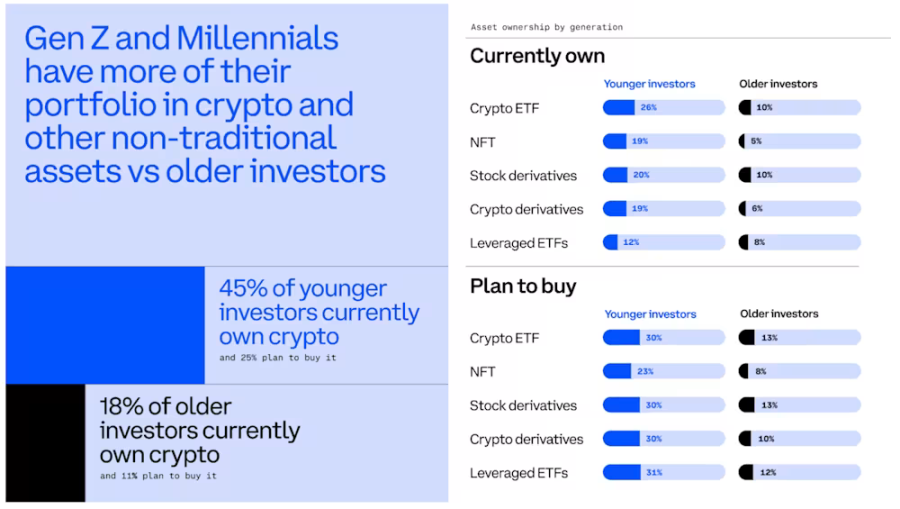
A Generation Shut Out of the Traditional Wealth Ladder

Younger investors are far more optimistic about the economy than older generations, but they believe the existing financial system is not designed for them. Survey data shows that nearly seven out of ten (73%) young people believe it is more difficult for their generation to accumulate wealth through traditional means compared to their parents' generation. In contrast, only 57% of older generations share this view.

They have witnessed soaring housing costs, overwhelming student debt, and sluggish wage growth. In this context, more and more young people are seeking alternative ways to accumulate wealth beyond the traditional model of "home equity + stock portfolio."

Non-Traditional Asset Allocation Three Times Higher Than Older Generations

This anxiety is directly reflected in their asset allocation strategies. The survey shows that younger investors allocate 25% of their portfolios to non-traditional asset classes such as cryptocurrencies, financial derivatives, non-fungible tokens (NFTs), and other emerging products. This is three times the proportion allocated by older investors, who only allocate 8% to non-traditional assets.

The proportion of stock holdings is roughly similar across generations, but the key difference lies in the fact that younger investors diversify their portfolios beyond stocks. They are more actively seeking opportunities for returns beyond traditional stock dividends and are more willing to experiment with new investment tools and emerging markets to narrow the wealth gap.

Cryptocurrency Is Not a Side Investment but a Core Allocation

This generational shift in investment philosophy is most evident in the acceptance of cryptocurrency. The report shows that 45% of younger investors already hold cryptocurrency, compared to only 18% of older investors. Additionally, nearly half (47%) of younger investors want to gain exposure to new crypto assets before the general market, while only 16% of older investors share this desire.

In the eyes of the younger generation, cryptocurrency is not merely a form of speculative trading but an important tool to help them catch up in wealth accumulation. Eighty percent of young people believe that cryptocurrency provides their generation with more financial opportunities outside the traditional financial system. At the same time, another 80% are convinced that cryptocurrency will play a significantly larger role in the future financial system. Among older investors, only about 60% share this view.

The younger generation's enthusiasm for exploring emerging markets extends beyond spot cryptocurrencies; they are also eager to engage with more non-traditional assets. Data shows that 80% of younger investors are willing to try new investment opportunities ahead of others, while less than half of older generations share this attitude. Younger investors consistently show strong interest in emerging non-traditional products such as cryptocurrency derivatives, prediction markets, 24/7 stock trading, early token offerings, altcoins, and decentralized finance lending.

The Impact of This Trend on Future Markets

The younger generation of investors has already demonstrated distinct characteristics: they trade more frequently, are willing to take greater risks for higher returns, and are shifting a significant portion of their portfolios to non-traditional assets, with cryptocurrency at the core. At the same time, they are driving the entire financial industry toward a transformation that better meets the needs of the internet-native generation, creating platforms that operate around the clock and support diverse asset trading.


Perguntas relacionadas

QAccording to the Coinbase report, what percentage of young investors have allocated their portfolios to non-traditional assets?

AYoung investors have allocated 25% of their portfolios to non-traditional assets like cryptocurrency, derivatives, and NFTs.

QHow does the view on the difficulty of building wealth through traditional pathways differ between younger and older generations?

A73% of young investors believe it is harder for their generation to build wealth through traditional pathways, compared to only 57% of older investors who share this view.

QWhat proportion of young investors already hold cryptocurrency, and how does this compare to older investors?

A45% of young investors hold cryptocurrency, whereas only 18% of older investors do.

QWhat is the prevailing belief among young investors regarding the future role of cryptocurrency in the financial system?

A80% of young investors believe that cryptocurrency will play a significantly larger role in the future financial system.

QBeyond spot crypto, what types of emerging, non-traditional products are young investors interested in?

AYoung investors are highly interested in emerging products like crypto derivatives, prediction markets, 24/7 stock trading, early token sales, altcoins, and DeFi lending.

Leituras Relacionadas

Report Interpretation: J.P. Morgan Details Micron's Pre-Earnings Sentiment, Current Hardware Sector Dynamics

Morgan Stanley analyst Joshua Meyers' report (June 21, 2026) highlights key trends in the hardware and semiconductor sector ahead of Micron's earnings. The core takeaways are: 1. **Micron & Memory:** Memory remains a high-conviction long theme, driven by strong AI demand and rising ASPs. However, investor focus is shifting to the sustainability of Micron's >80% gross margins and the specifics of potential new long-term supply agreements (SCAs). 2. **Hardware Supply Chain:** AI-related demand for servers, networking, and storage remains robust, but company performance is diverging. Celestica (CLS) shows improved margin confidence, Western Digital and Seagate benefit from pricing, Fabrinet (FN) sees predictable AI optics growth, and Teradyne (TER) anticipates a new Google customer. 3. **AI Capex & WFE Forecasts:** JPMorgan increased its Wafer Fab Equipment (WFE) market growth forecasts to 28% in 2026 and 29% in 2027. AI infrastructure financing is evolving, with higher project-level debt reducing constraints on capex expansion. The report signals that while the AI-driven hardware cycle is strong, the market is entering a phase focused on execution verification (e.g., Micron's SCA details, Fabrinet's ramp with Amazon) and valuation sustainability. Key near-term signals include Micron's guidance, Arista Networks' outlook, and the pace of demand normalization post potential tariff-related pull-ins.

marsbitHá 6h

Report Interpretation: J.P. Morgan Details Micron's Pre-Earnings Sentiment, Current Hardware Sector Dynamics

marsbitHá 6h

Research Report Analysis: The Fed's New Chair's Debut – New Leader, But Same Script?

Report Analysis: Federal Reserve's New Chair Debut – A New Captain, But the Same Script? Morgan Stanley's chief global economist Seth B. Carpenter analyzes the first FOMC meeting under new Fed Chair Kevin Warsh in a June 21 report. Warsh deliberately avoided providing forward guidance on interest rates, aligning with his philosophy. However, market expectations for a rate hike this year were reinforced. Key signals lie elsewhere: inflation may fall more than expected, and quantitative tightening (QT) could be more aggressive than anticipated. The FOMC's "dot plot" suggests only one rate hike in 2026. Carpenter argues that if inflation undershoots forecasts, the logic for even a single hike weakens, especially as projections indicate potential rate cuts in 2027. On QT, Warsh's stance is clear. Carpenter notes that measures like halving the Treasury's account balance could shrink the Fed's balance sheet by around $500 billion with minimal market impact. Combined with adjustments to reserve interest and liquidity rules, the ultimate QT scale may exceed expectations, though its market effect might be less disruptive unless the Fed actively sells Mortgage-Backed Securities (MBS). While Warsh initiated a review of the Fed's policy framework, the 2% inflation target remains intact for now. The report concludes that the market may be overestimating the significance of reduced forward guidance and the near-term rate hike risk, while potentially underestimating the scope and manageable nature of the coming balance sheet reduction. The key debates will hinge on upcoming core PCE data, the specifics of the QT path, and the framework review's findings.

marsbitHá 7h

Research Report Analysis: The Fed's New Chair's Debut – New Leader, But Same Script?

marsbitHá 7h

Critical Game Week: BTC Retracement Confirmation vs. HYPE Support Battle | Guest Analysis

This weekly analysis outlines a critical juncture for BTC and HYPE markets, focusing on key price level confirmations. **BTC Analysis:** BTC is at a pivotal point after a five-wave rally from the June 5th low of $59,100. The price has broken below a short-term rising channel's lower boundary, with the current move seen as a pullback to test this breakdown. Failure to reclaim this level could lead to a retest of the $59,000-$60,000 support zone. The core scenario hinges on this channel retest outcome. * **Key Levels:** Resistance at $64,500-$65,000 (channel boundary) and $69,500-$70,500. Support at $59,000-$60,000 and $55,000. * **Strategy:** A core bearish stance is maintained (20% short from last week), with short-term plans for tactical trades. Three detailed contingency plans (A/B/C) are provided for short positions on resistance tests or breakdowns, emphasizing strict stop-loss discipline. **HYPE Analysis:** HYPE shows strong momentum but is currently in a corrective phase after hitting a new high of $76.94. The price is retesting the crucial $64-$66 support area. * **Key Levels:** Resistance near $77 and $80-$82. Support at $64-$66 and $52-$54. * **Strategy:** The short-term approach is "buy on dips, avoid chasing rallies." A long position is considered only if clear stabilization signals appear at the $64-$66 or deeper $52-$54 support zones, with tight risk controls. **General Risk Management:** A standardized trailing stop-loss protocol is emphasized: set initial stop, breakeven at +1% profit, then trail stops upward to lock in gains. *Disclaimer: All analysis is presented as a personal trading framework, not investment advice. Market conditions are complex and require dynamic adjustment.*

marsbitHá 7h

Critical Game Week: BTC Retracement Confirmation vs. HYPE Support Battle | Guest Analysis

marsbitHá 7h

Trading

Spot
Futuros
活动图片