‘Disappointing’ — crypto advocates react to delay in CLARITY vote

cointelegraphPublicado em 2026-08-10Última atualização em 2026-08-10

Resumo

The Digital Asset Market Clarity (CLARITY) Act's Senate cloture vote has been delayed until September, disappointing crypto industry advocates who see the postponement as reducing the bill's chances of passing before the 2026 midterm elections. The Senate's inaction before its recess frustrated supporters like Senator Cynthia Lummis. While figures such as Coinbase's CEO remain hopeful for September, banking critics argue the bill creates unfair advantages. Despite the setback, prediction markets still show some users betting on the legislation passing this year, though it would require further votes in the House and the President's signature to become law.

With the Digital Asset Market Clarity (CLARITY) Act now set for a cloture vote in September, many advocates and industry leaders are frustrated and disappointed at lawmakers’ failure to act before the US Senate broke for a month-long recess.

On Saturday, the Senate Daily Press reported that Majority Leader John Thune filed cloture on a motion for the CLARITY Act to go to the chamber floor for consideration, ending speculation that lawmakers would address the bill more than a year after it was passed by the House of Representatives. The CLARITY vote is now expected when the Senate reconvenes in mid-September, and would require support from 60 senators to pass.

Across the crypto industry, many executives and advocates expressed their disappointment with the Senate’s inaction, as the push to September will happen with just 50 days before the 2026 midterm elections, likely reducing the odds of CLARITY passing.

“[Y]ou can imagine how frustrated I am,” said Senator Cythnia Lummis on Friday after the chamber did not schedule a vote on CLARITY, adding: “I will continue working with my colleagues to get this done — this fight is far from over.”
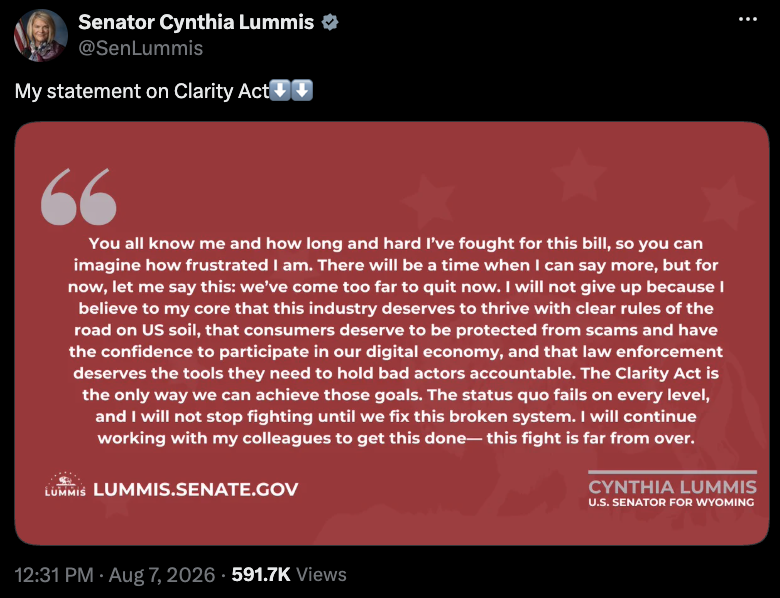
Source: Cynthia Lummis

Others, including Coinbase CEO Brian Armstrong and the exchange’s chief policy officer Faryar Shirzad, called the Senate’s action “disappointing” but said that September would be the time to “finish the job.” Bitmine Chair Tom Lee noted in the company’s weekly report that “financial markets seem more focused on the recent softer inflation and jobs data” rather than any potential impact of CLARITY not passing.

While there were reports of progress in bipartisan talks on the crypto market structure bill, lawmakers in the Senate didn’t announce solutions in response to pushes from many Democrats for stricter ethics provisions, in particular for rules affecting US President Donald Trump’s crypto investments. Trump continues to face scrutiny from many in Congress over his family’s crypto business, World Liberty Financial, and his own projects, including the memecoin launched days before he took office.

Some banking advocates, in contrast, have been pushing lawmakers to address how CLARITY could still allow companies to pay interest to stablecoin holders in certain situations, challenging the industry. In a Thursday Wall Street Journal op-ed published before Thune’s cloture motion, the publication’s editorial board said that, under CLARITY, small banks would miss out “because they rely on interest payments to attract deposits.“ The editorial continued:

“The Clarity Act can serve a useful purpose with some language changes,“ said the editorial board. “The crypto industry and its friends in Washington portray themselves as defenders of free markets. What they really want is to be quasi-banks without abiding by the same regulations.“

Related: CLARITY Act delay gives Asian financial hubs an opening: First Digital CEO

Prediction market users still anticipating CLARITY by 2027

Despite the setback for the bill in Congress, some event contracts on prediction market platforms are still offering users favorable odds on CLARITY passing by the end of the year.

On Kalshi, an event contract with $1.23 million wagered gave users an 88% chance of the Senate voting on the legislation before Oct. 1, while a similar one on Polymarket gave a 26% chance of the bill being signed into law this year. That contract had total wagers topping $5.79 million. If passed by the Senate, CLARITY would need to return to the House for a vote before potentially going to Trump’s desk.

Magazine: BIP-110 ends with a whimper, CLARITY vote punted: Hodler’s Digest, Aug. 9

Perguntas relacionadas

QWhat is the main reason for the disappointment among crypto advocates regarding the CLARITY Act, according to the article?

AThe main reason for disappointment is the Senate's failure to hold a vote on the CLARITY Act before going on a month-long recess, pushing the critical cloture vote to September and likely reducing its chances of passing so close to the midterm elections.

QWho filed the cloture motion to bring the CLARITY Act to the Senate floor for consideration, and when is the vote now expected?

AMajority Leader John Thune filed the cloture motion. The vote is now expected when the Senate reconvenes in mid-September.

QWhat specific concern from some banking advocates is mentioned as a challenge to the CLARITY Act?

ASome banking advocates are concerned that the CLARITY Act could still allow companies to pay interest to stablecoin holders in certain situations, arguing that this would put small banks at a disadvantage as they rely on interest payments to attract deposits.

QAccording to prediction markets mentioned in the article, what are the odds given for the CLARITY Act being signed into law by the end of the year?

AOn Polymarket, a prediction market contract gives a 26% chance of the CLARITY Act being signed into law by the end of the year.

QWhat is one political issue that reportedly delayed Senate progress on the crypto market structure bill, as mentioned in the article?

AProgress was delayed due to pushes from many Democrats for stricter ethics provisions, particularly rules affecting former President Donald Trump's crypto investments, with lawmakers not announcing solutions in response.

Leituras Relacionadas

BTC Daily Adjustment in Progress, HYPE Nears Short-term Directional Decision | Invited Analysis

This weekly analysis examines the recent price action of Bitcoin (BTC) and HYPE, focusing on key technical developments and outlining potential trading strategies. **Bitcoin (BTC) Analysis:** * **Market Trend Assessment:** The analysis applies a "52-week moving average confirmation method" to assess the broader trend. While BTC's weekly closing price has broken above this key average, the moving average itself remains in a downtrend, and a proper pullback confirmation is still lacking. The conclusion is that the rally from the July 1st low is still classified as a technical rebound, not yet confirming a new bull market. * **Daily Chart Structure:** The report argues that the five-wave rally (a-e) from the July low likely concluded at the September 21st high. The recent breakdown below the key support of $82,500, followed by a weak-volume rebound, supports this view. If the e-wave is complete, a larger corrective decline (potentially in three sub-waves) is anticipated. The first leg of this correction is underway, with an initial target around $78,000. * **Weekly Outlook & Strategy:** * **Outlook:** The focus is on the downside targets from the September 21st high. Key resistance is seen at $85,500 and the $87,500-$90,000 zone. Support levels are identified at $80,500-$82,500, $75,000-$78,000, and $69,100-$70,500. * **Strategy:** The medium-term posture is neutral/cautious, recommending watching for a potential pullback to a "channel" for confirmation. For short-term traders, two scenarios are outlined: (A) Selling into strength near the $85,500-$87,500 resistance if bearish signals appear, or (B) Selling a confirmed breakdown below the $80,500-$82,500 support zone. A 30% position size with strict stop-loss management is advised. **HYPE Analysis:** * **Daily Chart Structure:** HYPE broke below the lower boundary of its two-month ascending channel on October 8th. Price is currently in a "pullback confirmation" phase, testing this breached support-turned-resistance. A failure to reclaim this level would signal weakness and open the path towards the $75-$77 support area. The longer-term uptrend line, however, remains intact. * **Weekly Outlook & Strategy:** * **Outlook:** The critical watchpoint is the outcome of the current test of the former channel support. Resistance levels are noted at $88-$90, $94, and $102. Key support zones are $80-$82 and $75-$77. * **Strategy:** Two bullish scenarios are proposed for short-term trades: (1) A light long position if price convincingly reclaims and holds above the former channel support, or (2) A light long position if price falls to the $75-$77 support area and shows signs of stabilization. A 30% position size with strict stop-loss discipline is emphasized. **Risk Management Reminder:** The article includes a standard trailing stop-loss protocol (moving stop to breakeven at +1% profit, then locking in profits progressively). It strongly cautions that all analysis is for informational purposes only, not investment advice, and strategies must be adapted to changing market conditions.

marsbitHá 46m

BTC Daily Adjustment in Progress, HYPE Nears Short-term Directional Decision | Invited Analysis

marsbitHá 46m

U.S. Defense Procurement Seeks to Exclude Chinese PCBs, Stirring Domestic Disputes Among American Companies

A U.S. defense procurement rule set to take effect in January 2027, which aims to exclude printed circuit boards (PCBs) from China, Russia, Iran, and North Korea, has sparked debate within the American industry. While the policy, stemming from the 2021 National Defense Authorization Act, is intended to bolster U.S. domestic manufacturing and supply chain security, it faces conflicting pressures. The U.S. PCB industry association (PCBAA) urges swift implementation to redirect defense contracts to local manufacturers. In contrast, technology industry groups like the Information Technology Industry Council (ITI) seek a longer transition period, citing high costs and complexities for companies needing to establish new, certified supply lines and production facilities. The rule's direct impact on China's vast PCB industry is estimated to be minimal, affecting less than 1% of its total demand. However, it highlights a broader U.S. strategy to revive advanced electronics manufacturing through defense contracts, tax credits, and subsidies. Despite these efforts, rebuilding a competitive domestic PCB industry faces significant hurdles, including multi-year factory construction timelines, reliance on overseas materials and equipment, and the challenge of achieving commercial scale without sufficient non-defense orders. Notably, even U.S. defense contractors like TTM continue to expand production capacity in China to leverage its mature, cost-effective supply chain. Meanwhile, China's PCB sector is transitioning from scale to technological sophistication, making significant inroads in high-end areas like AI servers and advanced packaging. Leading Chinese firms are achieving breakthroughs in materials and complex multi-layer board production, supported by a deep industrial ecosystem of suppliers, manufacturers, and end-client collaboration. This entrenched system of scale, iterative development, and integrated supply chains represents a competitive advantage that U.S. policy alone cannot quickly replicate. The core challenge for the U.S. is not merely redirecting orders but rebuilding the comprehensive manufacturing capabilities and commercial viability that have shifted overseas.

marsbitHá 46m

U.S. Defense Procurement Seeks to Exclude Chinese PCBs, Stirring Domestic Disputes Among American Companies

marsbitHá 46m

Trading

Spot
活动图片