Fable 5 is about to make a comeback, code exposed? Anthropic CEO kicked out of the White House

marsbitPublicado em 2026-06-25Última atualização em 2026-06-25

Resumo

Fable 5, a previously restricted AI model from Anthropic, appears poised for a comeback. Evidence from leaked code in the Claude Code v2.1.190 version suggests a shift in its business model from a separate purchase to a potentially limited weekly usage allowance within standard Claude subscriptions. Furthermore, the model has reportedly reappeared in Amazon Bedrock documentation. This potential revival coincides with significant internal changes at Anthropic. According to a report by The Wired, CEO Dario Amodei was reportedly sidelined from negotiations with the Trump administration over Fable 5's export restrictions. Government officials found him difficult to communicate with. Co-founder Tom Brown and policy head Sarah Heck took over discussions, leading to more productive technical talks aimed at addressing White House security concerns about the model being "jailbroken." External pressure is mounting as a bipartisan group of US lawmakers has demanded answers from the Commerce Department by a June 26 deadline regarding the criteria and timeline for potentially reinstating public access to Fable 5. The potential return of Fable 5 comes as competitors OpenAI and Google have reportedly delayed their own major model releases. If Anthropic successfully navigates the government's security review, Fable 5 could gain a significant "safety-certified" advantage in the enterprise market. The countdown to the June 26 deadline is now underway.

Just now, good news arrived—Fable 5 is likely coming back!

Sharp-eyed developers have already found evidence in the latest code that Fable 5 is about to make a comeback.

Everyone is excitedly spreading the word: Fable 5 might be making a covert return soon.

Has Fable 5's "Covert Return" Been Written into the Code?

If you think Anthropic can only sit back and do nothing, you’re underestimating the survival instincts of this Silicon Valley top unicorn.

Recently, tech geeks in the rag-tag Discord community dug deep into the underlying code of Claude Code v2.1.190 and uncovered some unusual new hidden strings.
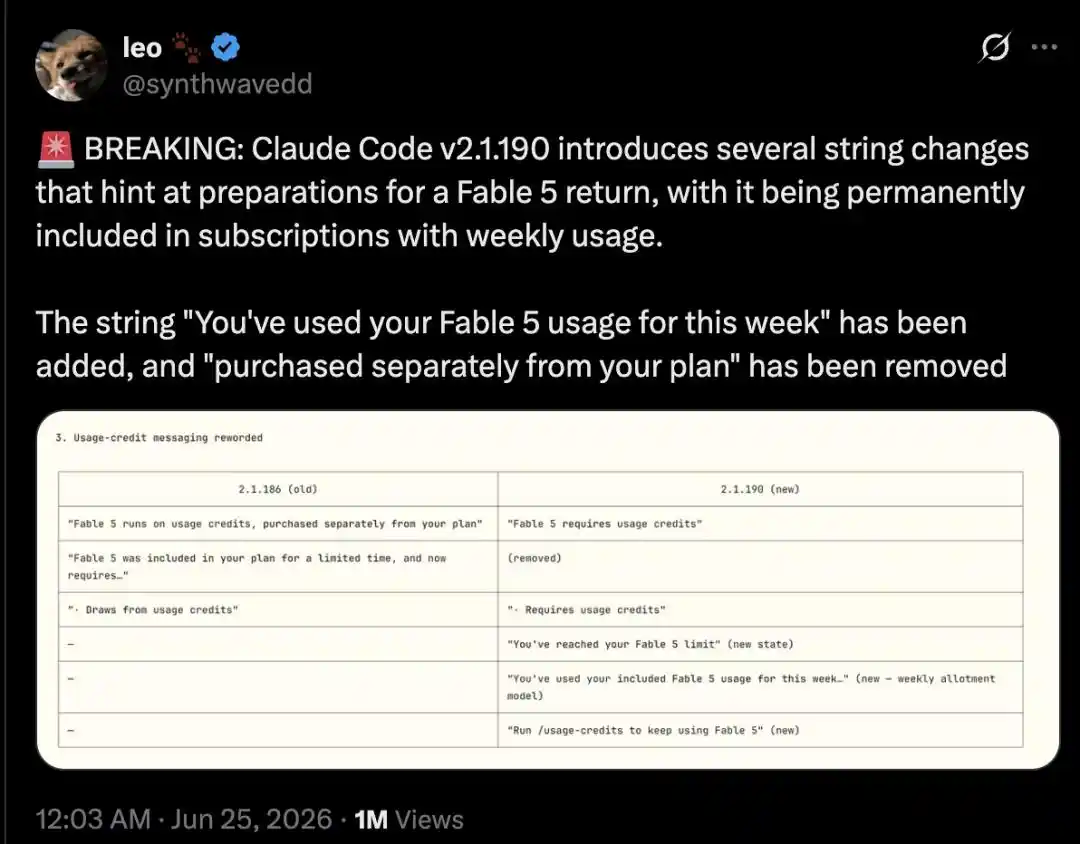
These seemingly dull lines of code send a major signal to the industry: Anthropic is secretly planning to quietly return Fable 5 to users.

The first piece of evidence is the change in subscription model.

In the old version, Fable 5 was positioned as a premium "one-time purchase/separate purchase" product.

But in the newly exposed code, a key prompt phrase has been quietly deleted: "purchased separately from your plan."

It has been replaced with a brand new user prompt string:

You've used your Fable 5 usage for this week.

In other words, Anthropic is secretly restructuring the business logic of Fable 5!

It will likely no longer be an expensive standalone add-on but will instead be permanently integrated into Claude's regular subscription plan, albeit with a weekly usage cap or quota.

But for the vast majority of regular subscribers, this is good news! This isn't a downgrade—it's an epic upgrade at no extra cost.

The second, even more exciting piece of evidence is: Fable 5 has quietly appeared on Amazon Cloud!

If code changes are just preparations on the client side, then changes to cloud APIs are the real smoking gun.

According to multiple sources, Fable 5 has quietly reappeared in the Amazon Bedrock documentation/model cards.
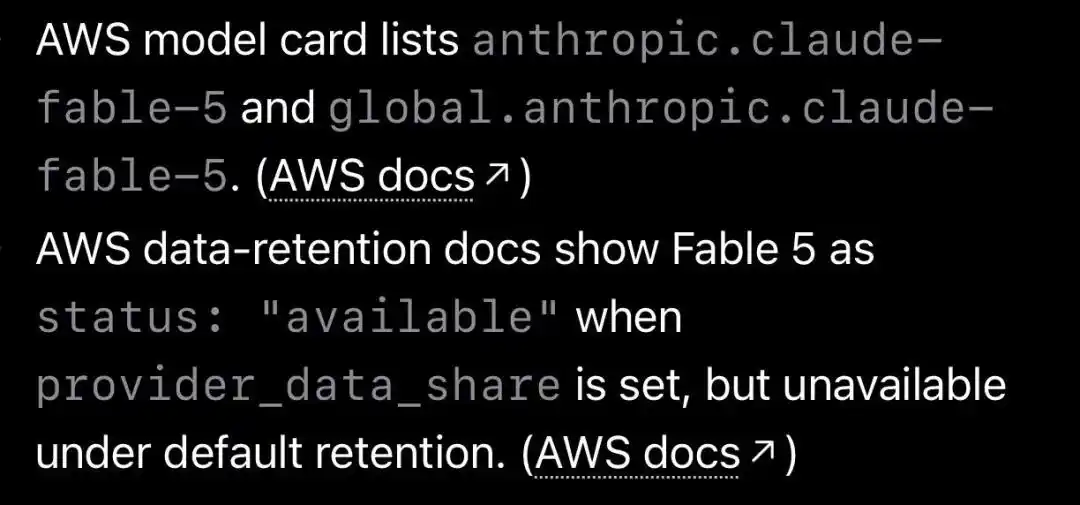
Although the company remains silent, only promising that "access will be restored soon," the undercurrents behind this are already surging.

On Polymarket, the most keen-scented speculators have started placing bets like crazy. The probability of betting that "Fable 5 will fully return by June 26th" has surged past 30%.

Why June 26th? We'll explain later.

"Get that weirdo out of here!"—The Inside Story of Anthropic's Leadership Change

Why has Fable 5 suddenly seen a turnaround? It's all thanks to Anthropic's wise decision—to kick Amodei out!

Today, foreign media The Wired reported that the Amodei chapter is over.

In the eyes of the U.S. government, Anthropic CEO Dario Amodei is nothing short of an "unreasonable weirdo."

According to multiple insiders who spoke to the media, after Fable 5 was banned, Anthropic held several closed-door meetings with Trump administration officials in an attempt to lobby the government to lift the export controls.

However, as soon as Dario sat at the negotiation table, the atmosphere would freeze over.

Government officials had an extremely low opinion of Dario. In their view, this stubborn tech fanatic was extremely difficult to communicate with, completely unwilling to listen to the government's national security concerns, and even showed an intolerable level of paranoia on certain issues.

Seeing that the negotiations were about to collapse completely, Anthropic's board made a decision akin to "cutting off the arm to save the body": kick the CEO out and bring in someone who can actually talk!

Replacing Dario at the main negotiation table was another co-founder, Tom Brown, assisted by Head of Public Policy Sarah Heck.
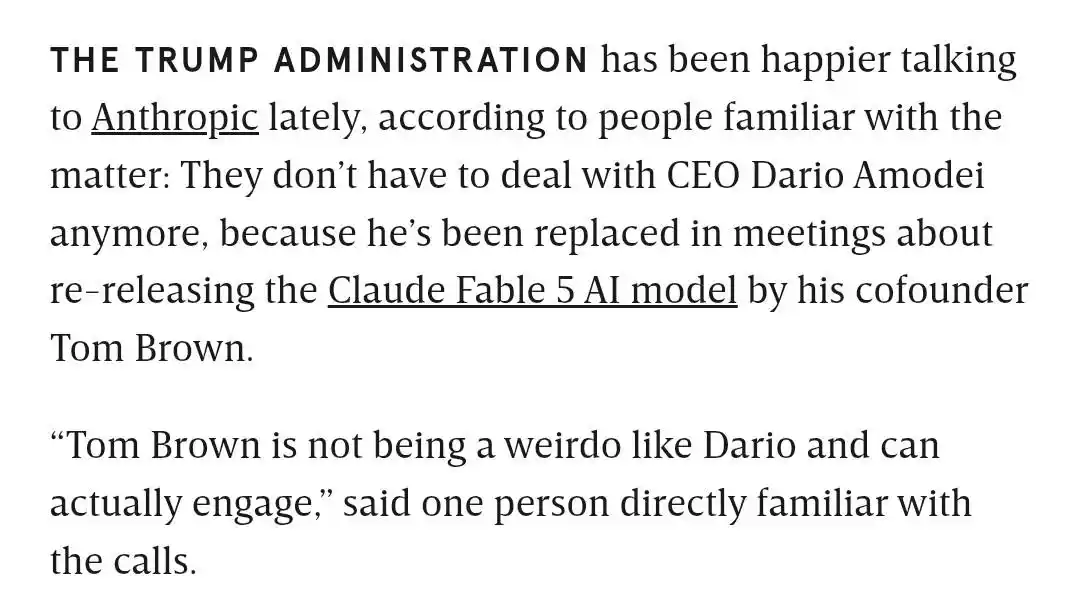
The change had an immediate effect.

A government official involved breathed a sigh of relief and privately complained:

Tom isn't as weird as Dario; he's actually someone you can have a normal conversation with.

The truth is out! The recent smoother communication between the Trump administration and Anthropic is because they successfully avoided the CEO!

Finally, with the recommendation of Tom Brown and Sarah Heck, the negotiations expanded not only among senior government officials but also went deep into the technical working group level.

The technical staff from both sides were finally able to sit down and calmly discuss a substantive issue—

What level of technical proof does Anthropic need to provide to alleviate the Trump administration's concerns about Fable 5 being "jailbroken"?

Previously, the White House and Anthropic were playing a cat-and-mouse game.

After Fable 5 was banned, there was a core point of contention in the negotiations.

White House officials and cybersecurity experts were increasingly leaning toward a pessimistic view: for LLMs, existing safety guardrails are just stopgap measures.

As model capabilities rapidly iterate and jailbreaking techniques continuously improve, any static restrictions will ultimately be bypassed.

However, the Anthropic technical team, led by Tom Brown, is trying hard to prove to the government: they have the ability to establish a new, more dynamically defensive security architecture when Fable 5 returns.

Although disagreements exist, the "no longer weird" communication style at least allowed the White House to see Anthropic's sincerity in solving the problem.

June 26th Deadline Approaches, Capitol Hill Issues "Ultimatum"

Now back to the question: why is the date "June 26th" so crucial?

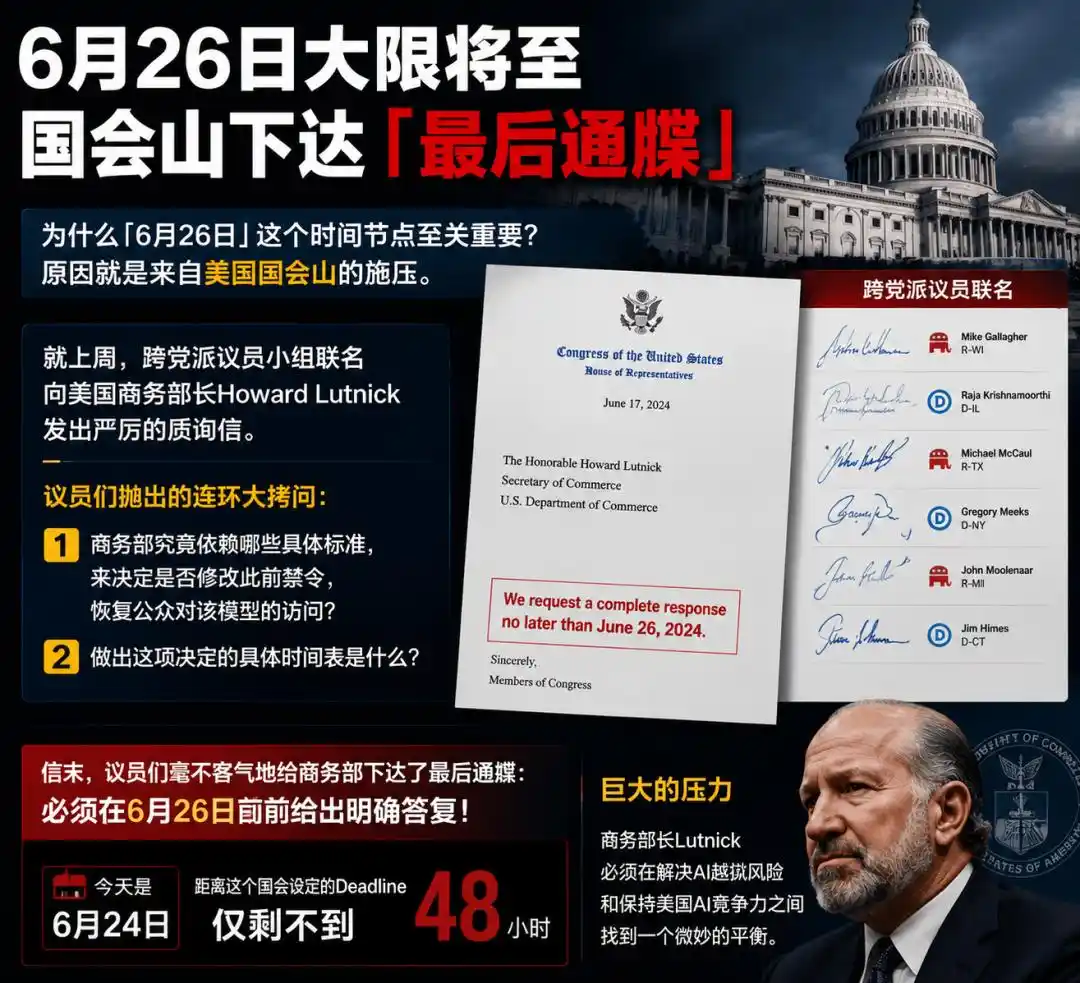
The reason is pressure from Capitol Hill.

Just last week, a bipartisan group of Republican and Democratic lawmakers jointly sent a stern letter of inquiry to U.S. Secretary of Commerce Howard Lutnick.
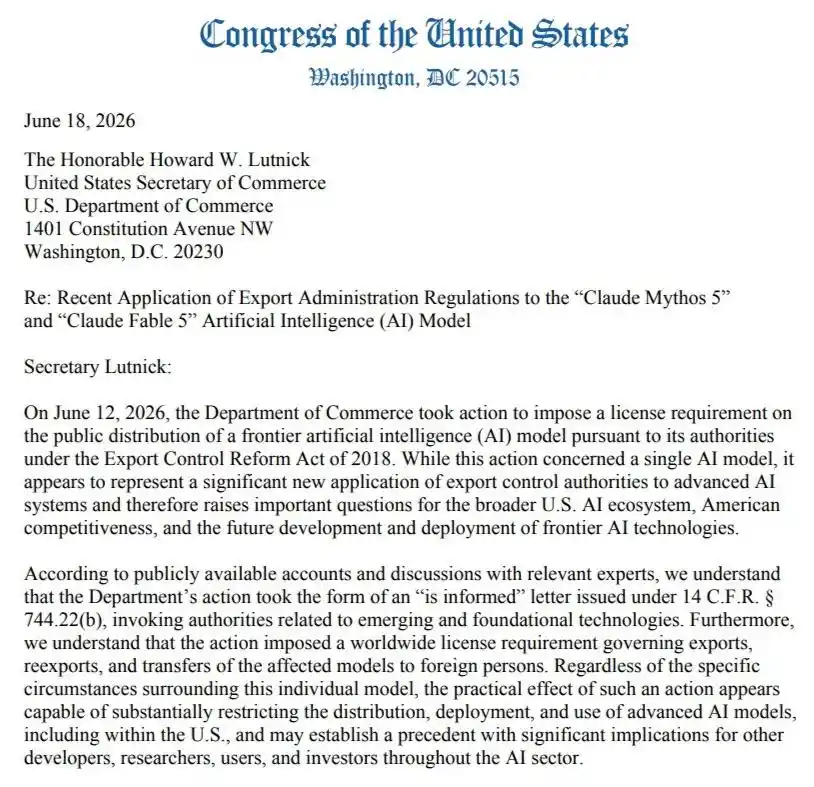
The lineup of signing lawmakers was impressive. They fired off a series of tough questions about Fable 5's redeployment:

1. What specific criteria is the Department of Commerce relying on to decide whether to modify the previous ban and restore public access to this model?

2. What is the specific timeline for making this decision?

At the end of the letter, the lawmakers didn't mince words, issuing an ultimatum to the Commerce Department: they must provide a clear answer by June 26th!

Today is June 24th. The deadline set by Congress is less than 48 hours away.

Now, the eyes of the world are fixed on this potentially turning-point time window.

Currently, Commerce Secretary Lutnick is under immense pressure. He must find a delicate balance between addressing AI jailbreak risks and maintaining U.S. AI competitiveness.
Silicon Valley Collectively Delays, Is Fable 5's Return Imminent?

Recently, heavyweight news emerged in the industry: OpenAI's GPT-5.6 and Google's Gemini 3.5 Pro both face unexpected delays!

If a few days ago, Anthropic seemed like a weak player desperately seeking "unbanning," now the situation has undergone an epic reversal.

And Anthropic's good days might be near—once it passes the U.S. government's stringent cybersecurity review, Fable 5 will virtually gain an "impenetrable armor" with "White House safety certification."

In the enterprise market, which is extremely sensitive to security, a ready-made model that has undergone the toughest scrutiny and is security-vetted is far more attractive than those "futures" still being polished in the lab.

The countdown to June 26th has entered its final seconds.

References:

https://x.com/synthwavedd/status/2069813760622043483?s=20

https://www.wired.com/story/the-trump-white-house-is-over-anthropics-dario-amodei/

This article is from WeChat public account "Xinzhiyuan", Editor: Aeneas

Criptomoedas em alta

Perguntas relacionadas

QWhat is the main evidence from the leaked code suggesting that Fable 5 might be revived by Anthropic?

AThe primary evidence from the leaked code is the removal of the phrase 'purchased separately from your plan' and its replacement with a new user prompt string: 'You've used your Fable 5 usage for this week.' This indicates Anthropic is likely restructuring Fable 5's business model from a separate, one-time purchase to being bundled into Claude's regular subscription plan with a weekly usage limit or quota.

QWhy was Anthropic's CEO, Dario Amodei, reportedly removed from negotiations with the U.S. government?

ADario Amodei was reportedly removed from negotiations because government officials viewed him as difficult to communicate with, stubborn, and unable to understand or accept national security concerns regarding Fable 5. His presence reportedly soured the negotiation atmosphere, prompting the Anthropic board to replace him with co-founder Tom Brown and policy head Sarah Heck to facilitate more productive talks.

QWhat is the significance of the date June 26th mentioned in the article?

AJune 26th is a critical deadline set by a bipartisan group of U.S. lawmakers. They sent a formal inquiry to the Secretary of Commerce demanding clear answers about the specific standards and timeline for potentially lifting the ban on public access to the Fable 5 model. The Secretary is required to respond by this date, creating pressure for a decision regarding Fable 5's status.

QAccording to the article, what potential advantage could Fable 5 gain if it passes U.S. government security reviews?

AIf Fable 5 passes the stringent U.S. government cybersecurity reviews, it could gain an informal 'White House security certification.' This perceived 'gold standard' of safety could give it a significant competitive advantage in the enterprise market, where security is a top priority, especially over rival models from OpenAI and Google that are facing delays.

QWhere, besides client code, has evidence of Fable 5's potential return been spotted according to the article?

ABesides evidence found in client-side code (Claude Code v2.1.190), Fable 5 has also reportedly reappeared in the Amazon Bedrock documentation and model cards. This presence in the cloud service's backend infrastructure is seen as stronger, more concrete evidence ('real proof') of its impending return compared to client-side code changes.

Leituras Relacionadas

The Future Outlook of Bitcoin

Bitcoin: A Mid-2026 Perspective Bitcoin analyst Will Clemente assesses the asset's outlook, arguing that despite a challenging period, it now presents a compelling long-term value opportunity. The current bear market, while less severe in peak drawdown than 2022, has been difficult due to a lack of clear catalysts, underperformance versus assets like gold, and persistent ETF outflows. However, key negative pressures are showing signs of abating. Digital Asset Treasuries (DATs), a major source of sell pressure during the bull market, are slowing accumulation or shifting strategies. While quantum computing remains a long-term concern, its risk is likely significantly priced in at current levels. Fundamentally, the Bitcoin network remains decentralized and healthy, with a robust global node distribution. Although hash rate has declined as miners pivot to AI/HPC, the network's difficulty adjustment ensures security, and the resilience suggests a diverse, non-public mining base. Valuation metrics indicate Bitcoin is in deeply undervalued territory. It is consolidating near its 2021 highs, below the 200-week EMA, with weekly RSI showing a bullish divergence from oversold levels. The MVRV ratio is at historically low levels, signaling the market's aggregate cost basis is near the current price. Long-term holders have resumed accumulation, and trading volume across spot, ETF, and derivatives markets has dried up to multi-year lows. Implied volatility is cheap, and futures basis is compressed, reflecting a complete lack of speculative interest. The core bullish thesis hinges on seller exhaustion. After a year of selling from DATs and ETFs, and with quantum risks largely discounted, the pool of remaining motivated sellers appears limited. A potential catalyst could be steady, price-insensitive inflows from large institutions adding small strategic allocations to portfolios for diversification, given Bitcoin's recent low correlation with other assets. Conclusion: Bitcoin is considered "cheap" with most risks priced in. While a final leg down is possible, the network is healthy, and long-term holders are buying. Strategies include dollar-cost averaging, waiting for a definitive catalyst or price reversal, or entering a position now while using inexpensive options to hedge against further downside. The current setup suggests an interesting period ahead for the orange coin.

marsbitHá 34m

The Future Outlook of Bitcoin

marsbitHá 34m

Grayscale Clarifies Whether the Cryptocurrency Market Growth-Promoting Clarity Act Will Be Passed This Year

Zach Pandl, the Research Director at Grayscale, stated that the passage of the CLARITY Act—legislation aimed at establishing a comprehensive regulatory framework for the crypto market in the U.S.—is unlikely to occur in Congress this year. According to Pandl, the Senate's tight schedule and the political climate in an election year make bipartisan agreement on the bill difficult. Pandl noted that the failure of the Clarity Act will not directly impact Bitcoin's role as a store of value, the operation of core blockchains, or the growth of stablecoin payments in the short term. The U.S. crypto sector has operated for nearly 17 years without such comprehensive market structure legislation. However, he warned that the absence of a clear regulatory framework could slow the influx of new investment and capital formation in the U.S. The proposed law aims to open new avenues for capital formation via blockchain, support the development of tokenized securities markets, and create a comprehensive oversight system for digital asset intermediaries, along with various consumer, investor, and software developer protections. Pandl believes federal regulators, particularly the SEC, will continue to fill regulatory gaps even without new legislation, issuing rules in areas like tokenized securities in the coming months. While significant progress has been made under the current administration regarding institutional custody, banking access, staking, and crypto ETPs, Pandl cautioned that without comprehensive market structure laws, much new investment and developer activity may shift outside the United States.

cryptonews.ruHá 1h

Grayscale Clarifies Whether the Cryptocurrency Market Growth-Promoting Clarity Act Will Be Passed This Year

cryptonews.ruHá 1h

Michael Saylor Identifies the Next Financial Opportunity Worth Billions

Michael Saylor, Executive Chairman of Strategy Inc. (Nasdaq: MSTR), identified digital credit as the next billion-dollar business opportunity in finance. In an August 7th post on X, he suggested entrepreneurs explore this category. Saylor's post included a chart showing the effective yields of four of Strategy's digital credit products as of 11:10 AM EDT. Leading was Stride Preferred Shares (STRD) with a 15.29% yield, followed by Stretch Preferred Shares (STRC) at 12.63%, Strike Preferred Shares (STRK) at 12.08%, and Strife Preferred Shares (STRF) at 10.38%. These preferred securities allow Strategy to raise capital from income-seeking investors, offering various dividend rates, risk levels, and positions in the company's capital structure. Strategy has developed a suite of preferred shares classified as digital credit instruments. For instance, the Stretch Preferred Shares (STRC) are perpetual, variable-rate securities. This approach applies established credit market structures to companies with digital asset-based balance sheets, connecting capital-seeking issuers with yield-seeking investors through Wall Street-like products. Saylor positioned these as a "digital credit stack," built upon but not backed by Strategy's bitcoin reserve, expanding the company's capital access while targeting yield-focused buyers. The billion-dollar potential lies in creating a scalable, replicable business model where issuers can raise capital via tailored income securities and investors can select products based on yield, risk, and capital priority. For Strategy, this model attracts capital from investors seeking income without direct bitcoin exposure, while the company maintains its broader bitcoin strategy. Growing dividend obligations have influenced how Strategy manages its bitcoin holdings and cash reserves, with the company selling some bitcoin to fund preferred share payments and build a USD reserve for liquidity.

cryptonews.ruHá 1h

Michael Saylor Identifies the Next Financial Opportunity Worth Billions

cryptonews.ruHá 1h

Trading

Spot

Artigos em Destaque

Como comprar HOUSE

Bem-vindo à HTX.com!Tornámos a compra de Housecoin (HOUSE) simples e conveniente.Segue o nosso guia passo a passo para iniciar a tua jornada no mundo das criptos.Passo 1: cria a tua conta HTXUtiliza o teu e-mail ou número de telefone para te inscreveres numa conta gratuita na HTX.Desfruta de um processo de inscrição sem complicações e desbloqueia todas as funcionalidades.Obter a minha contaPasso 2: vai para Comprar Cripto e escolhe o teu método de pagamentoCartão de crédito/débito: usa o teu visa ou mastercard para comprar Housecoin (HOUSE) instantaneamente.Saldo: usa os fundos da tua conta HTX para transacionar sem problemas.Terceiros: adicionamos métodos de pagamento populares, como Google Pay e Apple Pay, para aumentar a conveniência.P2P: transaciona diretamente com outros utilizadores na HTX.Mercado de balcão (OTC): oferecemos serviços personalizados e taxas de câmbio competitivas para os traders.Passo 3: armazena teu Housecoin (HOUSE)Depois de comprar o teu Housecoin (HOUSE), armazena-o na tua conta HTX.Alternativamente, podes enviá-lo para outro lugar através de transferência blockchain ou usá-lo para transacionar outras criptomoedas.Passo 4: transaciona Housecoin (HOUSE)Transaciona facilmente Housecoin (HOUSE) no mercado à vista da HTX.Acede simplesmente à tua conta, seleciona o teu par de trading, executa as tuas transações e monitoriza em tempo real.Oferecemos uma experiência de fácil utilização tanto para principiantes como para traders experientes.

512 Visualizações TotaisPublicado em {updateTime}Atualizado em 2026.06.02

Como comprar HOUSE

Discussões

Bem-vindo à Comunidade HTX. Aqui, pode manter-se informado sobre os mais recentes desenvolvimentos da plataforma e obter acesso a análises profissionais de mercado. As opiniões dos utilizadores sobre o preço de HOUSE (HOUSE) são apresentadas abaixo.

活动图片