Michael Saylor Identifies the Next Financial Opportunity Worth Billions

cryptonews.ruPublicado em 2026-08-09Última atualização em 2026-08-09

Resumo

Michael Saylor, Executive Chairman of Strategy Inc. (Nasdaq: MSTR), identified digital credit as the next billion-dollar business opportunity in finance. In an August 7th post on X, he suggested entrepreneurs explore this category. Saylor's post included a chart showing the effective yields of four of Strategy's digital credit products as of 11:10 AM EDT. Leading was Stride Preferred Shares (STRD) with a 15.29% yield, followed by Stretch Preferred Shares (STRC) at 12.63%, Strike Preferred Shares (STRK) at 12.08%, and Strife Preferred Shares (STRF) at 10.38%. These preferred securities allow Strategy to raise capital from income-seeking investors, offering various dividend rates, risk levels, and positions in the company's capital structure. Strategy has developed a suite of preferred shares classified as digital credit instruments. For instance, the Stretch Preferred Shares (STRC) are perpetual, variable-rate securities. This approach applies established credit market structures to companies with digital asset-based balance sheets, connecting capital-seeking issuers with yield-seeking investors through Wall Street-like products. Saylor positioned these as a "digital credit stack," built upon but not backed by Strategy's bitcoin reserve, expanding the company's capital access while targeting yield-focused buyers. The billion-dollar potential lies in creating a scalable, replicable business model where issuers can raise capital via tailored income securities and investors ca...

Michael Saylor, Executive Chairman of Strategy Inc. (Nasdaq: MSTR), shared his view on the next billion-dollar business in finance in an August 7 post on X, pointing entrepreneurs towards digital credit as the financial category he would explore.

Saylor wrote on X:

"If I were looking for the next billion-dollar business in finance, I would study digital credit."

A chart attached to his post showed the effective yields of four securities from Strategy's suite of digital credit products as of 11:10 AM Eastern Time (EDT). Leading the way were Stride Preferred Shares (STRD) with a yield of 15.29%, followed by Stretch Preferred Shares (STRC) at 12.63%, Strike Preferred Shares (STRK) at 12.08%, and Strife Preferred Shares (STRF) at 10.38%.
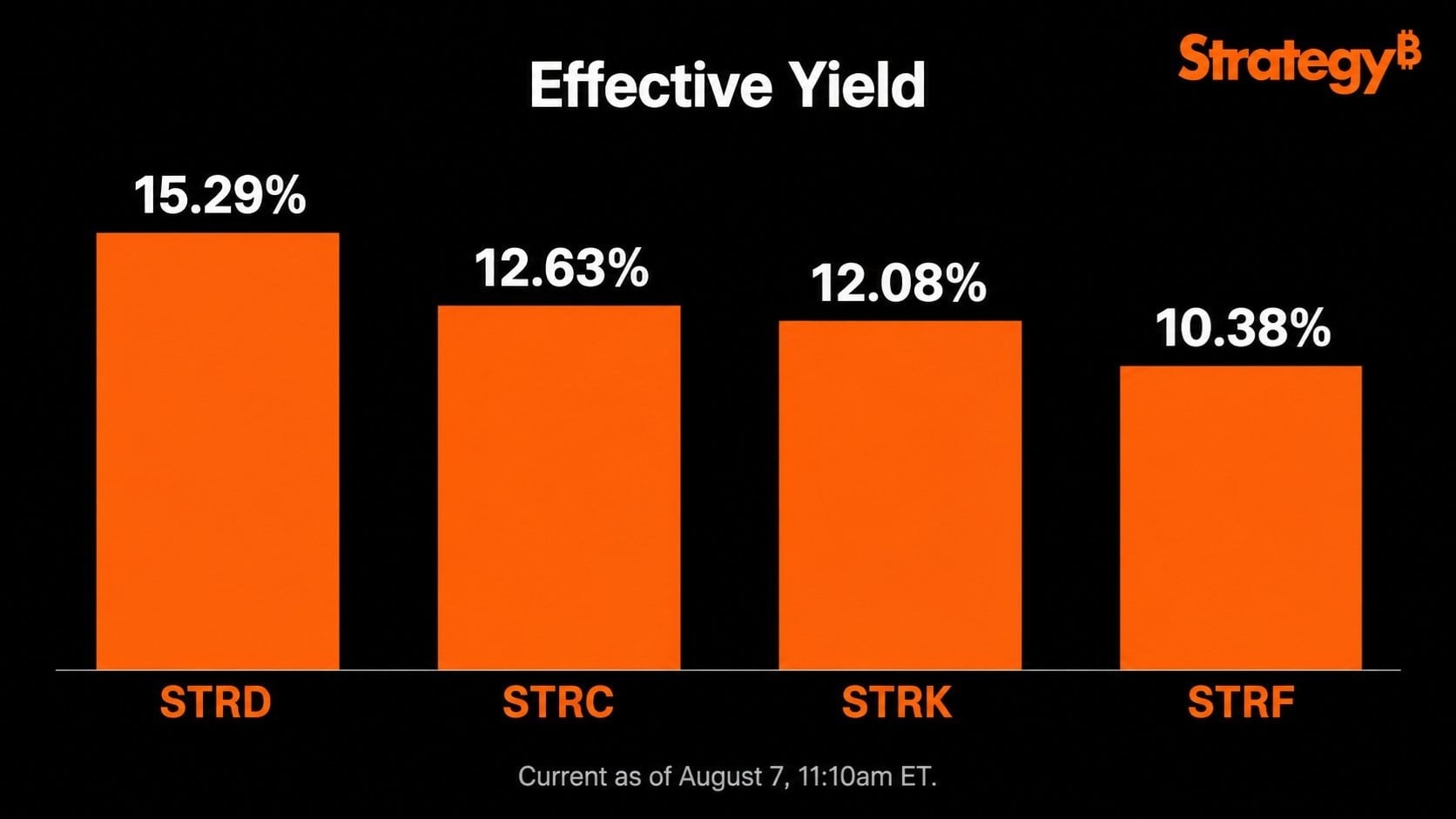
Effective yields of Strategy's credit products. Source: Strategy Inc.

Collectively, these four types of preferred securities allow Strategy to raise capital from yield-seeking investors while offering varying dividend rates, risk levels, and positions in the company's capital structure. These securities extend Strategy's financing options beyond common stock and debt obligations.

Strategy Creates Digital Credit Products Based on Capital Markets

Strategy has developed a set of preferred shares which it classifies as digital credit instruments. Its Stretch Preferred Shares (STRC) are perpetual preferred securities with a variable dividend rate, allowing Strategy to adjust payouts while offering investors a yield-oriented instrument.

The broader assortment targets investors with different yield and risk preferences, simultaneously extending familiar preferred share structures into digital asset markets. Preferred securities pay dividends and occupy a different position compared to common shares in a company's capital structure.

Growing dividend obligations have also influenced how Strategy manages its Bitcoin holdings and cash reserves. The company has sold Bitcoin to finance preferred share payments and build a US dollar reserve, ensuring liquidity for its expanding yield securities.

Why Saylor Considers the Digital Credit Market a Billion-Dollar Opportunity

The scale of this opportunity stems from applying established credit market structures to companies and balance sheets underpinned by digital assets. This model connects capital-seeking issuers with yield-seeking investors through securities that resemble familiar Wall Street products.

Saylor has defined these preferred securities as a "digital credit stack," positioning them as fixed-income alternatives built upon Strategy's Bitcoin reserve. These securities are not secured by Strategy's Bitcoin assets. This approach expands the company's access to capital while targeting yield-seeking buyers through publicly listed securities.

This model creates a potentially replicable business: issuers can raise capital using tailored yield securities, and investors can select products based on yield, risk, and capital priority. Strategy is already testing this concept through several offerings.

Digital Credit Extends Beyond a Single Product

Investor interest in Strategy's preferred securities has grown as the company expands its digital lending product line. STRC has become a significant part of this expansion; Saylor highlighted its growth while also outlining the potential scale of the digital lending market.

The broader opportunity lies in creating products for various capital pools rather than relying on a single offering. A scalable structure could give issuers more flexibility to align with market preferences for yield and risk.

For Strategy, this approach allows it to raise capital from buyers who want yield exposure without direct Bitcoin exposure, while maintaining its broader Bitcoin ownership strategy.

end-content

Perguntas relacionadas

QAccording to Michael Saylor, what financial category would he explore for the next billion-dollar business?

AMichael Saylor stated he would explore digital credit for the next billion-dollar business in finance.

QWhich Strategy preferred stock had the highest effective yield according to the chart in the article?

AAccording to the chart, the Stride (STRD) preferred stock had the highest effective yield at 15.29%.

QHow are Strategy's preferred securities classified, and what is one key feature of the Stretch (STRC) preferred stock?

AStrategy classifies its preferred securities as digital credit instruments. The Stretch (STRC) preferred stock is a perpetual preferred security with a variable dividend rate.

QWhy does Michael Saylor believe the digital credit market represents a billion-dollar opportunity?

AHe believes it represents a billion-dollar opportunity because it applies established credit market structures to companies and balance sheets underpinned by digital assets, creating scalable financial products for income-seeking investors.

QHow has the growth of dividend obligations impacted Strategy's management of its Bitcoin reserves and cash?

AThe growing dividend obligations have led Strategy to sell Bitcoin to finance preferred stock payments and build a U.S. dollar reserve, ensuring liquidity for its expanding income securities.

Leituras Relacionadas

The Future Outlook of Bitcoin

Bitcoin: A Mid-2026 Perspective Bitcoin analyst Will Clemente assesses the asset's outlook, arguing that despite a challenging period, it now presents a compelling long-term value opportunity. The current bear market, while less severe in peak drawdown than 2022, has been difficult due to a lack of clear catalysts, underperformance versus assets like gold, and persistent ETF outflows. However, key negative pressures are showing signs of abating. Digital Asset Treasuries (DATs), a major source of sell pressure during the bull market, are slowing accumulation or shifting strategies. While quantum computing remains a long-term concern, its risk is likely significantly priced in at current levels. Fundamentally, the Bitcoin network remains decentralized and healthy, with a robust global node distribution. Although hash rate has declined as miners pivot to AI/HPC, the network's difficulty adjustment ensures security, and the resilience suggests a diverse, non-public mining base. Valuation metrics indicate Bitcoin is in deeply undervalued territory. It is consolidating near its 2021 highs, below the 200-week EMA, with weekly RSI showing a bullish divergence from oversold levels. The MVRV ratio is at historically low levels, signaling the market's aggregate cost basis is near the current price. Long-term holders have resumed accumulation, and trading volume across spot, ETF, and derivatives markets has dried up to multi-year lows. Implied volatility is cheap, and futures basis is compressed, reflecting a complete lack of speculative interest. The core bullish thesis hinges on seller exhaustion. After a year of selling from DATs and ETFs, and with quantum risks largely discounted, the pool of remaining motivated sellers appears limited. A potential catalyst could be steady, price-insensitive inflows from large institutions adding small strategic allocations to portfolios for diversification, given Bitcoin's recent low correlation with other assets. Conclusion: Bitcoin is considered "cheap" with most risks priced in. While a final leg down is possible, the network is healthy, and long-term holders are buying. Strategies include dollar-cost averaging, waiting for a definitive catalyst or price reversal, or entering a position now while using inexpensive options to hedge against further downside. The current setup suggests an interesting period ahead for the orange coin.

marsbitHá 28m

The Future Outlook of Bitcoin

marsbitHá 28m

Grayscale Clarifies Whether the Cryptocurrency Market Growth-Promoting Clarity Act Will Be Passed This Year

Zach Pandl, the Research Director at Grayscale, stated that the passage of the CLARITY Act—legislation aimed at establishing a comprehensive regulatory framework for the crypto market in the U.S.—is unlikely to occur in Congress this year. According to Pandl, the Senate's tight schedule and the political climate in an election year make bipartisan agreement on the bill difficult. Pandl noted that the failure of the Clarity Act will not directly impact Bitcoin's role as a store of value, the operation of core blockchains, or the growth of stablecoin payments in the short term. The U.S. crypto sector has operated for nearly 17 years without such comprehensive market structure legislation. However, he warned that the absence of a clear regulatory framework could slow the influx of new investment and capital formation in the U.S. The proposed law aims to open new avenues for capital formation via blockchain, support the development of tokenized securities markets, and create a comprehensive oversight system for digital asset intermediaries, along with various consumer, investor, and software developer protections. Pandl believes federal regulators, particularly the SEC, will continue to fill regulatory gaps even without new legislation, issuing rules in areas like tokenized securities in the coming months. While significant progress has been made under the current administration regarding institutional custody, banking access, staking, and crypto ETPs, Pandl cautioned that without comprehensive market structure laws, much new investment and developer activity may shift outside the United States.

cryptonews.ruHá 1h

Grayscale Clarifies Whether the Cryptocurrency Market Growth-Promoting Clarity Act Will Be Passed This Year

cryptonews.ruHá 1h

Trading

Spot
活动图片