Everyone is MicroStrategy: When JPMorgan Starts Accepting BTC as Collateral, Will You Still Sell Your Coins?

marsbitPublicado em 2025-12-10Última atualização em 2025-12-10

Resumo

The article discusses a major shift on Wall Street, where major banks like JPMorgan, Citi, and Bank of America have reportedly begun accepting Bitcoin as collateral for cash loans. This move, revealed by MicroStrategy's Michael Saylor, signifies Bitcoin's evolution into a "pristine collateral" asset, comparable to U.S. Treasuries or gold. It allows holders to access liquidity without selling their Bitcoin, avoiding capital gains taxes and maintaining exposure to potential price appreciation. This development effectively democratizes the "Buy, Borrow, Die" strategy previously accessible only to large institutions and the ultra-wealthy. It is framed as a critical step in Bitcoin's monetary evolution, enabling credit creation. A "credit flywheel" is described: rising BTC prices increase collateral value, allowing for larger loans, which can be used to purchase more assets, potentially driving prices higher. This shift also suggests a weakening of restrictive regulations like the SEC's SAB 121, transferring power from crypto-native exchanges to traditional financial institutions. The article concludes with a warning about the risks of leverage, as price drops could trigger mass, forced liquidations. It offers advice for investors: adopt a "debt mindset" to use loans for expenses while holding assets, cautiously manage loan-to-value ratios to avoid margin calls, and watch for a resurgence of regulated, compliant CeFi platforms.

Why sell your coins when you can borrow money?

This mantra, once only circulated among crypto whales, has now become the official creed of Wall Street's big six banks.
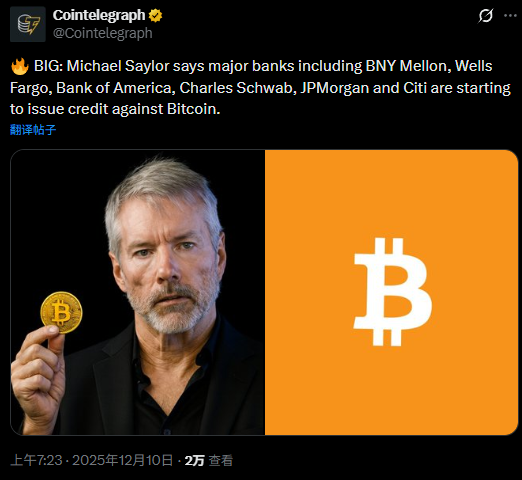
According to MicroStrategy founder Michael Saylor, top financial institutions including JPMorgan, Citi, and Bank of America have quietly launched a revolutionary business: accepting Bitcoin as collateral to provide clients with fiat currency loans.

Don't underestimate this news that didn't make the headlines. If the approval of ETFs meant Bitcoin entered Wall Street's stock accounts, then "accepting collateral" means Bitcoin has entered the core of Wall Street's balance sheets.

This is a qualitative change in monetary nature: Bitcoin is no longer just a chip for trading; it has officially gained the status of "Pristine Collateral," on par with U.S. Treasury bonds and gold. From now on, Bitcoin holders can obtain liquidity without selling a single Satoshi.

A "buy, don't sell" credit flywheel is slowly turning.


Everyone is MicroStrategy

Over the past four years, Michael Saylor has stunned the world with an almost insane strategy: issue debt to buy coins, use coins as collateral to buy more coins, issue more debt, buy more coins.

This "stepping on your own feet to spiral upwards"玩法 had one huge barrier to entry—you had to be a publicly listed company or a billionaire with an extremely high credit rating to borrow money at low interest rates. Ordinary institutions and high-net-worth individuals who wanted to exchange Bitcoin for cash often had to turn to DeFi protocols (facing the risk of contract hacks) or second-tier lending platforms (facing the risk of misuse like FTX), with high interest rates and full of uncertainty.

Now, Wall Street has broken down this barrier.

When JPMorgan and Citi start accepting BTC as collateral, it means they have standardized, productized, and合规化 Saylor's strategy.

Imagine this scenario: a family office holding 1000 BTC, which previously needed $10 million for周转, had to sell part of its Bitcoin, not only paying high capital gains taxes but also losing future upside potential. Now, it only needs to抵押 its Bitcoin to the bank to get $10 million in cash.

  • Tax-wise: A loan is not income, so it is not taxable.
  • Asset-wise: Ownership of the Bitcoin remains in its hands, and it still enjoys the benefits of price appreciation.

This is the common strategy for the wealthy class: "Buy, Borrow, Die." When this strategy is普及 by Wall Street to the entire crypto market, the logic of Bitcoin selling pressure will be completely rewritten: In this market, true diamond hands will no longer need to sell coins.


Credit Expansion: Fiat Flows In Like Water

From a macro perspective, this is also the most critical step in Bitcoin's monetization process: Credit Creation.

In the modern financial system, money is not only printed by central banks but also loaned out by commercial banks. When banks accept real estate as collateral to loan out dollars, real estate participates in the credit expansion of the dollar; when banks accept Bitcoin as collateral to loan out dollars, Bitcoin effectively becomes the anchor for the issuance of "shadow dollars."

This means the flood barrier between the Bitcoin system and the fiat system has been blown open.

In the past, pushing up the Bitcoin price required real "net inflows" of capital. Now, through抵押借贷, Bitcoin itself can create new purchasing power. You抵押 BTC to borrow dollars, and then you can use those dollars to buy more BTC (or buy a house, buy stocks).

This forms a positive Credit Flywheel: Coin price rises ->抵押物 value increases -> Loanable amount increases -> Loan out more fiat -> Buy more assets -> Coin price continues to rise.

As long as Bitcoin's long-term volatility remains controllable within the banks' risk models, this flywheel will introduce astronomical levels of fiat liquidity. This is a more ferocious catalyst than ETF inflows because ETFs are linear capital accumulation, while credit is exponential expansion with leverage.


Regulatory Acquiescence and the Demise of SAB 121

The fact that the big six banks dare to do this is itself a huge political signal.

Remember, the SEC's SAB 121 (Staff Accounting Bulletin No. 121) was once a tight curse. It required banks that custody crypto assets to record those assets on their balance sheets as liabilities, which greatly increased the banks' capital pressure and effectively prohibited banks from engaging in crypto custody.

Now, the fact that Wall Street giants are collectively launching抵押借贷 businesses indicates that SAB 121 is practically dead in terms of implementation, or that banks have found ways to circumvent the regulation (or obtained regulatory exemptions).

This is not surprising. When Bitcoin ETF规模突破千亿美元, Bitcoin has become too big to ignore. Rather than letting these high-value assets flow to crypto-native companies like Coinbase, it's better for "Old Money" to firmly control them through custody and credit业务.

This is a transfer of power. The pricing power and liquidity control of Bitcoin are shifting from exchanges like Binance to the headquarters of JPMorgan in Manhattan.


Risk: The Cruelty of Deleveraging

Of course, the flywheel can spin forward, but it can also reverse.

When we incorporate Bitcoin into the traditional credit system, we also expose Bitcoin to the risks of traditional debt crises.

Although "never selling coins" sounds beautiful, borrowing comes with a清算线 (Margin Call). When the Bitcoin price experiences a sharp correction of 30% or more, the banks' risk control systems will be more冷酷无情 than any DeFi protocol. They will forcibly sell the抵押品 to recover the loan.

This kind of credit-driven rise is often accompanied by an even more brutal deleveraging process. The future Bitcoin market might see reduced volatility due to institutional involvement, but once a systemic crash occurs, its chain reaction will no longer be confined to the crypto circle but could spill over into traditional financial markets.


Investor Survival Guide

Facing this new "creditized" cycle, how should ordinary investors respond?

Learn "Debt Thinking":

  • Your goal used to be "accumulate more coins," then sell them for U.S. dollars when the price rose.
  • Your future goal should be "accumulate more high-quality assets (BTC)," establish a good credit history, learn to use low-interest loans like the wealthy to cover living expenses, and retain the appreciation rights of your assets.

Beware the "Leverage死神":

  • Wall Street can play the "borrowing flywheel" because they have unlimited margin and hedging tools.
  • If ordinary retail investors imitate Saylor's循环抵押 (using抵押 BTC to buy more BTC), be sure to control the Loan-to-Value ratio (LTV). Bitcoin is still a highly volatile asset. It is recommended that LTV never exceed 30%-40%, leaving yourself a safety cushion of more than 50% for price drops. Don't fall to forced liquidation just before dawn.

Pay Attention to the "Return of CeFi":

  • As banks enter the game, centralized lending (CeFi) will experience a second spring, but the protagonists this time are not Celsius or BlockFi, but compliant licensed institutions. Pay attention to those crypto wealth management platforms that have打通 fiat on/off ramps and have deep cooperation with banks, as they might be the new红利入口.


Criptomoedas em alta

Perguntas relacionadas

QWhat revolutionary service have top financial institutions like JPMorgan and Citibank started offering, according to the article?

AThey have started accepting Bitcoin as collateral to provide fiat currency loans to clients.

QHow does using Bitcoin as collateral for loans instead of selling it benefit holders from a tax and asset perspective?

ABorrowing against Bitcoin is not considered taxable income, so no taxes are incurred, and the borrower retains ownership of the Bitcoin, allowing them to benefit from any price appreciation.

QWhat is the 'Buy, Borrow, Die' strategy mentioned in the article, and how does it relate to Bitcoin?

AIt is a strategy where individuals buy assets (like Bitcoin), borrow against them for liquidity without selling, and hold the assets indefinitely to avoid capital gains taxes and benefit from long-term appreciation. Wall Street is now making this strategy accessible for Bitcoin holders.

QWhat significant regulatory hurdle (SAB 121) did banks overcome to offer Bitcoin collateralized loans, and what does its bypassing signify?

ASAB 121 required banks to hold crypto assets as liabilities on their balance sheets, increasing capital requirements. Its effective bypassing indicates regulatory acceptance or exemption, allowing traditional banks to integrate Bitcoin into their financial services.

QWhat major risk does the article associate with using Bitcoin in the traditional credit system, particularly during a market downturn?

AThe risk is a brutal deleveraging process where a sharp Bitcoin price drop (e.g., 30%+) triggers margin calls, leading to forced liquidation of collateral by banks, which could cause a systemic crash affecting both crypto and traditional markets.

Leituras Relacionadas

When the World Cup Collides with Agents: From Web2 to Web3, How Are Wallets Evolving into Agentic Wallets?

World Cup as a Catalyst for Agentic Wallets: From Web2 to Web3 This article explores how the World Cup provides a real-world scenario for observing the evolution of digital wallets from simple asset managers towards "Agentic Wallets"—intelligent, AI-powered interfaces. Using the example of prediction markets like Polymarket, it illustrates how AI Agents can lower the barrier to Web3 interaction. Instead of navigating complex DApps, users can express intent in natural language (e.g., "I think Portugal will win") within platforms like Discord or web pages. The Agent then interprets this intent, finds the relevant market, and seamlessly guides the user through the on-chain transaction via their wallet. The core shift is from wallets as mere "function menus" for signing transactions to "intent interpreters" that understand user goals. The article highlights parallel developments in traditional finance, such as Mastercard's "Agent Pay" and WeChat Pay's AI tests, which focus on granting AI controlled, authorized, and auditable payment capabilities. This underscores a broader trend of AI entering the financial layer. However, the article emphasizes that the primary challenge for Agentic Wallets in Web3 is not automation but establishing clear security boundaries. Unlike traditional systems with chargebacks, on-chain transactions are often irreversible. Therefore, future wallets must ensure users retain ultimate control and comprehension. They need to transparently communicate an Agent's permissions, spending limits, authorized durations, and provide easy ways to pause or revoke access. The World Cup experiments represent early steps toward wallets that are not just applications but ubiquitous, intelligent interfaces that simplify Web3 while keeping users securely in control.

marsbitHá 44m

When the World Cup Collides with Agents: From Web2 to Web3, How Are Wallets Evolving into Agentic Wallets?

marsbitHá 44m

Options Don't Work in DeFi? Vitalik Might Not Agree

For years, the prevailing view has been that options struggle to gain traction in DeFi due to complexity, fragmented liquidity, and lack of natural demand compared to products like perpetual futures. However, a recent algorithmic stablecoin design proposed by Vitalik Buterin presents a different perspective, using options not as a standalone trading product, but as foundational infrastructure for other financial instruments. In this design, one unit of ETH is split into two components: a "stable" side (P) that retains value up to a specified strike price, and an "upside" side (N) that captures all appreciation above that strike. Combined, they always equal one ETH, eliminating debt, margin, and liquidation risks inherent in typical collateralized debt position (CDP) stablecoins. The stable component essentially mimics the payoff of a covered call option. To function as a stablecoin, this structure requires continuously rolling deep in-the-money calls, which introduces challenges like rollover slippage, predictable transaction flow vulnerable to front-running, and persistent liquidity needs. A core hurdle is finding consistent buyers for the leveraged ETH upside exposure (N). While it offers leverage without funding rates or liquidation, it must compete with simpler alternatives like direct call options or perpetuals. The system's scalability depends on a sustained demand for this specific form of leverage. The author draws parallels to their experience with Rysk, where earlier versions of DeFi options protocols struggled. The breakthrough came with Rysk V12, which aligns incentives: asset holders generate yield by selling covered calls against their holdings, while market makers efficiently acquire the desired option exposure. This demonstrates that options can find product-market fit when embedded as a risk distribution and pricing engine within structured products, stablecoins, or yield-generating assets, rather than marketed as a complex direct trading instrument. Vitalik's proposal reinforces this architectural approach—using fully collateralized, non-custodial, and physically settled options as a fundamental building block. The real opportunity for options in DeFi may lie not in becoming the next perpetual swap, but in powering the next generation of on-chain financial products.

marsbitHá 1h

Options Don't Work in DeFi? Vitalik Might Not Agree

marsbitHá 1h

Conversation with Investor Zheng Di: MicroStrategy's Coin Sale Experiment, AI Economy, and Opportunities in US Stocks

Frontier tech investor Zheng "Didier" Di discusses the recent Bitcoin price drop, the financial strategy shift at MicroStrategy, the AI-driven surge in U.S. stocks, and the evolving role of crypto exchanges. Didier posits that the recent BTC decline stems less from macro factors or ETF outflows, and more from market repricing due to MicroStrategy's new financial structure. Following a wave of preferred stock and debt issuance (STRC, STRZ, etc.), MicroStrategy must now manage cash flow to pay dividends, potentially leading to a market expectation of sustained, small-scale BTC sales to maintain its "per-share bitcoin neutral" principle. Didier views this as a financial "experiment" testing market capacity for such recurring sell pressure, which, while creating near-term structural headwinds, likely avoids a true "death spiral" absent major new external shocks. Shifting to AI, Didier argues that tokens are becoming the new form of labor, with AI models and compute (tokenized inputs) increasingly replacing human roles in execution and middle-management. This drives enterprise efficiency and higher margins, fueling the sustained rally in U.S. semiconductor, data center, and infrastructure stocks. He foresees an emerging "machine economy" where automated agents transact and collaborate on-chain. Regarding crypto exchanges offering U.S. equities, Didier sees this as a natural evolution. With few crypto-native assets generating lasting value, exchanges are pivoting towards real-world assets (RWAs) like stocks and bonds. This doesn't necessarily cannibalize crypto but reflects a maturing industry focusing on blockchain's core utilities: decentralized choice and efficient settlement. He notes that trading logic for crypto natives doesn't need to drastically change, as meme-driven and fundamentalist strategies find analogs in U.S. markets. The "1011 event" (likely referring to a major market crash) severely damaged crypto market liquidity, marking a probable end to the altcoin speculative cycle, with capital flowing towards the deeper liquidity of U.S. markets. For the macro outlook, Didier is cautious about near-term market pressure from potential mega-IPOs (e.g., SpaceX) and the U.S. midterm elections, which could bring more regulatory scrutiny. Long-term, he remains bullish on AI's productivity gains and its convergence with blockchain/Web3, predicting a shift from speculative frenzy to a more institutionalized, industrial phase for the crypto sector.

marsbitHá 1h

Conversation with Investor Zheng Di: MicroStrategy's Coin Sale Experiment, AI Economy, and Opportunities in US Stocks

marsbitHá 1h

Playnance’s $GCOIN Lists on KoinBX Amid Rapid Growth in India

Playnance's native token, $GCOIN, has been listed on the cryptocurrency exchange KoinBX as of June 18. This move aims to enhance accessibility for its rapidly growing community, particularly in India, where the blockchain-powered Web3 iGaming ecosystem has gained significant traction. Over 130 partners in Playnance's "Be the Boss" program have built communities engaging thousands of active players in the region. The "Be the Boss" model allows participants to create and manage their own gaming communities, earning rewards tied to community activity. CEO Pini Peter noted India's high engagement, with community leaders successfully building player networks. One partner, Dr. Nicolas, reported earning over $57,000 through the program in recent months, highlighting both the financial rewards and the opportunity to grow an engaged community. $GCOIN serves as the ecosystem's core utility token, incentivizing participation and aligning the interests of players and community leaders ("Bosses"). The listing on KoinBX is part of Playnance's strategy to expand globally, increasing the token's utility and accessibility by combining community ownership, gamified engagement, and blockchain-based incentives. Founded in 2020, Playnance is a Web3 iGaming infrastructure company focused on creating live, non-custodial, on-chain products to onboard mainstream users. It currently processes approximately one million transactions daily, aiming to simplify the user experience while maintaining full on-chain transparency.

TheNewsCryptoHá 2h

Playnance’s $GCOIN Lists on KoinBX Amid Rapid Growth in India

TheNewsCryptoHá 2h

Trading

Spot
Futuros

Artigos em Destaque

O que é BITCOIN

Compreender o HarryPotterObamaSonic10Inu (ERC-20) e a Sua Posição no Espaço Cripto Nos últimos anos, o mercado de criptomoedas assistiu a um aumento na popularidade das moedas meme, cativando não apenas os traders, mas também aqueles que procuram envolvimento comunitário e valor de entretenimento. Entre estes tokens únicos está o HarryPotterObamaSonic10Inu (ERC-20), um projeto intrigante que mistura referências culturais no tecido das criptomoedas. Este artigo explora os principais aspetos do HarryPotterObamaSonic10Inu, examinando os seus mecanismos, a sua ética orientada pela comunidade e o seu envolvimento com o vasto panorama cripto. O que é o HarryPotterObamaSonic10Inu (ERC-20)? Como o nome sugere, o HarryPotterObamaSonic10Inu é uma moeda meme construída na blockchain Ethereum, classificada sob o padrão ERC-20. Ao contrário das criptomoedas tradicionais, que podem enfatizar a utilidade prática ou o potencial de investimento, este token prospera no valor de entretenimento e na força da sua comunidade. O projeto visa promover um ambiente onde utilizadores envolvidos possam reunir-se, partilhar ideias e participar em atividades inspiradas por diversos fenómenos culturais. Uma característica notável do HarryPotterObamaSonic10Inu é a zero taxa sobre transações. Este elemento atraente visa encorajar a negociação e o envolvimento da comunidade, isento de encargos adicionais que podem desencorajar os traders de pequena escala. A oferta total da moeda está fixada em mil milhões de tokens, uma cifra que marca a sua intenção de manter uma circulação substancial dentro da comunidade. Criador do HarryPotterObamaSonic10Inu (ERC-20) As origens do HarryPotterObamaSonic10Inu estão um pouco envoltas em mistério; os detalhes sobre o criador permanecem desconhecidos. O desenvolvimento deste token carece de uma equipa identificável ou de um plano explícito, o que não é raro no setor das moedas meme. Em vez disso, o projeto surgiu de forma orgânica, com o seu progresso a depender fortemente do entusiasmo e da participação da sua comunidade. Investidores do HarryPotterObamaSonic10Inu (ERC-20) No que diz respeito a investimentos externos e apoios, o HarryPotterObamaSonic10Inu também permanece ambíguo. O token não lista quaisquer fundações de investimento conhecidas ou apoio organizacional significativo. Em vez disso, o “sangue vital” do projeto é a sua comunidade de base, que informa o seu crescimento e sustentabilidade através da ação coletiva e do envolvimento no espaço cripto. Como Funciona o HarryPotterObamaSonic10Inu (ERC-20)? Como uma moeda meme, o HarryPotterObamaSonic10Inu opera principalmente fora dos quadros tradicionais que muitas vezes governam o valor dos ativos. Existem vários aspetos distintivos que definem como o projeto funciona: Transações Sem Taxas: Sem taxas sobre transações, os utilizadores podem comprar e vender o token livremente, sem a preocupação de custos ocultos. Envolvimento da Comunidade: O projeto prospera na interação da comunidade, aproveitando plataformas de redes sociais para criar entusiasmo e facilitar a participação. Discussões, partilha de conteúdo e envolvimento são elementos cruciais que ajudam a expandir o seu alcance e a fomentar a lealdade entre os apoiantes. Sem Utilidade Prática: Deve ser notado que o HarryPotterObamaSonic10Inu não oferece utilidade concreta dentro do ecossistema financeiro. Em vez disso, é classificado como um token principalmente para entretenimento e atividades comunitárias. Referência Cultural: O token incorpora de forma inteligente elementos da cultura popular para atrair interesse, conectando-se tanto com entusiastas de memes como com seguidores de criptomoedas. HarryPotterObamaSonic10Inu exemplifica como as moedas meme operam de forma diferente de projetos de criptomoedas mais tradicionais, entrando no mercado como construções sociais inovadoras em vez de ativos utilitários. Linha do Tempo do HarryPotterObamaSonic10Inu (ERC-20) A história do HarryPotterObamaSonic10Inu é marcada por vários marcos notáveis: Criação: O token surgiu de um meme viral, capturando a imaginação de muitos entusiastas de criptomoedas. Datas específicas de criação não estão disponíveis, sublinhando a sua ascensão orgânica. Listagem em Exchanges: O HarryPotterObamaSonic10Inu conseguiu entrar em várias exchanges, permitindo um acesso e negociação mais fáceis pela comunidade. Iniciativas de Envolvimento da Comunidade: Atividades contínuas direcionadas a melhorar a interação comunitária, incluindo concursos, campanhas em redes sociais e geração de conteúdo por fãs e defensores. Planos de Expansão Futura: O roteiro do projeto inclui o lançamento de uma coleção de NFTs, mercadorias e um site de eCommerce relacionado aos seus temas culturais, envolvendo ainda mais a comunidade e tentando adicionar mais dimensões ao seu ecossistema. Pontos-Chave sobre o HarryPotterObamaSonic10Inu (ERC-20) Natureza Orientada pela Comunidade: O projeto prioriza a contribuição coletiva e a criatividade, assegurando que o envolvimento dos utilizadores está na vanguarda do seu desenvolvimento. Classificação como Moeda Meme: Representa o epítome da criptomoeda baseada em entretenimento, destacando-se dos veículos de investimento tradicionais. Sem Afiliação Direta com o Bitcoin: Apesar da semelhança no nome do ticker, o HarryPotterObamaSonic10Inu é distinto e não tem qualquer relação com o Bitcoin ou outras criptomoedas estabelecidas. Foco na Colaboração: O HarryPotterObamaSonic10Inu é projetado para criar um espaço de colaboração e partilha de histórias entre os seus detentores, proporcionando uma via para a criatividade e o fortalecimento da comunidade. Perspectivas Futuras: A ambição de expandir além da sua premissa inicial para NFTs e mercadorias delineia um caminho para o projeto potencialmente entrar em avenidas mais mainstream dentro da cultura digital. À medida que as moedas meme continuam a capturar a imaginação da comunidade cripto, HarryPotterObamaSonic10Inu (ERC-20) destaca-se devido aos seus laços culturais e abordagem centrada na comunidade. Embora possa não se encaixar no molde típico de um token orientado para utilidade, a sua essência reside na alegria e camaradagem fomentadas entre os seus apoiantes, destacando a natureza em evolução das criptomoedas em uma era cada vez mais digital. À medida que o projeto continua a desenvolver-se, será importante observar como as dinâmicas comunitárias influenciam a sua trajetória no panorama em constante mudança da tecnologia blockchain.

1.7k Visualizações TotaisPublicado em {updateTime}Atualizado em 2024.12.03

O que é BITCOIN

Como comprar BTC

Bem-vindo à HTX.com!Tornámos a compra de Bitcoin (BTC) simples e conveniente.Segue o nosso guia passo a passo para iniciar a tua jornada no mundo das criptos.Passo 1: cria a tua conta HTXUtiliza o teu e-mail ou número de telefone para te inscreveres numa conta gratuita na HTX.Desfruta de um processo de inscrição sem complicações e desbloqueia todas as funcionalidades.Obter a minha contaPasso 2: vai para Comprar Cripto e escolhe o teu método de pagamentoCartão de crédito/débito: usa o teu visa ou mastercard para comprar Bitcoin (BTC) instantaneamente.Saldo: usa os fundos da tua conta HTX para transacionar sem problemas.Terceiros: adicionamos métodos de pagamento populares, como Google Pay e Apple Pay, para aumentar a conveniência.P2P: transaciona diretamente com outros utilizadores na HTX.Mercado de balcão (OTC): oferecemos serviços personalizados e taxas de câmbio competitivas para os traders.Passo 3: armazena teu Bitcoin (BTC)Depois de comprar o teu Bitcoin (BTC), armazena-o na tua conta HTX.Alternativamente, podes enviá-lo para outro lugar através de transferência blockchain ou usá-lo para transacionar outras criptomoedas.Passo 4: transaciona Bitcoin (BTC)Transaciona facilmente Bitcoin (BTC) no mercado à vista da HTX.Acede simplesmente à tua conta, seleciona o teu par de trading, executa as tuas transações e monitoriza em tempo real.Oferecemos uma experiência de fácil utilização tanto para principiantes como para traders experientes.

4.2k Visualizações TotaisPublicado em {updateTime}Atualizado em 2026.06.02

Como comprar BTC

O que é $BITCOIN

OURO DIGITAL ($BITCOIN): Uma Análise Abrangente Introdução ao OURO DIGITAL ($BITCOIN) OURO DIGITAL ($BITCOIN) é um projeto baseado em blockchain que opera na rede Solana, com o objetivo de combinar as características dos metais preciosos tradicionais com a inovação das tecnologias descentralizadas. Embora partilhe um nome com o Bitcoin, frequentemente referido como “ouro digital” devido à sua percepção como uma reserva de valor, o OURO DIGITAL é um token separado projetado para criar um ecossistema único dentro da paisagem Web3. O seu objetivo é posicionar-se como um ativo digital alternativo viável, embora os detalhes sobre as suas aplicações e funcionalidades ainda estejam em desenvolvimento. O que é o OURO DIGITAL ($BITCOIN)? OURO DIGITAL ($BITCOIN) é um token de criptomoeda explicitamente projetado para uso na blockchain Solana. Em contraste com o Bitcoin, que fornece um papel amplamente reconhecido como armazenamento de valor, este token parece focar em aplicações e características mais amplas. Aspectos notáveis incluem: Infraestrutura Blockchain: O token é construído na blockchain Solana, conhecida pela sua capacidade de lidar com transações de alta velocidade e baixo custo. Dinâmicas de Oferta: O OURO DIGITAL tem um fornecimento máximo limitado a 100 quatrilhões de tokens (100P $BITCOIN), embora os detalhes sobre o seu fornecimento circulante ainda não tenham sido divulgados. Utilidade: Embora as funcionalidades precisas não estejam explicitamente delineadas, existem indicações de que o token poderia ser utilizado para várias aplicações, potencialmente envolvendo aplicações descentralizadas (dApps) ou estratégias de tokenização de ativos. Quem é o Criador do OURO DIGITAL ($BITCOIN)? Neste momento, a identidade dos criadores e da equipa de desenvolvimento por trás do OURO DIGITAL ($BITCOIN) permanece desconhecida. Esta situação é típica entre muitos projetos inovadores no espaço da blockchain, particularmente aqueles alinhados com finanças descentralizadas e fenómenos de moedas meme. Embora tal anonimato possa fomentar uma cultura orientada pela comunidade, intensifica as preocupações sobre governança e responsabilidade. Quem são os Investidores do OURO DIGITAL ($BITCOIN)? As informações disponíveis indicam que o OURO DIGITAL ($BITCOIN) não tem apoiantes institucionais conhecidos ou investimentos proeminentes de capital de risco. O projeto parece operar num modelo peer-to-peer focado no apoio e adoção da comunidade, em vez de rotas de financiamento tradicionais. A sua atividade e liquidez estão principalmente situadas em exchanges descentralizadas (DEXs), como a PumpSwap, em vez de plataformas de negociação centralizadas estabelecidas, destacando ainda mais a sua abordagem de base. Como Funciona o OURO DIGITAL ($BITCOIN) A mecânica operacional do OURO DIGITAL ($BITCOIN) pode ser elaborada com base no seu design de blockchain e nas características da rede: Mecanismo de Consenso: Ao aproveitar o exclusivo proof-of-history (PoH) da Solana combinado com um modelo de proof-of-stake (PoS), o projeto assegura uma validação eficiente das transações, contribuindo para o alto desempenho da rede. Tokenomics: Embora mecanismos deflacionários específicos não tenham sido extensivamente detalhados, o vasto fornecimento máximo de tokens implica que pode atender a microtransações ou casos de uso de nicho que ainda estão por definir. Interoperabilidade: Existe o potencial para integração com o ecossistema mais amplo da Solana, incluindo várias plataformas de finanças descentralizadas (DeFi). No entanto, os detalhes sobre integrações específicas permanecem não especificados. Cronologia de Eventos Chave Aqui está uma cronologia que destaca marcos significativos relacionados ao OURO DIGITAL ($BITCOIN): 2023: O lançamento inicial do token ocorre na blockchain Solana, marcado pelo seu endereço de contrato. 2024: O OURO DIGITAL ganha visibilidade ao tornar-se disponível para negociação em exchanges descentralizadas como a PumpSwap, permitindo que os utilizadores o negociem contra SOL. 2025: O projeto testemunha atividade de negociação esporádica e potencial interesse em envolvimentos liderados pela comunidade, embora não tenham sido documentadas parcerias ou avanços técnicos notáveis até ao momento. Análise Crítica Forças Escalabilidade: A infraestrutura subjacente da Solana suporta altos volumes de transações, o que pode aumentar a utilidade do $BITCOIN em vários cenários de transação. Acessibilidade: O potencial preço de negociação baixo por token pode atrair investidores de retalho, facilitando uma participação mais ampla devido a oportunidades de propriedade fracionada. Riscos Falta de Transparência: A ausência de apoiantes, desenvolvedores ou um processo de auditoria publicamente conhecidos pode gerar ceticismo em relação à sustentabilidade e confiabilidade do projeto. Volatilidade do Mercado: A atividade de negociação depende fortemente do comportamento especulativo, o que pode resultar em volatilidade significativa dos preços e incerteza para os investidores. Conclusão O OURO DIGITAL ($BITCOIN) surge como um projeto intrigante, mas ambíguo, dentro do ecossistema em rápida evolução da Solana. Embora tente aproveitar a narrativa do “ouro digital”, a sua divergência do papel estabelecido do Bitcoin como reserva de valor sublinha a necessidade de uma diferenciação mais clara da sua utilidade pretendida e estrutura de governança. A aceitação e adoção futuras dependerão provavelmente da abordagem da atual opacidade e da definição mais explícita das suas estratégias operacionais e económicas. Nota: Este relatório abrange informações sintetizadas disponíveis até outubro de 2023, e desenvolvimentos podem ter ocorrido além do período de pesquisa.

96 Visualizações TotaisPublicado em {updateTime}Atualizado em 2025.05.13

O que é $BITCOIN

Discussões

Bem-vindo à Comunidade HTX. Aqui, pode manter-se informado sobre os mais recentes desenvolvimentos da plataforma e obter acesso a análises profissionais de mercado. As opiniões dos utilizadores sobre o preço de BTC (BTC) são apresentadas abaixo.

活动图片