Options Don't Work in DeFi? Vitalik Might Not Agree

marsbitPublicado em 2026-06-19Última atualização em 2026-06-19

Resumo

For years, the prevailing view has been that options struggle to gain traction in DeFi due to complexity, fragmented liquidity, and lack of natural demand compared to products like perpetual futures. However, a recent algorithmic stablecoin design proposed by Vitalik Buterin presents a different perspective, using options not as a standalone trading product, but as foundational infrastructure for other financial instruments. In this design, one unit of ETH is split into two components: a "stable" side (P) that retains value up to a specified strike price, and an "upside" side (N) that captures all appreciation above that strike. Combined, they always equal one ETH, eliminating debt, margin, and liquidation risks inherent in typical collateralized debt position (CDP) stablecoins. The stable component essentially mimics the payoff of a covered call option. To function as a stablecoin, this structure requires continuously rolling deep in-the-money calls, which introduces challenges like rollover slippage, predictable transaction flow vulnerable to front-running, and persistent liquidity needs. A core hurdle is finding consistent buyers for the leveraged ETH upside exposure (N). While it offers leverage without funding rates or liquidation, it must compete with simpler alternatives like direct call options or perpetuals. The system's scalability depends on a sustained demand for this specific form of leverage. The author draws parallels to their experience with Rysk, where ear...

Editor's Note: For a long time, DeFi options have not become a mainstream trading category. Compared to perpetual contracts, they are more complex, have more fragmented liquidity, and find it harder to establish stable, organic demand.

However, Vitalik's recent proposal for an algorithmic stablecoin opens up another possibility for options: they are no longer treated as an independent trading product, but rather become the foundational financial building blocks behind stablecoins, yield products, and structured assets.

The author of this article interprets this proposal from the perspective of options. He believes that the stable-side asset in Vitalik's design is essentially similar to a synthetic covered call: the user splits 1 ETH into two parts, one part obtains 'stable value' below a certain strike price, and the other part obtains the upside gains above the strike price. Since these two parts always add up to 1 ETH, the system does not need to introduce debt, margin, or liquidation mechanisms, thereby avoiding the core liquidation risk of traditional CDP stablecoins.

Yet, the difficulties of this design are equally apparent. For the stable-side asset to approximate a stablecoin, it requires continuously rolling deep in-the-money call options, which brings issues like rollover slippage, front-running of fixed trading paths, and insufficient liquidity. More importantly, behind every unit of stable asset, someone must continuously hold the corresponding upside-side asset, which is essentially a leveraged long ETH position without funding rates or liquidation risk. Whether this demand can exist long-term determines whether the system can truly expand.

Finally, drawing from Rysk's experience, the author points out that the reason DeFi options have struggled to scale in the past is because they are too complex as a direct trading product, and user demand is not sufficiently organic. But if you change its position, placing options at the underlying layer of more complex assets like stablecoins, structured yields, and index products, they might actually be more suitable as DeFi infrastructure. In other words, the opportunity for options in DeFi may not be to become the next perpetual contract, but to become the pricing and risk distribution engine behind the next generation of on-chain financial products.

The original article follows:

For years, I've heard the same line: "Options don't work in DeFi."

After working on Rysk, I admit there's some truth to that. Most DeFi options products have struggled to gain traction. Liquidity is fragmented, attracting organic trading flow is difficult, and traders consistently opt for simpler products. Perpetuals became the default tool for expressing directional views, while prediction markets offer a simpler way to trade event outcomes.

That's precisely why Vitalik's recent proposal caught my attention. He suggests using an option-like equity structure to build an algorithmic stablecoin without a liquidation mechanism.
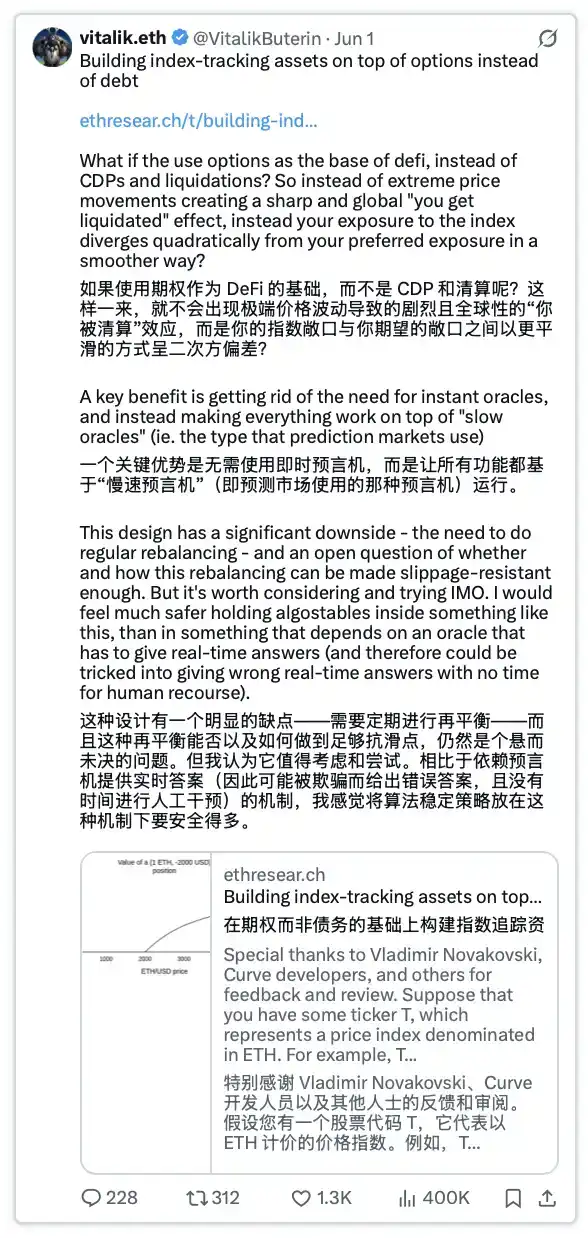
What really drew me in was the angle: options not as a product to trade, but as infrastructure underlying a product.

This is the view I've been pushing for years, and the core idea behind building Rysk V12. For us, the product is yield; for Vitalik, the product is stability. The more I thought about it, the more familiar the design felt.

The stable side he describes is essentially a covered call.

Why It's a Covered Call

His design splits one unit of ETH into two types of equity. One side is P, which holds the value up to a certain strike price; the other side is N, which receives the appreciation above that strike. Together they always sum to one unit of ETH, so there's no debt, no margin, and nothing to liquidate.

Assume ETH price is $2,500, with a strike price of $1,500. As long as ETH stays above $1,500, P behaves like equity stable at $1,500; only if ETH falls below $1,500 does P start taking downside risk. N gets all the upside above $1,500.

This is exactly the payoff structure of a covered call.

The holder keeps the asset, sells the upside above a certain strike, and collects a premium. P replicates precisely this covered call payoff. N is equivalent to the call option held by the buyer.

More accurately, it's a synthetic covered call. No one externally sells an actual option; instead, the equity is split to reconstruct the same payoff.

This is the same thesis behind Rysk V12. Users hold ETH, BTC, or HYPE and earn upfront yield by selling covered calls. Vitalik points the same building block towards stability.

Same engine, different product.

The Problem: It's Deep In-The-Money and Must Be Continuously Rolled

Right now, most Rysk users sell out-of-the-money covered calls. They hold ETH and choose a strike above the current price: either betting price won't reach it, or being willing to sell and take profit at that higher price if it does, while keeping the premium regardless.

But the stable side in Vitalik's design needs a different structure. To behave like a stable amount, the strike must be far below spot, so the call would be deep in-the-money, with most of its value being intrinsic.

At a spot price of $2,500 and a $1,500 strike, there's $1,000 of intrinsic value the buyer must pay upfront. That makes the trade far more capital intensive.

But a call can only stay stable for a moment. Once ETH drifts towards the strike, it starts taking ETH downside, so it must be rolled down to a lower strike, again and again.

So, this stable asset is essentially a program of continuously rolling covered calls.

Vitalik points out this risk himself. The slippage from repeated rollovers is the biggest threat to the design, and how the roll is executed is the truly hard part.

Any mechanism that trades on a fixed, public schedule is easily front-run. This is precisely the problem DeFi Options Vaults (DOVs) faced: they sold the same duration, same strike options every week at the same time, so the market knew exactly what was coming and positioned ahead, extracting value from that flow.

Regardless, every roll needs a buyer. The question is: who buys it? And at what price?

The Hardest Part Is Funding It

In Vitalik's model, someone must deposit a full unit of ETH, split it, sell the stable side, and hold the upside side. This depositor is the person the whole system relies on.

The most obvious candidates are market makers.

But the position they end up holding is essentially leveraged long ETH. And anyone wanting leveraged long ETH can just buy a call option or go long a perpetual. That's simpler, more efficient, and more familiar. The depositor is taking a harder path to get a position they could get more easily elsewhere.

The upside side does have one real advantage: it offers real leverage without funding rates or liquidation risk, which a perpetual cannot.

But it still needs to find buyers, and not just once. For every unit of stable asset that exists, someone must hold the corresponding upside side.

To scale, this model needs a persistent set of people who, in any market environment, are willing to hold ETH leveraged longs in this specific form continuously.

And market makers are resource optimizers by nature. Without a clear reason, they won't adopt something new, capital intensive, and with heavy integration costs. "Speculators and market makers will provide liquidity" is the assumption the whole design rests on. But that behavior doesn't happen in a vacuum.

What We Learned at Rysk

We learned this the hard way at Rysk. Earlier versions of the protocol struggled to expand, lacked organic demand, and never found product-market fit.

In the current protocol, Rysk V12, both sides of the trade have strong reasons to participate. So, Rysk starts with two parties who already want in. Holders want yield from assets they already hold, and their assets are the collateral.

Market makers compete to buy this flow via an RFQ (Request-for-Quote) mechanism. They only pay the premium, don't need to post collateral, end up with the option exposure they actually want, and can price and hedge it on their own books. This is the more capital-efficient side of the trade, which is why trading desks integrate spontaneously.

No one is asked to hold a position they could get more easily elsewhere.

The system also doesn't rely on incentives or token emissions.

Worth Building

I'm glad to see this design being seriously explored. The challenges are real, but they're the interesting kind. This is exactly the design space DeFi should explore.

What feels validating is that this proposal reinforces the same choices we made at Rysk: fully collateralized, no liquidation, no counterparty risk, and physical settlement requiring an oracle only at expiry.

Different use case, same foundation. That foundation is live and proven on HyperEVM, with market makers competing for flow. We've also deployed to Ethereum mainnet and will open to the public soon.

If you're exploring stablecoins, structured products, index products, or anything with optionality under the hood, feel free to reach out.

Options are building blocks. The truly interesting stuff is what gets built on top.

Perguntas relacionadas

QAccording to the article, what is the core financial derivative that Vitalik's proposed stablecoin design is analogous to?

AThe stable-side asset in Vitalik's proposed design is essentially analogous to a synthetic covered call option.

QWhat is the primary challenge identified for Vitalik's stablecoin model based on a covered call structure?

AThe primary challenge is the need to continuously roll deep in-the-money call options to maintain stability, which introduces issues like rollover slippage, front-running on fixed roll schedules, and liquidity dependency.

QFor Vitalik's design to function, who must hold the 'upside' (N) portion of the split ETH, and what does holding it represent?

AFor the system to function, someone must hold the 'upside' (N) portion, which represents a leveraged long position on ETH without funding rates or liquidation risk. The article suggests market makers are the most obvious candidates to provide this liquidity.

QWhat key lesson did the author learn from building Rysk about making DeFi options viable?

AThe key lesson is that DeFi options struggle to scale when positioned as direct trading products due to complexity and lack of natural demand. Instead, they find product-market fit when embedded as a foundational infrastructure layer underneath more complex products like stablecoins, structured yields, or index products.

QWhat is the main advantage of the 'upside' (N) asset in Vitalik's model compared to using perpetual contracts for leveraged ETH exposure?

AThe main advantage of the 'upside' (N) asset is that it provides real leverage on ETH without the recurring costs of funding rates and without the risk of liquidation, which perpetual contracts cannot offer.

Leituras Relacionadas

Behind the AI Scorecards Lies a Chinese 'Question Setter'

Behind the AI scorecards that dominate industry discussions—benchmarks like MMLU-Pro, MMMU, and MMMU-Pro—stands a Chinese-Canadian researcher: Wenhu Chen. As an assistant professor at the University of Waterloo and founder of the TIGER Lab, Chen has become a key "exam-setter" for evaluating large language and multimodal models. Chen first gained broader recognition with MMLU-Pro, a more challenging and stable update to the popular MMLU benchmark. As top models like OpenAI’s o3 began achieving near-perfect scores on the original MMLU, it became difficult to distinguish their true capabilities. MMLU-Pro introduced more complex reasoning questions, expanded answer choices, and filtered out ambiguous or simple items, effectively reintroducing differentiation among state-of-the-art models. His work on MMMU addressed the evaluation of multimodal models, requiring them to integrate visual information (like charts, diagrams, or tables) with textual knowledge across diverse academic subjects. Even the strongest models initially scored only around 56-59%, highlighting significant room for improvement in genuine multimodal reasoning. MMMU-Pro further refined this by preventing models from bypassing visual cues. Chen’s research focus has long been on complex information understanding and reasoning. His background—including a PhD at UC Santa Barbara, research at Google/DeepMind on Gemini, and now a role in Meta’s superintelligence lab—provides deep insight into model development and their potential weaknesses. His TIGER Lab also builds models (e.g., for video understanding and generation), ensuring his evaluation benchmarks are grounded in practical challenges. While AI headlines often spotlight company leaders and product launches, Chen’s work exemplifies the critical, behind-the-scenes contributions of researchers crafting the rigorous standards that define and drive progress in AI capabilities.

marsbitHá 57m

Behind the AI Scorecards Lies a Chinese 'Question Setter'

marsbitHá 57m

STRC Unpegged by 11%, Can Strategy's Perpetual Motion Machine Keep Turning?

STRC, the perpetual preferred stock of MicroStrategy, is experiencing a persistent de-pegging from its target par value of $100, with the discount recently widening to over 11%. This de-anchoring challenges the core design of STRC, which was intended as a stable, income-oriented security operating near $100. As a crucial funding engine for MicroStrategy's Bitcoin acquisition strategy, STRC's price reflects market confidence in the company's entire capital model. The company's "capital flywheel" relies on issuing STRC at or above $100 via an At-the-Market (ATM) program to raise cash for buying Bitcoin, thereby boosting company equity and theoretically supporting STRC's value. A monthly adjustable dividend mechanism was designed to maintain this peg. Despite raising the dividend to 11.5% and increasing payment frequency, the de-pegging persists. Market concerns extend beyond technical factors like leveraged arbitrage unwinding. Analysts point to MicroStrategy's limited cash reserves relative to its ~$1.7 billion annual dividend obligation for preferred shares. While the company counters that its vast Bitcoin holdings could cover decades of payments, this argument hinges on the potential need to sell Bitcoin—a shift from its longstanding "hodl" narrative. The company's recent sale of a small amount of BTC, framed as a test, amplified these liquidity and strategy concerns. If STRC remains discounted, impairing MicroStrategy's ability to raise cheap capital, fears may grow that the company could sell more Bitcoin to meet obligations. This scenario could transform MicroStrategy from a major market buyer into a potential seller, posing significant downside risk for Bitcoin. The re-pegging of STRC is thus a key indicator for the health of MicroStrategy's capital structure and its market impact.

Odaily星球日报Há 1h

STRC Unpegged by 11%, Can Strategy's Perpetual Motion Machine Keep Turning?

Odaily星球日报Há 1h

Silicon Valley's Most Sought-After New Role Has Emerged

Silicon Valley's New Most Wanted Job: The Rise of the Forward Deployment Engineer The AI industry is witnessing a significant shift. The focus has moved from developing cutting-edge models to deploying them effectively within enterprises. This has made the "Forward Deployment Engineer" (FDE) a critical and highly sought-after role at major firms like OpenAI, Anthropic, and Google. For the past three years, the industry prioritized model scientists. However, companies are now facing a harsh reality: purchasing powerful AI tools does not guarantee productivity gains or organizational change. The biggest hurdle is not the technology itself, but integrating it into complex legacy systems, workflows, and corporate cultures. This includes challenges like data silos, compliance requirements, and internal resistance. The FDE role, pioneered by Palantir Technologies, addresses this "last-mile" problem. FDEs are deployed on-site with clients for extended periods. Their job is to deeply understand the client's specific organizational structure, processes, and pain points, then tailor and implement the AI solution accordingly. They combine skills in technology, project management, and organizational change. A clear signal of this trend emerged in May 2026 when three AI giants made major moves. Anthropic launched a $1.5B joint venture for enterprise deployment. OpenAI formed an independent deployment subsidiary, DeployCo, with over $4B in commitments and acquired a deployment consultancy. Google Cloud's CEO publicly announced a large-scale recruitment drive for FDEs. This shift represents a fundamental change in the software business model: from selling tools to selling guaranteed outcomes. FDEs are the agents of this change, responsible for delivering a working system within the production environment, not just a demo. Real-world cases, such as challenges at Goldman Sachs (compliance barriers) and Target (internal cultural resistance), illustrate that the primary obstacles to AI adoption are organizational, not technical. An FDE's value lies in navigating these human and procedural complexities to facilitate a successful "AI migration." In essence, as core AI technology becomes more accessible and affordable, the true premium is shifting to the human expertise required to understand organizations and drive change—making the FDE role pivotal for the next phase of the AI revolution.

marsbitHá 1h

Silicon Valley's Most Sought-After New Role Has Emerged

marsbitHá 1h

When the World Cup Collides with Agents: From Web2 to Web3, How Are Wallets Evolving into Agentic Wallets?

World Cup as a Catalyst for Agentic Wallets: From Web2 to Web3 This article explores how the World Cup provides a real-world scenario for observing the evolution of digital wallets from simple asset managers towards "Agentic Wallets"—intelligent, AI-powered interfaces. Using the example of prediction markets like Polymarket, it illustrates how AI Agents can lower the barrier to Web3 interaction. Instead of navigating complex DApps, users can express intent in natural language (e.g., "I think Portugal will win") within platforms like Discord or web pages. The Agent then interprets this intent, finds the relevant market, and seamlessly guides the user through the on-chain transaction via their wallet. The core shift is from wallets as mere "function menus" for signing transactions to "intent interpreters" that understand user goals. The article highlights parallel developments in traditional finance, such as Mastercard's "Agent Pay" and WeChat Pay's AI tests, which focus on granting AI controlled, authorized, and auditable payment capabilities. This underscores a broader trend of AI entering the financial layer. However, the article emphasizes that the primary challenge for Agentic Wallets in Web3 is not automation but establishing clear security boundaries. Unlike traditional systems with chargebacks, on-chain transactions are often irreversible. Therefore, future wallets must ensure users retain ultimate control and comprehension. They need to transparently communicate an Agent's permissions, spending limits, authorized durations, and provide easy ways to pause or revoke access. The World Cup experiments represent early steps toward wallets that are not just applications but ubiquitous, intelligent interfaces that simplify Web3 while keeping users securely in control.

marsbitHá 2h

When the World Cup Collides with Agents: From Web2 to Web3, How Are Wallets Evolving into Agentic Wallets?

marsbitHá 2h

Trading

Spot
Futuros
活动图片