Euro Stablecoins Have Entered DeFi, What Are Other Local Currencies Waiting For?

marsbitPublicado em 2026-03-30Última atualização em 2026-03-30

Resumo

Euro stablecoins are leading the adoption of non-USD stablecoins in DeFi, while other local currency stablecoins remain primarily used for payments and settlements. The implementation of MiCA regulations in Europe effectively ended Tether’s EURT, reducing its supply from over $400M to around $50M. However, the broader non-USD stablecoin market (excluding EURT) has nearly tripled since early 2023, reaching $1.1B by February 2026. Euro-denominated stablecoins account for over 90% of non-USD transaction volume and are increasingly integrated into DeFi protocols like Aave and Morpho for lending and trading. In contrast, other local currency stablecoins (e.g., BRL, JPY) are mostly used for payments, remittances, and enterprise settlements, with nearly 80% of their activity falling under unidentified transfers. Regulatory clarity, as seen in Brazil and Japan, is crucial for adoption. The growth of non-USD stablecoins is driven by their potential to reduce FX costs, streamline cross-border payments, and minimize dollar dependency. While euro stablecoins have set a precedent for DeFi integration, broader adoption of other local currency tokens will likely focus first on payment infrastructure before expanding into DeFi applications.

Author: Prathik Desai / The Token Dispatch

Compiled by: Deep Tide TechFlow

Deep Tide Introduction: This article uses data to clarify a commonly confused issue: non-USD stablecoins are not a monolithic block; euro stablecoins and other local currency stablecoins are on completely different paths.

EURT was directly killed by MiCA regulations, but this forced the entire market to rebuild—its supply has nearly tripled since 2023.

A more critical finding is: 90% of non-USD transfer volume is contributed by euro stablecoins, while other local currencies are currently almost only used for payment settlement. DeFi integration is the next stage, not now.

Full text as follows:

Money is only truly useful when it reaches its destination. Wages earned overseas must pass through banks, foreign exchange counters, payment partners, and local compliance reviews before they can return home to pay for rent, tuition, utilities, and food. Until then, it is just value in motion, not yet a medium of exchange.

The same problem now appears on-chain. Stablecoins move funds globally with code, but their utility depends on where they can connect, who is allowed to use them, and which rules govern their reserves and redemptions.

This concept struck me while I was researching Dune's report "Beyond De-dollarization: The Rise of Local Currency Stablecoins".

In today's quantitative analysis, I will explain the factors affecting the growth of non-USD local currency-pegged stablecoins.

The Teeth of Regulation

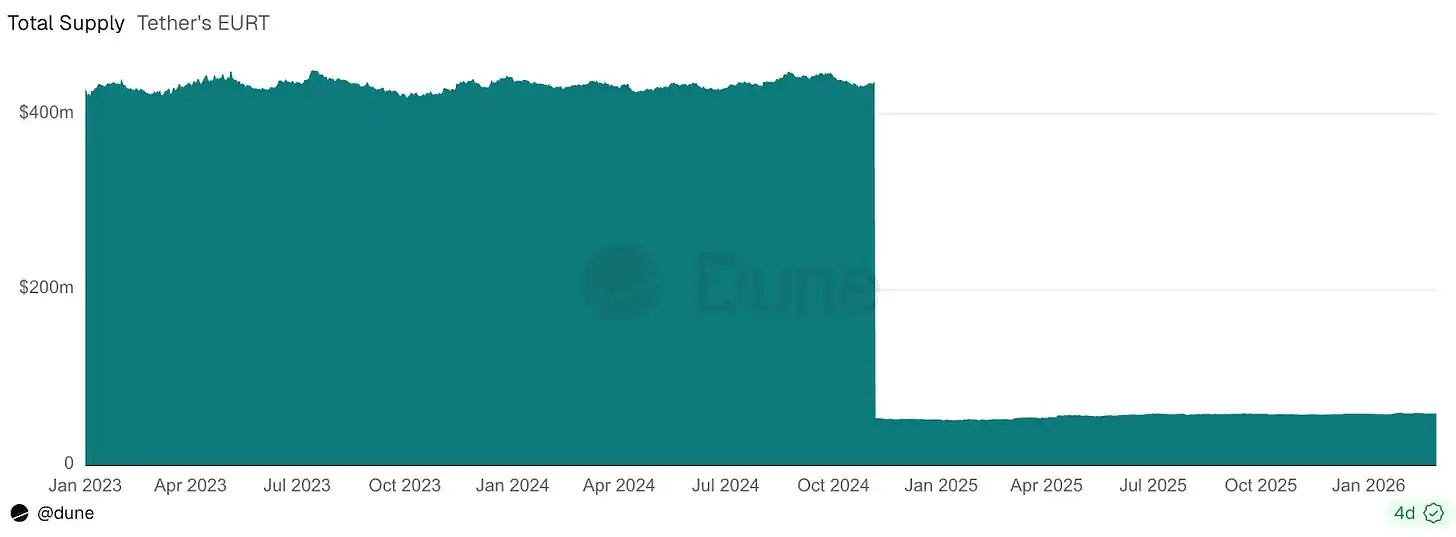
The clearest case of regulatory impact happened to Tether's euro-pegged stablecoin. The European Union's Markets in Crypto-Assets Regulation (MiCA), which came into full effect in 2024, almost immediately pronounced a death sentence on Tether Euro (EURT).

EURT was once one of the earliest and largest non-USD stablecoins, with its circulating supply dropping from over $400 million to about $50 million. The total supply of local currency stablecoins consequently fell from $1 billion to $350 million.
Crypto enthusiasts often assume the code is enough. They create a token, inject liquidity, and expect the market to do the rest. But non-USD stablecoins are not just abstract internet money. They attempt to be better digital versions of local currencies like the Euro, Yen, or Thai Baht, capable of flowing on public rails unrestricted by bank hours. Yet they operate within domestic financial systems, subject to reserve requirements, licensing norms, payment networks, and redemption expectations.

The shutdown of EURT reminds us that first-mover advantage and largest scale are not enough. One change in the domestic rulebook can erase all the advantages of the pioneer.

But regulation is not always detrimental to stablecoins. If it were, non-USD stablecoins might have stalled after EURT's exit.
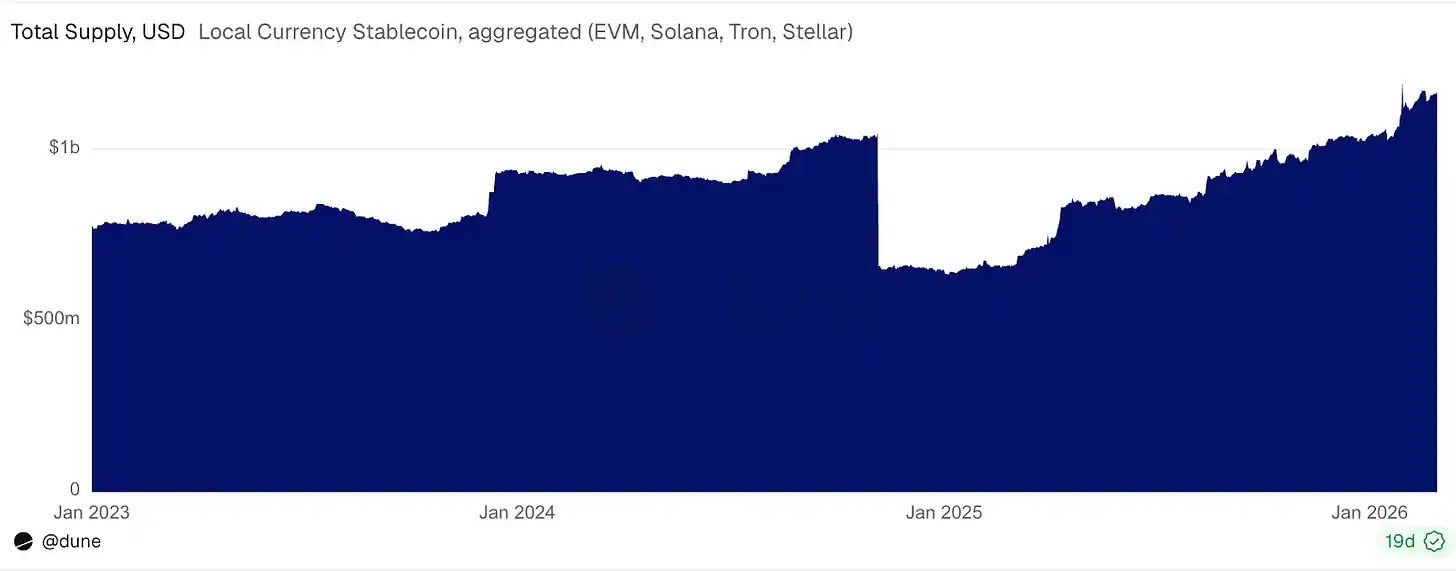
If EURT is excluded, the total supply of non-USD stablecoins grew from about $350 million in January 2023 to $1.1 billion in February 2026, nearly tripling.

The Market is Expanding

While the supply grew, the number of addresses holding balances of such stablecoins grew from about 42,000 to over 1.2 million in the same period.

Monthly transfer volume increased 16-fold, from $600 million to $10 billion. The monthly number of sending addresses grew 22-fold, from about 6,000 to 135,000.

The growth rate of holders and senders was faster than the growth rate of the supply, indicating the market expanded through increased participation.
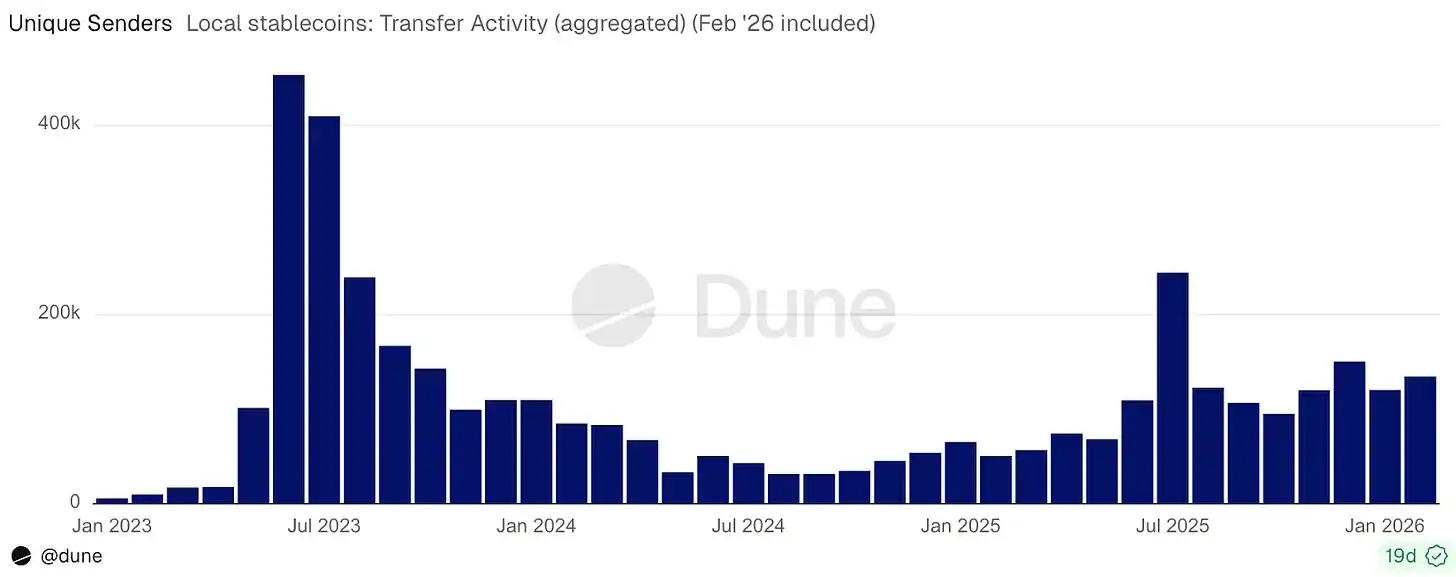
Therefore, regulation is not always harmful to the market as it was for Tether Euro; here it actually attracted more stablecoin issuers and users.

Where Non-USD Funds Are Flowing

By early 2026, unidentified transfers accounted for 38% of total local currency stablecoin transfer activity. This likely reflects payment and settlement activities, including peer-to-peer transfers and transfers from self-custody wallets to payment service providers.

Next was lending, accounting for 29%; DEX activity accounted for 17%; and centralized exchange-related flows accounted for 14%.
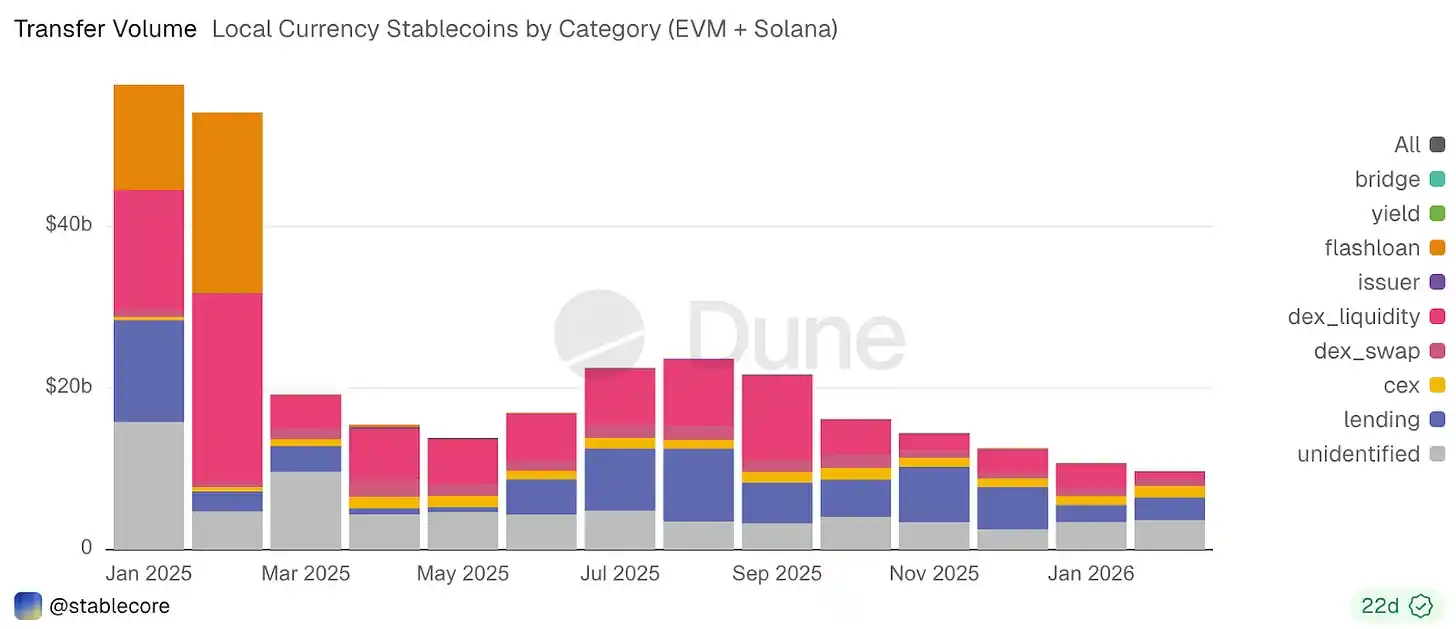
This categorization shows that non-USD stablecoins are primarily used on-chain for two types of scenarios: one is for payments, or as funds flowing between individuals or businesses; the other is for basic DeFi operations, such as lending and trading.

But there is a caveat in the data. If euro-pegged stablecoins are stripped from the data, the market shows a completely different trend.

Euro stablecoins account for over 90% of the transfer volume and are being used as financial assets themselves. Users deposit them into lending markets, use them on DEXs, treating them more as on-chain cash that can earn yield, serve as collateral, and be cycled through DeFi. This makes local currency stablecoins appear more mature.

EURC, along with EURS, EURm, and EUROe, has entered yield-generating DeFi venues like Aave, Morpho, and Fluid.

After removing euro stablecoins, the remaining non-USD digital currencies are primarily used for settlement infrastructure.
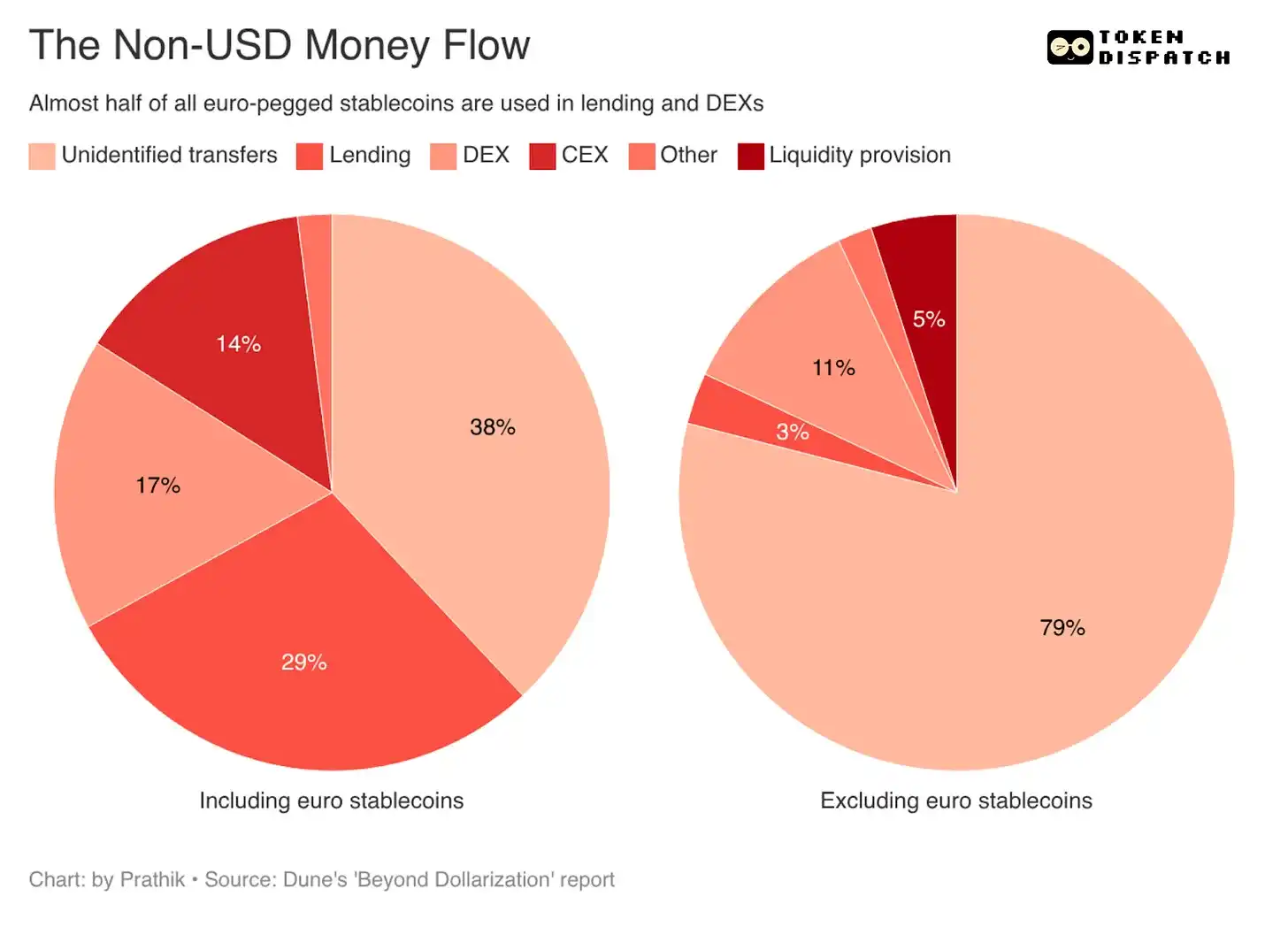
Nearly eighty percent of non-USD, non-euro stablecoin transfers fall into the unidentified transfer category. This likely covers wallet-to-wallet fund transfers, business debt settlements, remittance-style transfers, and payment flows circulating through service providers.

The dominance of euro-pegged currencies among non-USD stablecoins indicates that the next phase of growth is more likely to be concentrated in basic DeFi operations. Beyond the euro, non-USD stablecoins will first expand as infrastructure for domestic funds flowing on digital rails, before they can be used for basic DeFi operations.

This growth is crucial because it will come from stablecoins used for payroll, treasury management, merchant settlements, remittances, and foreign exchange (FX).

These areas are more heavily regulated than basic DeFi operations because operating funds tolerate far less ambiguity than speculative assets. If a token is expected to operate within domestic payment systems, treasury workflows, and environments with strict compliance requirements, it will need predictable reserves, clear redemption processes, and legal clarity. Therefore, regulation will play a key role in the adoption of non-USD stablecoins.

This also explains why growth is concentrated in regions with mature financial systems. The report notes that the activity of the Brazilian Real (BRL) and Japanese Yen (JPY) accelerated after improvements in local regulatory frameworks; while markets lacking specific regulatory regimes, such as Indonesia, lagged behind.

I also found the economic rationale for non-USD stablecoins.

Cross-border payments still bear high conversion costs, with remittances losing a considerable portion to FX spreads and intermediary steps. More local currency stablecoins can reduce the amount of value that needs to detour through the US dollar before reaching its destination. This can lower foreign exchange costs, eliminate settlement friction, and allow businesses and individuals to hold value in the currency they earn, spend, and save.

Its potential is far greater than DeFi itself. Euro stablecoins have already set a strong precedent for integrating local digital money into the financial system. However, the bigger win would be reducing the cost and speed of global cross-border fund flows and reducing reliance on the US dollar globally.

Issuers who can make local currencies easier to send, settle, and embed into existing payment infrastructure will benefit from the huge potential of non-USD stablecoins. If they can create favorable conditions for better adoption, DeFi integration will naturally follow.


Perguntas relacionadas

QWhat was the impact of the MiCA regulation on Tether's euro-pegged stablecoin (EURT)?

AThe MiCA regulation effectively led to the demise of Tether's euro-pegged stablecoin (EURT), causing its circulating supply to plummet from over $400 million to approximately $50 million.

QHow much has the total supply of non-USD stablecoins (excluding EURT) grown from January 2023 to February 2026?

AExcluding EURT, the total supply of non-USD stablecoins grew from approximately $350 million in January 2023 to $1.1 billion in February 2026, nearly tripling.

QWhat percentage of non-USD stablecoin transfer volume is contributed by euro-pegged stablecoins?

AEuro-pegged stablecoins contribute to over 90% of the total transfer volume of non-USD stablecoins.

QWhat are the two primary use cases for non-USD stablecoins on-chain, as indicated by the data?

AThe two primary use cases are for payments and settlements (including peer-to-peer transfers and transfers to payment service providers) and for DeFi primitive operations such as lending and trading.

QAccording to the article, what is a key factor for the growth of non-USD stablecoin adoption in a market?

AA key factor for growth is the presence of a clear and improved local regulatory framework, as seen in markets like Brazil and Japan, whereas markets lacking such frameworks, like Indonesia, have lagged behind.

Leituras Relacionadas

The Essence of AI Layoffs: Why More AI Adoption Leads to More Corporate Anxiety?

The author, awaiting potential inclusion on an 8000-person layoff list, analyzes the true nature of recent "AI-driven" layoffs. They argue that while AI use, particularly tools like Claude for code generation, has skyrocketed and boosted developer output (e.g., 2-5x more code commits), this has not translated into proportional business growth or revenue. The core issue is a misalignment between increased "Input" (code) and tangible "Outcomes" (user value, revenue). AI acts as a costly B2B SaaS, inflating operational expenses without guaranteed returns. Two key problems emerge: 1) The friction that once filtered out bad ideas is gone, as AI allows cheap pursuit of even weak concepts. 2) Organizational "alignment tax"—the difficulty of coordinating across teams—becomes crippling when development velocity outpaces consensus-building. Thus, layoffs serve two immediate purposes: 1) To offset ballooning AI costs (Token consumption) and maintain cash flow, as rising input costs without outcome growth destroys unit economics. 2) To reduce organizational bloat and alignment friction by simply removing teams, thereby speeding up execution in the short term. Therefore, these layoffs are fundamentally caused by AI, even if AI doesn't directly replace roles. They represent a painful correction until companies learn to convert AI-driven productivity into real business outcomes and streamline organizational coordination to match the new pace of work. The cycle will continue until this learning curve is mastered.

marsbitHá 31m

The Essence of AI Layoffs: Why More AI Adoption Leads to More Corporate Anxiety?

marsbitHá 31m

Can the Solana Foundation and Google's Collaboration on Pay.sh Bridge the Payment Link Between Web2 and Web3 in the Agent Economy?

Solana Foundation, in collaboration with Google Cloud, has launched Pay.sh, a payment gateway designed to bridge the gap between AI agents and enterprise-grade service infrastructure. The initiative aims to solve a key bottleneck in the "agent economy": existing payment systems are ill-suited for autonomous AI agents. Traditional methods like credit cards require human verification, while newer on-chain protocols like x402 and MPP create a separate, Web3-native system that raises barriers for service providers. Pay.sh functions as a universal payment layer. It allows users to fund a Solana wallet via credit card or stablecoin, which then acts as an identity and payment proxy for AI agents. When an agent needs to access a paid API service (e.g., Google Cloud, Alibaba Cloud), Pay.sh handles the transaction seamlessly. It leverages the HTTP 402 status code ("Payment Required") to initiate payments, intelligently choosing between one-time transfers (x402-style) or session-based authorizations (MPC-style) based on the service's billing model. This spares agents from manual account registration and API key management. A key feature for service providers is low integration effort. They can adopt Pay.sh by providing a declarative configuration file, enabling features like tiered pricing, free tiers, and automatic revenue splitting to multiple addresses (e.g., for royalties, cloud costs). Providers can also list their APIs in a central Pay Skill Registry for agent discovery. The collaboration with Google Cloud provides crucial infrastructure for API proxying, traffic routing, and compliance logging, aiming to keep agent activities within regulated boundaries. By connecting Web2 services with Web3 payment rails, Pay.sh positions the Solana wallet as a foundational identity and payment tool for AI agents, potentially driving more transaction volume to the Solana ecosystem. However, the report notes challenges. The service registry currently lacks robust vetting, risking exposure to unauthorized or malicious third-party APIs. Pay.sh also inherits security and compatibility risks from its underlying payment protocols (x402, MPC). Furthermore, adoption may be hindered by varying regional data privacy and payment compliance regulations among API providers. Despite these hurdles, Pay.sh represents a significant step towards integrating Web2 and Web3 for autonomous agent commerce.

marsbitHá 38m

Can the Solana Foundation and Google's Collaboration on Pay.sh Bridge the Payment Link Between Web2 and Web3 in the Agent Economy?

marsbitHá 38m

Bitcoin's Bull-Bear Cycle Indicator Turns Positive for the First Time in 7 Months: End of Bear Market or False Breakout?

Bitcoin's "Bull-Bear Market Cycle Indicator" from CryptoQuant has turned positive for the first time since October 2025. This gauge, based on the P&L Index relative to its 365-day moving average, suggests a potential shift from a bear market phase. Concurrently, the Bull Score Index rose to a neutral reading of 50 in late April. The indicator's move into positive territory follows a roughly 35% price rebound from a low near $60,000 in February to above $81,000. The recovery over approximately three months was faster than the 12-month period observed during the 2022 bear market. However, analysts caution against premature optimism, citing a historical precedent from March 2022. Back then, the Bull Score Index briefly hit 50, but it proved to be a false signal as Bitcoin's price subsequently plunged further. Structural differences exist in the current cycle, including consistent inflows into spot Bitcoin ETFs and an increase in large holder addresses. Yet, some models, referencing the four-year halving cycle, suggest a potential deeper bottom near $50,000 might still be possible around late 2026. In summary, while on-chain data shows marked improvement and the worst panic may be over, market participants remain cautious. A convincing trend reversal confirmation likely requires Bitcoin to sustainably break above key resistance, such as the 200-day moving average near $82,000.

marsbitHá 45m

Bitcoin's Bull-Bear Cycle Indicator Turns Positive for the First Time in 7 Months: End of Bear Market or False Breakout?

marsbitHá 45m

How to Automate Any Workflow with Claude Skills (Complete Tutorial)

This is a comprehensive guide to mastering Claude Skills, a feature for creating permanent, reusable instruction sets that automate specific workflows. Unlike simple saved prompts, Skills function like trained employees, delivering consistent, high-quality outputs by defining the entire task process, standards, error handling, and output format. The guide is structured in four phases: **Phase 1: Installation (5 minutes).** Skills are folders containing a `SKILL.md` file. The user is instructed to find a relevant Skill online, install it, test it on a real task, and compare its performance to one-off prompts. **Phase 2: Building Your First Custom Skill.** Start by rigorously defining the Skill's purpose, trigger phrases, and providing a concrete example of perfect output. The `SKILL.md` file has two parts: a YAML frontmatter with a specific name/description/triggers, and a detailed, step-by-step workflow written in natural language with examples and quality standards. **Phase 3: Testing & Optimization for Production.** Test the Skill in three scenarios: 1) a standard, common task; 2) edge cases with missing or conflicting data; and 3) a pressure test with maximum complexity. Any failure indicates a needed instruction. Implement a weekly optimization cycle to continuously refine the Skill based on real usage. **Phase 4: Building a Complete Skill Library.** The goal is to create a team of Skills for all repetitive tasks. Examples are given for industries like real estate, marketing, finance, consulting, and e-commerce. The user should list their tasks, prioritize them, and build one new Skill per week, maintaining a master document to track their library. The conclusion emphasizes the compounding time savings: ten Skills saving 30 minutes each per week reclaims over 260 hours (6.5 work weeks) per year, fundamentally transforming one's work system.

marsbitHá 1h

How to Automate Any Workflow with Claude Skills (Complete Tutorial)

marsbitHá 1h

Trading

Spot
Futuros
活动图片




