Ethereum's Year of Interoperability: A Deep Dive into EIL, a Grand Experiment in Entrusting 'Trust' to Game Theory?

marsbitPublicado em 2026-01-12Última atualização em 2026-01-12

Resumo

Ethereum is entering a major phase of mass adoption in 2026, driven by the development of the Ethereum Interoperability Layer (EIL). EIL is not a new blockchain but a set of standards and protocols designed to connect Ethereum’s Layer 2 (L2) networks seamlessly. It aims to standardize state proofs and message passing between L2s, enabling native interoperability without altering their core security models. Currently, L2s operate as isolated environments with separate signatures, assets, and user experiences. EIL, combined with Account Abstraction (ERC-4337) and a trust-minimized messaging layer (XLP), allows users to perform cross-chain transactions with a single signature, abstracting away complexities like gas fees and repeated authorizations. Unlike traditional bridges or intent-based solutions, EIL avoids introducing new trust assumptions like solvers. Instead, it relies on XLP providers to facilitate instant transactions, with Ethereum L1 serving as a fallback enforcement layer via slashing mechanisms in case of malfeasance. However, EIL faces challenges in balancing efficiency and security. Its model shifts trust from technical verification to economic incentives and penalties, raising questions about sustainability under market volatility, scalability in multi-chain environments, and the economic feasibility of liquidity provision. Despite these open questions, EIL represents a significant experiment in expanding Ethereum’s interoperability while preserving its core...

2026 is destined to be a pivotal year for Ethereum's Mass Adoption.

With the finalization of multiple underlying upgrades in 2025 and the establishment and advancement of the Interop roadmap, the Ethereum ecosystem is gradually entering the "Great Era of Interoperability." Against this backdrop, EIL (Ethereum Interoperability Layer) is stepping into the spotlight from behind the scenes (Further reading: "Ethereum's Interop Roadmap: Unlocking the 'Last Mile' of Mass Adoption").

If early technical discussions were still at the "proof-of-concept" stage, EIL has undoubtedly now entered the deep waters of standard implementation and engineering. This has sparked a series of major community debates. For instance, when pursuing a Web2-smooth cross-chain experience, are we quietly altering the long-held trust boundaries of Ethereum?

Objectively speaking, when any technological vision moves towards engineering implementation, trade-offs between efficiency and security are inevitable. This article also attempts to move beyond technical slogans and, by examining the specific design details of EIL, deconstruct its real trade-offs between efficiency, standards, and security assumptions.

I. What Exactly is EIL 'Sewing' Together?

First, we need to clarify the essence of EIL once again—it is not a new chain, nor a new consensus layer, but rather a set of interoperability communication frameworks and standard protocol collections.

In short, the core logic of EIL lies in standardizing the "state proofs" and "message passing" of different L2s without rewriting Ethereum's underlying security model, enabling different L2s to possess composability and interaction capabilities akin to a single chain without changing their own security assumptions (Further reading: "The End of Ethereum Islands: How EIL Reconstructs Fragmented L2s into a 'Supercomputer'?").

As is well known, in the current Ethereum ecosystem, each L2 is an isolated island. For example, your account (EOA) on Optimism and your account on Arbitrum, while having the same address, have completely isolated states:

  • Signature Isolation: Your signature on Chain A cannot be directly verified by Chain B;
  • Asset Isolation: Your assets on Chain A are also invisible to Chain B;
  • Interaction Barriers: Cross-chain operations require repeated authorizations, gas swaps, waiting for settlement, etc.;

EIL, combining the capabilities of "Account Abstraction (ERC-4337)" and a "trust-minimized message layer," constructs a unified execution environment at the account layer + message layer, attempting to eliminate these artificial divisions:

The author previously gave an intuitive example: cross-chain interactions used to be like traveling abroad—you needed to exchange currency (cross-chain assets), obtain a visa (re-authorize), and follow local traffic rules (purchase target chain Gas). Entering the EIL era, cross-chain interactions are more like using a Visa card globally:

No matter which country you are in, just swipe your card once (sign), and the underlying banking network (EIL) automatically handles exchange rates, settlement, and verification—you don't perceive the existence of national borders.

Compared to traditional cross-chain bridges, Relayers, and Intent/Solver models, the advantages of this design are also intuitive—the Native route is the safest, most transparent, but slow and experience-fragmented; the Intent route offers the best experience but introduces Solver trust and game theory; EIL attempts to push the experience closer to Intent without introducing a Solver, but requires deep integration with wallets and protocol layers.
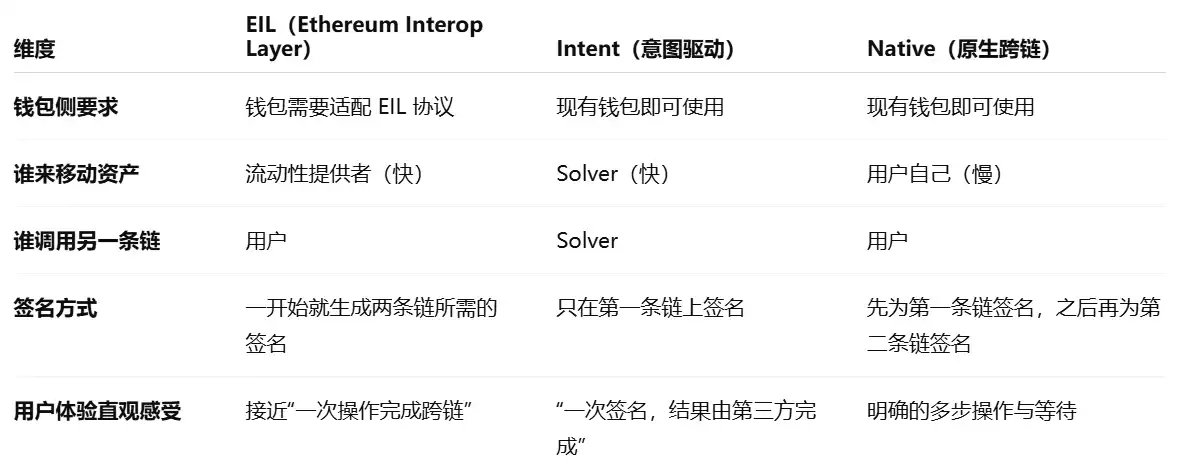
Source: Based on @MarcinM02, self-generated image

The EIL proposal put forward by the Ethereum Foundation's Account Abstraction team paints such a future: users only need to sign once to complete a cross-chain transaction, without relying on centralized relays or adding new trust assumptions, and can initiate transactions directly from their wallet for seamless settlement across different L2s.

II. EIL's Engineering Path: Account Abstraction + Trust-Minimized Message Layer

Of course, this also raises a more practical question: whether the implementation details and ecosystem adaptation of EIL can achieve "theory equals practice" remains an open proposition.

We can break down EIL's engineering implementation path. As mentioned above, it does not attempt to introduce a new inter-chain consensus but is built upon two existing building blocks: ERC-4337 Account Abstraction (AA) + a trust-minimized cross-chain message and liquidity mechanism.

First is Account Abstraction based on ERC-4337. It decouples the account and the private key, allowing a user account to become a smart contract account with customizable validation logic and cross-chain execution logic, no longer limited to the traditional EOA key-pair model.

The significance of this for EIL is that cross-chain operations do not need to rely on external executors (Solvers) to act on your behalf. Instead, they can be expressed at the account layer as a standardized User Operation object (UserOp), constructed and managed uniformly by the wallet.

These functions were previously impossible with EOA itself and required complex external contract wrappers. Account Abstraction based on ERC-4337 allows user accounts to evolve from a rigid "key pair" into programmable code. More bluntly, users only need one signature (UserOp) to express cross-chain intent (Further reading: "From EOA to Account Abstraction: Will Web3's Next Leap Happen in the 'Account System'?"):

Account contracts can embed more complex validation/execution rules; one signature can trigger a series of cross-chain instructions. Combined with mechanisms like Paymaster, it can even achieve Gas abstraction—for example, paying for target chain fees using source chain assets, eliminating the awkwardness of having to buy a few dollars of native Gas tokens before crossing chains.

This is why the EIL narrative is often tied to wallet experience, as what it truly aims to change is the entry point through which users interact with the multi-chain world.

The second is the trust-minimized message passing mechanism—XLP (Cross-chain Liquidity Provider), which solves the efficiency problem of cross-chain message passing.

Because traditional cross-chain interactions rely on relays or centralized bridges, EIL introduces XLP. On this basis, an ideal path that is theoretically efficient and sacrifices as little security as possible can be built:

  • The user submits a cross-chain transaction on the source chain;
  • XLP observes this intent in the mempool and advances funds/Gas on the target chain, providing a "Payment Voucher";
  • The user utilizes the voucher to complete self-execution on the target chain;

The actual user experience is near-instantaneous settlement, without waiting for the slow settlement of the official bridge.

However, you might spot a problem: what if the XLP takes the money but doesn't deliver? The ingenious design of EIL lies in the fact that if an XLP defaults, the user can submit proof on Ethereum L1 to trigger permissionless slashing of its staked assets.

The official bridge is only used for settlement and recourse in case of bad debt. This means the system runs extremely fast under normal conditions; in extreme cases, security is still backed by Ethereum L1.
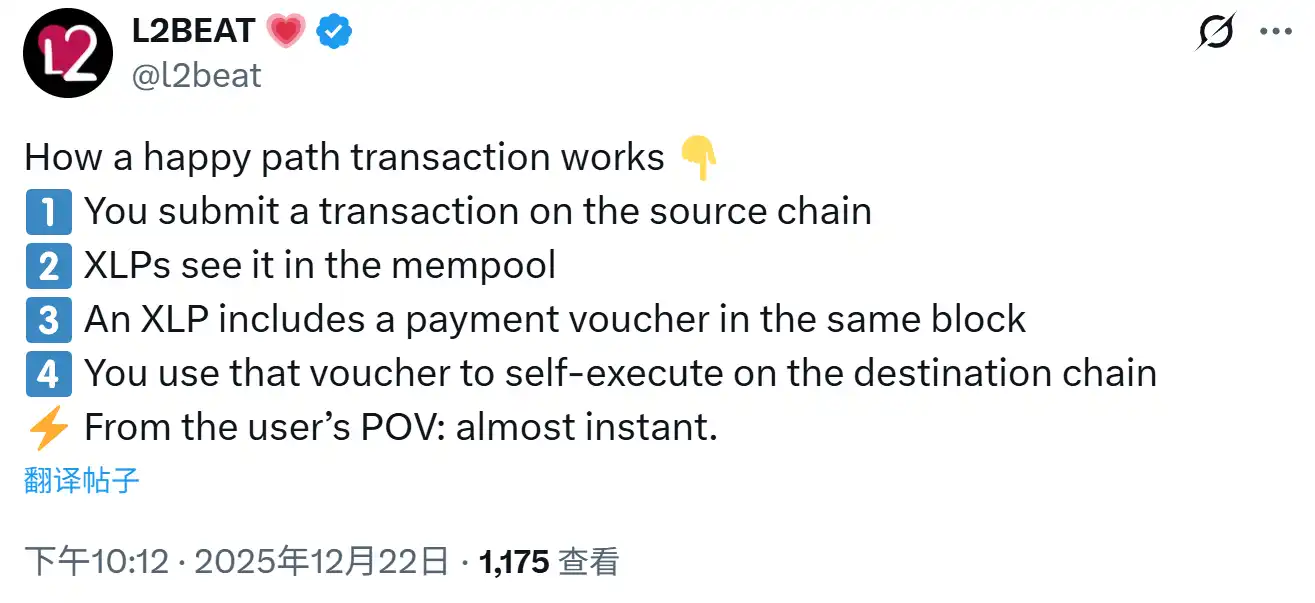
This structure means moving the slow and expensive security mechanism out of the default path, instead concentrating the trust pressure on failure handling.

Of course, this is also one of the sources of controversy: when security relies more on the "executability of the failure path" and the "effectiveness of economic penalties," is EIL truly adding no new trust assumptions? Or is it merely shifting trust from explicit relays to a more hidden, more engineered set of conditions?

This leads to the more critical discussion below—while it looks elegant in theory, what potential centralization and economic frictions might it face in the real-world ecosystem, and why does the community remain cautious about it?

III. Between Vision and Engineering: Is EIL Truly 'Minimizing Trust'?

By now, EIL's ambition is clear. Its design strives to avoid explicit relay trust and attempts to converge cross-chain interactions into one signature and one user operation at the wallet layer.

The problem is—trust doesn't just disappear; it merely migrates.

This is why platforms like L2BEAT, which have long focused on L2 risk boundaries, remain particularly cautious about the engineering implementation of EIL. After all, once an interoperability layer becomes the universal default path, any hidden assumptions, incentive failures, or governance single points of failure could amplify into systemic risks.

Specifically, EIL's efficiency comes from two points: first, AA packages actions into one signature; second, XLP's advance payment allows users to bypass waiting. The former is more straightforward, an efficiency gain from embedded AA. But the latter's advance payment means that some security no longer comes from immediately verifiable finality, but from "economic guarantees that can be pursued and penalized."

This undoubtedly pushes the risk exposure towards several more engineering-oriented questions:

  • Under real market fluctuations, how are the XLP's default probability, capital cost, and risk hedging priced?
  • Is "slashing" timely and executable enough to cover losses in extreme scenarios?
  • When amounts become larger and paths more complex (multi-hop/multi-chain), do failure scenarios become exponentially more difficult?

Ultimately, the trust foundation here is no longer mathematical proof but the validator's staked collateral. If the cost of attack is lower than the potential profit, the system still faces rollback risks.

Furthermore, objectively speaking, EIL attempts to solve liquidity fragmentation through technical means, but liquidity itself is market behavior. If significant cost and trust disparities still exist between chains, a mere communication standard (EIL) cannot make liquidity truly flow. After all, a pure communication protocol standard cannot solve the economic essence of "liquidity unwillingness to flow."

Extending this thought further, without accompanying economic incentive design, EIL might face the dilemma of having standardized pipelines but lacking executors because it's unprofitable.

However, overall, EIL is one of the most important infrastructure concepts proposed by the Ethereum community to address fragmented L2 experiences. It attempts to simplify UX while maintaining Ethereum's core values (self-custody, censorship resistance, disintermediation), which is commendable in itself (Further reading: "Seeing Through the Noise of Ethereum 'Degeneration': Why is 'Ethereum Values' the Widest Moat?").

For ordinary users, there's no need to hastily praise or否定 EIL, but rather to understand its trade-offs and boundary assumptions in protocol design.

After all, for the current Ethereum, EIL is not a simple upgrade to existing cross-chain pain points, but a technical and value attempt that deeply integrates experience, economy, and security trust boundaries. It has the potential to push Ethereum towards truly seamless interoperability, but it might also expose new boundary effects and necessary compromises during implementation.

In Conclusion

In 2026, EIL is not a plug-and-play ultimate answer, but more like a systematic test of trust boundaries, engineering feasibility, and the limits of user experience.

If it succeeds, Ethereum's L2 world will truly look like one chain; if it is less successful, it will undoubtedly leave clear lessons for the next generation of interoperability design.

Before 2026, everything is still an experiment.

And this, perhaps, is Ethereum's most real and most respectable aspect.

Perguntas relacionadas

QWhat is the core purpose of the Ethereum Interoperability Layer (EIL)?

AThe core purpose of the Ethereum Interoperability Layer (EIL) is to serve as a set of interoperability communication frameworks and standard protocol collections. It aims to standardize 'state proofs' and 'message passing' for different Layer 2 solutions (L2s) without altering Ethereum's underlying security model, enabling seamless composability and interaction between L2s as if they were a single chain.

QHow does EIL combine Account Abstraction (ERC-4337) and trust-minimized messaging to improve cross-chain experiences?

AEIL combines Account Abstraction (ERC-4337), which decouples accounts from private keys and allows user accounts to become programmable smart contract accounts, with a trust-minimized cross-chain messaging and liquidity mechanism (XLP). This enables users to express cross-chain intent with a single signature (UserOp), while XLP providers prepay funds/Gas on the target chain for near-instant transactions, backed by economic penalties for malfeasance enforceable via Ethereum L1.

QWhat are the potential risks or trust assumptions introduced by EIL's engineering design?

AEIL's design shifts some security from immediate verifiable finality to economic guarantees reliant on penalties. Risks include the pricing of XLP违约 probability and capital costs, the timeliness and executability of slashing mechanisms in extreme cases, and potential systemic risks if incentives fail or governance becomes centralized. Trust is not eliminated but transferred to more engineered economic and failure-handling processes.

QHow does EIL differ from traditional cross-chain bridges or Intent/Solver models in terms of security and user experience?

ATraditional cross-chain bridges (native routes) are secure and transparent but slow with fragmented user experiences. Intent/Solver models offer the best user experience but introduce solver trust and博弈. EIL attempts to approach Intent-like usability without solvers by deeply integrating wallet and protocol standards, relying on Account Abstraction and trust-minimized messaging, though it requires significant ecosystem adaptation and introduces new economic trust assumptions.

QWhy is the Ethereum community cautious about EIL's implementation despite its promising vision?

AThe Ethereum community remains cautious because EIL's efficiency gains depend on economic incentives and penalty mechanisms that are untested at scale. Concerns include the feasibility of timely slashing, market-driven risks for XLP providers, liquidity fragmentation economic issues not solved by mere communication standards, and the potential for new centralization points or failure scenarios in complex multi-chain transactions, which could amplify systemic risks if not properly engineered.

Leituras Relacionadas

In-Depth Report on the On-Chain Lending Market: When Off-Chain Credit Meets On-Chain Liquidation

The on-chain lending market has evolved from a peripheral DeFi niche into core financial infrastructure. As of early 2026, total value locked (TVL) in on-chain lending protocols has reached $64.3 billion, accounting for 53.54% of total DeFi TVL, making it the largest and most mature vertical within decentralized finance. Aave dominates the sector with approximately $32.9 billion in TVL, commanding nearly half of the market—a leadership position that is unlikely to be challenged in the foreseeable future. However, the path of on-chain lending forward is not without risk. Liquidation cascades, credit defaults, and cross-chain vulnerabilities remain systemic threats hanging over the industry. At the same time, a deeper structural transformation is underway: on-chain lending is shifting from a “leverage tool for crypto-native users” to a “compliant gateway for institutional capital”. The scale of RWA (Real World Asset) lending has surpassed $18.5 billion, with U.S. Treasuries and government securities increasingly serving as core collateral. Institutional capital inflows are reshaping both the user base and risk appetite of the sector. This report systematically analyzes the evolution of on-chain lending definitions, competitive dynamics, core risks, and future trends, providing a comprehensive industry outlook for investors and trade practitioners. Key findings suggest that the “one dominant player with several strong challengers” structure will persist in the short term, while fixed-rate lending, compliant collateral, and institutional credit underwriting will define the next phase of competition. For investors focused on DeFi infrastructure, three key opportunity tracks stand out, namely, the Aave ecosystem (Morpho, Spark), RWA lending protocols (Ondo, Maple) and fixed-rate innovation (Notional, Pendle).

HTX LearnHá 1h

In-Depth Report on the On-Chain Lending Market: When Off-Chain Credit Meets On-Chain Liquidation

HTX LearnHá 1h

Fu Peng's First Public Speech in 2026: What Exactly Are Crypto Assets? Why Did I Join the Crypto Asset Industry?

Fu Peng, a renowned macroeconomist and now Chief Economist at New火 Group, delivered his first public speech of 2026 at the Hong Kong Web3 Festival. He explained his perspective on crypto assets and why he joined the industry, framing it within the context of macroeconomic trends and financial evolution. Fu emphasized that crypto assets are transitioning from an early, belief-driven phase to a mature, institutionally integrated asset class. He drew parallels to the 1970s-80s, when technological advances (like computing) revolutionized traditional finance, leading to the rise of FICC (Fixed Income, Currencies, and Commodities). Similarly, current advancements in AI, data, and blockchain are reshaping finance, with crypto assets becoming part of a new "FICC + C" (C for Crypto) framework. He noted that institutional capital, including traditional hedge funds, avoided early crypto due to its speculative nature but are now engaging as regulatory clarity emerges (e.g., stablecoin laws, CFTC classifying crypto as a commodity). Fu predicted that 2025-2026 marks a turning point where crypto becomes a standardized, financially viable asset for diversified portfolios, akin to commodities or derivatives in traditional finance. Fu defined Bitcoin not as "digital gold" in a simplistic sense but as a value-preserving, financially tradable asset. He highlighted that crypto's future lies in regulated, institutional adoption, moving away from retail-dominated trading. His entry into crypto signals this maturation, where traditional finance integrates crypto into mainstream asset management.

marsbitHá 2h

Fu Peng's First Public Speech in 2026: What Exactly Are Crypto Assets? Why Did I Join the Crypto Asset Industry?

marsbitHá 2h

Justin Sun Sues Trump Family: What $75 Million Bought Was Only a Blacklist

Justin Sun, founder of Tron, has filed a lawsuit in federal court against World Liberty Financial (WLF), alleging he was made the "primary target of a fraudulent scheme" after investing $75 million. Sun claims the investment secured him an advisor title and WLFI tokens, which were later frozen by WLF, causing "hundreds of millions in losses." The dispute began in late 2024 when Sun's investment helped revive WLF's struggling token sale, which ultimately raised $550 million. Shortly after, the SEC dropped its lawsuit against Sun following Donald Trump's inauguration. However, relations soured when Sun refused WLF's demands for additional funding. In August 2025, WLF added a "blacklist" function to its smart contract, allowing it to unilaterally freeze tokens. Sun's holdings, worth approximately $107 million, were frozen, and he was threatened with token destruction. The lawsuit highlights WLF's structure, which directs 75% of token sale profits to the Trump family, who had earned $1 billion by December 2025. WLF's CEO is Zach Witkoff, son of U.S. Middle East envoy Steve Witkoff. The project faces scrutiny for opaque operations, including a controversial loan arrangement on the Dolomite platform, co-founded by a WLF advisor. Despite Sun's history with the SEC, the case underscores centralization risks within DeFi, as WLF controls governance and holds powers to freeze assets arbitrarily. Sun's tokens remain frozen as legal proceedings begin.

marsbitHá 2h

Justin Sun Sues Trump Family: What $75 Million Bought Was Only a Blacklist

marsbitHá 2h

Trading

Spot
Futuros

Artigos em Destaque

O que é ETH 2.0

ETH 2.0: Uma Nova Era para o Ethereum Introdução ETH 2.0, amplamente conhecido como Ethereum 2.0, marca uma atualização monumental à blockchain do Ethereum. Esta transição não é meramente uma mudança estética; visa melhorar fundamentalmente a escalabilidade, segurança e sustentabilidade da rede. Com uma mudança do mecanismo de consenso em Proof of Work (PoW), intensivo em energia, para um Proof of Stake (PoS) mais eficiente, o ETH 2.0 promete uma abordagem transformadora ao ecossistema blockchain. O que é ETH 2.0? ETH 2.0 é um conjunto de atualizações distintas e interconectadas focadas na otimização das capacidades e desempenho do Ethereum. Esta reformulação foi projetada para abordar desafios críticos que o mecanismo atual do Ethereum enfrentou, particularmente em relação à velocidade das transações e à congestão da rede. Objetivos do ETH 2.0 Os principais objetivos do ETH 2.0 giram em torno da melhoria de três aspectos centrais: Escalabilidade: Com o objetivo de melhorar significativamente o número de transações que a rede pode manejar por segundo, o ETH 2.0 procura ultrapassar a limitação atual de aproximadamente 15 transações por segundo, alcançando potencialmente milhares. Segurança: Medidas de segurança melhoradas são integrais ao ETH 2.0, especialmente através da resistência aprimorada contra ciberataques e da preservação do ethos descentralizado do Ethereum. Sustentabilidade: O novo mecanismo PoS foi projetado não apenas para melhorar a eficiência, mas também para reduzir drasticamente o consumo de energia, alinhando a estrutura operacional do Ethereum com considerações ambientais. Quem é o Criador do ETH 2.0? A criação do ETH 2.0 pode ser atribuída à Ethereum Foundation. Esta organização sem fins lucrativos, que desempenha um papel crucial no apoio ao desenvolvimento do Ethereum, é liderada pelo co-fundador notável Vitalik Buterin. A sua visão de um Ethereum mais escalável e sustentável tem sido a força motriz por trás desta atualização, envolvendo contribuições de uma comunidade global de desenvolvedores e entusiastas dedicados a melhorar o protocolo. Quem são os Investidores do ETH 2.0? Embora os detalhes sobre os investidores do ETH 2.0 não tenham sido tornados públicos, é sabido que a Ethereum Foundation recebe apoio de várias organizações e indivíduos no espaço da blockchain e tecnologia. Esses parceiros incluem firmas de capital de risco, empresas de tecnologia e organizações filantrópicas que compartilham um interesse mútuo em apoiar o desenvolvimento de tecnologias descentralizadas e infraestrutura de blockchain. Como Funciona o ETH 2.0? ETH 2.0 é notável por introduzir uma série de características chave que o diferenciam do seu predecessor. Proof of Stake (PoS) A transição para um mecanismo de consenso PoS é uma das mudanças de destaque do ETH 2.0. Ao contrário do PoW, que depende da mineração intensiva em energia para a verificação de transações, o PoS permite que os utilizadores validem transações e criem novos blocos de acordo com a quantidade de ETH que apostam na rede. Isso leva a uma maior eficiência energética, reduzindo o consumo em aproximadamente 99,95%, tornando o Ethereum 2.0 uma alternativa consideravelmente mais ecológica. Shard Chains As shard chains são outra inovação crítica do ETH 2.0. Estas cadeias menores operam em paralelo com a cadeia principal do Ethereum, permitindo que várias transações sejam processadas simultaneamente. Esta abordagem melhora a capacidade geral da rede, abordando preocupações de escalabilidade que têm atormentado o Ethereum. Beacon Chain No coração do ETH 2.0 está a Beacon Chain, que coordena a rede e gere o protocolo PoS. Ela atua como uma espécie de organizador: supervisiona os validadores, garante que as shards permaneçam conectadas à rede e monitora a saúde geral do ecossistema blockchain. Linha do Tempo do ETH 2.0 A jornada do ETH 2.0 tem sido marcada por vários marcos chave que traçam a evolução desta atualização significativa: Dezembro de 2020: O lançamento da Beacon Chain marcou a introdução do PoS, preparando o caminho para a migração para o ETH 2.0. Setembro de 2022: A conclusão de “The Merge” representa um momento crucial em que a rede Ethereum fez a transição com sucesso de um quadro PoW para um PoS, anunciando uma nova era para o Ethereum. 2023: O lançamento esperado das shard chains visa melhorar ainda mais a escalabilidade da rede Ethereum, solidificando o ETH 2.0 como uma plataforma robusta para aplicações e serviços descentralizados. Características Chave e Benefícios Escalabilidade Melhorada Uma das vantagens mais significativas do ETH 2.0 é a sua escalabilidade melhorada. A combinação de PoS e shard chains permite que a rede expanda a sua capacidade, permitindo que acomode um volume de transações muito maior em comparação com o sistema legado. Eficiência Energética A implementação do PoS representa um enorme passo em direção à eficiência energética na tecnologia blockchain. Ao reduzir drasticamente o consumo de energia, o ETH 2.0 não só reduz os custos operacionais, mas também se alinha mais estreitamente com os objetivos globais de sustentabilidade. Segurança Aprimorada Os mecanismos atualizados do ETH 2.0 contribuem para uma segurança melhorada em toda a rede. O uso do PoS, juntamente com medidas de controle inovadoras estabelecidas através das shard chains e da Beacon Chain, assegura um maior grau de proteção contra potenciais ameaças. Custos Mais Baixos para os Utilizadores À medida que a escalabilidade melhora, os efeitos sobre os custos de transação também serão evidentes. Aumentada a capacidade e reduzida a congestão, espera-se que isso se traduza em taxas mais baixas para os utilizadores, tornando o Ethereum mais acessível para transações do dia a dia. Conclusão ETH 2.0 marca uma evolução significativa no ecossistema da blockchain do Ethereum. Ao abordar questões fundamentais como a escalabilidade, o consumo de energia, a eficiência das transações e a segurança geral, a importância desta atualização não pode ser subestimada. A transição para o Proof of Stake, a introdução das shard chains e o trabalho fundamental da Beacon Chain são indicativos de um futuro em que o Ethereum pode atender à crescente demanda do mercado descentralizado. Em uma indústria movida pela inovação e progresso, o ETH 2.0 representa um testemunho das capacidades da tecnologia blockchain em pavimentar o caminho para uma economia digital mais sustentável e eficiente.

100 Visualizações TotaisPublicado em {updateTime}Atualizado em 2024.12.03

O que é ETH 2.0

O que é ETH 3.0

ETH3.0 e $eth 3.0: Uma Análise Profunda do Futuro do Ethereum Introdução No ambiente em rápida evolução da criptomoeda e da tecnologia blockchain, o ETH3.0, frequentemente denotado como $eth 3.0, emergiu como um tema de considerável interesse e especulação. O termo abrange dois conceitos principais que merecem esclarecimento: Ethereum 3.0: Esta representa uma potencial atualização futura destinada a aumentar as capacidades da atual blockchain do Ethereum, focando especialmente na melhoria da escalabilidade e desempenho. ETH3.0 Meme Token: Este distinto projeto de criptomoeda procura aproveitar a blockchain do Ethereum na criação de um ecossistema centrado em memes, promovendo o envolvimento na comunidade de criptomoedas. Compreender esses aspectos do ETH3.0 é essencial não apenas para entusiastas de criptomoedas, mas também para aqueles que observam as tendências tecnológicas mais amplas no espaço digital. O que é ETH3.0? Ethereum 3.0 Ethereum 3.0 é promovido como uma atualização proposta para a rede Ethereum já estabelecida, que tem sido a espinha dorsal de muitas aplicações descentralizadas (dApps) e contratos inteligentes desde a sua criação. As melhorias vislumbradas concentram-se principalmente na escalabilidade—integrando tecnologias avançadas como sharding e provas de conhecimento zero (zk-proofs). Essas inovações tecnológicas visam facilitar um número sem precedentes de transações por segundo (TPS), potencialmente alcançando milhões, abordando assim uma das limitações mais significativas enfrentadas pela tecnologia blockchain atual. A melhoria não é meramente técnica, mas também estratégica; visa preparar a rede Ethereum para uma adoção generalizada e utilidade em um futuro marcado por uma maior demanda por soluções descentralizadas. ETH3.0 Meme Token Em contraste com o Ethereum 3.0, o ETH3.0 Meme Token aventura-se por um domínio mais leve e divertido, combinando a cultura dos memes da internet com a dinâmica das criptomoedas. Este projeto permite que os usuários comprem, vendam e negociem memes na blockchain do Ethereum, proporcionando uma plataforma que fomenta o envolvimento da comunidade através da criatividade e interesses compartilhados. O ETH3.0 Meme Token visa demonstrar como a tecnologia blockchain pode interseccionar com a cultura digital, criando casos de uso que são tanto divertidos quanto financeiramente viáveis. Quem é o Criador do ETH3.0? Ethereum 3.0 A iniciativa em direção ao Ethereum 3.0 é impulsionada principalmente por um consórcio de desenvolvedores e pesquisadores dentro da comunidade Ethereum, notavelmente incluindo Justin Drake. Conhecido por suas percepções e contribuições para a evolução do Ethereum, Drake tem sido uma figura proeminente nas discussões sobre a transição do Ethereum para uma nova camada de consenso, referida como “Beam Chain”. Esta abordagem colaborativa ao desenvolvimento significa que o Ethereum 3.0 não é fruto de um único criador, mas sim uma manifestação da engenhosidade coletiva focada no avanço da tecnologia blockchain. ETH3.0 Meme Token Os detalhes sobre o criador do ETH3.0 Meme Token são atualmente indetectáveis. A natureza dos tokens de meme frequentemente leva a uma estrutura mais descentralizada e impulsionada pela comunidade, o que poderia explicar a falta de atribuição específica. Isso alinha-se com a ethos da comunidade de criptomoedas mais ampla, onde a inovação geralmente surge de esforços colaborativos em vez de esforços individuais. Quem são os Investidores do ETH3.0? Ethereum 3.0 O apoio ao Ethereum 3.0 provém principalmente da Fundação Ethereum, juntamente com uma comunidade entusiástica de desenvolvedores e investidores. Esta associação fundacional proporciona um grau significativo de legitimidade e melhora as perspectivas de uma implementação bem-sucedida, uma vez que aproveita a confiança e credibilidade construída ao longo de anos de operações de rede. Em um clima em rápida mudança no mundo das criptomoedas, o apoio da comunidade desempenha um papel crucial no impulso ao desenvolvimento e adoção, posicionando o Ethereum 3.0 como um sério candidato a futuros avanços na blockchain. ETH3.0 Meme Token Embora as fontes atualmente disponíveis não forneçam informações explícitas sobre as fundações ou organizações de investimento que apoiam o ETH3.0 Meme Token, é indicativo do modelo típico de financiamento para tokens de meme, que frequentemente depende de apoio base e engajamento da comunidade. Os investidores em tais projetos costumam consistir em indivíduos motivados pelo potencial de inovação impulsionada pela comunidade e pelo espírito de cooperação encontrado dentro da comunidade cripto. Como Funciona o ETH3.0? Ethereum 3.0 As características distintivas do Ethereum 3.0 residem em sua proposta de implementação de sharding e tecnologia zk-proof. Sharding é um método de partição da blockchain em partes menores e gerenciáveis ou “shards”, que podem processar transações simultaneamente em vez de sequencialmente. Esta descentralização do processamento ajuda a prevenir congestionamentos e garante que a rede permaneça responsiva mesmo sob carga pesada. A tecnologia de prova de conhecimento zero (zk-proof) contribui com outra camada de sofisticação ao permitir a validação de transações sem revelar os dados subjacentes envolvidos. Este aspecto não apenas melhora a privacidade, mas também aumenta a eficiência geral da rede. Há também conversas sobre a incorporação de uma Máquina Virtual Ethereum de conhecimento zero (zkEVM) nesta atualização, amplificando ainda mais as capacidades e utilidade da rede. ETH3.0 Meme Token O ETH3.0 Meme Token distingue-se ao capitalizar sobre a popularidade da cultura dos memes. Estabelece um mercado para que os usuários participem da negociação de memes, não apenas para entretenimento, mas também para potencial ganho econômico. Ao integrar recursos como staking, provisão de liquidez e mecanismos de governança, o projeto fomenta um ambiente que incentiva a interação e participação da comunidade. Ao oferecer uma mistura única de entretenimento e oportunidade econômica, o ETH3.0 Meme Token visa atrair um público diversificado, variando de entusiastas de criptomoedas a conhecedores casuais de memes. Cronologia do ETH3.0 Ethereum 3.0 11 de novembro de 2024: Justin Drake sugere a próxima atualização do ETH 3.0, centrada nas melhorias de escalabilidade. Este anúncio sinaliza o início de discussões formais sobre a futura arquitetura do Ethereum. 12 de novembro de 2024: A proposta antecipada para Ethereum 3.0 deve ser revelada no Devcon em Bangkok, preparando o cenário para um feedback mais amplo da comunidade e potenciais próximos passos no desenvolvimento. ETH3.0 Meme Token 21 de março de 2024: O ETH3.0 Meme Token é oficialmente listado no CoinMarketCap, marcando sua entrada no domínio público das criptomoedas e aumentando a visibilidade de seu ecossistema baseado em memes. Pontos Chave Em conclusão, Ethereum 3.0 representa uma evolução significativa dentro da rede Ethereum, focando em superar limitações quanto à escalabilidade e desempenho através de tecnologias avançadas. As atualizações propostas refletem uma abordagem proativa às futuras demandas e usabilidade. Por outro lado, o ETH3.0 Meme Token encapsula a essência da cultura impulsionada pela comunidade no espaço das criptomoedas, aproveitando a cultura dos memes para criar plataformas envolventes que incentivam a criatividade e participação dos usuários. Compreender os distintos propósitos e funcionalidades do ETH3.0 e $eth 3.0 é fundamental para qualquer pessoa interessada nos desenvolvimentos contínuos dentro do espaço cripto. Com ambas as iniciativas a pavimentar caminhos únicos, elas sublinham coletivamente a natureza dinâmica e multifacetada da inovação em blockchain.

98 Visualizações TotaisPublicado em {updateTime}Atualizado em 2024.12.03

O que é ETH 3.0

Como comprar ETH

Bem-vindo à HTX.com!Tornámos a compra de Ethereum (ETH) simples e conveniente.Segue o nosso guia passo a passo para iniciar a tua jornada no mundo das criptos.Passo 1: cria a tua conta HTXUtiliza o teu e-mail ou número de telefone para te inscreveres numa conta gratuita na HTX.Desfruta de um processo de inscrição sem complicações e desbloqueia todas as funcionalidades.Obter a minha contaPasso 2: vai para Comprar Cripto e escolhe o teu método de pagamentoCartão de crédito/débito: usa o teu visa ou mastercard para comprar Ethereum (ETH) instantaneamente.Saldo: usa os fundos da tua conta HTX para transacionar sem problemas.Terceiros: adicionamos métodos de pagamento populares, como Google Pay e Apple Pay, para aumentar a conveniência.P2P: transaciona diretamente com outros utilizadores na HTX.Mercado de balcão (OTC): oferecemos serviços personalizados e taxas de câmbio competitivas para os traders.Passo 3: armazena teu Ethereum (ETH)Depois de comprar o teu Ethereum (ETH), armazena-o na tua conta HTX.Alternativamente, podes enviá-lo para outro lugar através de transferência blockchain ou usá-lo para transacionar outras criptomoedas.Passo 4: transaciona Ethereum (ETH)Transaciona facilmente Ethereum (ETH) no mercado à vista da HTX.Acede simplesmente à tua conta, seleciona o teu par de trading, executa as tuas transações e monitoriza em tempo real.Oferecemos uma experiência de fácil utilização tanto para principiantes como para traders experientes.

2.9k Visualizações TotaisPublicado em {updateTime}Atualizado em 2025.03.21

Como comprar ETH

Discussões

Bem-vindo à Comunidade HTX. Aqui, pode manter-se informado sobre os mais recentes desenvolvimentos da plataforma e obter acesso a análises profissionais de mercado. As opiniões dos utilizadores sobre o preço de ETH (ETH) são apresentadas abaixo.

活动图片















