Ethereum's Quantum Security and Privacy: Why Developers Are Reassessing Priorities

cryptonews.ruPublicado em 2026-08-30Última atualização em 2026-08-30

Resumo

The article discusses a major shift in Ethereum's development priorities, focusing on quantum resistance, privacy, and scalability. The new roadmap, updated to 2029, elevates post-quantum cryptography as a critical near-term goal, aiming to prepare the network for future quantum computing threats before they become practical. Privacy is also being integrated at the base protocol level (Private L1), moving beyond an add-on feature, using mechanisms like keyed nonces and zero-knowledge proofs to obscure user activity. Scalability efforts will leverage technologies like STARK proofs and zkVM, while the protocol architecture is being simplified under the "Lean Ethereum" concept. This strategic pivot coincides with significant personnel changes within the Ethereum Foundation and is influenced by external tech trends like AI and the growing market demand for privacy-focused cryptocurrencies. The article concludes that while these updates present long-term technical promise, market volatility and implementation complexities remain considerations for investors.

Ethereum's quantum security has become one of the main focuses of the new roadmap: the team behind the second-largest cryptocurrency by market cap is strengthening its focus on post-quantum cryptography, privacy, and scaling, while some previous technical priorities are taking a backseat. This is not about a one-time upgrade but a shift in priorities: developers are choosing schemes designed to prepare the network for future risks, although a practical quantum threat to $ETH is currently seen as a task for the coming years, not a current widespread hack.

Ethereum is needed as an open blockchain infrastructure for digital finance and applications: the network can verify transactions, run programmable rules, and build services on top of the base layer. Its strengths compared to more rigid networks are update flexibility, a developed ecosystem, support for scaling solutions, and a quick transition towards privacy and new cryptographic schemes.

How Vitalik Buterin Described the New Vision for Ethereum

On August 10, Vitalik Buterin explained that he compared Ethereum's previous development plans with the current Strawmap, calculated until 2029. As a result, the priorities have changed noticeably: quantum attack resistance, base-layer privacy, and a simpler protocol architecture are now at the center of attention. According to his logic, quantum computing can no longer be left out of basic planning: if signatures and keys ever become a weak point, protection will need to be rebuilt in advance, not during a crisis.

The main roadmap, prepared in 2023, was synchronized with the new Strawmap. Buterin compares the modernization approach to the Ship of Theseus: if every part of a ship is gradually replaced, does it remain the same ship? The logic for Ethereum is similar. Developers want to update key system elements without a sharp break from the current network—essentially rebuilding the blockchain while it's in motion.

Such changes are planned to be carried out through a series of hard forks within the Lean Ethereum concept. Its meaning is to simplify the infrastructure, leave fewer complex components, and rely on a limited set of reliable cryptographic primitives. For a network where every transaction must be verifiable and secure, such compactness becomes not just a matter of convenience but a security factor.

What Changed in the Strawmap

Fresh edits to the Strawmap appeared in August. The map still contains upcoming upgrades, including Ethereum Improvement Proposals, as well as the Glamsterdam upgrade in 2026 and the Hegota upgrade in 2027. A separate block is dedicated to long-term priorities—security, scaling, and privacy.

Compared to the 2023 roadmap, the new version changes the balance of forces. Buterin highlights several key shifts.

  • Quantum resistance has risen higher on the priority list.
  • Some EVM improvements have become less important.
  • Some previous technical solutions are being replaced by more modern designs.
  • Ideas not present in the early plan have been added to the Strawmap, primarily due to rapid progress in artificial intelligence and post-quantum cryptography.

These changes show that the team is responding not only to the network's internal problems. External technological trends also influence the plans: the development of AI, growing interest in zero-knowledge proofs, and the anticipation of an era where quantum computers become a practical threat to old protection schemes.

Privacy Moves to the Base Protocol Level

One of the most noticeable shifts is related to privacy. It is now considered not as an additional feature on top of the network but as a requirement for the base level—Private L1. The idea is to make it harder to link network actions to a specific user and allow data verification without revealing unnecessary information.

To this end, keyed nonces and recent roots are being discussed. These mechanisms should help hide connections between operations and participants. Part of the task of protecting sensitive information may also be addressed by FOCIL—a mechanism that fights censorship and forcibly includes transactions in the ledger.

Additionally, developers are considering lean privacy pools and wormholes. The latter idea is related to zero-knowledge proofs and proposal EIP-7503. In such a model, a user can prove the correctness of an action without revealing all details. For a blockchain, this is an important balance: the network remains verifiable, but publicity no longer means complete transparency of every step.

Post-Quantum Cryptography Becomes an Urgent Task

2029 is increasingly mentioned as a possible deadline by which significant digital infrastructure must transition to quantum-resistant solutions.

Specialists from Microsoft, Google, and Cloudflare consider 2029 an important milestone for preparing significant digital infrastructure for quantum risks.

US authorities, in turn, plan to transition federal service cryptography to new standards by 2030.

Simply put, post-quantum cryptography is a set of protection methods designed to withstand attacks not only from ordinary computers but also from future quantum computers. For Ethereum, this means gradually replacing vulnerable elements: primarily signature schemes, proof aggregation methods, and account protection mechanisms.

Ethereum is moving in the same direction. Among the options are replacing some current mechanisms with hash-based signatures like leanXMSS, implementing leanSPHINCS, and aggregation via zkzk-frames. Nicolas Kocinie from the Ethereum Foundation believes that individual solutions for account protection can be implemented without a hard fork.

The problem is particularly important because modern electronic signatures in many systems are built on algorithms that could be weakened by a quantum computer in the future. For cryptocurrencies, this is not an abstract threat: if a vulnerability in computer security affects signatures or keys, user funds will be at risk.

Currently, the main risk does not appear as an instant opportunity to steal $ETH, but as a future scenario: a sufficiently powerful quantum computer could attempt to recover private keys from public data or weaken the signatures that underpin the right to control funds. Therefore, addresses, keys, and wallets that can be transferred to new schemes before such a threat becomes practical are important.

In this context, ECDSA, hash functions, and new signature schemes are discussed. Ethereum's cryptography must be ready for a world where quantum mechanics stops being just a laboratory topic and becomes a practical basis for computation. If an ordinary computer takes too long to solve such tasks, a specialized quantum machine could potentially change the rules of the game.

How Users Can Reduce Future Quantum Risks

For an ordinary $ETH holder, the main task now is not to panic but to monitor network and wallet updates. While developers are preparing quantum-resistant schemes, a reasonable set of actions looks like this.

  • Store seed phrases and private keys offline and do not enter them into third-party services.
  • Use wallets that quickly support Ethereum updates and new account protection standards.
  • After the appearance of recommended quantum-resistant schemes, transfer funds to new addresses or accounts if such a step is suggested by wallet or protocol developers.
  • Do not keep large amounts in old wallets that have not been updated for a long time and may not support new signature mechanisms.

Scaling Through STARK and More Rigid Constructions

Scaling is associated with new state types and recursive STARK proofs. Buterin calls STARK proofs and AI-accelerated formal verification methods full-fledged building blocks upon which Ethereum's future can be designed.

STARK proofs and formal verification, enhanced by artificial intelligence, are becoming some of the reliable components for Ethereum's technical development.

Instead of trying to scale all network activity equally, developers want to use more specialized mechanisms with clear limitations. This approach should help better withstand periods of high load and allocate resources more accurately. For a data transmission protocol in a distributed network, this is fundamental: the clearer the rules, the easier the verification and the lower the risk of unexpected failures.

Blobs, Native Rollups, and the Role of Artificial Intelligence

The new Strawmap includes elements that in 2023 either did not yet exist in their current form or were not seriously considered. Among them are blobs, gas futures, native rollups, and more noticeable integration of artificial intelligence.

Some previous ideas, on the contrary, have become outdated. For example, Verkle trees no longer look like the main direction, and developers plan to gradually transition from them to polynomial binary trees. This is another example of how the roadmap changes along with the technological environment.

Buterin separately talks about zkVM. This concept suggests that the protocol will give users access to a system of commands different from the EVM. Among the main candidates are leanISA and RISC-V. According to Buterin's estimate, such systems are simpler, more modern, and more efficient than the EVM.

Why the Reassessment of Plans Coincided with Personnel Changes

The new priority setting emerged after a series of departures from the Ethereum Foundation. Since 2025, developers and managers have left the organization. Among them:

  • Peter Szilagyi.
  • Tomasz Stanczak.
  • Raul Kripalani.
  • Josh Stark.
  • Tim Beiko.
  • Barnabe Monnot.
  • Julian Ma.
  • Carl Beekhuizen.

Other specialists have also left.

Not all commented on their decisions. Peter Szilagyi, for example, hinted at Vitalik Buterin's too strong influence on the direction of the ecosystem. Buterin himself previously stated that the role of the Ethereum Foundation has been reassessed: it is now more of a "Special Node" with a specific purpose, not the central command hub of the entire network.

Therefore, the roadmap update can be seen not only as a technical process. It is happening against the backdrop of personnel changes, a reassessment of the balance of influence, and a search for a new coordination model within the ecosystem.

Privacy Became a Market Signal

The interest in privacy is not growing in a vacuum. Over the past year, attention to anonymous coins has sharply increased in the cryptocurrency market.

The price picture for this period looks like this:

  • Zcash: around $40 in summer 2025 and $796 now, a roughly 20x increase.
  • Monero: $150 in summer 2025, $443 now, and a rise above $570 in January 2026.
  • Ethereum: over $4,700 in August 2025 and around $2,460 now.

Against this backdrop, the focus on privacy can be explained not only by technical reasons but also by market expectations. Users increasingly want cryptocurrencies to combine blockchain transparency with personal data protection.

At the same time, technologies based on zero-knowledge proofs are useful not only for privacy. They help scale the network and simplify the verification of complex operations. According to Buterin, SNARKs in 2023 were not yet mature enough to be included in the roadmap. By 2026, the situation had changed, so the new paradigm began to look more realistic.

Should You Buy $ETH Now?

The situation around $ETH is ambiguous: the technical roadmap has become clearer regarding privacy, scaling, and quantum resistance, but the price after August 2025 is noticeably lower than previous levels, and there have been personnel changes within the Ethereum Foundation.

  • Arguments in favor of buying could include long-term updates, work with zero-knowledge proofs, a course towards Private L1, and preparation for post-quantum cryptography.
  • Arguments against buying or for caution include volatility, the complexity of hard forks, dependence on development timelines, and the risk that the market has already priced in some of the expectations.
  • A neutral approach is to buy $ETH only with a clear horizon in mind, limit its share in the portfolio, and not use money whose loss would be critical.

Quantum Threat to Bitcoin and the Marketing Effect

Quantum computing could become a problem not only for Ethereum. Bitcoin is also often discussed in this context. Deloitte believes that over 4 million $BTC on early addresses, including about 1 million $BTC from the Patoshi mining period, could be at risk. These coins are potentially associated with Satoshi Nakamoto.

Ledger's CTO, Charles Guillemet, admits that Bitcoin might go through a series of hard forks in the future. The reason is simple: it will be difficult for users to agree on a single modernization method. Ethereum compared to it looks more flexible, although this flexibility is achieved at the cost of constantly refining goals and the noticeable role of key figures like Vitalik Buterin.

There is also a more pragmatic explanation for what is happening. The updated roadmap can work as a signal for investors. After personnel changes and a prolonged price decline, the asset needs to show clear future directions: privacy, scaling, quantum resistance, and more modern cryptography.

What This Means for Ethereum's Future

Ethereum's current course cannot be called entirely new. Many ideas have been discussed for a long time, but now they have received a different order and a clearer place in the development plan. The main shift is that quantum security, privacy, and provable scalability are becoming not peripheral improvements but part of the core of the future architecture.

Developers are adjusting the roadmap to the technological reality: AI is developing faster, zero-knowledge proofs are becoming more practical, and post-quantum cryptography is ceasing to be a distant future topic. For a network that aims to be the basic infrastructure for digital finance, such a reassessment looks not like a sharp turn but an attempt to prepare in advance for the next stage of the industry's development.

end-content
Criptomoedas em alta

Perguntas relacionadas

QAccording to the article, what are the three main new priorities for Ethereum's development roadmap as highlighted by Vitalik Buterin?

AThe three main new priorities are quantum resistance (post-quantum cryptography), base-layer privacy (Private L1), and a simpler protocol architecture.

QWhy has post-quantum cryptography become an urgent task for Ethereum, according to the text?

APost-quantum cryptography has become urgent because significant digital infrastructure is targeting 2029 as a deadline to prepare for quantum risks, with U.S. authorities aiming to transition federal cryptography by 2030. The threat is future-focused: a sufficiently powerful quantum computer could potentially recover private keys from public data or weaken the digital signatures that secure funds.

QWhat is the concept of 'Private L1' mentioned in the article, and how does it differ from previous approaches to privacy on Ethereum?

A'Private L1' refers to treating privacy as a requirement for the base-layer protocol itself, rather than as an additional feature built on top of the network. The goal is to make it harder to link network actions to specific users and to enable data verification without revealing unnecessary information, moving privacy from a peripheral add-on to a core architectural principle.

QThe article mentions that the updated roadmap coincides with personnel changes at the Ethereum Foundation. What reason did one departing developer, Peter Szilágyi, hint at for his departure?

APeter Szilágyi hinted that his departure was due to what he perceived as Vitalik Buterin's excessive influence on the direction of the ecosystem.

QWhat are two specific technical mechanisms or concepts mentioned for improving Ethereum's scalability in the new Strawmap?

ATwo specific concepts for improving scalability mentioned are the use of recursive STARK proofs and the exploration of 'native rollups.'

Leituras Relacionadas

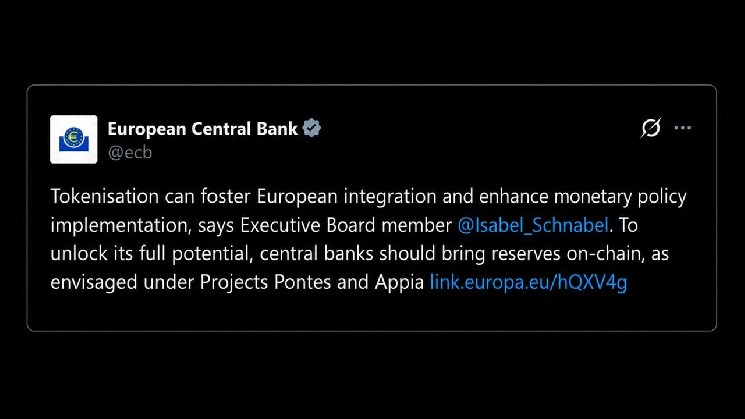
ECB's Schnabel says central bank money 'should move to blockchain'

ECB Executive Board member Isabel Schnabel stated that central bank money "must move onto the blockchain." She argued that stablecoins lack the independent ability to scale liquidity during financial stress—a gap only a central bank can fill. Her proposed solution involves tokenization, which she says can make transactions faster, safer, and more programmable, but only if the safest asset (central bank money) is on the same "rails" as other tokenized assets. This marks a notable shift for the Eurosystem, which had previously viewed Distributed Ledger Technology (DLT) mainly as a tool for regulating stablecoins and crypto, not as infrastructure to adopt directly. The first step is Project Pontes, launching in September. It will initially synchronize the ECB’s existing TARGET services with private DLT platforms. Eventually, it aims to enable settlement finality on a Eurosystem-managed DLT platform with smart contract functionality and 24/7 operation. The long-term strategy is Project Appia, tasked with developing the architecture, standards, and legal framework for a genuine European tokenized asset market by 2028. Trials have already processed around €1.6 billion, and since March 2026, the ECB accepts DLT-based assets as collateral. While not directly impacting Bitcoin's price, these developments signal that a major G7 central bank is preparing to settle transactions on-chain, lending legitimacy to the underlying infrastructure of crypto markets. The ECB's move to avoid "disintermediation" by private tokenization shows that debates in central bank boardrooms are now aligning with discussions long followed in the crypto space.

cryptonews.ruHá 47m

ECB's Schnabel says central bank money 'should move to blockchain'

cryptonews.ruHá 47m

Ripple Labs Warns of a New Challenge for Blockchains

Ripple Labs is preparing the XRP Ledger for quantum threats but now emphasizes a broader challenge: ensuring financial infrastructure can adapt simultaneously to quantum computing and artificial intelligence. Senior Director of Engineering Ayo Akinyele states the goal is not merely anticipating a "Q-Day" but building infrastructure capable of preemptively adopting new security mechanisms without network disruption. The shift to post-quantum cryptography involves more than swapping algorithms; it requires flexible infrastructure, improved key management, and clear upgrade paths. Financial systems were not designed with quantum computers in mind, necessitating a rethink of transaction, identity, asset, and data protection. This is underscored by significant investments, such as the $2 billion U.S.-IBM quantum factory initiative and a 2030 U.S. government mandate for post-quantum cryptography adoption. AI introduces distinct risks by driving automation and autonomous economic activity, increasing demand for an always-on, internet-oriented payment infrastructure. AI agents could soon conduct transactions independently, creating new security requirements. Ripple Labs advocates for proactive, orderly preparation rather than a crisis-driven transition, having outlined a four-phase strategy aiming for a full XRP Ledger transition by 2028, now expanded to address both quantum and AI-driven challenges.

cryptonews.ruHá 47m

Ripple Labs Warns of a New Challenge for Blockchains

cryptonews.ruHá 47m

Trading

Spot

Artigos em Destaque

O que é ETH 2.0

ETH 2.0: Uma Nova Era para o Ethereum Introdução ETH 2.0, amplamente conhecido como Ethereum 2.0, marca uma atualização monumental à blockchain do Ethereum. Esta transição não é meramente uma mudança estética; visa melhorar fundamentalmente a escalabilidade, segurança e sustentabilidade da rede. Com uma mudança do mecanismo de consenso em Proof of Work (PoW), intensivo em energia, para um Proof of Stake (PoS) mais eficiente, o ETH 2.0 promete uma abordagem transformadora ao ecossistema blockchain. O que é ETH 2.0? ETH 2.0 é um conjunto de atualizações distintas e interconectadas focadas na otimização das capacidades e desempenho do Ethereum. Esta reformulação foi projetada para abordar desafios críticos que o mecanismo atual do Ethereum enfrentou, particularmente em relação à velocidade das transações e à congestão da rede. Objetivos do ETH 2.0 Os principais objetivos do ETH 2.0 giram em torno da melhoria de três aspectos centrais: Escalabilidade: Com o objetivo de melhorar significativamente o número de transações que a rede pode manejar por segundo, o ETH 2.0 procura ultrapassar a limitação atual de aproximadamente 15 transações por segundo, alcançando potencialmente milhares. Segurança: Medidas de segurança melhoradas são integrais ao ETH 2.0, especialmente através da resistência aprimorada contra ciberataques e da preservação do ethos descentralizado do Ethereum. Sustentabilidade: O novo mecanismo PoS foi projetado não apenas para melhorar a eficiência, mas também para reduzir drasticamente o consumo de energia, alinhando a estrutura operacional do Ethereum com considerações ambientais. Quem é o Criador do ETH 2.0? A criação do ETH 2.0 pode ser atribuída à Ethereum Foundation. Esta organização sem fins lucrativos, que desempenha um papel crucial no apoio ao desenvolvimento do Ethereum, é liderada pelo co-fundador notável Vitalik Buterin. A sua visão de um Ethereum mais escalável e sustentável tem sido a força motriz por trás desta atualização, envolvendo contribuições de uma comunidade global de desenvolvedores e entusiastas dedicados a melhorar o protocolo. Quem são os Investidores do ETH 2.0? Embora os detalhes sobre os investidores do ETH 2.0 não tenham sido tornados públicos, é sabido que a Ethereum Foundation recebe apoio de várias organizações e indivíduos no espaço da blockchain e tecnologia. Esses parceiros incluem firmas de capital de risco, empresas de tecnologia e organizações filantrópicas que compartilham um interesse mútuo em apoiar o desenvolvimento de tecnologias descentralizadas e infraestrutura de blockchain. Como Funciona o ETH 2.0? ETH 2.0 é notável por introduzir uma série de características chave que o diferenciam do seu predecessor. Proof of Stake (PoS) A transição para um mecanismo de consenso PoS é uma das mudanças de destaque do ETH 2.0. Ao contrário do PoW, que depende da mineração intensiva em energia para a verificação de transações, o PoS permite que os utilizadores validem transações e criem novos blocos de acordo com a quantidade de ETH que apostam na rede. Isso leva a uma maior eficiência energética, reduzindo o consumo em aproximadamente 99,95%, tornando o Ethereum 2.0 uma alternativa consideravelmente mais ecológica. Shard Chains As shard chains são outra inovação crítica do ETH 2.0. Estas cadeias menores operam em paralelo com a cadeia principal do Ethereum, permitindo que várias transações sejam processadas simultaneamente. Esta abordagem melhora a capacidade geral da rede, abordando preocupações de escalabilidade que têm atormentado o Ethereum. Beacon Chain No coração do ETH 2.0 está a Beacon Chain, que coordena a rede e gere o protocolo PoS. Ela atua como uma espécie de organizador: supervisiona os validadores, garante que as shards permaneçam conectadas à rede e monitora a saúde geral do ecossistema blockchain. Linha do Tempo do ETH 2.0 A jornada do ETH 2.0 tem sido marcada por vários marcos chave que traçam a evolução desta atualização significativa: Dezembro de 2020: O lançamento da Beacon Chain marcou a introdução do PoS, preparando o caminho para a migração para o ETH 2.0. Setembro de 2022: A conclusão de “The Merge” representa um momento crucial em que a rede Ethereum fez a transição com sucesso de um quadro PoW para um PoS, anunciando uma nova era para o Ethereum. 2023: O lançamento esperado das shard chains visa melhorar ainda mais a escalabilidade da rede Ethereum, solidificando o ETH 2.0 como uma plataforma robusta para aplicações e serviços descentralizados. Características Chave e Benefícios Escalabilidade Melhorada Uma das vantagens mais significativas do ETH 2.0 é a sua escalabilidade melhorada. A combinação de PoS e shard chains permite que a rede expanda a sua capacidade, permitindo que acomode um volume de transações muito maior em comparação com o sistema legado. Eficiência Energética A implementação do PoS representa um enorme passo em direção à eficiência energética na tecnologia blockchain. Ao reduzir drasticamente o consumo de energia, o ETH 2.0 não só reduz os custos operacionais, mas também se alinha mais estreitamente com os objetivos globais de sustentabilidade. Segurança Aprimorada Os mecanismos atualizados do ETH 2.0 contribuem para uma segurança melhorada em toda a rede. O uso do PoS, juntamente com medidas de controle inovadoras estabelecidas através das shard chains e da Beacon Chain, assegura um maior grau de proteção contra potenciais ameaças. Custos Mais Baixos para os Utilizadores À medida que a escalabilidade melhora, os efeitos sobre os custos de transação também serão evidentes. Aumentada a capacidade e reduzida a congestão, espera-se que isso se traduza em taxas mais baixas para os utilizadores, tornando o Ethereum mais acessível para transações do dia a dia. Conclusão ETH 2.0 marca uma evolução significativa no ecossistema da blockchain do Ethereum. Ao abordar questões fundamentais como a escalabilidade, o consumo de energia, a eficiência das transações e a segurança geral, a importância desta atualização não pode ser subestimada. A transição para o Proof of Stake, a introdução das shard chains e o trabalho fundamental da Beacon Chain são indicativos de um futuro em que o Ethereum pode atender à crescente demanda do mercado descentralizado. Em uma indústria movida pela inovação e progresso, o ETH 2.0 representa um testemunho das capacidades da tecnologia blockchain em pavimentar o caminho para uma economia digital mais sustentável e eficiente.

300 Visualizações TotaisPublicado em {updateTime}Atualizado em 2024.12.03

O que é ETH 2.0

O que é ETH 3.0

ETH3.0 e $eth 3.0: Uma Análise Profunda do Futuro do Ethereum Introdução No ambiente em rápida evolução da criptomoeda e da tecnologia blockchain, o ETH3.0, frequentemente denotado como $eth 3.0, emergiu como um tema de considerável interesse e especulação. O termo abrange dois conceitos principais que merecem esclarecimento: Ethereum 3.0: Esta representa uma potencial atualização futura destinada a aumentar as capacidades da atual blockchain do Ethereum, focando especialmente na melhoria da escalabilidade e desempenho. ETH3.0 Meme Token: Este distinto projeto de criptomoeda procura aproveitar a blockchain do Ethereum na criação de um ecossistema centrado em memes, promovendo o envolvimento na comunidade de criptomoedas. Compreender esses aspectos do ETH3.0 é essencial não apenas para entusiastas de criptomoedas, mas também para aqueles que observam as tendências tecnológicas mais amplas no espaço digital. O que é ETH3.0? Ethereum 3.0 Ethereum 3.0 é promovido como uma atualização proposta para a rede Ethereum já estabelecida, que tem sido a espinha dorsal de muitas aplicações descentralizadas (dApps) e contratos inteligentes desde a sua criação. As melhorias vislumbradas concentram-se principalmente na escalabilidade—integrando tecnologias avançadas como sharding e provas de conhecimento zero (zk-proofs). Essas inovações tecnológicas visam facilitar um número sem precedentes de transações por segundo (TPS), potencialmente alcançando milhões, abordando assim uma das limitações mais significativas enfrentadas pela tecnologia blockchain atual. A melhoria não é meramente técnica, mas também estratégica; visa preparar a rede Ethereum para uma adoção generalizada e utilidade em um futuro marcado por uma maior demanda por soluções descentralizadas. ETH3.0 Meme Token Em contraste com o Ethereum 3.0, o ETH3.0 Meme Token aventura-se por um domínio mais leve e divertido, combinando a cultura dos memes da internet com a dinâmica das criptomoedas. Este projeto permite que os usuários comprem, vendam e negociem memes na blockchain do Ethereum, proporcionando uma plataforma que fomenta o envolvimento da comunidade através da criatividade e interesses compartilhados. O ETH3.0 Meme Token visa demonstrar como a tecnologia blockchain pode interseccionar com a cultura digital, criando casos de uso que são tanto divertidos quanto financeiramente viáveis. Quem é o Criador do ETH3.0? Ethereum 3.0 A iniciativa em direção ao Ethereum 3.0 é impulsionada principalmente por um consórcio de desenvolvedores e pesquisadores dentro da comunidade Ethereum, notavelmente incluindo Justin Drake. Conhecido por suas percepções e contribuições para a evolução do Ethereum, Drake tem sido uma figura proeminente nas discussões sobre a transição do Ethereum para uma nova camada de consenso, referida como “Beam Chain”. Esta abordagem colaborativa ao desenvolvimento significa que o Ethereum 3.0 não é fruto de um único criador, mas sim uma manifestação da engenhosidade coletiva focada no avanço da tecnologia blockchain. ETH3.0 Meme Token Os detalhes sobre o criador do ETH3.0 Meme Token são atualmente indetectáveis. A natureza dos tokens de meme frequentemente leva a uma estrutura mais descentralizada e impulsionada pela comunidade, o que poderia explicar a falta de atribuição específica. Isso alinha-se com a ethos da comunidade de criptomoedas mais ampla, onde a inovação geralmente surge de esforços colaborativos em vez de esforços individuais. Quem são os Investidores do ETH3.0? Ethereum 3.0 O apoio ao Ethereum 3.0 provém principalmente da Fundação Ethereum, juntamente com uma comunidade entusiástica de desenvolvedores e investidores. Esta associação fundacional proporciona um grau significativo de legitimidade e melhora as perspectivas de uma implementação bem-sucedida, uma vez que aproveita a confiança e credibilidade construída ao longo de anos de operações de rede. Em um clima em rápida mudança no mundo das criptomoedas, o apoio da comunidade desempenha um papel crucial no impulso ao desenvolvimento e adoção, posicionando o Ethereum 3.0 como um sério candidato a futuros avanços na blockchain. ETH3.0 Meme Token Embora as fontes atualmente disponíveis não forneçam informações explícitas sobre as fundações ou organizações de investimento que apoiam o ETH3.0 Meme Token, é indicativo do modelo típico de financiamento para tokens de meme, que frequentemente depende de apoio base e engajamento da comunidade. Os investidores em tais projetos costumam consistir em indivíduos motivados pelo potencial de inovação impulsionada pela comunidade e pelo espírito de cooperação encontrado dentro da comunidade cripto. Como Funciona o ETH3.0? Ethereum 3.0 As características distintivas do Ethereum 3.0 residem em sua proposta de implementação de sharding e tecnologia zk-proof. Sharding é um método de partição da blockchain em partes menores e gerenciáveis ou “shards”, que podem processar transações simultaneamente em vez de sequencialmente. Esta descentralização do processamento ajuda a prevenir congestionamentos e garante que a rede permaneça responsiva mesmo sob carga pesada. A tecnologia de prova de conhecimento zero (zk-proof) contribui com outra camada de sofisticação ao permitir a validação de transações sem revelar os dados subjacentes envolvidos. Este aspecto não apenas melhora a privacidade, mas também aumenta a eficiência geral da rede. Há também conversas sobre a incorporação de uma Máquina Virtual Ethereum de conhecimento zero (zkEVM) nesta atualização, amplificando ainda mais as capacidades e utilidade da rede. ETH3.0 Meme Token O ETH3.0 Meme Token distingue-se ao capitalizar sobre a popularidade da cultura dos memes. Estabelece um mercado para que os usuários participem da negociação de memes, não apenas para entretenimento, mas também para potencial ganho econômico. Ao integrar recursos como staking, provisão de liquidez e mecanismos de governança, o projeto fomenta um ambiente que incentiva a interação e participação da comunidade. Ao oferecer uma mistura única de entretenimento e oportunidade econômica, o ETH3.0 Meme Token visa atrair um público diversificado, variando de entusiastas de criptomoedas a conhecedores casuais de memes. Cronologia do ETH3.0 Ethereum 3.0 11 de novembro de 2024: Justin Drake sugere a próxima atualização do ETH 3.0, centrada nas melhorias de escalabilidade. Este anúncio sinaliza o início de discussões formais sobre a futura arquitetura do Ethereum. 12 de novembro de 2024: A proposta antecipada para Ethereum 3.0 deve ser revelada no Devcon em Bangkok, preparando o cenário para um feedback mais amplo da comunidade e potenciais próximos passos no desenvolvimento. ETH3.0 Meme Token 21 de março de 2024: O ETH3.0 Meme Token é oficialmente listado no CoinMarketCap, marcando sua entrada no domínio público das criptomoedas e aumentando a visibilidade de seu ecossistema baseado em memes. Pontos Chave Em conclusão, Ethereum 3.0 representa uma evolução significativa dentro da rede Ethereum, focando em superar limitações quanto à escalabilidade e desempenho através de tecnologias avançadas. As atualizações propostas refletem uma abordagem proativa às futuras demandas e usabilidade. Por outro lado, o ETH3.0 Meme Token encapsula a essência da cultura impulsionada pela comunidade no espaço das criptomoedas, aproveitando a cultura dos memes para criar plataformas envolventes que incentivam a criatividade e participação dos usuários. Compreender os distintos propósitos e funcionalidades do ETH3.0 e $eth 3.0 é fundamental para qualquer pessoa interessada nos desenvolvimentos contínuos dentro do espaço cripto. Com ambas as iniciativas a pavimentar caminhos únicos, elas sublinham coletivamente a natureza dinâmica e multifacetada da inovação em blockchain.

307 Visualizações TotaisPublicado em {updateTime}Atualizado em 2024.12.03

O que é ETH 3.0

Como comprar ETH

Bem-vindo à HTX.com!Tornámos a compra de Ethereum (ETH) simples e conveniente.Segue o nosso guia passo a passo para iniciar a tua jornada no mundo das criptos.Passo 1: cria a tua conta HTXUtiliza o teu e-mail ou número de telefone para te inscreveres numa conta gratuita na HTX.Desfruta de um processo de inscrição sem complicações e desbloqueia todas as funcionalidades.Obter a minha contaPasso 2: vai para Comprar Cripto e escolhe o teu método de pagamentoCartão de crédito/débito: usa o teu visa ou mastercard para comprar Ethereum (ETH) instantaneamente.Saldo: usa os fundos da tua conta HTX para transacionar sem problemas.Terceiros: adicionamos métodos de pagamento populares, como Google Pay e Apple Pay, para aumentar a conveniência.P2P: transaciona diretamente com outros utilizadores na HTX.Mercado de balcão (OTC): oferecemos serviços personalizados e taxas de câmbio competitivas para os traders.Passo 3: armazena teu Ethereum (ETH)Depois de comprar o teu Ethereum (ETH), armazena-o na tua conta HTX.Alternativamente, podes enviá-lo para outro lugar através de transferência blockchain ou usá-lo para transacionar outras criptomoedas.Passo 4: transaciona Ethereum (ETH)Transaciona facilmente Ethereum (ETH) no mercado à vista da HTX.Acede simplesmente à tua conta, seleciona o teu par de trading, executa as tuas transações e monitoriza em tempo real.Oferecemos uma experiência de fácil utilização tanto para principiantes como para traders experientes.

4.0k Visualizações TotaisPublicado em {updateTime}Atualizado em 2026.06.02

Como comprar ETH

Discussões

Bem-vindo à Comunidade HTX. Aqui, pode manter-se informado sobre os mais recentes desenvolvimentos da plataforma e obter acesso a análises profissionais de mercado. As opiniões dos utilizadores sobre o preço de ETH (ETH) são apresentadas abaixo.

活动图片