Ethereum Net Taker Volume Bottoms Rise: A Repeat Of The 2025 Pre-Rally Setup?

bitcoinistPublicado em 2025-12-12Última atualização em 2025-12-12

Resumo

Ethereum has declined below $3,200 after the Fed's rate cut, yet on-chain data suggests a potential market structure improvement. According to CryptoQuant, Ethereum’s Net Taker Volume (30-day MA) shows rising lows, indicating weakening aggressive selling pressure. This pattern mirrors early 2025, when a similar setup preceded a 3x rally after the metric turned positive. Currently, the market has absorbed sell flows for nearly three months, with each negative low forming higher than the last. If this trend continues, Net Taker Volume may flip positive in about a month, potentially signaling the start of a new bullish phase toward all-time highs.

Ethereum has retraced below the $3,200 level following the Federal Reserve’s decision to cut interest rates by 25 basis points, a move that initially sparked volatility across the crypto market. While many expected a stronger reaction from Ethereum, the asset instead slipped lower as traders reassessed the macro environment and the implications of a potential shift toward stagflation. Despite this pullback, on-chain data suggests that the underlying market structure may be quietly improving.

According to new insights from CryptoQuant, Ethereum’s Net Taker Volume (30-day moving average) is showing a clear upward trend in its lows. This metric tracks the balance between aggressive buyers and sellers in the derivatives market. Although ETH remains under selling pressure, the data reveals that the intensity of aggressive selling has been weakening steadily over the past several weeks. Each subsequent negative low is forming higher than the previous one, signaling that sellers are losing dominance.

While the broader sentiment remains cautious, subtle improvements in Net Taker Volume suggest that ETH’s current weakness may be masking the early stage of a larger structural shift.

Net Taker Volume Signals a Potential Structural Shift

According to CryptoQuant’s CoinCare, Ethereum may once again be approaching a pivotal turning point. The report highlights that a similar Net Taker Volume structure appeared earlier this year. After forming a clear bottom in January 2025, the metric began to trend upward—even while remaining in the negative zone—indicating that aggressive sellers were gradually losing strength.
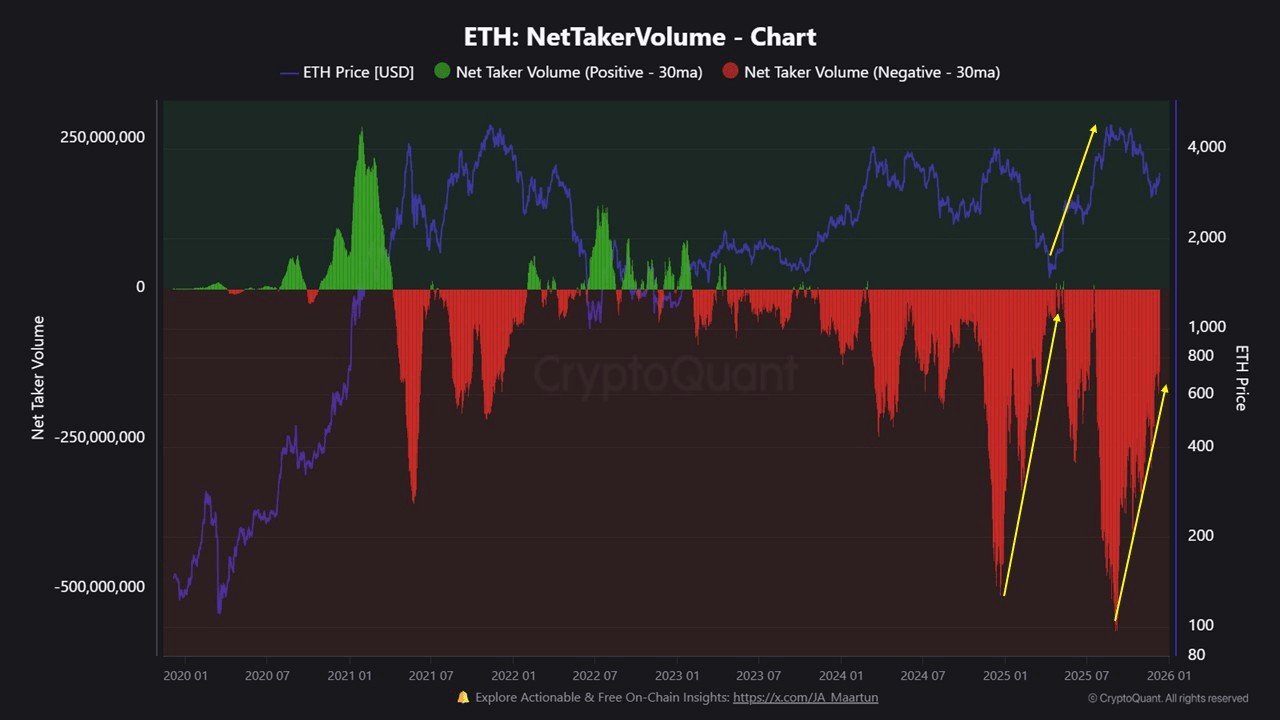
Ethereum Net Taker Volume | Source: CryptoQuant

By April, Net Taker Volume flipped decisively into positive territory. From that exact moment, Ethereum entered one of its strongest rallies of the cycle, surging more than 3x and printing a new all-time high.

Current conditions echo that same pattern. Since the peak of selling pressure in September, the market has continuously absorbed sell flows for nearly three months. Each negative low in Net Taker Volume has formed higher than the previous one, revealing improving market resilience despite the broader downtrend. If this trajectory holds, CoinCare estimates that a positive flip in Net Taker Volume may be only about a month away.

Historically, this transition from negative to positive has marked the beginning of Ethereum’s most explosive breakout phases. A confirmed move into positive territory would represent a high-probability trigger for the next expansion toward new all-time highs, signaling that momentum is quietly rebuilding beneath the surface.


Criptomoedas em alta

Leituras Relacionadas

Will History Repeat Itself? Fidelity Lists Five Catalysts to End the Crypto Winter

Fidelity's new report suggests that the current crypto winter for Bitcoin may be nearing its end, identifying five potential catalysts that could drive a market turnaround based on historical patterns. First, Bitcoin's approximately four-year cycle, driven by its halving mechanism, historically marks peaks and troughs. The last bottom was in November 2022, potentially pointing to the next around November 2026, though cycle length can vary. Second, clearer regulation has often preceded past bull markets. The focus is now on the CLARITY Act, which aims to clarify US digital asset oversight between the SEC and CFTC. Its passage could unlock domestic activity currently held back by legal uncertainty. Third, Federal Reserve monetary policy plays a role. A shift to lower interest rates tends to correlate with rising crypto prices by reducing borrowing costs and boosting risk appetite, though markets may price this in well ahead of any official change. Fourth, the emergence of breakthrough applications can fuel investor interest. Current trends like real-world asset tokenization, AI-related crypto infrastructure, and stablecoins are being watched, but history shows the biggest catalysts are often unexpected. Fifth, a new wave of institutional adoption could be a trigger. While ongoing adoption in 2026 hasn't sparked a new bull run, a major unexpected move—like a significant purchase by a tech giant or adoption as a hedge in a global crisis—could create a powerful new narrative. Fidelity concludes that while the market is in a downturn, historical turning points have often resulted from a combination of such factors, and the next phase for Bitcoin may depend on which of these catalysts materializes first.

Foresight NewsHá 9m

Will History Repeat Itself? Fidelity Lists Five Catalysts to End the Crypto Winter

Foresight NewsHá 9m

US CFTC Launches Broad Investigation into Polymarket, Is the Prediction Market Party Coming to an End?

The U.S. Commodity Futures Trading Commission (CFTC) is conducting a broad investigation into the prediction market platform Polymarket, focusing on its business practices including social media promotions. This follows a bipartisan letter from U.S. senators urging the CFTC to probe alleged fraudulent marketing tactics used to promote gambling-like products. The action coincides with a period of explosive growth for the prediction market sector, driven by events like the World Cup, with platforms like Kalshi and Robinhood reporting record trading volumes and revenue. The investigation signals a potential end to the sector's unregulated expansion and may lead to clearer federal oversight, particularly regarding investor protection and distinguishing prediction markets from traditional sports betting. The CFTC's move has also intensified a jurisdictional conflict with multiple U.S. states (including Kentucky and New York), which have sued platforms like Polymarket and Kalshi, accusing them of operating illegal sports betting and threatening state gambling tax revenues. Furthermore, the CME Group has sued the CFTC, challenging its approval of certain prediction market products. The report also highlights the political and capital interests intertwined with the industry. Donald Trump Jr. holds advisory and investment roles in both Kalshi and Polymarket, and the Trump administration has previously emphasized federal regulatory authority over these markets. The CFTC's investigation into Polymarket is framed as a step towards formalizing the industry's regulatory landscape, moving it from a phase of "wild growth" towards a more structured future.

marsbitHá 2h

US CFTC Launches Broad Investigation into Polymarket, Is the Prediction Market Party Coming to an End?

marsbitHá 2h

U.S. CFTC Launches Extensive Investigation into Polymarket, Is the Prediction Market Frenzy Season Cooling Down?

The U.S. Commodity Futures Trading Commission (CFTC) has launched a broad investigation into the prediction market platform Polymarket, focusing on its business practices including social media activities. This follows a bipartisan letter from U.S. senators urging the CFTC to probe allegations of paid influencer false marketing and fraudulent promotion of gambling-like products to American users. The investigation comes as the prediction market sector experiences explosive growth, largely driven by the World Cup. Weekly trading volumes have hit record highs, exceeding $14.4 billion, with platforms like Kalshi and Robinhood's new venture seeing significant activity. Major firms like Meta are also showing interest in the space. This regulatory scrutiny signals a potential end to the sector's "wild growth" phase. The CFTC's move also highlights an escalating jurisdictional conflict between federal regulators and state authorities. Over a dozen states, including Kentucky and New York, have sued platforms like Polymarket and Kalshi, accusing them of operating illegal sports betting, which threatens state gambling tax revenues. The CFTC is countersuing to assert its exclusive federal jurisdiction over these "event contracts" as derivatives. Furthermore, the CFTC's approval of Kalshi's Bitcoin perpetual futures contract has sparked a lawsuit from traditional exchange CME, alleging regulatory overreach. The political and capital landscape is intricate, with Donald Trump Jr. holding advisory roles and investments in both Kalshi and Polymarket. This connects capital, political influence, and regulatory bodies, suggesting the current investigation may be a step toward formalizing the industry's rules rather than halting its progress.

Odaily星球日报Há 2h

U.S. CFTC Launches Extensive Investigation into Polymarket, Is the Prediction Market Frenzy Season Cooling Down?

Odaily星球日报Há 2h

Trading

Spot

Artigos em Destaque

Como comprar NASDAQ100

Bem-vindo à HTX.com!Tornámos a compra de Nasdaq-100 Index (NASDAQ100) simples e conveniente.Segue o nosso guia passo a passo para iniciar a tua jornada no mundo das criptos.Passo 1: cria a tua conta HTXUtiliza o teu e-mail ou número de telefone para te inscreveres numa conta gratuita na HTX.Desfruta de um processo de inscrição sem complicações e desbloqueia todas as funcionalidades.Obter a minha contaPasso 2: vai para Comprar Cripto e escolhe o teu método de pagamentoCartão de crédito/débito: usa o teu visa ou mastercard para comprar Nasdaq-100 Index (NASDAQ100) instantaneamente.Saldo: usa os fundos da tua conta HTX para transacionar sem problemas.Terceiros: adicionamos métodos de pagamento populares, como Google Pay e Apple Pay, para aumentar a conveniência.P2P: transaciona diretamente com outros utilizadores na HTX.Mercado de balcão (OTC): oferecemos serviços personalizados e taxas de câmbio competitivas para os traders.Passo 3: armazena teu Nasdaq-100 Index (NASDAQ100)Depois de comprar o teu Nasdaq-100 Index (NASDAQ100), armazena-o na tua conta HTX.Alternativamente, podes enviá-lo para outro lugar através de transferência blockchain ou usá-lo para transacionar outras criptomoedas.Passo 4: transaciona Nasdaq-100 Index (NASDAQ100)Transaciona facilmente Nasdaq-100 Index (NASDAQ100) no mercado à vista da HTX.Acede simplesmente à tua conta, seleciona o teu par de trading, executa as tuas transações e monitoriza em tempo real.Oferecemos uma experiência de fácil utilização tanto para principiantes como para traders experientes.

27 Visualizações TotaisPublicado em {updateTime}Atualizado em 2026.06.18

Como comprar NASDAQ100

O que é RE

I. Introdução ao Projeto1. O Que É o Re Protocol?O Re Protocol é um protocolo de resseguro descentralizado que conecta capital em stablecoin a mercados de resseguro regulamentados no mundo real. Os utilizadores depositam stablecoins no contrato inteligente da Insurance Capital Layer (ICL). Os fundos depositados são utilizados para apoiar contratos de resseguro totalmente colateralizados, e os depositantes recebem recompensas em troca. O rendimento é derivado de fontes tanto on-chain como off-chain, além de spreads específicos de tokens. O protocolo opera em várias cadeias, incluindo Ethereum, Avalanche e Arbitrum.2. Como Funciona o Re Protocol?Os utilizadores depositam ativos aprovados (como USDC, USDe, sUSDe) em contratos inteligentes ICL para cunhar um de dois tokens que geram rendimento. Os fundos são agregados diariamente em um cofre de custódia Fireblocks, mantido sob controle de múltiplas assinaturas, com saldos publicados diariamente para oráculos Chainlink. Quando os resseguradores licenciados retiram fundos de acordo com uma Surplus Note, uma parte do capital é transferida para contas de confiança de resseguro §114 domiciliadas nos EUA, servindo como colateral em conformidade para as apólices do ressegurador. À medida que os contratos de resseguro vencem e a equipe atuarial libera capital, a liquidez flui de volta para o protocolo, apoiando os resgates de reUSD e acumulando rendimento para ambos os tokens.O protocolo oferece dois tokens correspondentes a diferentes tranches na estrutura de capital:reUSD (Basis-Plus, Tranche Sênior): O rendimento é uma taxa misturada (média ponderada da taxa SOFR e da taxa sUSDe de 7 dias) mais um spread de 250 pontos base. Oferece maior liquidez e suporta resgates instantâneos quando há capacidade disponível.reUSDe (Insurance Alpha, Tranche Júnior): O rendimento é a mesma taxa misturada mais um spread de 850 pontos base, em troca de absorver perdas antes da tranche sênior. Os resgates são trimestrais. O reUSDe tem um período mínimo de detenção de pelo menos 40 dias.Camadas de Proteção de Capital: O próprio capital do ressegurador absorve as perdas primeiro, seguido pelo reUSDe, com o reUSD como a tranche mais sênior protegida pelas duas camadas abaixo dela.3. Quem Fundou o Re Protocol?Karn Saroya, Co-Fundador e CEO, graduou-se no MIT. Anteriormente, fundou a plataforma insurtech apoiada por capital de risco Cover (uma corretora licenciada, que mais tarde cessou operações) e anteriormente fundou o aplicativo de moda Stylekick (adquirido pela Shopify em 2015). Ele também trabalhou anteriormente em consultoria de serviços financeiros.Detalhes de Financiamento:Setembro de 2022: O Re completou uma rodada de Seed de $14 milhões liderada pela Tribe Capital (incubada através do seu Tribe Crypto Labs), com participação da Framework Ventures, Morgan Creek Digital, Defy VC, Stratos, Exor, SiriusPoint, entre outros.Maio de 2024: Completou uma rodada de financiamento de $7 milhões liderada pela Electric Capital.4. Tokenomics do Re ProtocolRE é o token de governança do Re Protocol com um fornecimento total fixo de 1 bilhão de tokens, sem mecanismo inflacionário e sem plano de cunhagem contínua. O token é utilizado para governança através de um modelo de stake-to-vote, cobrindo acesso ao mercado, orçamentos de incentivos, staking e delegação, comitês, atualizações do protocolo e capital de resiliência compartilhado.Distribuição de tokens:Ecosistema (50%): Usado para recompensas de staking, participação na governança, liquidez, integrações, subsídios, expansão de mercado e crescimento do ecossistema. 159,6 milhões de tokens estão em circulação no TGE, com o restante sujeito a um vesting linear ao longo de 48 meses.Contribuidores Principais (20%): Inclui contribuintes principais e consultores que constroem o protocolo, sistemas de governança, integrações, estruturas de risco e infraestrutura de mercado; 12 meses de cliff mais 36 meses de vesting linear.Investidores (17%): Apoios estratégicos; 12 meses de cliff mais 36 meses de vesting linear.Reserva para Desenvolvimento do Ecossistema (13%): Reserva de longo prazo para futuras contribuições e contribuintes.5. Cronograma de Principais MarcosSetembro de 2022: O Re completou uma rodada de Seed de $14 milhões, estreou publicamente e se posicionou como o primeiro protocolo de resseguro alimentado por blockchain, inicialmente construído na Avalanche.Maio de 2024: Completou uma rodada de financiamento de $7 milhões liderada pela Electric Capital.18 de junho de 2026: O token $RE foi oficialmente lançado.​II. Informação sobre o TokenNome do token: RE(Re)III. Links RelacionadosWebsite:https://re.xyz/Exploradores:https://etherscan.io/token/0x526526528f35ac738177003b8773b402b8df8143Twitter:https://twitter.com/reNota: A introdução ao projeto provém dos materiais publicados ou fornecidos pela equipa oficial do projeto, que é apenas para referência e não constitui aconselhamento de investimento. A HTX não se responsabiliza por quaisquer perdas diretas ou indiretas resultantes.

254 Visualizações TotaisPublicado em {updateTime}Atualizado em 2026.06.29

O que é RE

Como comprar RE

Bem-vindo à HTX.com!Tornámos a compra de Re (RE) simples e conveniente.Segue o nosso guia passo a passo para iniciar a tua jornada no mundo das criptos.Passo 1: cria a tua conta HTXUtiliza o teu e-mail ou número de telefone para te inscreveres numa conta gratuita na HTX.Desfruta de um processo de inscrição sem complicações e desbloqueia todas as funcionalidades.Obter a minha contaPasso 2: vai para Comprar Cripto e escolhe o teu método de pagamentoCartão de crédito/débito: usa o teu visa ou mastercard para comprar Re (RE) instantaneamente.Saldo: usa os fundos da tua conta HTX para transacionar sem problemas.Terceiros: adicionamos métodos de pagamento populares, como Google Pay e Apple Pay, para aumentar a conveniência.P2P: transaciona diretamente com outros utilizadores na HTX.Mercado de balcão (OTC): oferecemos serviços personalizados e taxas de câmbio competitivas para os traders.Passo 3: armazena teu Re (RE)Depois de comprar o teu Re (RE), armazena-o na tua conta HTX.Alternativamente, podes enviá-lo para outro lugar através de transferência blockchain ou usá-lo para transacionar outras criptomoedas.Passo 4: transaciona Re (RE)Transaciona facilmente Re (RE) no mercado à vista da HTX.Acede simplesmente à tua conta, seleciona o teu par de trading, executa as tuas transações e monitoriza em tempo real.Oferecemos uma experiência de fácil utilização tanto para principiantes como para traders experientes.

78 Visualizações TotaisPublicado em {updateTime}Atualizado em 2026.06.29

Como comprar RE

Discussões

Bem-vindo à Comunidade HTX. Aqui, pode manter-se informado sobre os mais recentes desenvolvimentos da plataforma e obter acesso a análises profissionais de mercado. As opiniões dos utilizadores sobre o preço de A (A) são apresentadas abaixo.

活动图片