Ethereum Derivatives See Heavy Unwind As Open Interest Falls Hard – A Leveraged Flush?

bitcoinistPublicado em 2025-12-22Última atualização em 2025-12-22

Resumo

Amidst a volatile market, Ethereum's price briefly reclaimed $3,000, but its derivatives market is signaling a significant shift. Open Interest (OI) has plummeted by 50% since August, indicating a massive unwind of leveraged positions and a sharp decline in trader risk appetite. This drop, observed across major exchanges like Binance (-31%), suggests robust market deleveraging and a lower probability of explosive short-term price moves. Concurrently, ETH withdrawals from exchanges have spiked to multi-year lows, reducing immediate sell pressure. While this points to a more cautious, consolidating market, such a flush of leverage has historically preceded major structural shifts.

On Sunday, the Ethereum price retested the $3,000 mark after trading below the level for the past few days due to a volatile market environment. ETH’s price may be gradually regaining upside momentum, but other aspects are still experiencing downward pressure, such as the Open Interest (OI).

Sharp Drop In Ethereum Open Interest

In the current volatile state of the cryptocurrency landscape, the Ethereum derivatives market is signaling a key indicator. This crucial signal is coming from the ETH Open interest, which has witnessed a significant pullback in the past few months. According to the research from the advanced investment and on-chain data analytics platform Alphractal, the metric has dropped by half or 50% since August this year.

A significant drop in this metric is a clear indication that trader positioning and risk appetite have shifted notably. Following a period of high leverage and aggressive speculation, the sharp collapse indicates that positions are being unwound, exposure is being decreased, and momentum is cooling across futures markets.

Alphractal highlighted that the Ethereum open interest is valued at roughly half of what it was in August 2025, suggesting a drastic decline in market risk. Such a move points to institutions and large whale holders who have closed leveraged ETH positions. The exiting of positions by big investors shows that they are reducing exposure and speculative pressure.
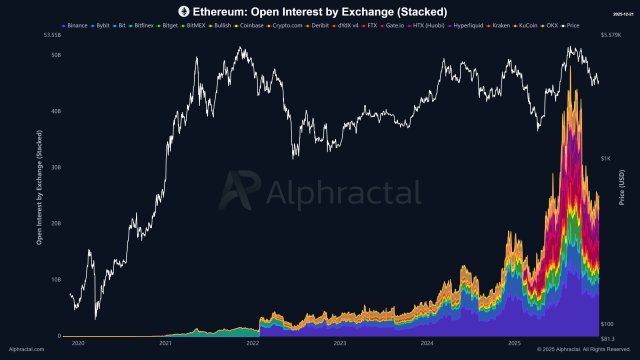
Source: Chart from Alphractal on X

ETH’s open interest has also fallen sharply on cryptocurrency exchanges. After examining the Ethereum Open Interest distribution by exchange, Alphractal unveiled a 31% decline to $7.64 billion on the world’s largest exchange, Binance.

On Gateio, open interest is at $3.72 billion, indicating a 15% decrease, while HTX (formerly known as House) has fallen by 12.65% to $3.12 million. Furthermore, Bybit has $2.53 billion with a 10.25% drop, HyperLiquid has $2.51 billion with a 10.18%, and Bitget has $1.79 billion with a 7.25% decline.

With exchanges’ open interest dropping, this tells a compelling story of the current market structure. This outlines robust deleveraging across the Ethereum market and a lower probability of explosive moves in the short term.

Typically, an atmosphere that is more cautious and protective implies stages of consolidation or preparation for the next trend leg. However, deep declines in open interest have historically frequently preceded significant structural changes, either a healthier reversal or a downward continuation with less leverage.

ETH Withdrawals From Crypto Exchanges Have Spiked

Ethereum’s open interest drop comes at a time of a massive drop in ETH supply on crypto exchanges. Currently, ETH withdrawals have reached their lowest levels since 2016, reflecting growing trader caution and dampened short-term sell pressure.

As more ETH is taken out of exchanges and placed in long-term holding locations, the liquid supply keeps decreasing. While the supply decrease bolsters ETH’s volatility, it also encourages price pressure to rise.

ETH trading at $3,048 on the 1D chart | Source: ETHUSDT on Tradingview.com

Criptomoedas em alta

Perguntas relacionadas

QWhat has happened to Ethereum's Open Interest (OI) since August this year, according to the article?

AEthereum's Open Interest has dropped by 50% since August this year, indicating a significant unwind of leveraged positions and a decrease in market risk.

QWhich cryptocurrency exchange saw the largest decline in Ethereum Open Interest, and by how much?

ABinance, the world's largest exchange, saw the largest decline in Ethereum Open Interest, with a 31% drop to $7.64 billion.

QWhat does a sharp drop in Open Interest typically signal about trader behavior and market conditions?

AA sharp drop in Open Interest signals that traders are unwinding positions, decreasing their exposure, and reducing leverage. It indicates a shift to a more cautious and protective atmosphere, often leading to market consolidation or preparation for the next trend.

QAlongside the drop in Open Interest, what other on-chain activity suggests growing trader caution?

AAlongside the drop in Open Interest, the supply of ETH on cryptocurrency exchanges has reached its lowest level since 2016, as more ETH is being withdrawn to long-term holding locations, which dampens short-term sell pressure.

QWhat is the potential implication of a decreasing liquid supply of ETH on exchanges for its price?

AA decreasing liquid supply of ETH on exchanges reduces the available coins for immediate selling, which can bolster ETH's volatility and create upward price pressure.

Leituras Relacionadas

Has Bitcoin Bottomed, or Is a 'Shakeout' Approaching? What's the Situation with XRP?

Cryptocurrency analytics platform Santiment shared key insights on Bitcoin and altcoin markets, highlighting significant signals from on-chain data. Analysis shows Bitcoin's 365-day MVRV ratio has fallen to -26%, indicating substantial losses for long-term holders, a level historically associated with market bottom formations and long-term buying opportunities. While short-term MVRV is near breakeven, suggesting no clear directional signal, the annual perspective points to a bottom before bullish cycles. On-chain data reveals divergent behavior: large wallets (10-10,000 BTC) have been accumulating, adding ~18,500 BTC in 10 days, while smaller retail investors continue buying dips. Analysts caution that high retail demand can sometimes create a risk of a final market shakeout or correction. The altcoin market shows a mixed picture. Ethereum's 365-day MVRV is around -33%, but recent monthly gains combined with overly optimistic social sentiment pose a short-term correction risk. XRP is in oversold territory with 30-day and 365-day MVRVs at -57.5% and -45.5% respectively, signaling potential for a strong mid-to-long term rebound. Social activity and optimism are rising for Solana, while investor sentiment remains calmer towards Cardano. Future direction for Bitcoin and altcoins depends not only on on-chain metrics but also on macroeconomic and regulatory developments. The Federal Reserve's interest rate decision and upcoming policy rulings are increasing market volatility expectations, while uncertainty around the U.S. Congressional clarity process continues to pressure pricing. *This is not investment advice.

cryptonews.ruHá 27m

Has Bitcoin Bottomed, or Is a 'Shakeout' Approaching? What's the Situation with XRP?

cryptonews.ruHá 27m

Bank of Korea Reveals Results of Tokenized Deposit Testing

The Bank of Korea has announced the results of its pilot test for tokenized deposits. Involving 28 central banks and international financial organizations, the project saw participation from major South Korean banks including KB Kookmin Bank, NH NongHyup Bank, Shinhan Bank, Woori Bank, and Hana Bank. Transactions, from payment orders to final settlement, were completed in real time, averaging just 80 seconds. The test involved 30 transactions across 17 different scenarios—such as corporate and interbank transfers—and was conducted in six currencies, including the Korean won, US dollar, and euro, with a total transaction value reaching approximately $995,000. The central bank reported that the platform operated stably throughout, despite being only partially connected to the existing banking infrastructure. Settlements using tokenized deposits were executed seamlessly, quickly, and transparently. An internal transfer of 20 million won (about $13,890) between NH NongHyup Bank and Shinhan Bank was also successfully processed via the Project Agora platform, which involved connecting to the Bank of Korea's CBDC test platform, Project Hangang. Additionally, KB Kookmin Bank and Japan's MUFG Bank tested cross-border payments using these deposit tokens—digital certificates issued by commercial banks within the pilot, not directly by the central bank. The Bank of Korea plans to continue testing payments with tokenized deposits. This follows last year's pledge by South Korean authorities to tighten regulations for won-based stablecoins, which will require approval from both the central bank and the Financial Services Commission.

cryptonews.ruHá 2h

Bank of Korea Reveals Results of Tokenized Deposit Testing

cryptonews.ruHá 2h

Trading

Spot

Artigos em Destaque

Como comprar O

Bem-vindo à HTX.com!Tornámos a compra de O1 exchange (O) simples e conveniente.Segue o nosso guia passo a passo para iniciar a tua jornada no mundo das criptos.Passo 1: cria a tua conta HTXUtiliza o teu e-mail ou número de telefone para te inscreveres numa conta gratuita na HTX.Desfruta de um processo de inscrição sem complicações e desbloqueia todas as funcionalidades.Obter a minha contaPasso 2: vai para Comprar Cripto e escolhe o teu método de pagamentoCartão de crédito/débito: usa o teu visa ou mastercard para comprar O1 exchange (O) instantaneamente.Saldo: usa os fundos da tua conta HTX para transacionar sem problemas.Terceiros: adicionamos métodos de pagamento populares, como Google Pay e Apple Pay, para aumentar a conveniência.P2P: transaciona diretamente com outros utilizadores na HTX.Mercado de balcão (OTC): oferecemos serviços personalizados e taxas de câmbio competitivas para os traders.Passo 3: armazena teu O1 exchange (O)Depois de comprar o teu O1 exchange (O), armazena-o na tua conta HTX.Alternativamente, podes enviá-lo para outro lugar através de transferência blockchain ou usá-lo para transacionar outras criptomoedas.Passo 4: transaciona O1 exchange (O)Transaciona facilmente O1 exchange (O) no mercado à vista da HTX.Acede simplesmente à tua conta, seleciona o teu par de trading, executa as tuas transações e monitoriza em tempo real.Oferecemos uma experiência de fácil utilização tanto para principiantes como para traders experientes.

354 Visualizações TotaisPublicado em {updateTime}Atualizado em 2026.06.29

Como comprar O

Como comprar PROS

Bem-vindo à HTX.com!Tornámos a compra de Pharos (PROS) simples e conveniente.Segue o nosso guia passo a passo para iniciar a tua jornada no mundo das criptos.Passo 1: cria a tua conta HTXUtiliza o teu e-mail ou número de telefone para te inscreveres numa conta gratuita na HTX.Desfruta de um processo de inscrição sem complicações e desbloqueia todas as funcionalidades.Obter a minha contaPasso 2: vai para Comprar Cripto e escolhe o teu método de pagamentoCartão de crédito/débito: usa o teu visa ou mastercard para comprar Pharos (PROS) instantaneamente.Saldo: usa os fundos da tua conta HTX para transacionar sem problemas.Terceiros: adicionamos métodos de pagamento populares, como Google Pay e Apple Pay, para aumentar a conveniência.P2P: transaciona diretamente com outros utilizadores na HTX.Mercado de balcão (OTC): oferecemos serviços personalizados e taxas de câmbio competitivas para os traders.Passo 3: armazena teu Pharos (PROS)Depois de comprar o teu Pharos (PROS), armazena-o na tua conta HTX.Alternativamente, podes enviá-lo para outro lugar através de transferência blockchain ou usá-lo para transacionar outras criptomoedas.Passo 4: transaciona Pharos (PROS)Transaciona facilmente Pharos (PROS) no mercado à vista da HTX.Acede simplesmente à tua conta, seleciona o teu par de trading, executa as tuas transações e monitoriza em tempo real.Oferecemos uma experiência de fácil utilização tanto para principiantes como para traders experientes.

373 Visualizações TotaisPublicado em {updateTime}Atualizado em 2026.06.29

Como comprar PROS

O que é VERONA

I. Introdução ao Projeto VERONA é uma blockchain construída para todos, em todo o lado, através da abstração da cadeia. Utilizando a sua camada de Abstração Generalizada, a VERONA distingue-se por integrar funcionalidades complexas de blockchain, como contas, assinaturas e interoperabilidade, diretamente ao nível do protocolo. Esta abordagem permite a interação com aplicações de blockchain sem a necessidade de compreender as tecnologias subjacentes.1) Informação Básica Nome: VERONA (VERONA)III. Links Relacionados Link do site oficial: https://xion.burnt.com/ Whitepaper: https://xion.burnt.com/whitepaper.pdf Exploradores: https://explorer.burnt.com/ Mídias Sociais: https://x.com/burnt_xion Nota: A introdução ao projeto provém dos materiais publicados ou fornecidos pela equipa oficial do projeto, que é apenas para referência e não constitui aconselhamento de investimento. A HTX não se responsabiliza por quaisquer perdas diretas ou indiretas resultantes.

1.0k Visualizações TotaisPublicado em {updateTime}Atualizado em 2026.06.22

O que é VERONA

Discussões

Bem-vindo à Comunidade HTX. Aqui, pode manter-se informado sobre os mais recentes desenvolvimentos da plataforma e obter acesso a análises profissionais de mercado. As opiniões dos utilizadores sobre o preço de A (A) são apresentadas abaixo.

活动图片