Ethereum could get faster in January with gas limit rise to 80M

cointelegraphPublicado em 2025-12-18Última atualização em 2025-12-18

Resumo

Ethereum's transaction throughput is set to increase in early January with a planned gas limit rise from 60 million to 80 million. This will be enabled by the second blob parameter-only (BPO) hard fork, scheduled for January 7, following a similar upgrade in December that also increased blob capacity by 66%. Blobs store data off-chain, reducing gas costs and improving scalability without overloading the network. While this upgrade won't match the speed of chains like Solana, it enhances Ethereum's efficiency as a secure settlement layer. Developers will confirm the final plans on January 5. Increasing the gas limit has been a key focus in 2025, with previous raises in February, July, and November. The long-term goal is to reach a gas limit of 180 million by the end of 2026.

Transaction throughput on the Ethereum network is set to be boosted again in early January with the second blob parameter-only (BPO) hard fork expected to enable the Ethereum gas limit to rise from 60 million to 80 million.

Christine Kim, vice president of the research team at Galaxy Digital, shared the news in a post Tuesday, noting the confidence Nethermind developers Ben Adams and Kamil Chodala expressed in Monday’s Ethereum All Core Developers call that all testing should be complete before the next BPO hard fork — scheduled Jan. 7 — which is expected to increase blob capacity on the Ethereum mainnet by 66%.

It would follow the first BPO hard fork on Dec. 9, which increased blob capacity by 66%.

Ethereum Foundation developer operations engineer Barnabas Busa, however, noted that two client-level optimizations are needed before another increase in the block gas limit — namely, partial blob responses on the execution layer and the max blobs flag on the consensus layer.
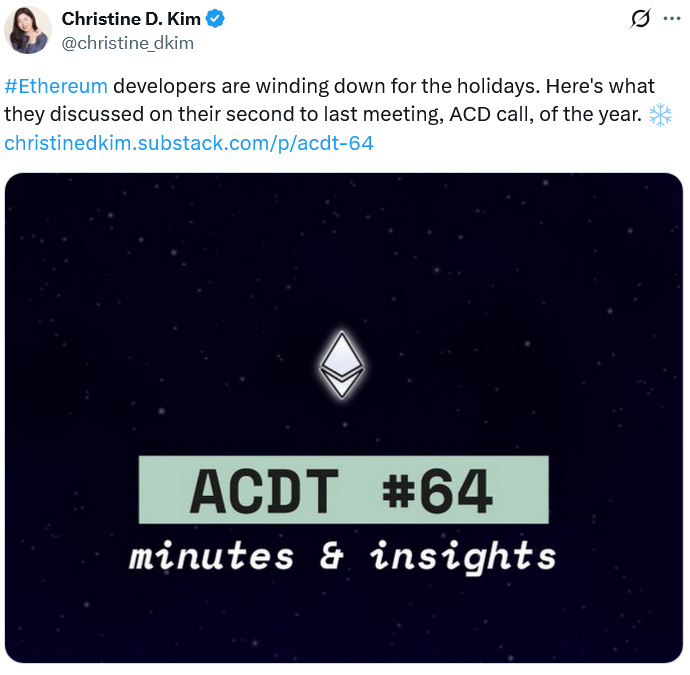
Source: Christine Kim

Blobs on Ethereum are large data chunks that store transaction and rollup data off-chain, lowering gas costs and increasing scalability without bloating the network.

Optimizing blob capacity to raise the gas limit directly increases the number of transactions and smart contract operations that can fit in each Ethereum block, boosting overall throughput while potentially lowering fees.

While raising Ethereum’s gas limit to 80 million won’t match the speed or low costs of layer 1s like Solana or Sui, it strengthens Ethereum’s appeal as a secure settlement and execution layer without significantly compromising decentralization — arguably its greatest advantage over competitors.

Ethereum devs will confirm plans early in the new year

Participants in the weekly Ethereum All Core Developers meetup will reconvene on Jan. 5 to confirm when to raise the gas limit following the second BPO hard fork.

Increasing Ethereum’s gas limit has been a priority this year

Increasing Ethereum’s gas limit to expand the network’s execution capacity has been a major focus for developers and researchers this year, with three increases.

Related: Securitize announces ‘real’ tokenized stocks, touts DeFi integration

The first occurred in early February, raising it from 30 million to 35 million, the second in July to 45 million, and the third in late November to 60 million.
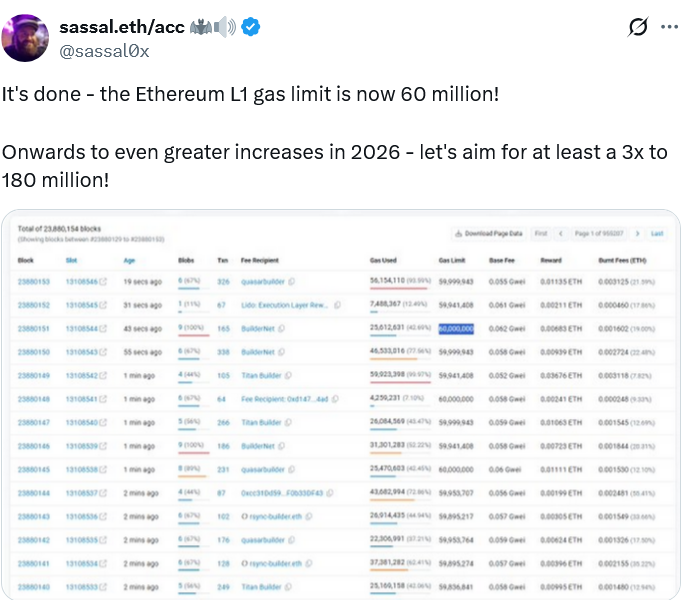
Source: Anthony Sassano

Members of the Ethereum developer and research community have expressed a common goal to raise the network’s gas limit to 180 million by the end of 2026.

Magazine: Meet the onchain crypto detectives fighting crime better than the cops

Criptomoedas em alta

Leituras Relacionadas

The Verdict in Choi Tae-won's Divorce Case: Revealing the Inheritance Undercurrent Behind SK Hynix's Trillion-Won Empire

SK Group Chairman Chey Tae-won's high-profile divorce case, involving a record 1.38 trillion won settlement, has drawn attention to the succession plans for Korea's second-largest conglomerate, especially its crown jewel, SK hynix. Unlike traditional chaebol scripts centered on the eldest son, Chey's three children from his marriage to former President Roh Tae-woo's daughter, Roh Soh-yeong, are carving distinct, non-traditional paths. Eldest daughter Chey Yun-jung (b. 1989) is seen as the most evident successor. With a scientific and consulting background, she holds executive roles at SK bioscience and SK Inc.'s growth support department, focusing on future strategy and biopharma. Her marriage is to an AI infrastructure entrepreneur, not a traditional business alliance. Second daughter Chey Min-jung (b. 1991) took a unique route, voluntarily serving as a South Korean naval officer, including an anti-piracy deployment. She later worked on policy and strategy for SK hynix in Washington D.C. before co-founding an AI-driven healthcare startup. She married a former U.S. Marine Corps officer, connecting her to U.S. defense and policy circles—networks crucial for a global semiconductor giant. The only son, Chey In-geun (b. 1995), who studied physics like his father, worked briefly at SK E&S before joining McKinsey. Despite fitting the traditional "heir" profile as the eldest son, he remains silent and holds no public position or shares in SK, suggesting the old succession playbook is obsolete. As SK hynix's valuation soars, becoming a geopolitical asset in the AI era, the heirs' legitimacy is no longer automatic. They must prove themselves in fields like AI biotech, global policy, and strategic consulting. Their marriages also reflect new elite networks in tech and defense, not old political alliances. Their inheritance is the complex challenge of navigating a globalized, tech-driven world, not just a corporate throne.

marsbitOntem 09:06

The Verdict in Choi Tae-won's Divorce Case: Revealing the Inheritance Undercurrent Behind SK Hynix's Trillion-Won Empire

marsbitOntem 09:06

From OpenSea to OpenRouter: Is Alex Atallah Repeating His 'Exit at the Peak' Playbook?

From OpenSea to OpenRouter: Is Alex Atallah Repeating His "Exit at the Peak" Playbook? According to the Wall Street Journal, payments giant Stripe is in talks to acquire the AI model aggregation platform OpenRouter in a potential deal valuing the company near $100 billion. This would mark founder Alex Atallah's second creation of a company reaching a $100 billion valuation, following his co-founding of NFT marketplace OpenSea. OpenRouter, founded just over three years ago, has grown rapidly by acting as a unified gateway for developers to access over 400 AI models. It currently has about 10 million users and processes over 200 trillion tokens monthly. While the platform's annualized revenue is around $50 million, its valuation has skyrocketed from $1.3 billion in March 2026. The potential acquisition by Stripe, a company OpenRouter's founder once likened it to, represents a major expansion into AI infrastructure for the payments leader. This move echoes Atallah's previous timing with OpenSea, where he departed before the NFT market's significant downturn. For OpenRouter, selling now may be strategic. Despite its scale, its business model—charging a 5-5.5% fee on AI inference calls—faces pressure from competition, open-source models, and potential price wars among model providers, limiting its profitability narrative for an IPO. A key asset for potential acquirers like Stripe is OpenRouter's vast repository of real-world AI usage data, which offers unique insights into model performance and developer preferences that are difficult to replicate. Whether this potential deal signifies a new valuation benchmark for AI infrastructure or another market peak signal remains to be seen.

链捕手Ontem 08:42

From OpenSea to OpenRouter: Is Alex Atallah Repeating His 'Exit at the Peak' Playbook?

链捕手Ontem 08:42

Trading

Spot

Artigos em Destaque

Como comprar GAS

Bem-vindo à HTX.com!Tornámos a compra de GAS (GAS) simples e conveniente.Segue o nosso guia passo a passo para iniciar a tua jornada no mundo das criptos.Passo 1: cria a tua conta HTXUtiliza o teu e-mail ou número de telefone para te inscreveres numa conta gratuita na HTX.Desfruta de um processo de inscrição sem complicações e desbloqueia todas as funcionalidades.Obter a minha contaPasso 2: vai para Comprar Cripto e escolhe o teu método de pagamentoCartão de crédito/débito: usa o teu visa ou mastercard para comprar GAS (GAS) instantaneamente.Saldo: usa os fundos da tua conta HTX para transacionar sem problemas.Terceiros: adicionamos métodos de pagamento populares, como Google Pay e Apple Pay, para aumentar a conveniência.P2P: transaciona diretamente com outros utilizadores na HTX.Mercado de balcão (OTC): oferecemos serviços personalizados e taxas de câmbio competitivas para os traders.Passo 3: armazena teu GAS (GAS)Depois de comprar o teu GAS (GAS), armazena-o na tua conta HTX.Alternativamente, podes enviá-lo para outro lugar através de transferência blockchain ou usá-lo para transacionar outras criptomoedas.Passo 4: transaciona GAS (GAS)Transaciona facilmente GAS (GAS) no mercado à vista da HTX.Acede simplesmente à tua conta, seleciona o teu par de trading, executa as tuas transações e monitoriza em tempo real.Oferecemos uma experiência de fácil utilização tanto para principiantes como para traders experientes.

242 Visualizações TotaisPublicado em {updateTime}Atualizado em 2026.06.02

Como comprar GAS

Discussões

Bem-vindo à Comunidade HTX. Aqui, pode manter-se informado sobre os mais recentes desenvolvimentos da plataforma e obter acesso a análises profissionais de mercado. As opiniões dos utilizadores sobre o preço de GAS (GAS) são apresentadas abaixo.

活动图片