Written by: etherscan.eth
Compiled by: AididiaoJP, Foresight News
A few weeks ago, an Etherscan user named Nima shared an unpleasant experience. After completing just two stablecoin transfers, he received over 89 address monitoring alert emails in a short period.
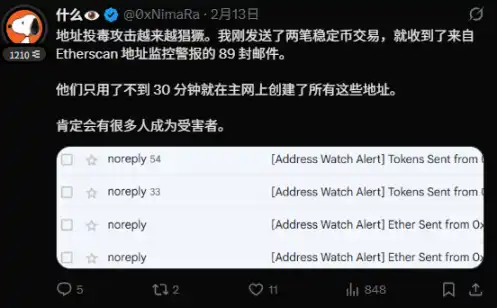
As Nima pointed out, these alerts were triggered by address poisoning transactions. The sole purpose of these transactions, created by attackers, is to implant highly similar fake addresses into the user's transaction history, intending to trick the user into mistakenly using these fake addresses when copying for their next transfer.
Address poisoning has existed on Ethereum for years. However, such incidents highlight that these attack campaigns have become highly automated and scaled. What was once sporadic spam is now executed on a massive scale, with attackers often implanting poisoning transfers within minutes of a legitimate transaction occurring.
To understand why such attacks have become more prevalent, we need to analyze two dimensions: the evolution of address poisoning attack methods, and the fundamental reasons why they can be easily operated at scale.
Additionally, this article will focus on explaining a core prevention principle to help users effectively defend against such attacks.
I. The Industrialization of Address Poisoning
Address poisoning was once considered a niche fraudulent tactic used by opportunistic attackers. However, today, its operational model increasingly exhibits industrial characteristics.
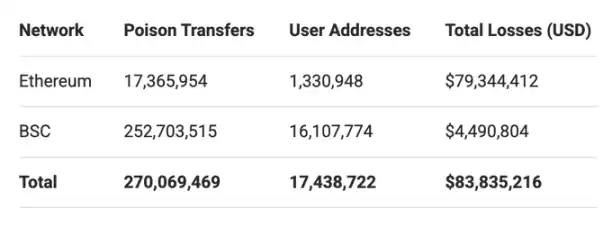
A study published in 2025, analyzing address poisoning activities between July 2022 and June 2024 (i.e., before the Fusaka upgrade), showed that there were approximately 17 million poisoning attempts on Ethereum, involving about 1.3 million users, with confirmed losses of at least $79.3 million.
The table below, based on results from the "Blockchain Address Poisoning Research," shows the scale of address poisoning activities on Ethereum and BSC between July 2022 and June 2024. The data indicates that on the BSC chain, where transaction fees are significantly lower, the frequency of poisoning transfers was 1355% higher.
Attackers typically identify potential targets by monitoring blockchain activity. Once a target user's transaction is detected, automated systems generate highly similar addresses that share the same starting and ending characters as the legitimate addresses the user has interacted with. The attackers then send poisoning transfers containing these fake addresses to the target address, causing them to appear in the user's transaction history.
Attackers tend to target addresses with higher profit potential. Addresses that frequently make transfers, hold large token balances, or participate in large-value transfers typically receive more poisoning attempts.
Competition Mechanism Enhances Attack Efficiency
The 2025 study revealed a noteworthy phenomenon: different attack groups often compete with each other. In many poisoning campaigns, multiple attackers send poisoning transfers to the same target address almost simultaneously.
Each attack group attempts to be the first to implant their fake address into the user's transaction history, hoping that their address will be selected first when the user copies an address later. The one who successfully implants first has an increased probability of having their fake address mistakenly copied by the user.
The case of the following address fully demonstrates the intensity of this competition. In this case, within minutes of a legitimate USDT transfer being completed, 13 poisoning transactions were implanted.
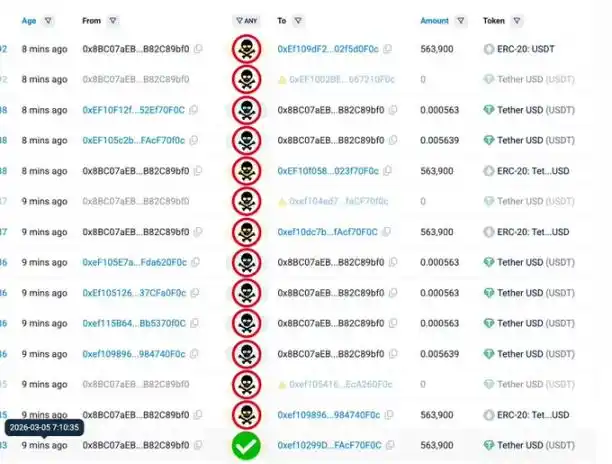
Note: Etherscan hides zero-value transfers by default; hidden items have been unhidden here for demonstration purposes
Common methods used in address poisoning attacks include: dust transfers, fake token transfers, and zero-value token transfers.
II. Reasons Why Address Poisoning Attacks Are Easy to Scale
At first glance, the success rate of address poisoning seems low. After all, most users are not fooled. However, from an economic perspective, the logic of such attacks is quite different.
The Logic of a Probability Game
Researchers found that the success rate of a single poisoning attempt on Ethereum is approximately 0.01%. In other words, out of every 10,000 poisoning transfers, only about 1 might lead to a user mistakenly sending funds to the attacker.
Given this, poisoning campaigns are no longer limited to a few addresses but tend to send thousands or even millions of poisoning transfers. When the attempt base is large enough, even a tiny success rate can accumulate to generate considerable illegal profits.
A single successful large-value transfer fraud can easily cover the costs of thousands of failed attempts.
Lower Transaction Costs Stimulate Increase in Poisoning Attempts
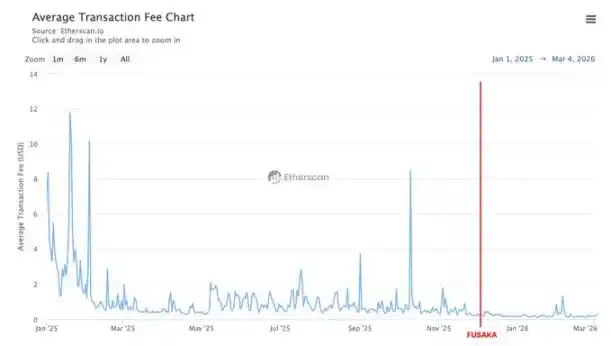
The Fusaka upgrade, activated on December 3, 2025, introduced scalability optimizations that effectively reduced transaction costs on Ethereum. While benefiting ordinary users and developers, this change also significantly lowered the cost for attackers to initiate a single poisoning transfer, enabling them to send poisoning attempts on an unprecedented scale.
After the Fusaka upgrade, Ethereum network activity increased markedly. In the 90 days post-upgrade, the average daily transaction processing volume increased by 30% compared to the 90 days pre-upgrade. During the same period, the average daily number of newly created addresses increased by about 78%.
Furthermore, we observed a significant increase in dust transfer activity. In these transfers, attackers send transactions involving the same token as in the user's history but for a very small amount.
The data below compares dust transfer activity for several major assets in the 90 days before and after the Fusaka upgrade. For stablecoins like USDT, USDC, and DAI, dust transfers refer to transactions below $0.01; for ETH, it refers to transfers below 0.00001 ETH.
USDT
- Pre-upgrade: 4.2 million
- Post-upgrade: 29.9 million
- Increase: +25.7 million (+612%)
USDC
- Pre-upgrade: 2.6 million
- Post-upgrade: 14.9 million
- Increase: +12.3 million (+473%)
DAI
- Pre-upgrade: 142,405
- Post-upgrade: 811,029
- Increase: +668,624 (+470%)
ETH
- Pre-upgrade: 104.5 million
- Post-upgrade: 169.7 million
- Increase: +65.2 million (+62%)
The data indicates that shortly after the Fusaka upgrade, dust transfer activity (below $0.01) surged sharply, peaked, and then declined somewhat, but remained significantly higher than pre-upgrade levels. In contrast, transfer activity above $0.01 remained relatively stable during the same period.
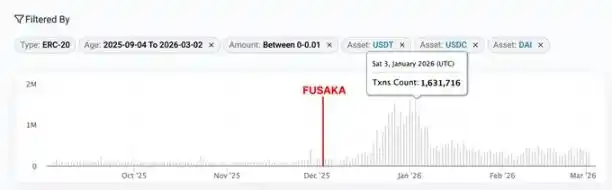
Chart: Comparison of dust transfer trends (<$0.01) for USDT, USDC, and DAI in the 90 days before and after the Fusaka upgrade
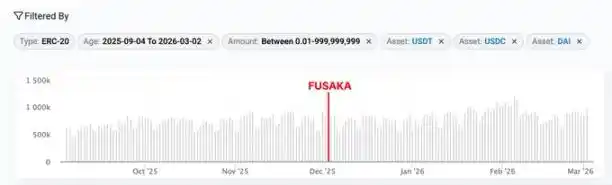
Chart: Comparison of regular transfer trends (>$0.01) for USDT, USDC, and DAI in the 90 days before and after the Fusaka upgrade
In many attack campaigns, attackers first bulk-send tokens and ETH to newly generated fake addresses, which then send dust transfers one by one to the target addresses. Since dust transfers involve extremely low amounts, with lower transaction costs, attackers can operate on a massive scale at very low cost.

Illustration: Address Fake_Phishing1688433 bulk-sending tokens and ETH to multiple different fake addresses in one transaction
It is important to clarify that not all dust transfers are poisoning acts. Dust transfers can also originate from legitimate activities, such as token airdrops or小额 interactions between addresses. However, after reviewing a large number of dust transfer records, it can be judged that a significant portion of them are highly likely to be poisoning attempts.
III. Core Prevention Principle
Always carefully verify the destination address before sending any funds.
Here are some practical suggestions for reducing risk when using Etherscan:
Use Identifiable Address Labels

For addresses you frequently interact with, set private name tags on Etherscan. This helps make legitimate addresses clearly distinguishable among many similar addresses.
Using domain name services like ENS can also improve the recognizability of addresses throughout the browser.
It is also recommended to use the wallet's address book feature to whitelist commonly used addresses, ensuring funds are always sent to the intended target.
Enable Address Highlighting
Etherscan's address highlighting feature helps users visually distinguish between visually similar addresses. If two addresses look almost identical but are highlighted differently, one is highly likely to be a poisoning address.
Always Double-Check Before Copying an Address
Etherscan proactively pops up提醒 windows when users copy addresses that may be associated with suspicious activity. This suspicious activity includes:
- Low-value token transfers
- Fake token transfers
- Tokens with poor reputation
- Tokens with outdated information
When you see such a reminder, be sure to pause and carefully verify whether the address you are copying is the target address you真正 intend to interact with.

Remember, there is no "undo" button in the crypto world. Once funds are sent to the wrong address, the possibility of recovery is minimal.
Summary
As lower costs make high-volume attack strategies more economical, address poisoning attacks on Ethereum are becoming increasingly rampant. Such attacks also negatively impact the user experience, with大量 poisoning spam cluttering transaction history interfaces面向 users.
Effectively preventing address poisoning attacks requires both users to improve their own security awareness and better interface design support. For users, the most crucial habit to develop is: always carefully verify the destination address before sending funds.
At the same time, related tools and user interfaces should play a greater role in helping users quickly identify suspicious activity.
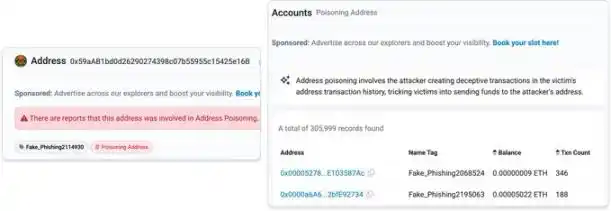
Poisoning address label on Etherscan (https://etherscan.io/accounts/label/poisoning-address)
Etherscan is continuously committed to improving the browser interface and API services to help users more easily identify such attacks. We proactively label fake addresses, identify and hide zero-value token transfers, and label fake tokens. By providing this curated data, users can more easily spot potential address poisoning attempts without manually sifting through massive transaction records.
As poisoning attacks escalate with automation and high-volume dust transfer methods, clearly presenting these risk signals is crucial to helping users distinguish between suspicious activity and legitimate transactions.
Criptomoedas em alta














Perguntas relacionadas
QWhat is address poisoning in the context of Ethereum, and how does it work?
AAddress poisoning is a scam where attackers send transactions to a user's address using a fake address that looks very similar to a legitimate one the user has previously interacted with. The goal is to implant this fake address into the user's transaction history, hoping the user will mistakenly copy and send funds to it in the future.
QAccording to the article, how has the Fusaka upgrade on Ethereum impacted address poisoning attacks?
AThe Fusaka upgrade, which lowered transaction costs on Ethereum, made it significantly cheaper for attackers to launch address poisoning attempts. This led to a massive increase in dust transactions (transfers of tiny amounts of tokens), which are often used in these attacks, as attackers could operate on a much larger scale.
QWhat is the estimated success rate of an address poisoning attack on Ethereum, and why do attackers still pursue it?
AThe estimated success rate of a single address poisoning attempt on Ethereum is about 0.01%. Attackers still pursue it because it is a numbers game. By sending thousands or millions of attempts, the small success rate can accumulate into substantial illegal profits, as one successful large transfer can easily cover the cost of thousands of failed attempts.
QWhat is the single most important principle for users to protect themselves from address poisoning?
AThe single most important principle is to always carefully verify the destination address before sending any funds. Users should double-check the full address and not rely solely on the first and last few characters.
QWhat are some specific tools or features on Etherscan that can help users identify and avoid poisoned addresses?
AEtherscan offers several features to help users: Address Highlighting to visually distinguish between similar-looking addresses, Private Name Tags and ENS names to make legitimate addresses easily identifiable, an Address Book for whitelisting trusted addresses, and Warning Pop-ups that appear when a user attempts to copy an address associated with suspicious activity like low-value token transfers.
Leituras Relacionadas





Trading
Artigos em Destaque
O que é ETH 2.0
ETH 2.0: Uma Nova Era para o Ethereum Introdução ETH 2.0, amplamente conhecido como Ethereum 2.0, marca uma atualização monumental à blockchain do Ethereum. Esta transição não é meramente uma mudança estética; visa melhorar fundamentalmente a escalabilidade, segurança e sustentabilidade da rede. Com uma mudança do mecanismo de consenso em Proof of Work (PoW), intensivo em energia, para um Proof of Stake (PoS) mais eficiente, o ETH 2.0 promete uma abordagem transformadora ao ecossistema blockchain. O que é ETH 2.0? ETH 2.0 é um conjunto de atualizações distintas e interconectadas focadas na otimização das capacidades e desempenho do Ethereum. Esta reformulação foi projetada para abordar desafios críticos que o mecanismo atual do Ethereum enfrentou, particularmente em relação à velocidade das transações e à congestão da rede. Objetivos do ETH 2.0 Os principais objetivos do ETH 2.0 giram em torno da melhoria de três aspectos centrais: Escalabilidade: Com o objetivo de melhorar significativamente o número de transações que a rede pode manejar por segundo, o ETH 2.0 procura ultrapassar a limitação atual de aproximadamente 15 transações por segundo, alcançando potencialmente milhares. Segurança: Medidas de segurança melhoradas são integrais ao ETH 2.0, especialmente através da resistência aprimorada contra ciberataques e da preservação do ethos descentralizado do Ethereum. Sustentabilidade: O novo mecanismo PoS foi projetado não apenas para melhorar a eficiência, mas também para reduzir drasticamente o consumo de energia, alinhando a estrutura operacional do Ethereum com considerações ambientais. Quem é o Criador do ETH 2.0? A criação do ETH 2.0 pode ser atribuída à Ethereum Foundation. Esta organização sem fins lucrativos, que desempenha um papel crucial no apoio ao desenvolvimento do Ethereum, é liderada pelo co-fundador notável Vitalik Buterin. A sua visão de um Ethereum mais escalável e sustentável tem sido a força motriz por trás desta atualização, envolvendo contribuições de uma comunidade global de desenvolvedores e entusiastas dedicados a melhorar o protocolo. Quem são os Investidores do ETH 2.0? Embora os detalhes sobre os investidores do ETH 2.0 não tenham sido tornados públicos, é sabido que a Ethereum Foundation recebe apoio de várias organizações e indivíduos no espaço da blockchain e tecnologia. Esses parceiros incluem firmas de capital de risco, empresas de tecnologia e organizações filantrópicas que compartilham um interesse mútuo em apoiar o desenvolvimento de tecnologias descentralizadas e infraestrutura de blockchain. Como Funciona o ETH 2.0? ETH 2.0 é notável por introduzir uma série de características chave que o diferenciam do seu predecessor. Proof of Stake (PoS) A transição para um mecanismo de consenso PoS é uma das mudanças de destaque do ETH 2.0. Ao contrário do PoW, que depende da mineração intensiva em energia para a verificação de transações, o PoS permite que os utilizadores validem transações e criem novos blocos de acordo com a quantidade de ETH que apostam na rede. Isso leva a uma maior eficiência energética, reduzindo o consumo em aproximadamente 99,95%, tornando o Ethereum 2.0 uma alternativa consideravelmente mais ecológica. Shard Chains As shard chains são outra inovação crítica do ETH 2.0. Estas cadeias menores operam em paralelo com a cadeia principal do Ethereum, permitindo que várias transações sejam processadas simultaneamente. Esta abordagem melhora a capacidade geral da rede, abordando preocupações de escalabilidade que têm atormentado o Ethereum. Beacon Chain No coração do ETH 2.0 está a Beacon Chain, que coordena a rede e gere o protocolo PoS. Ela atua como uma espécie de organizador: supervisiona os validadores, garante que as shards permaneçam conectadas à rede e monitora a saúde geral do ecossistema blockchain. Linha do Tempo do ETH 2.0 A jornada do ETH 2.0 tem sido marcada por vários marcos chave que traçam a evolução desta atualização significativa: Dezembro de 2020: O lançamento da Beacon Chain marcou a introdução do PoS, preparando o caminho para a migração para o ETH 2.0. Setembro de 2022: A conclusão de “The Merge” representa um momento crucial em que a rede Ethereum fez a transição com sucesso de um quadro PoW para um PoS, anunciando uma nova era para o Ethereum. 2023: O lançamento esperado das shard chains visa melhorar ainda mais a escalabilidade da rede Ethereum, solidificando o ETH 2.0 como uma plataforma robusta para aplicações e serviços descentralizados. Características Chave e Benefícios Escalabilidade Melhorada Uma das vantagens mais significativas do ETH 2.0 é a sua escalabilidade melhorada. A combinação de PoS e shard chains permite que a rede expanda a sua capacidade, permitindo que acomode um volume de transações muito maior em comparação com o sistema legado. Eficiência Energética A implementação do PoS representa um enorme passo em direção à eficiência energética na tecnologia blockchain. Ao reduzir drasticamente o consumo de energia, o ETH 2.0 não só reduz os custos operacionais, mas também se alinha mais estreitamente com os objetivos globais de sustentabilidade. Segurança Aprimorada Os mecanismos atualizados do ETH 2.0 contribuem para uma segurança melhorada em toda a rede. O uso do PoS, juntamente com medidas de controle inovadoras estabelecidas através das shard chains e da Beacon Chain, assegura um maior grau de proteção contra potenciais ameaças. Custos Mais Baixos para os Utilizadores À medida que a escalabilidade melhora, os efeitos sobre os custos de transação também serão evidentes. Aumentada a capacidade e reduzida a congestão, espera-se que isso se traduza em taxas mais baixas para os utilizadores, tornando o Ethereum mais acessível para transações do dia a dia. Conclusão ETH 2.0 marca uma evolução significativa no ecossistema da blockchain do Ethereum. Ao abordar questões fundamentais como a escalabilidade, o consumo de energia, a eficiência das transações e a segurança geral, a importância desta atualização não pode ser subestimada. A transição para o Proof of Stake, a introdução das shard chains e o trabalho fundamental da Beacon Chain são indicativos de um futuro em que o Ethereum pode atender à crescente demanda do mercado descentralizado. Em uma indústria movida pela inovação e progresso, o ETH 2.0 representa um testemunho das capacidades da tecnologia blockchain em pavimentar o caminho para uma economia digital mais sustentável e eficiente.
146 Visualizações TotaisPublicado em {updateTime}Atualizado em 2024.12.03

O que é ETH 3.0
ETH3.0 e $eth 3.0: Uma Análise Profunda do Futuro do Ethereum Introdução No ambiente em rápida evolução da criptomoeda e da tecnologia blockchain, o ETH3.0, frequentemente denotado como $eth 3.0, emergiu como um tema de considerável interesse e especulação. O termo abrange dois conceitos principais que merecem esclarecimento: Ethereum 3.0: Esta representa uma potencial atualização futura destinada a aumentar as capacidades da atual blockchain do Ethereum, focando especialmente na melhoria da escalabilidade e desempenho. ETH3.0 Meme Token: Este distinto projeto de criptomoeda procura aproveitar a blockchain do Ethereum na criação de um ecossistema centrado em memes, promovendo o envolvimento na comunidade de criptomoedas. Compreender esses aspectos do ETH3.0 é essencial não apenas para entusiastas de criptomoedas, mas também para aqueles que observam as tendências tecnológicas mais amplas no espaço digital. O que é ETH3.0? Ethereum 3.0 Ethereum 3.0 é promovido como uma atualização proposta para a rede Ethereum já estabelecida, que tem sido a espinha dorsal de muitas aplicações descentralizadas (dApps) e contratos inteligentes desde a sua criação. As melhorias vislumbradas concentram-se principalmente na escalabilidade—integrando tecnologias avançadas como sharding e provas de conhecimento zero (zk-proofs). Essas inovações tecnológicas visam facilitar um número sem precedentes de transações por segundo (TPS), potencialmente alcançando milhões, abordando assim uma das limitações mais significativas enfrentadas pela tecnologia blockchain atual. A melhoria não é meramente técnica, mas também estratégica; visa preparar a rede Ethereum para uma adoção generalizada e utilidade em um futuro marcado por uma maior demanda por soluções descentralizadas. ETH3.0 Meme Token Em contraste com o Ethereum 3.0, o ETH3.0 Meme Token aventura-se por um domínio mais leve e divertido, combinando a cultura dos memes da internet com a dinâmica das criptomoedas. Este projeto permite que os usuários comprem, vendam e negociem memes na blockchain do Ethereum, proporcionando uma plataforma que fomenta o envolvimento da comunidade através da criatividade e interesses compartilhados. O ETH3.0 Meme Token visa demonstrar como a tecnologia blockchain pode interseccionar com a cultura digital, criando casos de uso que são tanto divertidos quanto financeiramente viáveis. Quem é o Criador do ETH3.0? Ethereum 3.0 A iniciativa em direção ao Ethereum 3.0 é impulsionada principalmente por um consórcio de desenvolvedores e pesquisadores dentro da comunidade Ethereum, notavelmente incluindo Justin Drake. Conhecido por suas percepções e contribuições para a evolução do Ethereum, Drake tem sido uma figura proeminente nas discussões sobre a transição do Ethereum para uma nova camada de consenso, referida como “Beam Chain”. Esta abordagem colaborativa ao desenvolvimento significa que o Ethereum 3.0 não é fruto de um único criador, mas sim uma manifestação da engenhosidade coletiva focada no avanço da tecnologia blockchain. ETH3.0 Meme Token Os detalhes sobre o criador do ETH3.0 Meme Token são atualmente indetectáveis. A natureza dos tokens de meme frequentemente leva a uma estrutura mais descentralizada e impulsionada pela comunidade, o que poderia explicar a falta de atribuição específica. Isso alinha-se com a ethos da comunidade de criptomoedas mais ampla, onde a inovação geralmente surge de esforços colaborativos em vez de esforços individuais. Quem são os Investidores do ETH3.0? Ethereum 3.0 O apoio ao Ethereum 3.0 provém principalmente da Fundação Ethereum, juntamente com uma comunidade entusiástica de desenvolvedores e investidores. Esta associação fundacional proporciona um grau significativo de legitimidade e melhora as perspectivas de uma implementação bem-sucedida, uma vez que aproveita a confiança e credibilidade construída ao longo de anos de operações de rede. Em um clima em rápida mudança no mundo das criptomoedas, o apoio da comunidade desempenha um papel crucial no impulso ao desenvolvimento e adoção, posicionando o Ethereum 3.0 como um sério candidato a futuros avanços na blockchain. ETH3.0 Meme Token Embora as fontes atualmente disponíveis não forneçam informações explícitas sobre as fundações ou organizações de investimento que apoiam o ETH3.0 Meme Token, é indicativo do modelo típico de financiamento para tokens de meme, que frequentemente depende de apoio base e engajamento da comunidade. Os investidores em tais projetos costumam consistir em indivíduos motivados pelo potencial de inovação impulsionada pela comunidade e pelo espírito de cooperação encontrado dentro da comunidade cripto. Como Funciona o ETH3.0? Ethereum 3.0 As características distintivas do Ethereum 3.0 residem em sua proposta de implementação de sharding e tecnologia zk-proof. Sharding é um método de partição da blockchain em partes menores e gerenciáveis ou “shards”, que podem processar transações simultaneamente em vez de sequencialmente. Esta descentralização do processamento ajuda a prevenir congestionamentos e garante que a rede permaneça responsiva mesmo sob carga pesada. A tecnologia de prova de conhecimento zero (zk-proof) contribui com outra camada de sofisticação ao permitir a validação de transações sem revelar os dados subjacentes envolvidos. Este aspecto não apenas melhora a privacidade, mas também aumenta a eficiência geral da rede. Há também conversas sobre a incorporação de uma Máquina Virtual Ethereum de conhecimento zero (zkEVM) nesta atualização, amplificando ainda mais as capacidades e utilidade da rede. ETH3.0 Meme Token O ETH3.0 Meme Token distingue-se ao capitalizar sobre a popularidade da cultura dos memes. Estabelece um mercado para que os usuários participem da negociação de memes, não apenas para entretenimento, mas também para potencial ganho econômico. Ao integrar recursos como staking, provisão de liquidez e mecanismos de governança, o projeto fomenta um ambiente que incentiva a interação e participação da comunidade. Ao oferecer uma mistura única de entretenimento e oportunidade econômica, o ETH3.0 Meme Token visa atrair um público diversificado, variando de entusiastas de criptomoedas a conhecedores casuais de memes. Cronologia do ETH3.0 Ethereum 3.0 11 de novembro de 2024: Justin Drake sugere a próxima atualização do ETH 3.0, centrada nas melhorias de escalabilidade. Este anúncio sinaliza o início de discussões formais sobre a futura arquitetura do Ethereum. 12 de novembro de 2024: A proposta antecipada para Ethereum 3.0 deve ser revelada no Devcon em Bangkok, preparando o cenário para um feedback mais amplo da comunidade e potenciais próximos passos no desenvolvimento. ETH3.0 Meme Token 21 de março de 2024: O ETH3.0 Meme Token é oficialmente listado no CoinMarketCap, marcando sua entrada no domínio público das criptomoedas e aumentando a visibilidade de seu ecossistema baseado em memes. Pontos Chave Em conclusão, Ethereum 3.0 representa uma evolução significativa dentro da rede Ethereum, focando em superar limitações quanto à escalabilidade e desempenho através de tecnologias avançadas. As atualizações propostas refletem uma abordagem proativa às futuras demandas e usabilidade. Por outro lado, o ETH3.0 Meme Token encapsula a essência da cultura impulsionada pela comunidade no espaço das criptomoedas, aproveitando a cultura dos memes para criar plataformas envolventes que incentivam a criatividade e participação dos usuários. Compreender os distintos propósitos e funcionalidades do ETH3.0 e $eth 3.0 é fundamental para qualquer pessoa interessada nos desenvolvimentos contínuos dentro do espaço cripto. Com ambas as iniciativas a pavimentar caminhos únicos, elas sublinham coletivamente a natureza dinâmica e multifacetada da inovação em blockchain.
149 Visualizações TotaisPublicado em {updateTime}Atualizado em 2024.12.03
Como comprar ETH
Bem-vindo à HTX.com!Tornámos a compra de Ethereum (ETH) simples e conveniente.Segue o nosso guia passo a passo para iniciar a tua jornada no mundo das criptos.Passo 1: cria a tua conta HTXUtiliza o teu e-mail ou número de telefone para te inscreveres numa conta gratuita na HTX.Desfruta de um processo de inscrição sem complicações e desbloqueia todas as funcionalidades.Obter a minha contaPasso 2: vai para Comprar Cripto e escolhe o teu método de pagamentoCartão de crédito/débito: usa o teu visa ou mastercard para comprar Ethereum (ETH) instantaneamente.Saldo: usa os fundos da tua conta HTX para transacionar sem problemas.Terceiros: adicionamos métodos de pagamento populares, como Google Pay e Apple Pay, para aumentar a conveniência.P2P: transaciona diretamente com outros utilizadores na HTX.Mercado de balcão (OTC): oferecemos serviços personalizados e taxas de câmbio competitivas para os traders.Passo 3: armazena teu Ethereum (ETH)Depois de comprar o teu Ethereum (ETH), armazena-o na tua conta HTX.Alternativamente, podes enviá-lo para outro lugar através de transferência blockchain ou usá-lo para transacionar outras criptomoedas.Passo 4: transaciona Ethereum (ETH)Transaciona facilmente Ethereum (ETH) no mercado à vista da HTX.Acede simplesmente à tua conta, seleciona o teu par de trading, executa as tuas transações e monitoriza em tempo real.Oferecemos uma experiência de fácil utilização tanto para principiantes como para traders experientes.
3.3k Visualizações TotaisPublicado em {updateTime}Atualizado em 2026.06.02

