ETH Breaks Below $1,900! Behind the 22% Plunge, Vitalik's 'Five-Year Austerity' Strategy

marsbitPublicado em 2026-02-24Última atualização em 2026-02-24

Resumo

Ethereum (ETH) has experienced a sharp decline, falling below $1,900 and dropping over 22% from recent highs. This downturn is driven by a combination of liquidity outflows and shifting market expectations. Key factors include significant net redemptions from U.S. spot Ethereum ETFs, large-scale selling by whale addresses (1.43 million ETH sold in two weeks), and substantial personal sales by co-founder Vitalik Buterin. In response, the Ethereum Foundation has announced a five-year "moderate austerity" strategy to ensure long-term financial sustainability and continued development of core technology. Buterin is personally funding certain public goods projects to reduce the Foundation’s financial burden. Despite price pressure, Ethereum’s network performance has improved, with TPS reaching a record high due to the Fusaka upgrade. However, centralization risks in block building remain. The upcoming Glamsterdam upgrade aims to address this with ePBS (enshrined Proposer-Builder Separation) to reduce dominance by a few large players and reshape MEV economics. Additionally, regulatory pressure is mounting with the EU’s MiCA regulation set to take effect in July 2026, increasing compliance costs and affecting DeFi and liquidity providers. Ethereum is currently in a phase of short-term volatility and structural adjustment, balancing capital outflows against long-term technical and governance improvements.

Author: Max.s

The current cryptocurrency market is undergoing a severe structural adjustment. According to the latest trading data (as shown on the chart, ETH/USDT has fallen to around $1,847.84, with a clear recent unilateral downward trend), Ethereum (ETH) is experiencing a deep correction driven by both capital flows and market expectations.
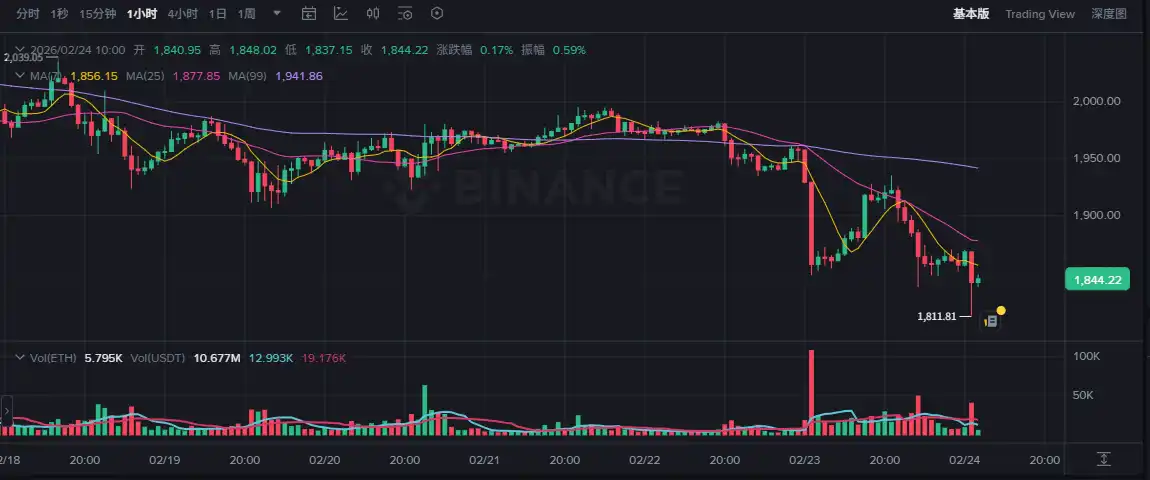
Looking back at the price movement in February 2026, ETH plummeted from above $2,360 to the $1,825 range in a short period, a drop of over 22.7%. Behind the surface of the price decline lies a comprehensive restructuring of the Ethereum network in terms of technical upgrades, organizational structure, and regulatory environment. For institutional investors and financial professionals, looking beyond short-term price fluctuations and understanding the transformation of Ethereum's underlying asset logic is the core issue at hand.

The most immediate pressure facing Ethereum currently comes from the continuous withdrawal of liquidity. This capital outflow is not a single event but a resonance of multiple sources of capital.

Net Redemptions in Spot ETFs: Risk aversion among institutional investors has significantly increased. For example, on January 29, 2026, U.S. spot Ethereum ETFs recorded a single-day net outflow of $155.7 million. Among them, Fidelity's FETH saw a net outflow of $59.2 million, BlackRock's ETHA had a net outflow of $54.9 million, and Grayscale's two funds also recorded outflows in the tens of millions of dollars. This indicates that traditional Wall Street capital is systematically reducing its exposure to Ethereum.

Concentrated Selling by Early Holders: On-chain data shows that whale accounts sold approximately 1.43 million ETH within just two weeks.

Founder's Sell-Off: This month, Ethereum co-founder Vitalik Buterin sold over 8,800 ETH, cashing out approximately $18.45 million. In traditional financial markets, intensive selling by core management is often seen as a major bearish signal, further exacerbating market panic.
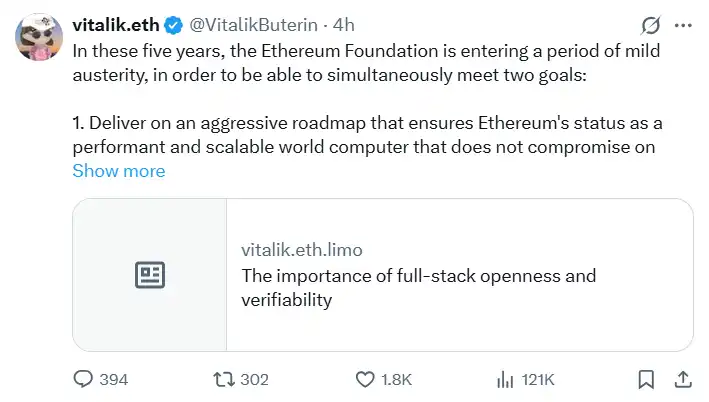
Facing the market's winter, the Ethereum Foundation (EF) has made a defensive shift in its financial strategy. Vitalik Buterin announced that the foundation will enter a five-year period of "moderate austerity."

From a corporate finance perspective, this is a classic cash flow management strategy. Its core objectives are twofold: first, to ensure the foundation can continue to fund the development of Ethereum's core underlying technology in the future, avoiding threats to its independence due to excessive resource consumption; second, to ensure that Ethereum's ambitious roadmap as a high-performance "world computer" is delivered on schedule.

To support this strategy, Vitalik himself proactively severed the funding dependence of some "special projects" on the foundation. He chose to extract 16,384 ETH and use decentralized staking yields to self-fund research and development for public goods such as open-source software, hardware, and privacy protection projects. This approach of internalizing peripheral R&D expenses and focusing on core business marks a move toward maturity and restraint in Ethereum's capital operations.

While the price is under pressure, Ethereum's technical fundamentals have shown remarkable resilience, even exhibiting a rare phenomenon of "price-volume divergence." Recently, the Ethereum network's TPS (transactions per second) reached a historic high of 75,862, far exceeding the previous peak of 58,786.
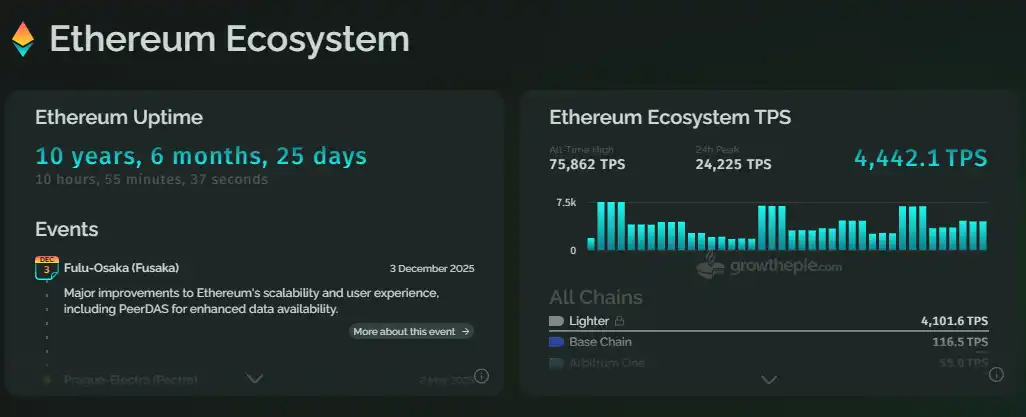
This is largely due to the Fusaka upgrade deployed last December. This upgrade introduced the PeerDAS mechanism, significantly expanding the data throughput of Layer 2 networks. However, with the explosion in data capacity, new systemic risks are emerging. Vitalik pointed out that because current block builders still need to download complete data, the network faces serious centralization risks.

To address this hidden danger, Ethereum plans to launch the Glamsterdam upgrade in 2026, which is essentially a bottom-up reform targeting internal oligopolies within the network.

ePBS Mechanism Reshapes Profit Distribution: The core of this upgrade is ePBS (in-protocol proposer-builder separation). It forcibly incorporates the block-building process into the protocol's底层, standardizing the bidding process and weakening the absolute dominance of the current few external builders over the market.

Preventing Rent-Seeking by Giants: For financial professionals, this means Ethereum is proactively intervening in its internal MEV (Maximal Extractable Value) market structure, breaking down the technical barriers of leading capital, and reconstructing the underlying logic of staking yields.

In addition to the internal structural pains, the Ethereum ecosystem also faces the impending regulatory hammer. The EU's MiCA (Markets in Crypto-Assets) regulation, set to take full effect on July 1, 2026, requires all crypto businesses operating within the EU to meet strict compliance standards.

The implementation of this regulation will directly impact the vast number of DeFi protocols, liquidity providers, and related derivative markets on the Ethereum chain that lack the backing of traditional corporate entities. The sharp rise in compliance costs and the early withdrawal of some non-compliant funds are the deep-seated macro reasons behind the recent sustained bleeding in the spot market.

Ethereum is in a period of divergence: on one side, there is the ruthless selling by short-term capital and the pre-pricing of strict regulations; on the other, there is the robust expansion of technical infrastructure and a self-driven revolution against internal monopolies. This is a typical "deleveraging" process, trading short-term pain for long-term systemic stability.


Perguntas relacionadas

QWhat is the main reason for the recent sharp decline in Ethereum's price, according to the article?

AThe main reason is a dual pressure from capital outflows and shifting expectations, including massive net redemptions from spot ETFs, concentrated selling by early large holders, and sell-offs by founders, all contributing to a 22.7% drop.

QWhat strategic shift did Vitalik Buterin announce for the Ethereum Foundation in response to market conditions?

AVitalik Buterin announced that the Ethereum Foundation will enter a five-year 'mild austerity' phase to ensure sustainable funding for core technology development and maintain independence while focusing on Ethereum's ambitious roadmap.

QHow did the recent Fusaka upgrade impact Ethereum's network performance?

AThe Fusaka upgrade, deployed last December, introduced the PeerDAS mechanism, which significantly increased data throughput for Layer 2 networks, pushing Ethereum's TPS to a new high of 75,862.

QWhat is the purpose of the upcoming Glamsterdam upgrade for Ethereum?

AThe Glamsterdam upgrade aims to address centralization risks by implementing ePBS (in-protocol proposer-builder separation) to reform the block building process, reduce dominance by a few external builders, and restructure the MEV market to prevent oligopoly.

QWhat regulatory challenge is the Ethereum ecosystem facing in 2026, as mentioned in the article?

AThe Ethereum ecosystem is facing the EU's MiCA (Markets in Crypto-Assets) regulation, set to take full effect on July 1, 2026, which imposes strict compliance standards on crypto firms operating in the EU, potentially impacting DeFi protocols and liquidity providers.

Leituras Relacionadas

Only a 50% Chance of Passing This Year, Can the CLARITY Bill Succeed Before the Midterm Elections?

The CLARITY Act, which passed the House in July 2025 with strong bipartisan support (294-134), faces a critical juncture in the Senate. The Senate Banking Committee is expected to hold a markup soon, but key issues remain unresolved, including stablecoin yield provisions, DeFi regulations, and securing full Republican committee support. Other contentious points involve the Blockchain Regulatory Certainty Act (BRCA), ethics amendments for government officials, and SEC-related matters. The legislative calendar is tight, with limited time before the midterm elections. If the committee markup is delayed beyond mid-May, the chances of passage in 2026 drop significantly. Senator Cynthia Lummis has warned that failure this year could delay comprehensive crypto market structure legislation until 2030 or later. Galaxy estimates the probability of the CLARITY Act becoming law in 2026 is only about 50%. The bill provides crucial regulatory clarity by defining jurisdictional boundaries between the SEC and CFTC, establishing a path for decentralization, and bringing digital commodity intermediaries under federal regulation. Its passage is seen as vital before potential power shifts in the next Congress, which could bring less favorable leadership to key committees. The timeline is compressed, and the bill must compete for floor time with other priorities like Iran authorization and DHS appropriations. Key hurdles include finalizing the stablecoin yield compromise text, addressing law enforcement concerns about BRCA, and navigating political dynamics around SEC nominations. The outcome of the Banking Committee markup and the level of bipartisan support will be critical indicators of its future success.

marsbitHá 4m

Only a 50% Chance of Passing This Year, Can the CLARITY Bill Succeed Before the Midterm Elections?

marsbitHá 4m

Only a 50% Chance of Passing This Year, Can the CLARITY Bill Succeed Before the Midterm Elections?

The CLARITY Act, which passed the U.S. House in July 2025 with strong bipartisan support (294-134), faces a critical juncture in the Senate. The Senate Banking Committee is expected to hold a markup soon, but key issues remain unresolved, including stablecoin yield provisions, DeFi regulations, and securing full Republican committee support. Additional challenges involve the Blockchain Regulatory Certainty Act (BRCA), ethics amendments for government officials, and SEC-related concerns. Galaxy estimates only a 50% chance of the bill becoming law in 2026. The tight legislative calendar, competing priorities like Iran military authorization and DHS appropriations, and the impending midterm elections create significant time pressure. If the bill is not passed before the new Congress convenes in 2027, comprehensive crypto market structure legislation could be delayed until 2030 or later, especially if leadership changes result in less favorable committee chairs. The act provides crucial regulatory clarity by defining the jurisdictional boundaries between the SEC and CFTC, establishing a path for decentralized networks to be classified as non-securities, and bringing digital commodity intermediaries under federal regulation. The outcome of ongoing Senate negotiations, particularly the release of revised text on stablecoin yields, will be a key indicator of its future prospects.

Odaily星球日报Há 14m

Only a 50% Chance of Passing This Year, Can the CLARITY Bill Succeed Before the Midterm Elections?

Odaily星球日报Há 14m

Four-Dimensional Resonance: Hong Kong Web3 Carnival Sub-Forum Co-Creates Blueprint for Global Financial New Infrastructure

The "Four-Dimensional Resonance: 2026 Global Financial New Infrastructure" forum, a core event of the Hong Kong Web3 Festival, was successfully held at the Hong Kong Convention and Exhibition Centre. Co-hosted by Web3Labs and DeShang Singularity Tech, with joint support from Bitroot, Injective, Microsoft, and Z Oracle, the event gathered policymakers, industry leaders, and investors to explore the integration and innovation of global financial infrastructure, focusing on RWA, AI, DeFi, and compliant payments. Policy speakers, including Hong Kong Legislative Council Member Mr. Wu Jiezhuang, South Korean National Assembly Member Mr. Min Byung-duk, and ACED Chairman Mr. Yun Seok-hun, emphasized the importance of cross-border regulatory collaboration and an open policy environment for fintech innovation. Web3Labs CEO Caspar and DeShang Singularity Tech CEO Chang Shuai highlighted Hong Kong’s role as a financial innovation center and the approaching "singularity moment" for global financial infrastructure. Technical insights were shared by MagnetX, Bitroot, Microsoft, and Injective on topics including AI Agent economies, the evolution of public blockchains, and AI’s transformative role in finance. Key partnerships and initiatives were launched: - GWDC 2026 Korea collaboration between Hong Kong and South Korea. - A strategic agreement between Web3Labs and Microsoft. - The launch of a public anti-fraud alliance by Z Oracle and partners. - The "Injective Rising Star" program to support AI and Web3 projects. Panel discussions delved into AI-driven smart payments, compliant cross-border transactions, and the fusion of RWA and DeFi. Participants agreed that integrating RWA with DeFi is crucial for the next stage of financial infrastructure, enabling a shift from physical to digital finance. The forum underscored Hong Kong’s pivotal role in advancing a globalized and sustainable Asian fintech ecosystem.

marsbitHá 23m

Four-Dimensional Resonance: Hong Kong Web3 Carnival Sub-Forum Co-Creates Blueprint for Global Financial New Infrastructure

marsbitHá 23m

Trading

Spot
Futuros
活动图片