‘Elite’ traders hunt dopamine-seeking retail on prediction markets: 10x Research

cointelegraphPublicado em 2025-12-09Última atualização em 2025-12-09

Resumo

Prediction markets are becoming a new arena in crypto where elite, well-equipped traders are systematically profiting from retail participants who often treat trading like gambling, driven by dopamine and narratives rather than discipline. According to 10x Research, a small, informed minority accurately prices probabilities and hedges exposure to extract value from retail-driven longshots. Data shows that on Polymarket, only 16.7% of wallets are profitable, while 83% have lost money. Concerns about insider trading are growing, with some users showing near-perfect win rates. Additionally, a bug was discovered that double-counts trading volume on third-party dashboards, though this is due to data errors rather than illegal wash trading.

Prediction markets are emerging as a new battleground in the crypto economy, where the best-informed traders are competing against casual retail bettors for profits.

Most users are behaving more like sports bettors than disciplined traders, according to a Tuesday report from research firm 10x Research, which said they are trading “dopamine and narrative for discipline and edge.” “Accuracy and profit are driven not by the crowd, but by a tiny, informed elite who price probability, hedge exposure, and extract premium from retail-driven longshots.”

The rising liquidity and retail participation are incentivizing professional trading desks to increase their prediction market activity and capture the spread and “misinformation asymmetry” arising from this market structure, 10x added.
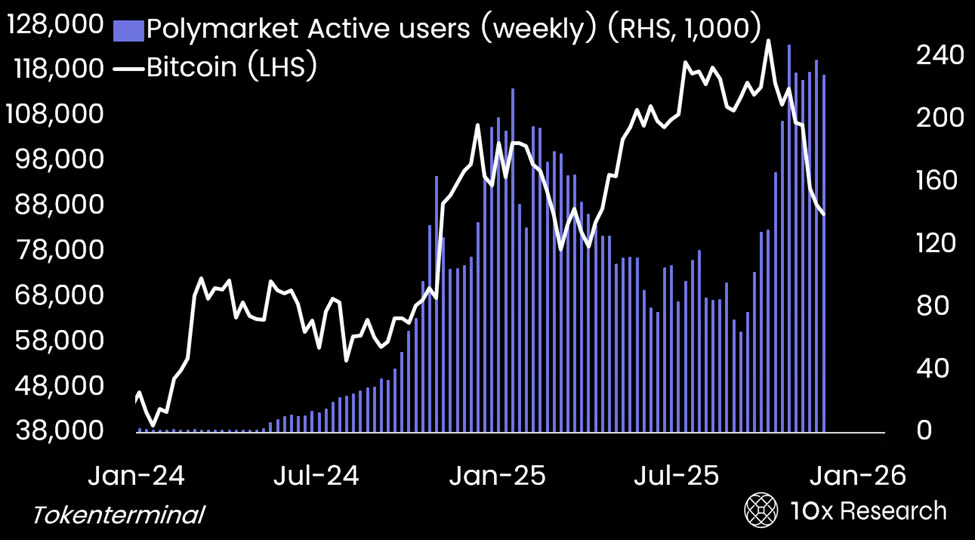
Polymarket active users, weekly, Bitcoin left-hand-side price, year-to-date chart. Source: 10x Research

Related: Bitcoin now settles Visa-scale volumes, but most is for wholesale, not coffee

The report is a concerning sign for casual traders looking to make easy money on prediction markets, as blockchain data suggests that most users lose their initial investment.
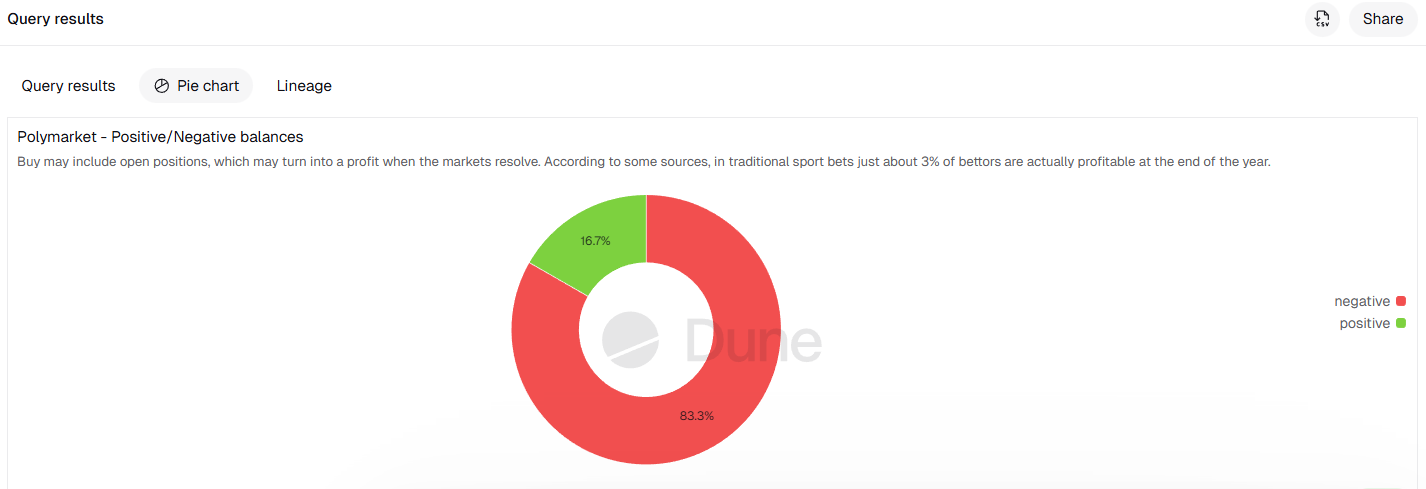
Polymarket, positive/negative wallet balances. Source: Dune.com

Only about 16.7% of wallets on Polymarket are in profit, while the remaining 83% have incurred losses, according to blockchain data from Dune.

Related: Prediction markets emerge as speculative ‘arbitrage arena’ for crypto traders

Perfect win rates fuel insider concerns

The flawless track record of some prediction market accounts is stoking concerns about possible insider trading, as certain users appear to win every time.

Polymarket user “pony-pony” boasts a 100% win rate with over $77,000 in realized profit by betting on events related to the artificial intelligence development company, OpenAI, prediction market data aggregator Polymarket Money said in a Monday X post.

Another user, “AlphaRaccoon,” also triggered insider allegations after generating over $1 million in a single day by successfully winning 22 out of 23 bets related to Google search trends.
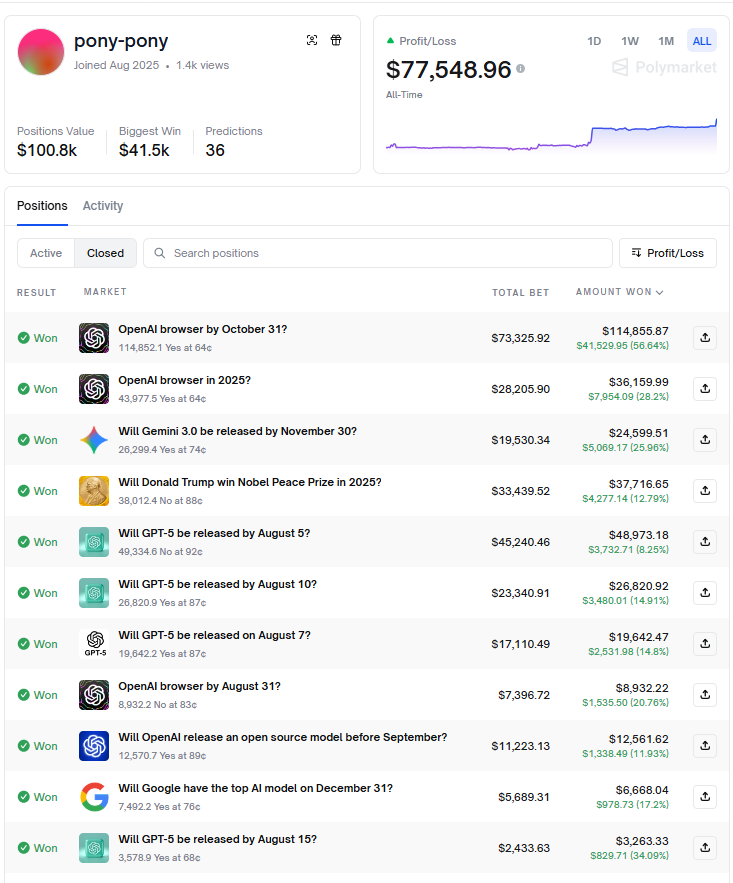
Source: Polymarket Money

Meanwhile, concerns are brewing over the reliability of Polymarket data on third-party data dashboards after a Paradigm researcher discovered a bug that double-counts the prediction market’s trading volume, Cointelegraph reported earlier on Tuesday.

The bug is inflating the primary volume metrics used to gauge prediction market activity, including the notional volume, which counts the number of contracts traded, and the cashflow volume, which measures the dollar value traded at the time of each trade, wrote Paradigm researcher Storm in a Tuesday X post.

However, the inflated volumes on data dashboards are due to errors in data interpretation, not wash trading, which is a deceptive and illegal practice in which entities buy and trade the same instrument to create a false impression of growing market activity.

Paradigm’s newly discovered bug was “validated” by multiple data dashboards, including AlliumLabs and DefiLlama, which are now updating their Polymarket dashboards to eliminate the double-counting error.

Magazine: Train AI agents to make better predictions... for token rewards

Leituras Relacionadas

Blood Loss of $55 Million Selling 3,588 BTC, Strategy Becomes a Literal Scumbag

On July 6th, Strategy (formerly MicroStrategy) disclosed in an SEC filing that it sold 3,588 Bitcoin (BTC) between June 29th and July 5th for approximately $216 million, at an average price of ~$60,200. This marked the company's largest net sale since initiating its Bitcoin strategy in 2020 and its first institutionalized reduction of its core holding. The sale resulted in a realized loss of about $54.8 million, as the selling price was below its average cost basis of ~$75,476 per BTC. The proceeds were used to pay preferred stock dividends and replenish USD reserves. This move follows a new "Digital Credit Capital Framework" approved on June 29th, authorizing the sale of up to $1.25 billion in Bitcoin. The sale consumes roughly 17% of this authorized amount in its first week. Strategy's foundational narrative, built by founder Michael Saylor, was a commitment to "never sell" Bitcoin. The recent institutionalized selling framework and these substantial sales represent a significant shift from that original promise. While the amount sold is only 0.4% of Strategy's total holdings of 843,775 BTC, the action challenges the premium at which its stock (MSTR) trades relative to its Bitcoin holdings. Investors had priced in the "never sell" narrative. The company now faces a contradiction: it sells Bitcoin at a loss to pay dividends on the preferred stock it issued to fund Bitcoin purchases. Saylor has framed selling as a tool for future strategic purchases, but each sale erodes the credibility of the original commitment, potentially threatening the premium valuation of MSTR shares.

Foresight NewsHá 37m

Blood Loss of $55 Million Selling 3,588 BTC, Strategy Becomes a Literal Scumbag

Foresight NewsHá 37m

Dialogue with Yihui Capital, SoundAI Technology, Ling Universe, and Zhongbo Jili: Opportunities and Challenges in the AI Smart Hardware Track

On June 28, 2026, an event titled "New Opportunities in AI Hardware: The Battle for Interactive Entry Points Begins" was held in Beijing. It featured a report from ITJuzi and discussions with experts from SoundAI, Ling Universe, One Reed Capital, and Zhongbo Juli on the opportunities and challenges in China's AI hardware sector. Key report findings highlight the sector's intense activity: 327 out of 431 startups founded post-2023 have secured funding, with 179 investments in H1 2026 alone. The landscape is dominated by embodied intelligent robots, while wearable tech like smart rings and AI glasses shows rapid growth. Geographically, Shenzhen leads, leveraging its superior hardware supply chain, followed by Beijing and Shanghai. The overarching trend is for companies to focus on micro-innovations within specific scenarios rather than reinventing foundational technology. Industry leaders shared several critical insights: 1. **Balancing Innovation & Market Readiness**: Entrepreneurs face the "hammer looking for a nail" dilemma. Success requires balancing technical capability with user acceptance, cost control, and incremental design improvements rather than chasing disruptive innovation. 2. **Competitive Landscape**: The future interactive entry point may not be a single super-device but a mix of universal terminals and specialized, scenario-specific hardware. While large companies have ecosystem advantages, startups can win by deeply targeting vertical markets and specific user groups. 3. **Core Challenges & Business Models**: Key hurdles include deep understanding of AI models and navigating non-transparent hardware supply chains. Viable business models may involve selling hardware at cost and generating revenue through software subscriptions, but this requires tight control over both hardware BOM and model inference costs. 4. **The Road to Commercialization**: The ultimate test is market validation—achieving sales growth and sustainable cash flow. Companies must find the right application scenario, use edge computing effectively, and close the loop from technology to commercial success. 5. **The Future of Interaction**: Proactive, context-aware interaction is the next frontier, though it's currently limited by issues like model hallucinations and environmental perception. The near-term focus should be on identifying target users and creating a coherent experience in specific domains, such as health wearables. In summary, to succeed in the competitive AI hardware arena, companies must strategically choose their niche, build a team with the right geographical advantages (e.g., leveraging Shenzhen's supply chain), and most importantly, execute a flawless commercialization strategy that translates technology into market-accepted products and sustainable business growth.

marsbitHá 1h

Dialogue with Yihui Capital, SoundAI Technology, Ling Universe, and Zhongbo Jili: Opportunities and Challenges in the AI Smart Hardware Track

marsbitHá 1h

Trading

Spot
活动图片